
- Quick Specs: Pump.fun Bonding Curve Mechanics (2026) 📉
- The Math Behind the Madness: How the Bonding Curve Works 📐
- The “Graduation” Event: Raydium Migration Explained 🎓
- Why Are Bonding Curves So Popular for Pump.fun Tokens?
- Risks and Rewards of Bonding Curve Launches
- Post-Migration Strategy: Securing Gains
- FAQ
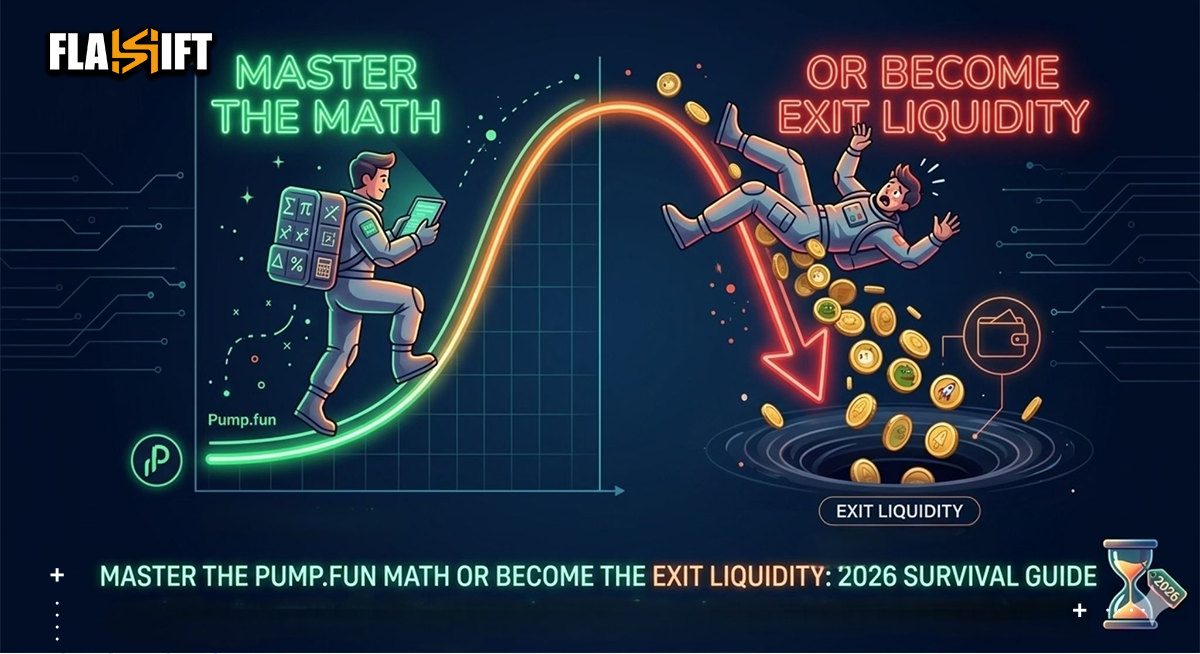
The era of “blind luck” in the Solana ecosystem is completely dead. While Pump.fun remains the dominant launchpad framework, the market in 2026 has matured into a game of pure mathematical speed. Elite traders are no longer guessing a coin’s viral appeal; they are calculating pump.fun bonding curve mechanics and front-running the exact millisecond of the Raydium migration.
If you do not understand the exact pump.fun bonding curve formula governing the virtual execution phase, you are mathematically guaranteed to serve as exit liquidity for automated actors. This technical guide breaks down the underlying algorithmic code, explains the virtual liquidity mechanism, and outlines how to preserve your capital during hyper-volatile migration events.
Quick Specs: Pump.fun Bonding Curve Mechanics (2026) 📉
Before you trade, understand the hard numbers that govern the curve.
| Feature | Technical Specification (2026) | Trader Implication |
| Migration Target | Hit exactly $69,000 Market Cap (~85 SOL) | The definitive finish line. Trading halts instantly and moves to a DEX. |
| Deployment Cost | ~0.02 SOL | Near-zero barrier, resulting in high automated spam volume. |
| Anti-Bot Mode | Sniper Protection Protocol | Buying in the absolute first block requires advanced RPC nodes. |
The Math Behind the Madness: How the Bonding Curve Works 📐
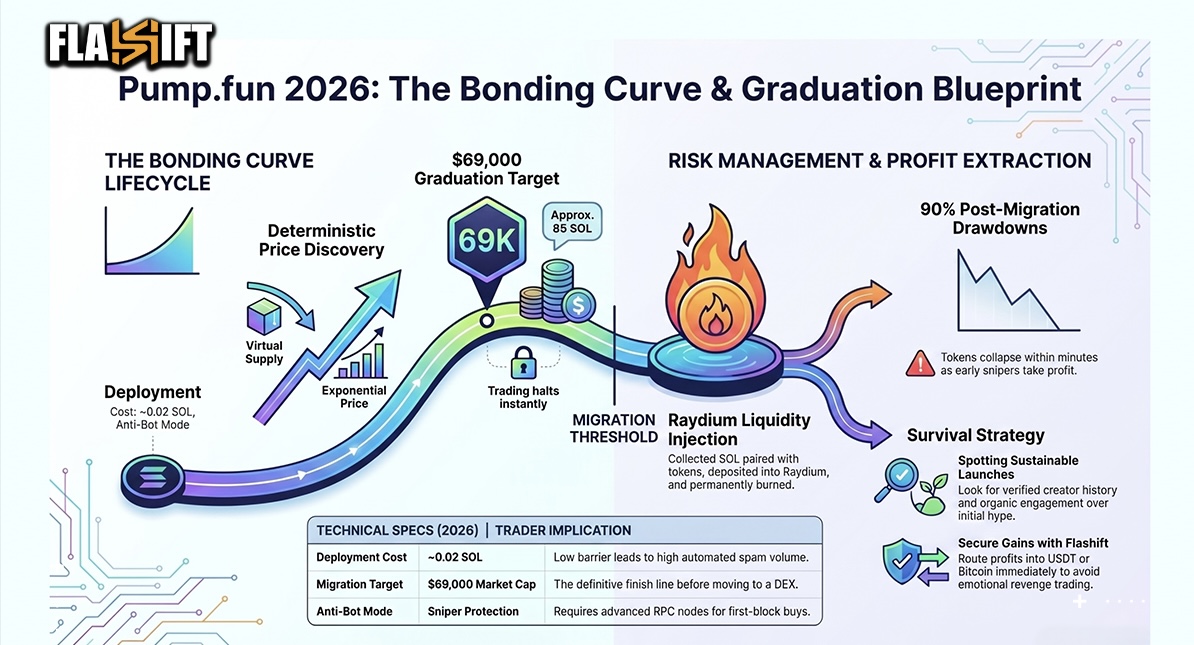
The pricing model of a Pump.fun token isn’t driven by an open order book or external market sentiment; it is governed by a hard-coded, deterministic mathematical pricing algorithm. To trade effectively, you must understand the exact pump.fun bonding curve mechanism.
The Mathematical Formula
Under the hood, the protocol utilizes a Virtual Constant Product Automated Market Maker (AMM) variant, closely mirroring the classic Uniswap x . y = k equation, where:
- x represents the virtual supply of the meme token.
- y represents the virtual supply of SOL inside the contract.
- k is a fixed invariant value determined at token creation.
Because k must remain constant, every time a trader executes a buy order, they deposit real SOL into the contract y increases), forcing the available virtual token supply (x) to decrease. This structural shift moves the execution point along an exponential curve, ensuring that the price increases deterministically with every single buy order.
The 2026 Virtual Metrics
- The Graduation Threshold: The pump.fun bonding curve mechanics are programmed to instantly halt internal trading the millisecond the token’s market capitalization hits exactly $69,000 (equivalent to approximately 85 SOL, depending on real-time network variables).
- The Virtual Allocation: At genesis, the contract injects a virtual supply of approximately 30 SOL into the equation. This virtual buffer ensures that early buyers face a smooth pricing scale rather than infinite slippage on the first block.
The “Graduation” Event: Raydium Migration Explained 🎓
What happens when the curve hits 100%? This is the most critical moment for a trader.
-
Trading Stops: Buy/Sell on the bonding curve is halted instantly.
-
Liquidity Seeding: The gathered SOL (from the bonding curve sales) is paired with the remaining token supply.
-
Raydium Injection: This pair is deposited into a standard Raydium Liquidity Pool and burned.
-
The Result: The token becomes a standard, tradable SPL token on decentralized exchanges. This is often where the “Real Volume” begins—or the massive dump happens.
Read More: How to Spot the Next Viral Meme-Coin on Pump.fun Safely
Why Are Bonding Curves So Popular for Pump.fun Tokens?
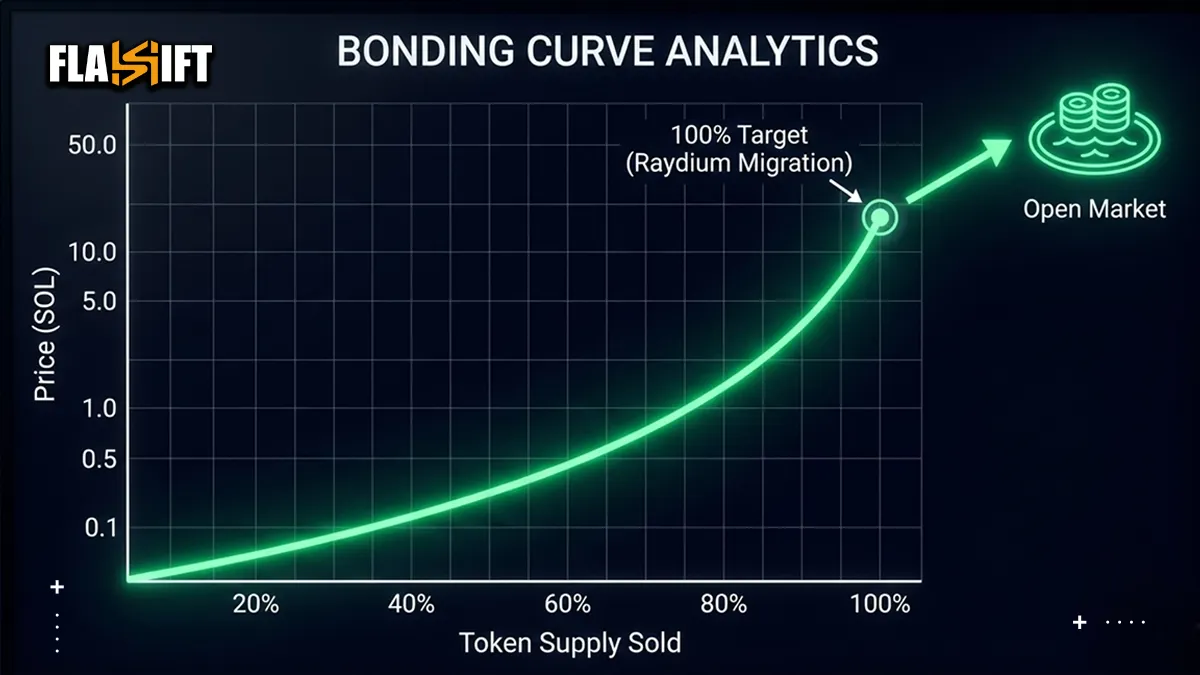
Bonding curves aren’t just math—they’re the fuel behind the viral energy of Pump.fun. By lowering barriers for creators and making price discovery automatic, they’ve turned meme coin launches into the fastest-moving trend of 2026.
Built-In Price Discovery Without Exchanges
Normally, traders rely on markets to find the “right” price of a token. With bonding curves:
- The smart contract sets the price as supply increases.
- There’s no need for centralized exchanges or market makers.
- Early momentum automatically drives the market forward.
This makes meme coins accessible to retail traders worldwide, not just insiders with early exchange listings.
Read More: Pump.fun: The Solana Meme-Coin Launchpad Everyone’s Talking About
Risks and Rewards of Bonding Curve Launches 
Bonding curves give meme coins their explosive upside, but they come with structural risks that require strict execution rules:
-
The High Risk of Pump-and-Dump Cycles: Meme tokens on bonding curves rise fast, but they collapse just as quickly. Creators or early sniping bots often sell directly into the graduation hype, leaving late buyers as exit liquidity. Many tokens see 90%+ drawdowns within minutes of migrating.
-
The Zero Survival Rate: The vast majority of Pump.fun launches are purely speculative with no lasting community. Once the initial momentum fades, liquidity dries up and the token price flatlines.
-
Spotting Sustainable Launches: To find safer plays, ignore the initial hype and look for verified creator history, organic non-botted engagement on Twitter/X, and active community participation that sustains beyond the open market transition.
Post-Migration Strategy: Securing Gains
Once a token successfully migrates to Raydium, it enters the open market where volatility spikes exponentially. If you caught the bonding curve early and generated returns, the smartest operational move is to extract those gains immediately.
Holding highly volatile profits within the exact same speculative execution environment often leads to emotional revenge trading and capital erosion. Experienced traders mitigate this by immediately separating their trading layer from their profit-taking layer.
Instead of routing funds back through high-slippage pools or transferring them to centralized entities that trigger compliance holds, seasoned market participants secure their capital by routing multi-chain liquidity directly into stable, sovereign assets. By utilizing a non-custodial capital migration architecture, you can swap your volatile Solana profits into decentralized stablecoins or long-term holdings like Bitcoin in a single transaction.
Moving your capital into a zero-custody layer ensures that your realized gains are settled securely from wallet to wallet, keeping your trading edge completely intact.
FAQ
How does Pump.fun use bonding curves?
Pump.fun lets anyone launch a meme token on Solana instantly. The bonding curve contract handles all sales, pushing up the price as demand grows. Once a threshold is reached, liquidity is added to a DEX like Raydium for open trading.
Why are meme coins so tied to bonding curves?
Bonding curves make meme launches simple, fast, and viral. They lower entry barriers, create built-in price discovery, and fuel FOMO—perfect for the meme culture driving crypto in 2025.
What are the risks of bonding curve launches?
Lack of fundamentals: most tokens don’t survive beyond the hype.
Liquidity risks: if liquidity isn’t locked, rugs are possible.
Always treat meme launches as high-risk speculation.
How can I join a Pump.fun meme coin launch?
You’ll need SOL in your wallet (for Solana launches) or ETH for Ethereum-based meme plays. Buy in directly through the bonding curve contract on Pump.fun or other launchpads.
What’s the fastest way to get SOL or ETH for meme launches?
With Flashift’s multi-chain swap, you can instantly convert USDT, USDC, or other tokens into SOL or ETH—without KYC or custody risk. This ensures you’re launch-ready when the next meme coin starts trending.