

- Binance Pool Closure Date and Timeline
- Which Binance Mining Services Are Closing?
- How to Switch Mining Pools Before November 10 (Step by Step)
- How to Choose the Best Binance Pool Alternative
- What Happens to Your Pending Mining Rewards?
- Where to Swap Your Mining Rewards After the Shutdown
- Will the Binance Pool Shutdown Affect the Bitcoin Network or Price?
- Binance Pool Shutdown Checklist
- Final Thoughts
- FAQ
What Happens When Binance Pool Shuts Down? Binance Pool, Pool Savings, Cloud Mining and Transaction Accelerator all stop on November 10, 2026, at 07:00 UTC. After that moment, any hashrate still pointed at Binance Pool earns nothing. To avoid losing income, you need to:
- Point your miners to a new pool before the deadline.
- Redeem any active Pool Savings positions.
- Confirm your Binance account can receive outstanding balances.
- Export your payout history before the pool pages go offline on November 24.
Binance announced the closure on October 13, 2026, describing it as part of an ongoing review of its products and services, as The Block reported. The rest of this guide explains the timeline, how to choose a replacement pool, and what to do with your rewards.
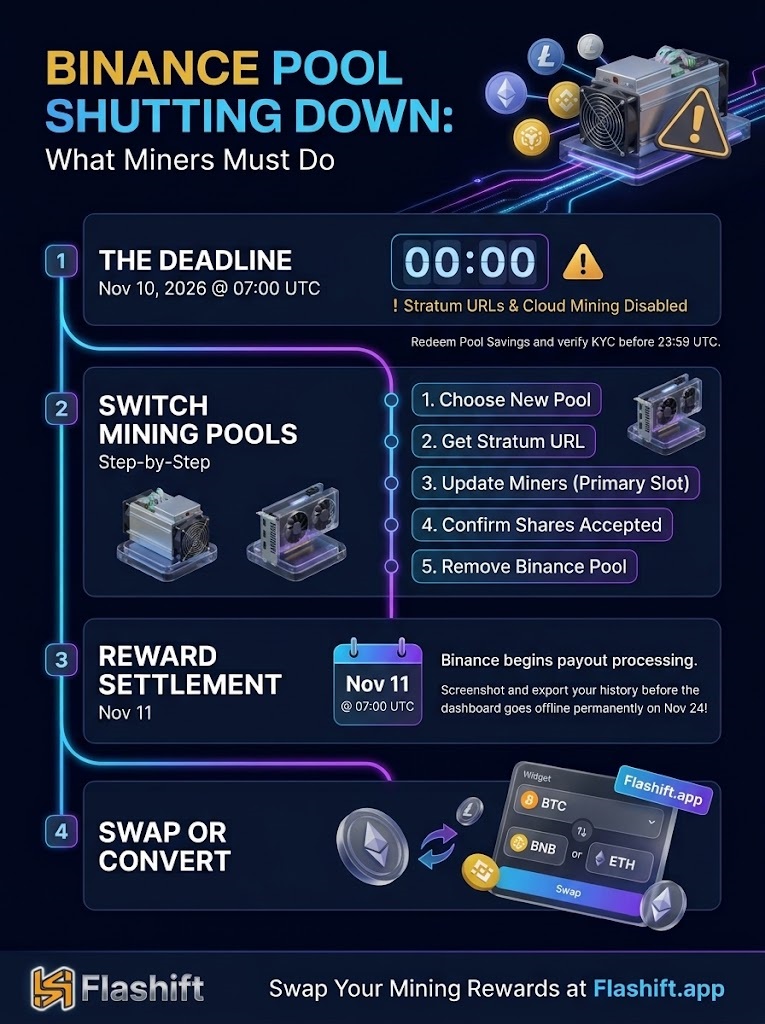
Binance Pool Closure Date and Timeline
Several deadlines overlap, so here they are in one place.
| Date (UTC) | What happens | What you should do |
| Oct 13, 2026 | Binance announces the shutdown | Start planning your migration |
| Nov 10, 07:00 | Stratum URLs and mining endpoints are disabled; shares are no longer accepted or credited | Have your miners fully switched before this time |
| Nov 10, 23:59 | Last chance to complete identity verification for the pool | Finish KYC if you still need it |
| Nov 11, 07:00 | Binance begins processing outstanding rewards, balances, refunds and settlements | Check your Binance account for incoming funds |
| Nov 24, 07:00 | Pool pages, historical data and payout records become permanently unavailable | Download your records before this date |
One practical point: nothing earned after the cutoff will be credited, so treat November 10 as a hard stop, not a soft target. Switching a day early costs you almost nothing. Switching a day late can mean a full day of unpaid hashing.
Which Binance Mining Services Are Closing?
The shutdown is broader than the pool itself. According to the announcement, these services are affected:
- Binance Pool, the main mining pool, which launched in April 2020 with Bitcoin and later expanded to other coins
- Pool Savings
- Cloud Mining
- Transaction Accelerator
- Related features, including Telegram hashrate alerts, email notifications and the mining pool API
If you built monitoring dashboards, profit trackers or automation on top of the Binance Pool API, those integrations will stop working. Plan to rebuild them against your new pool’s API.
How to Switch Mining Pools Before November 10 (Step by Step)
Moving a miner is usually a five-minute job per device. The process is the same whether you run a single ASIC or a farm.
- Choose your new pool
Pick a pool first, then create your account and generate worker credentials. Do this before touching any hardware, so you can test the connection.
- Gather the new Stratum details
Every pool publishes a Stratum URL (for example, stratum+tcp://…:3333), plus a username format that usually combines your account name and a worker name.
- Update your miners
Log in to each miner’s web interface (or your fleet-management software), and replace the pool URL, worker name and password. Most ASICs let you store three pool slots, so put the new pool first and, if you like, leave a backup in slot two.
- Verify shares are being accepted
Within a few minutes, you should see accepted shares on both the device and the new pool dashboard. If shares are rejected, recheck the username format and port.
- Remove Binance Pool completely
Do not leave Binance Pool as a fallback. After November 10 the endpoints go dark, and a stale backup entry can create confusing connection errors.
If you run GPUs rather than ASICs, the same logic applies to your mining software configuration. Our guide to how GPU mining works covers the setup basics if you need a refresher.
How to Choose the Best Binance Pool Alternative
Binance did not name a recommended replacement, so the decision is yours. Compare these factors rather than just picking the biggest name:
| Factor | Why it matters | What to look for |
| Payout model | Determines how stable your income is | FPPS or PPS+ if you want predictable pay like Binance Pool’s FPPS model; PPLNS if you accept variance for lower fees |
| Pool fee | Directly reduces your revenue | Compare the headline fee, and check whether transaction fees are included in rewards |
| Minimum payout | Affects how soon you can withdraw | A low threshold suits small miners |
| Payout frequency | Cash-flow control | Daily payouts are common; check the schedule |
| Server locations | Latency and rejected shares | A server region close to your farm |
| Coins supported | Important if you mine more than Bitcoin | Check your exact coin and algorithm |
| Transparency and reputation | Counterparty risk | Public hashrate stats, clear terms, a track record |
| API and monitoring | Replaces the features you are losing | Mobile alerts, worker dashboards, an API |
Since Binance Pool used a full pay-per-share (FPPS) model, as Unchained reported, matching that payout structure will make your income feel the most familiar after the switch.
Be careful about decentralization too. If every displaced miner piles into the same one or two pools, hashrate concentration rises. Spreading your hashrate across a mid-sized pool is slightly better for the network, and it can reduce your own dependence on a single operator.

What Happens to Your Pending Mining Rewards?
Pending rewards are the part that worries most miners, so here is what the announcement says:
- Earnings up to the cutoff are processed. Binance said it will handle outstanding rewards, balances, refunds and settlements beginning at 07:00 UTC on November 11.
- Nothing accrues after the cutoff. No new rewards, yield or service benefits will build up once the shutdown time passes.
- Pool Savings positions should be redeemed yourself. Do not wait for automatic handling.
- Verification matters. If your account still needs identity verification to receive funds, complete it by 23:59 UTC on November 10.
To protect yourself, take a screenshot or export of your reward history, balances and payout status now. Binance has said the pages remain viewable until November 24, but the safest habit is to keep your own copy for taxes and bookkeeping.
If the settlement does not appear when expected, contact Binance support through your account and have your records ready.
Where to Swap Your Mining Rewards After the Shutdown
Once your final Binance Pool payout lands, you have three common options:
- Hold it if you are accumulating for the long term.
- Cash out to stablecoins or fiat.
- Diversify by converting part of your Bitcoin into another coin.
If you want to move between assets without opening an order book, an instant exchange is the simplest route. For example, you can swap Bitcoin for Ethereum on our BTC to ETH exchange page, where you can compare the rate before you confirm. Miners often use this kind of conversion to spread risk or to pay for coins that are cheaper to send.
Before any swap, check these things:
- The wallet address and network. Sending to the wrong network is the most common and least reversible mistake.
- The quoted rate versus the final amount, including network fees.
- Minimum and maximum limits, so your amount is within range.
- Your tax situation. Mining income and swaps may both be taxable events depending on where you live, so keep your records.
Should You Consider Mining a Different Coin?
A forced pool switch is a natural moment to review your whole setup. If you have spare hardware, or you are weighing a switch away from Bitcoin altogether, consider the economics honestly: electricity cost, hardware efficiency, coin price and network difficulty all change profitability. CPU-friendly options exist too. Our beginner’s guide to mining Monero walks through one of them.
Will the Binance Pool Shutdown Affect the Bitcoin Network or Price?
Very unlikely in any meaningful way. Bitcoin’s difficulty adjustment is designed to absorb changes in hashrate, and miners who leave one pool simply reconnect to another. Hashrate from Binance Pool does not vanish. It relocates. The main short-term effect is a temporary dip in a few hours of hashing for anyone who forgets to switch.
Common Mistakes to Avoid
- Waiting until the last day. A bad configuration can take hours to troubleshoot.
- Keeping Binance Pool as a backup. It will stop responding.
- Ignoring Pool Savings. Redeem it manually.
- Forgetting verification. Missing the KYC deadline can complicate your payout.
- Not saving records. Historical pages disappear on November 24.
- Moving everything to one pool. Consider splitting hashrate for resilience.
Binance Pool Shutdown Checklist
- Pick a new pool and create an account
- Test one miner on the new pool first
- Switch all remaining miners and verify accepted shares
- Remove Binance Pool from every backup slot
- Redeem Pool Savings positions
- Complete any required verification by Nov 10, 23:59 UTC
- Export your reward and payout history
- Check your account for settlement after Nov 11, 07:00 UTC
- Decide whether to hold, cash out or swap your rewards
Final Thoughts
Binance Pool’s closure is an inconvenience, not a crisis. You have until November 10 at 07:00 UTC to redirect your hashrate, and a few weeks after that to collect what you are owed and save your records.
FAQ
1. When exactly does Binance Pool shut down?
November 10, 2026, at 07:00 UTC. Shares submitted after that time are not accepted or credited.
2. Will I lose my pending Binance Pool rewards?
Binance has said it will process outstanding rewards, balances, refunds and settlements starting at 07:00 UTC on November 11. Rewards stop accruing at the cutoff.
3. Is Binance Cloud Mining shutting down too?
Yes. Cloud Mining, Pool Savings and Transaction Accelerator are all part of the closure.
4. How long can I see my Binance Pool history?
Until 07:00 UTC on November 24, 2026. After that, access is permanently removed.
5. What is the best alternative to Binance Pool?
There is no single best option. Choose based on payout model, fees, minimum payout, location and reputation. If you liked FPPS, look for a pool with a similar payout structure.
6. Do I need to do anything if I only mined through Binance Cloud Mining?
Check your account for instructions and settlement details, and keep records of your contracts and earnings. Contact Binance support if anything is unclear.