
If you are looking for a no KYC crypto wallet, it is easy to focus on whether the wallet asks for your name, ID, or other personal information when you create it. That is only part of the picture.
A wallet can be non-custodial and require no KYC while the service you use to swap your crypto may have completely different requirements. This distinction becomes especially important when you want to exchange Bitcoin for another asset, move between blockchains, or compare different swap rates.
The real question is not simply which wallets are available without KYC. It is which wallets give you practical self-custody and what happens when you need to swap your crypto.
What Is a No-KYC Crypto Wallet?
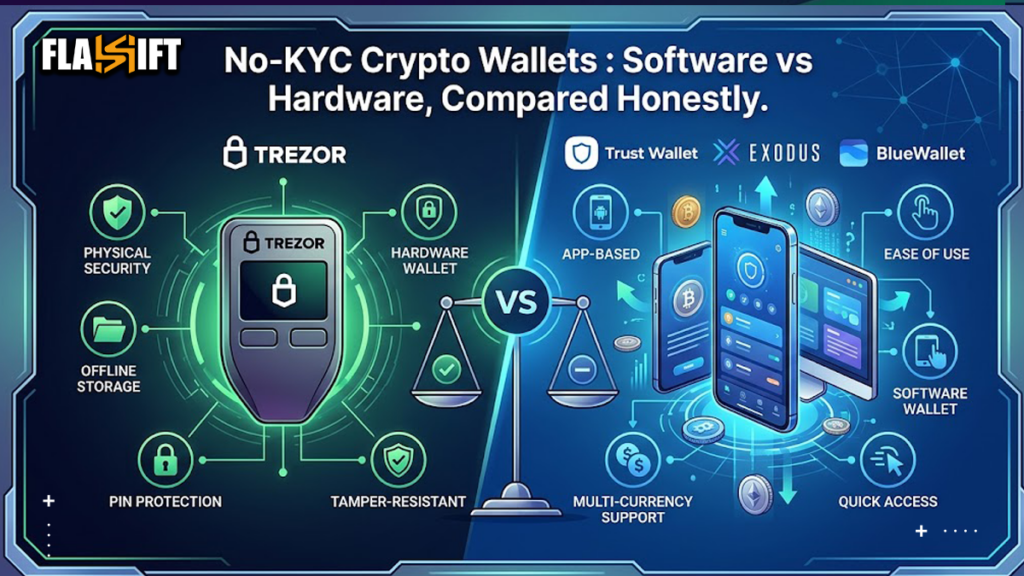
A no-KYC crypto wallet is generally a wallet that can be created and used without submitting identity documents or completing a traditional customer-verification process. In a non-custodial wallet, the user controls the private keys or recovery phrase rather than depositing funds into an exchange account.
This does not mean that everything you do with the wallet will automatically be KYC-free. Blockchain transactions remain visible on their respective networks, and third-party services connected to a wallet can have their own verification requirements.
That is why no KYC should not be treated as another word for anonymous. It usually describes the requirements of a particular wallet or service, not the complete privacy profile of every transaction.
Software vs. Hardware Wallets
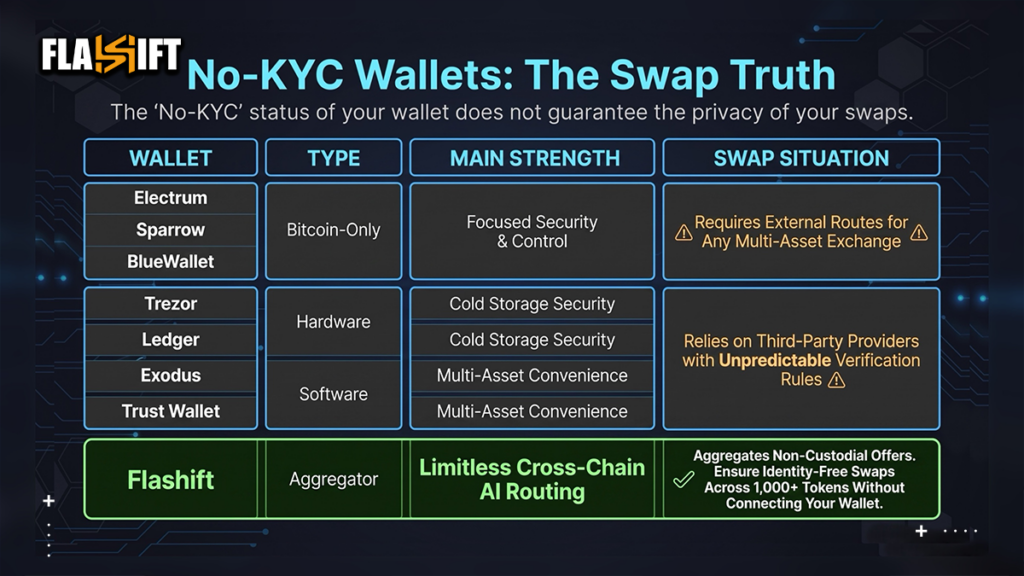
The biggest practical difference between software and hardware wallets is how private keys are protected.
Software wallets run on devices such as smartphones or computers. They are convenient for everyday transactions and usually make it easier to access and manage crypto quickly.
Hardware wallets keep the keys in a dedicated physical device and sign transactions through that device. This makes them particularly useful for users who prioritize long-term asset storage and want an additional layer between their private keys and an internet-connected computer.
Neither category automatically solves the swapping problem. A wallet can provide strong self-custody while offering limited options for exchanging one cryptocurrency for another.
No-KYC Wallets Compared
| Wallet | Type | Main strength |
| Electrum | Software | Bitcoin-focused management |
| Sparrow Wallet | Software | Advanced Bitcoin management |
| BlueWallet | Software | Simple Bitcoin experience |
| Trezor | Hardware | Hardware-based self-custody |
| Ledger | Hardware | Hardware wallet with integrated services |
| Exodus | Software | User-friendly multi-asset experience |
| Trust Wallet | Software | Multi-chain wallet and integrated swap |
The important difference is not simply whether a wallet has a Swap button. The important question is what happens behind that button and whether the available route fits your requirements.
Trezor (Hardware)

Trezor is an industry pioneer known for its open-source approach and hardware-based security architecture. It remains a strong option for users looking for a no KYC Bitcoin wallet for long-term and deep cold storage, while keeping private-key control on a dedicated device.
The Flaw: Trezor Suite’s native exchange feature relies on third-party providers, so the swapping experience and verification requirements can vary depending on the provider and transaction route. For users specifically looking for a consistent no-KYC swapping experience, the wallet itself does not guarantee that every available exchange route will meet that requirement.
Ledger (Hardware)

Ledger is a hardware wallet built around dedicated-device security and self-custody. It is a practical choice for users who want to keep their private keys offline while still having access to a wider range of crypto services.
- The Flaw: Ledger’s integrated swapping experience uses third-party providers, meaning the conditions are not necessarily identical for every swap. A wallet that does not require KYC should therefore not be confused with a guarantee that every swap provider connected to it is also no-KYC.
Electrum (Software)

Electrum is a Bitcoin-focused software wallet designed for users who want direct control over their BTC. Its focused approach makes it particularly relevant for people looking for a no KYC Bitcoin wallet rather than a full multi-asset trading platform.
- The Flaw: Electrum’s Bitcoin-focused design does not provide a broad built-in multi-asset swapping experience. If you want to exchange BTC for another cryptocurrency, you need a separate service instead of handling the entire process inside the wallet.
How to Swap Bitcoin from Electrum
Use Flashift as a separate swap route when Electrum does not support the conversion you need. Compare available offers for BTC like BTC to XMR and other assets without connecting your wallet or registering.
Sparrow Wallet (Software)
Sparrow Wallet is a Bitcoin-focused software wallet built for users who want detailed control over their BTC. It is better suited to Bitcoin management than to users who expect an all-in-one multi-asset exchange interface.
- The Flaw: Sparrow does not provide the broad, built-in multi-asset swapping experience found in some other wallets. When you need to convert BTC into another cryptocurrency, you therefore need to use an external swapping route.
How to Swap from Sparrow Wallet
Flashift provides an external swapping route for users who need to convert BTC into other assets like BTC to SOL. You can compare non-custodial offers without connecting Sparrow or creating an account.
BlueWallet (Software)
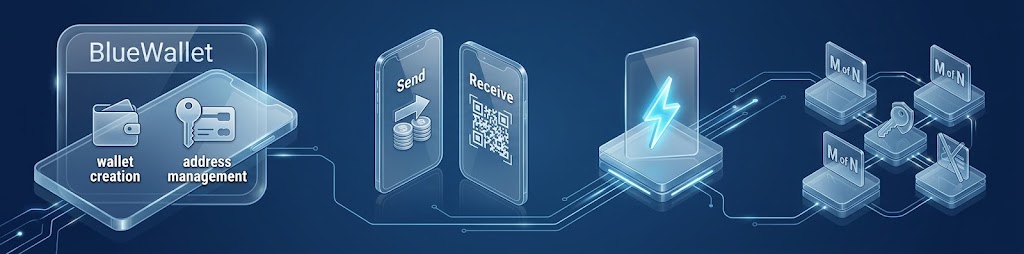
BlueWallet focuses on providing a simple Bitcoin wallet experience. It can work well for users who primarily want to hold, receive, and send BTC without turning their wallet into a full trading platform.
- The Flaw: Its Bitcoin-focused approach means it is not a complete multi-asset swapping solution. When you need to convert BTC into another cryptocurrency, you may have to leave the wallet and find a separate service.
How to Swap Bitcoin from BlueWallet
Use Flashift when you need to swap BTC beyond BlueWallet’s core Bitcoin functionality. It aggregates non-custodial offers so you can compare available routes in one place.
Exodus (Software)
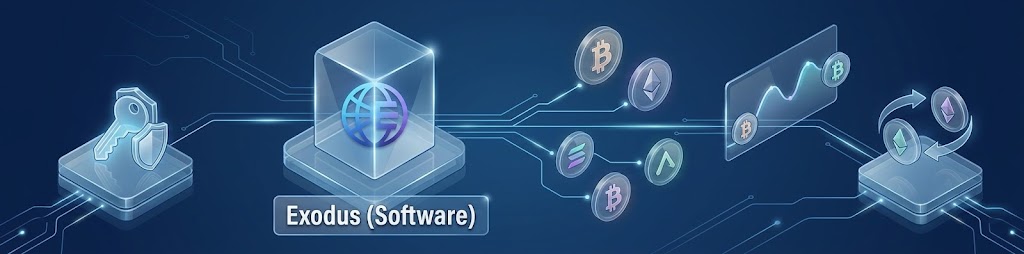
Exodus is a multi-asset software wallet designed around a simple user experience. It includes integrated swapping, making it more convenient than Bitcoin-only wallets when users want to exchange supported assets without manually finding a separate platform for every transaction.
- The Flaw: Integrated swapping does not mean that every swap follows identical conditions. Exodus relies on third-party providers for its exchange functionality, so availability, rates, and verification requirements can depend on the specific route and provider.
How to Swap on Exodus
Flashift provides an alternative to the swap routes available inside Exodus. You can compare offers from non-custodial exchange providers without connecting your wallet or registering.
Trust Wallet (Software)
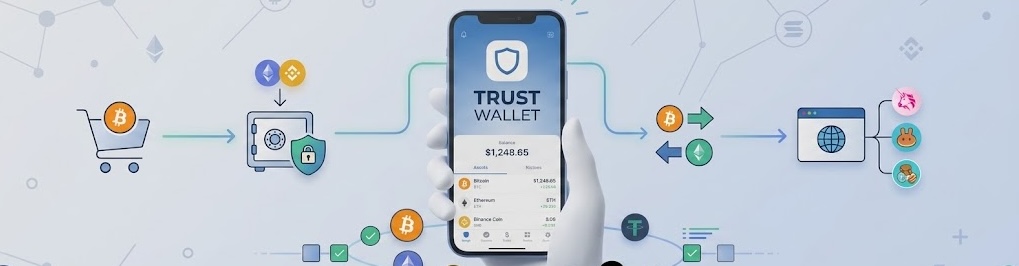
Trust Wallet is a multi-chain software wallet with integrated swapping functionality. Its broader asset support makes it more suitable for users who regularly work with different cryptocurrencies and blockchain networks.
- The Flaw: Having a built-in Swap feature does not mean that every available route has the same terms or KYC requirements. The actual conditions can depend on the provider, liquidity source, network, and trading pair involved.
How to Swap from Trust Wallet
Use Flashift to compare additional non-custodial swap routes beyond Trust Wallet’s integrated options. It supports cross-blockchain swaps without requiring wallet connection or registration.
No KYC Does Not Mean Completely Anonymous
This distinction is worth repeating because it is one of the most common misunderstandings around no-KYC wallets.
A wallet may let you create and control your crypto without submitting identity documents, but blockchain transactions are generally recorded publicly. Your transaction history can be associated with other information depending on where your funds came from and which services you use.
The same principle applies to swaps. A wallet’s own KYC policy does not automatically determine the policy of an exchange, aggregator, or other third-party service connected to it.
Read More: Crypto Wallet vs Exchange: Where Should Your Coins Actually Live in 2026?
Where Swapping Becomes the Weak Point
The practical weakness of many no-KYC wallets is not storing crypto. It is what happens when you want to change that crypto into something else.
A Bitcoin-focused wallet may be excellent for holding BTC but offer no convenient way to exchange BTC for ETH. A hardware wallet may provide strong key protection but rely on external providers for swaps. Even a wallet with an integrated Swap feature may offer different conditions depending on the provider and trading pair.
This is where an smart swap aggregator such as Flashift can be useful.
Flashift is not a wallet. It aggregates offers from non-custodial crypto exchanges and presents different available rates in one interface. It supports swaps across different blockchains and lets users compare fixed and floating-rate offers without connecting a wallet or creating an account.
For someone using a wallet without a suitable built-in swapping route, this creates a separate option: keep using the wallet for self-custody and use a dedicated aggregator when a swap is needed.
For cross-chain transactions, Flashift also functions as a Chain Abstraction Layer. The goal is to reduce the need for users to understand and manually handle wrapped tokens or potentially risky bridges when swapping between blockchain ecosystems.
Why an Aggregator Can Be Useful Even With a Built-In Swap
A built-in Swap button is convenient, but convenience and choice are not always the same thing.
A wallet may rely on a limited set of providers or available liquidity. An aggregator takes a different approach by bringing offers from multiple non-custodial exchange partners into one interface. Instead of checking each provider separately, users can compare the available options and choose the route that fits the transaction.
Flashift also supports more than one thousand tokens and cross-blockchain swaps, which can be useful when the required conversion goes beyond the assets or networks conveniently supported by a particular wallet’s internal swap system.
Common Mistakes When Choosing a No-KYC Wallet
The first mistake is assuming that no KYC means anonymous. It does not.
The second is assuming that a wallet’s built-in Swap feature automatically means every swap is available without verification. The actual conditions depend on the provider and transaction route.
The third is choosing a wallet without considering what you will do after buying or receiving crypto. If your main requirement is long-term BTC storage, a Bitcoin-focused wallet may make sense. If you regularly swap assets across multiple blockchains, the availability and flexibility of swapping routes become much more important.
The Bottom Line
The best no KYC crypto wallet in 2026 depends on what you actually need from it.
For Bitcoin-focused users, wallets such as Electrum, Sparrow Wallet, and BlueWallet can provide a focused way to manage BTC, but their lack of a broad built-in swapping experience means that users may need a separate service. Hardware wallets such as Trezor and Ledger add dedicated-device security, but their swap functions can depend on third-party providers and their individual KYC policies. Software wallets such as Exodus and Trust Wallet provide more integrated swapping, but the presence of an internal Swap feature still does not guarantee a universal no-KYC route.
The most useful way to evaluate a no-KYC crypto wallet is therefore to separate two questions: How does the wallet handle your keys, and how will you swap your crypto when you need to? If the wallet does not provide a suitable no-KYC route for the pair you need, a non-custodial swap aggregator such as Flashift can provide another way to compare available exchange offers without requiring wallet connection or registration.
FAQ
1. What is a no KYC crypto wallet?
A no KYC crypto wallet is a wallet that can generally be created and used without submitting traditional identity documents. Most non-custodial wallets give users control over their private keys rather than operating like an exchange account. However, this does not mean that every service used with the wallet will also be free of KYC requirements.
2. Are no KYC wallets completely anonymous?
No KYC does not mean complete anonymity. Blockchain transactions are generally recorded on public ledgers, and addresses can potentially be connected to a user’s identity through other services or transaction history. The privacy provided by a wallet should therefore be evaluated separately from the privacy policies of exchanges and swap providers.
3. Is a hardware wallet better than a software wallet for no-KYC crypto?
Hardware and software wallets solve different problems, so one is not automatically better simply because it does not require KYC. Hardware wallets such as Trezor and Ledger are designed to provide dedicated-device protection for private keys, while software wallets are generally more convenient for everyday access. Your choice should depend on how you balance security, convenience, supported assets, and your need for swapping.
4. Can I swap crypto without KYC if my wallet does not have a built-in exchange?
A wallet does not necessarily need its own exchange feature for you to swap crypto. You can use a separate non-custodial swapping service, but you should always check the requirements of the specific provider and trading route before starting a transaction. Flashift can be used as an aggregator to compare available offers from non-custodial exchange partners without requiring wallet connection or registration.
5. Why use Flashift with a no KYC crypto wallet?
Flashift is useful when the wallet you use does not offer a suitable swap route or when you want to compare alternatives instead of relying on a single integrated provider. It aggregates offers from non-custodial exchange partners and displays available rates and transaction information in one place. You can use the service without connecting your wallet or registering, while the actual swap is carried out through the selected exchange partner.