

- 📊 Bitcoin Halving Schedule & Current Block Reward Matrix
- What Is Bitcoin Halving and Why Does It Drive Market Cycles?
- Post-Halving Market Dynamics in 2026: Retail, Institutions & Miners
- The Halving Impact on Altcoins, Layer-2s, and Stablecoins
- 🤖 Automating Post-Halving Portfolio Rebalancing & Miner Payouts (Flashift MCP)
- Navigate the 2026–2028 Bitcoin Cycle with Flashift
- ❓ FAQs
Bitcoin’s fourth halving in April 2024 (at block 840,000) slashed the Bitcoin mining block reward from 6.25 BTC to 3.125 BTC. Now, in late 2026, More than halfway toward the fifth halving in 2028, the structural shockwaves of that issuance cut are fully visible across global liquidity, miner balance sheets, and altcoin market rotations.
Understanding the mid-cycle phase of Bitcoin’s halving economy is critical whether you are operating ASIC mining hardware, rotating BTC profits into high-beta altcoins, or hedging volatility into stablecoins. In this updated 2026–2028 guide, we break down the current Bitcoin block reward, how miners and institutional ETFs are shaping supply, the halving impact on altcoins, and how to execute instant, No-KYC cross-chain rotations using Flashift.
📊 Bitcoin Halving Schedule & Current Block Reward Matrix
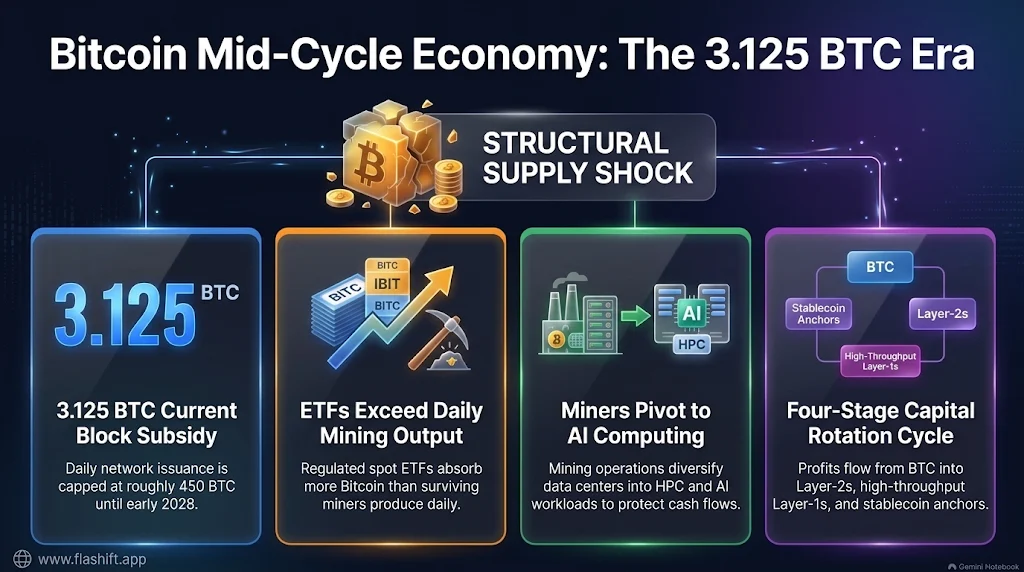
For traders and miners asking what is the current Bitcoin block reward?, the network currently issues exactly 3.125 BTC per block (roughly 450 BTC per day) until block height 1,050,000 is reached in early 2028:
| Halving Event | Block Height | Date | Block Reward (BTC) | Daily Issuance (~144 Blocks) |
| Genesis Era | Block 0 | Jan 2009 | 50.00 BTC | ~7,200 BTC / day |
| 1st Halving | Block 210,000 | Nov 2012 | 25.00 BTC | ~3,600 BTC / day |
| 2nd Halving | Block 420,000 | Jul 2016 | 12.50 BTC | ~1,800 BTC / day |
| 3rd Halving | Block 630,000 | May 2020 | 6.25 BTC | ~900 BTC / day |
| 4th Halving (Current Era) | Block 840,000 | Apr 2024 – 2028 | 🟢 3.125 BTC | ~450 BTC / day |
| 5th Halving (Upcoming) | Block 1,050,000 | Est. Mar/Apr 2028 | 1.5625 BTC | ~225 BTC / day |
What Is Bitcoin Halving and Why Does It Drive Market Cycles?
Bitcoin halving is an automated monetary rule hard-coded into Bitcoin’s consensus protocol. Every 210,000 blocks(approximately every four years), the subsidy paid to miners for validating transactions and securing the blockchain is cut by 50%.
This algorithmic disinflation serves two foundational purposes:
-
Enforcing Absolute Scarcity: It continuously slows the rate at which new BTC enters circulation until the maximum supply cap of 21 million BTC is reached around the year 2140.
-
Creating Cyclical Supply Shocks: When daily miner issuance drops by half while institutional and retail demand remains steady or grows, exchange sell-side liquidity dries up—historically setting the stage for multi-year repricing cycles.
Post-Halving Market Dynamics in 2026: Retail, Institutions & Miners
Because there is no halving event in 2025 or 2026, the current market is defined by how participants digest the 3.125 BTC block reward environment ahead of the 2028 supply cut:
1. Institutional Spot ETFs vs. Shrinking Liquid Supply
The 2024–2028 cycle is the first halving era to operate alongside regulated spot Bitcoin ETFs in the United States and global markets. With daily new mining supply capped at roughly 450 BTC, sustained ETF inflows and corporate treasury allocations routinely absorb more Bitcoin than miners produce—tightening liquid exchange reserves.
2. Miner Capitulation, Consolidation & Treasury Management
Operating on a 3.125 BTC mining reward has forced a structural overhaul across the mining sector:
-
Fleet Efficiency & Energy Migration: Unprofitable operators running legacy rigs have been forced offline,while surviving miners have upgraded to sub-15 J/TH ASICs and migrated toward stranded or renewable energy grids.
-
AI & HPC Revenue Diversification: Major mining operations now allocate data-center power toward high-performance computing (HPC) and AI workloads to stabilize cash flow against hashprice volatility.
-
Frictionless Treasury Liquidation: To cover electricity and operational expenses without suffering centralized exchange account freezes or high withdrawal fees, independent miners increasingly use non-custodial aggregators like Flashift to convert mined BTC directly into USDT or USDC.
3. Everyday Crypto Operators
When post-halving momentum spikes on-chain activity (driven by Runes, Ordinals, and DeFi settlements), Bitcoin base-layer transaction fees can surge rapidly. Active traders rely on cross-chain swap routing to move between native BTC, low-fee Layer-2 networks, and privacy assets without getting trapped in slow CEX queues.
The Halving Impact on Altcoins, Layer-2s, and Stablecoins
A top question among cycle traders is how Bitcoin halving effects spill over into the broader altcoin market.Historically and throughout 2026, capital follows a distinct post-halving rotation path:
-
BTC Dominance Expansion: Immediately before and after a halving, liquidity concentrates in Bitcoin as the primary institutional store of value.
-
Bitcoin Layer-2 & Utility Growth: High base-layer fees and idle BTC capital fuel adoption across Bitcoin L2s (such as Lightning Network, Stacks, and BitVM-based rollups) and native cross-chain liquidity protocols.
-
Altcoin & Privacy Coin Capital Rotation: Once Bitcoin establishes a post-halving valuation range, traders lock in BTC profits and rotate capital into high-throughput Layer-1s (like Solana and Ethereum), DePIN protocols,and privacy-preserving assets (such as Monero and Zcash) to capture higher percentage upside.
-
Stablecoins as the Defensive Anchor: During mid-cycle corrections, operators rotate volatile BTC and altcoin gains into USDT and USDC to preserve purchasing power and buy back dips.
Read More: Preparing for the Bitcoin Halving 2028: What It Means for the Market
⚡ Rotate Between BTC, Altcoins & Stablecoins Instantly (No-KYC)
Capture post-halving market rotations without depositing your keys onto a centralized exchange. Swap native BTC to USDT, ETH, SOL, or XMR directly from your wallet.
🤖 Automating Post-Halving Portfolio Rebalancing & Miner Payouts (Flashift MCP)
Whether you are an independent Bitcoin miner automating daily BTC-to-stablecoin expense coverage or a cycle trader rotating between BTC and altcoins, relying on centralized exchange API keys exposes you to mandatory KYC, rate limits, and custody freezes.
In 2026, technical operators automate their cross-chain swaps using the Flashift MCP. Built on the open Model Context Protocol, Flashift MCP connects AI agents and developer environments (such as Claude Desktop, Cursor, or LangChain scripts) directly to Flashift’s co-aggregation engine across 15+ non-custodial providers and 100+ blockchains.
With zero accounts and zero API keys, you can instruct your AI assistant to compare live fixed and floating rates for converting mined BTC into USDT (TRC-20/ERC-20) or rotating into altcoins via best in KYC routes, keeping your private keys 100% isolated in your hardware wallet.
Navigate the 2026–2028 Bitcoin Cycle with Flashift
As the market moves through the second half of the 2024–2028 halving cycle, agility and self-custody separate winning operators from trapped exchange users. With Flashift, you can:
-
Accumulate Native BTC Privately: Swap ETH, SOL, XMR, or stablecoins directly into native Bitcoin cold storage with 0% added aggregator commission.
-
Lock In Cycle Profits Instantly: Rotate BTC into USDT, USDC, or tokenized gold (PAXG) in minutes using fixed-rate quotes when volatility spikes.
-
Eliminate Custodial & KYC Friction: Use AI-graded route tags (No Hold, Best in KYC, and Best Rate) to ensure your capital never gets stuck in a centralized compliance review.
❓ FAQs
1. What is the current Bitcoin block reward in 2026?
The current Bitcoin mining block reward is 3.125 BTC per block (plus transaction fees). This reward was established during the fourth halving in April 2024 at block 840,000 and will remain in effect until the fifth halving at block 1,050,000 (expected around March–April 2028), when it will drop to 1.5625 BTC.
2. Did a Bitcoin halving happen in 2025 or 2026?
No. Bitcoin halvings occur every 210,000 blocks (roughly every four years). The fourth halving took place in April 2024, and the fifth halving is projected for spring 2028. The 2025–2026 period represents the mid-cycle expansion and consolidation phase where the market absorbs the 50% reduction in daily new BTC supply.
3. What is the Bitcoin halving impact on altcoins?
Bitcoin halvings typically trigger a multi-stage liquidity cycle.Capital initially flows into BTC as supply tightens, pushing Bitcoin dominance higher. Once BTC consolidates after major rallies, traders rotate profits into high-utility altcoins, Layer-2 networks, and privacy coins, historically fueling broader altcoin market expansions.
4. How are Bitcoin miners surviving the 3.125 BTC block reward?
Miners have adapted by upgrading to high-efficiency ASIC hardware, relocating to low-cost renewable energy regions, diversifying data-center capacity into AI/HPC hosting, and using zero-commission swap aggregators like Flashift to convert mined BTC into operational stablecoins without CEX withdrawal fees.
5. Will transaction fees eventually replace Bitcoin mining block rewards?
Yes. By protocol design, block subsidies halve every four years until all 21 million BTC are mined around 2140. Over time, on-chain transaction fees—driven by base-layer settlements and Bitcoin Layer-2 ecosystems—are designed to become the primary security incentive for miners.
6. How can I swap BTC into altcoins or stablecoins during the halving cycle without KYC?
You can use Flashift.app to compare real-time rates across 15+ non-custodial exchanges and DEXs. Select BTC and your target asset, choose a route tagged Best in KYC or Best Rate, enter your receiving wallet address, and complete the swap wallet-to-wallet with zero registration or ID verification.