
- 📊 Sui 2026 Structural & Market Matrix
- The Move Engine: Object-Centric Parallelization vs. Legacy Blockchains
- Institutional On-Ramps: The Impact of NYSE Arca Uplisting
- Relative Performance: Will Sui Outperform Bitcoin and Ethereum?
- Strategic Portfolio Rotation and Sovereignty with Flashift
- Strategic Risks to Monitor
- Conclusion: Claiming Financial Autonomy
- FAQ
As legacy Layer-1 networks struggle with Layer-2 fragmentation and network congestion, Sui has transitioned from a high-beta speculative asset into a dominant infrastructural force.
Sui‘s market momentum is not a product of temporary retail hype. Instead, it is driven by a fundamental shift in how institutional capital and Web3 developers view smart contract architecture. With the historic launch of the Grayscale Sui Staking ETF (GSUI) on NYSE Arca and the deployment of Nasdaq-listed Spot Sui ETFs, the asset has established a permanent footprint in traditional financial brokerages. To evaluate whether Sui can continue to outrun the broader altcoin market, we must analyze the protocol’s structural differentiators, token unlock dynamics, and liquidity routing frameworks.
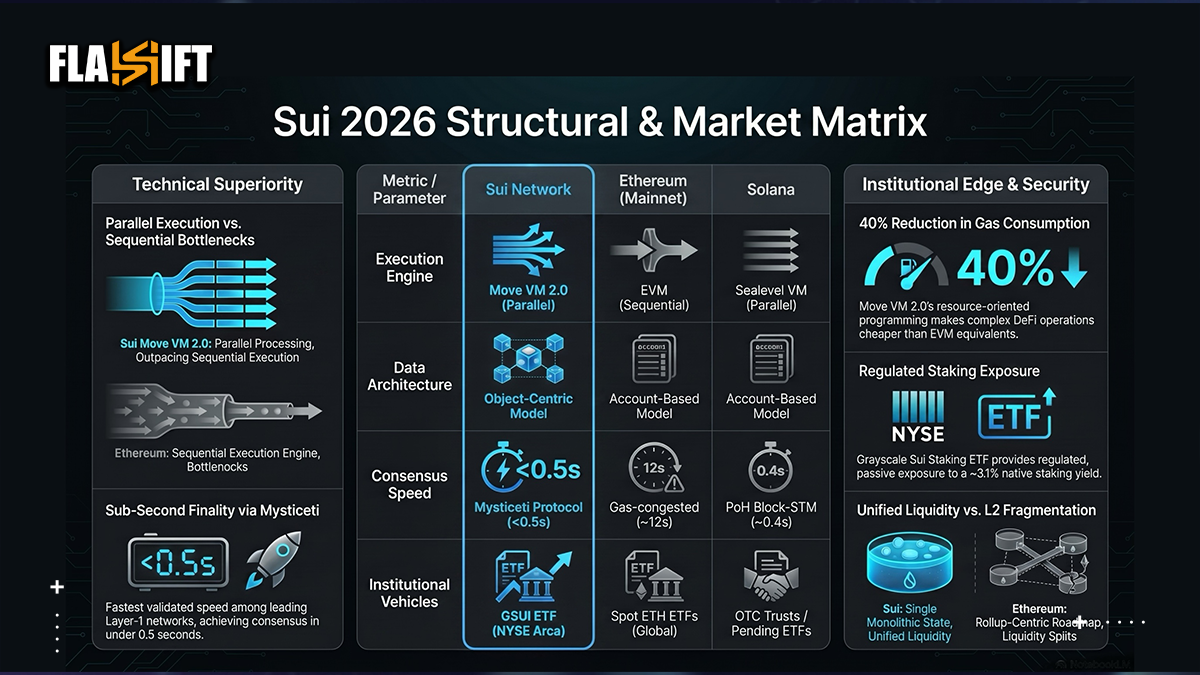
📊 Sui 2026 Structural & Market Matrix
| Metric / Parameter | Sui Network | Ethereum (Mainnet) | Solana |
| Execution Engine | Move VM 2.0 (Parallel) | EVM (Sequential) | Sealevel VM (Parallel) |
| Data Architecture | Object-Centric Model | Account-Based Model | Account-Based Model |
| Consensus Speed | Mysticeti Protocol (< 0.5s finality) | Gas-congested blocks (~12s) | PoH Block-STM (~0.4s) |
| Institutional Vehicles | GSUI ETF (NYSE Arca), Nasdaq TSUI ETF | Spot ETH ETFs (Global) | OTC Trusts / Pending Spot ETFs |
| Fee Predictability | Gas reference price (24h flat) | Volatile gas spikes (Gwei-dependent) | Dynamic priority fees |
| Primary Risk Factor | Imminent monthly token unlocks | Layer-2 liquidity fragmentation | Network stability under high load |
The Move Engine: Object-Centric Parallelization vs. Legacy Blockchains
To understand why Sui outpaces competitors under heavy network stress, we must examine its structural departure from the account-based systems used by Ethereum and Solana.
- The Object-Centric Data Model
In traditional smart contract networks, the global state is organized around “accounts” that hold balances. If two users interact with the same smart contract, their transactions must be processed sequentially to prevent double-spending.
Sui bypasses this bottleneck by treating everything on-chain—from token balances to NFTs—as an individual object with a unique cryptographic ID.
- Single-Owner Objects: Transactions involving assets owned by a single user (such as direct peer-to-peer token transfers) do not require global consensus. They bypass the main consensus queue entirely, achieving near-instant finality.
- Shared Objects: Transactions that interact with shared state (like decentralized exchange liquidity pools) are routed through Sui’s state-of-the-art Mysticeti consensus protocol, delivering finality in less than 0.5 seconds—the fastest validated speed in the Layer-1 landscape.
- Move VM 2.0 and Resource-Oriented Programming
The Move programming language, originally designed at Meta, treats digital assets as physical resources that cannot be duplicated, accidentally deleted, or swept by unauthorized re-entrancy bugs. In 2026, the implementation of Move VM 2.0 has reduced smart contract gas consumption by up to 40% globally, making complex DeFi operations cheaper on Sui than on any EVM equivalent.
Read More: Exploring Sui Blockchain: A Fast and Scalable Layer 1
Institutional On-Ramps: The Impact of NYSE Arca Uplisting
The retail speculation that dominated Sui’s early market cycles has been replaced by a highly structured institutional bid.
[Institutional Desk] ──► [GSUI ETF (NYSE Arca)] ──► [Direct Staked SUI Allocation]
                                                            │
                                                (Native Yield ~3.1%)
The GSUI Milestone
On February 18, 2026, Grayscale officially uplisted its private trust into the Grayscale Sui Staking ETF (GSUI) on NYSE Arca. This transition marks a critical milestone:
- Regulated Staking Yield: GSUI is the first exchange-traded product to offer traditional investors direct, passive exposure to Sui’s native staking rewards, which historically yield around 3.1% annually.
- Elimination of Asset Premium/Discount: The structural transition to an open-ended ETF allows continuous share creation and redemption, aligning the fund’s market price directly with the net asset value (NAV) of the underlying SUI tokens.
- Validation of Uptime: Unlike competitors that have suffered high-profile network halts during market-wide liquidations, Sui’s consensus architecture has demonstrated the institutional-grade reliability demanded by multi-million dollar portfolios.
Relative Performance: Will Sui Outperform Bitcoin and Ethereum?
While Bitcoin remains the premier sovereign store of value and Ethereum serves as the primary base layer for Layer-2 scaling, SUI occupies a distinct performance-driven niche.
Sui vs. Bitcoin: Velocity vs. Scarcity
Bitcoin is structurally limited by its Proof-of-Work design, processing transactions over 10-to-20 minute intervals. SUI does not compete as a store of value; it functions as high-velocity, low-latency financial bandwidth.
Sui natively scales up to 297,000 transactions per second (TPS) via horizontal validator scaling, making it the preferred ledger for high-frequency trading and Web3 consumer applications.
Sui vs. Ethereum: Monolithic Scale vs. L2 Fragmentation
Ethereum’s scaling roadmap relies heavily on rollups and Layer-2 networks. While this lowers transaction fees on individual sub-networks, it splits liquidity, degrades the user experience, and forces traders to constantly bridge assets.
Sui preserves a unified liquidity layer. By maintaining a single, monolithic state where assets can interact seamlessly without complex cross-chain bridges, Sui avoids the user-friction points that plague EVM-based decentralized applications.
Strategic Portfolio Rotation and Sovereignty with Flashift
For sophisticated Web3 participants, trading high-beta Layer-1 assets like SUI requires a proactive focus on security and privacy. When rotating capital during localized market peaks, relying on centralized hubs exposes your digital wealth to unnecessary regulatory bottlenecks and counterparty failures.
Using Flashift’s non-custodial routing engine, traders can instantly execute large-scale swaps between SUI, Ethereum (ETH), and censorship-resistant stablecoins directly from their cold storage wallets.
[Sovereign SUI Wallet] ──► [Flashift AI Smart Router] ──► [Sovereign ETH / Stablecoin Wallet]
         │                                                            │
 (Direct Transfer)              (Zero-Custody Swap Execution)       (Private Asset Protection)
Through this framework, you bypass:
- Intermediate Contract Vulnerabilities: At no point do you sign open-ended smart contract approvals. Transactions execute as native peer-to-peer transfers, protecting your wallet from exploiters.
- Compliance Hold Risks: Centralized databases are prone to sudden AML freezes. By using Flashift’s registration-free routing layer, you retain 100% custody of your private keys at every stage of the swap cycle.
- Artificial Slippage: Flashift’s real-time AI protocol monitors liquidity pools across 50+ global providers to guarantee the purest conversion rates, ensuring SUI trades execute with minimal price impact.
Strategic Risks to Monitor
While SUI’s technical and institutional foundation is exceptionally strong, smart investors must weigh the following risk vectors:
- Token Unlock Overhang: Only around 40% of SUI’s total 10 billion maximum supply is currently in active circulation. Monthly vesting unlocks for early contributors and investors introduce structural supply dilution that requires consistent buy pressure to absorb.
- Ecosystem Competition: Parallel EVM chains and competing Move VM networks (such as Aptos) are fighting for the same developer mindshare. SUI’s outperformance depends entirely on its ability to maintain its lead in on-chain Total Value Locked (TVL).
Conclusion: Claiming Financial Autonomy
Sui’s structural evolution in 2026 proves that blockchain scalability cannot rely on outdated, sequential execution models. By combining Move VM safety with institutional-grade products like GSUI, Sui has earned its place as a permanent pillar of decentralized finance.
However, maximizing your returns in this ecosystem means taking absolute ownership of your execution layer. By routing your swaps through non-custodial architectures like Flashift and securing your sovereign capital in multi-sig hardware setups, you protect your portfolio from centralized chokepoints and secure your financial autonomy.
FAQ
Can I trade Sui (SUI) without creating an exchange account?
Yes. By using Flashift’s intelligent, non-custodial routing engine, you can swap SUI directly for assets like ETH, BTC, or DAI with zero registration, zero accounts, and complete financial privacy.
What is the Grayscale Sui Staking ETF (GSUI)?
GSUI is an exchange-traded product listed on NYSE Arca that offers traditional brokerage accounts regulated, passive exposure to the SUI token while natively participating in network staking to capture on-chain yields.
Why is the Move programming language safer than Solidity?
Move is built around resource-oriented programming, treating digital assets as non-copyable physical objects. This architecture natively eliminates major smart contract exploits, such as re-entrancy bugs, which have cost EVM platforms billions in historical hacks.
Does Sui require bridges to interact with Ethereum?
In 2026, Sui integrated a native Ethereum bridge that allows secure cross-chain transactions without the need for risky, wrapped third-party assets or complex bridging protocols.
How does Flashift ensure I get the best rate when swapping SUI?
Flashift’s AI engine continuously aggregates and analyzes real-time liquidity and transaction friction across over 50 global exchanges. It automatically route swaps through the cleanest, lowest-slippage, and most reliable execution paths available.