
- Privacy Protocol Showdown (2026) 🛡️
- Why Vitalik Buterin Uses Railgun 🧠
- Railgun explained: How Railgun works?
- How to Go Dark: Using the Railway Wallet 📱
- Supported Chains & Assets: Can I Shield USDT? 🌐
- Railgun Crypto: Use Cases in DeFi
- Risks & regulations for Railgun Crypto
- The “Clean Entry”: Funding Railway via a chain abstraction way⚡
- Conclusion
- FAQ
Your trading history is public property. Railgun changes that.
In the glass house of Ethereum, every swap, loan, and trade you make is visible to bots, competitors, and chain analysts. For years, the only solution was “Mixers” like Tornado Cash, clunky tools that often flagged your wallet as suspicious by exchanges.
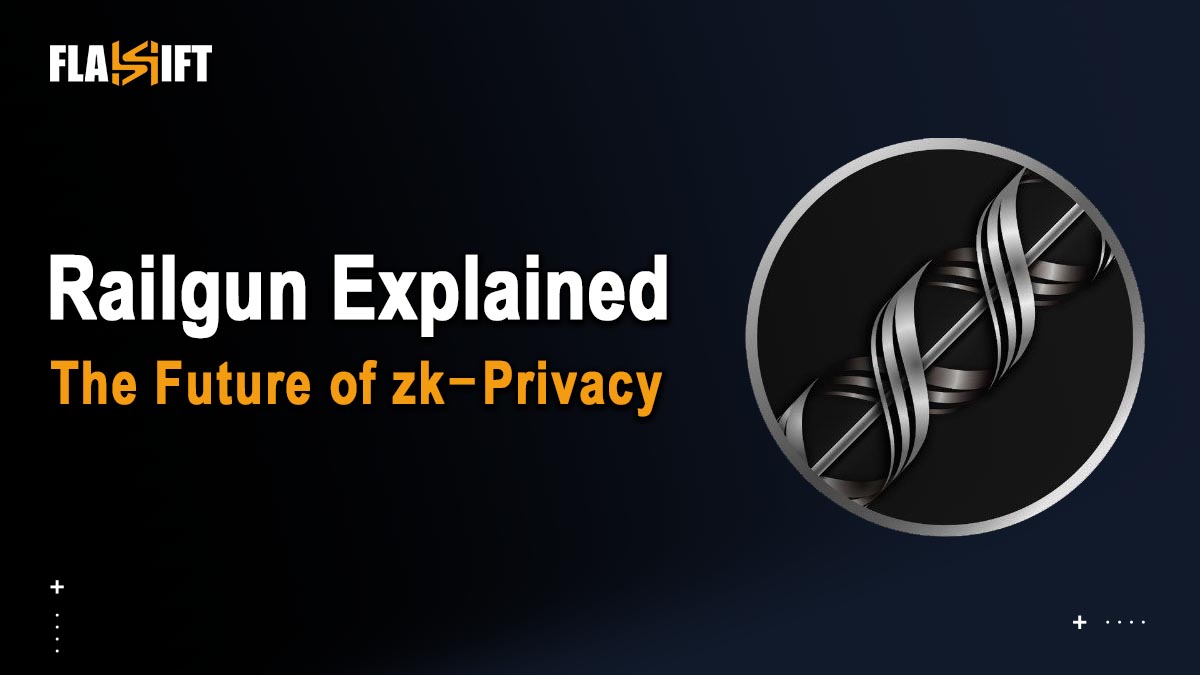
Enter Railgun (RAIL).
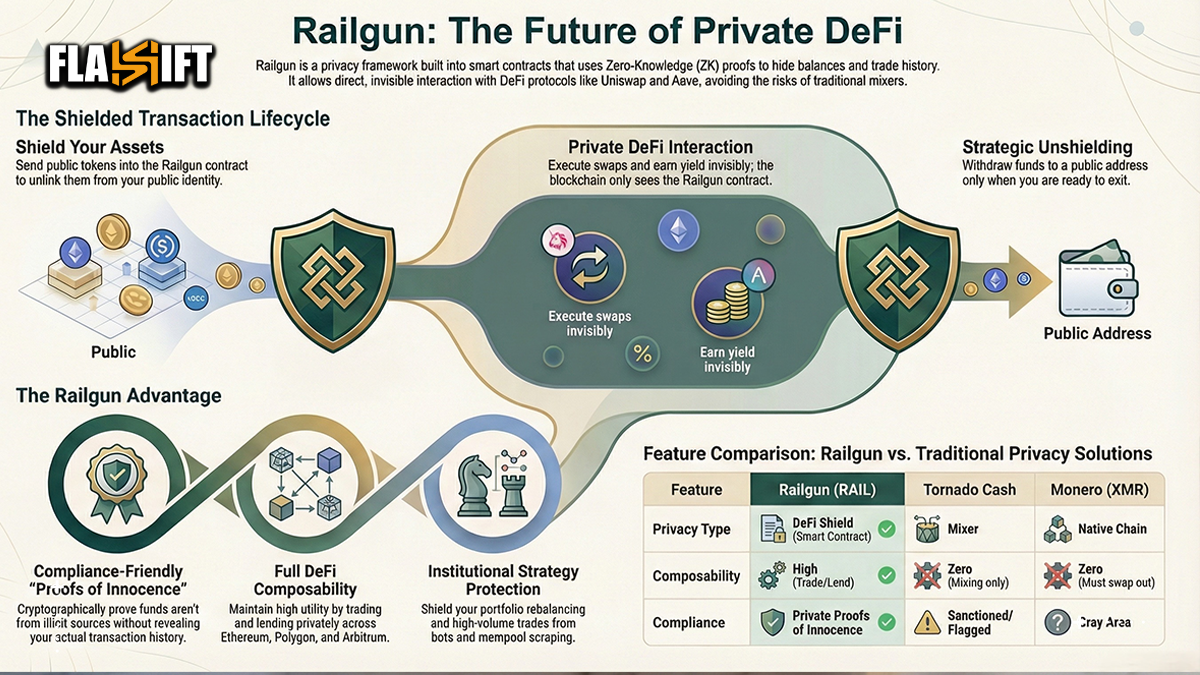
Endorsed by industry titans like Vitalik Buterin, Railgun is not a mixer; it is a Privacy System for DeFi. It allows you to interact with apps like Uniswap or Aave exactly as you do now, but with one crucial difference: Zero-Knowledge (ZK) Proofs shield your balance and history from the world.
In this 2026 deep dive, we explore how the Railway Wallet works, why it supports stablecoins like USDT, and how to use a non-custodial rote to fund your privacy stack without leaving a paper trail.
Privacy Protocol Showdown (2026) 🛡️
| Feature | Railgun (RAIL) | Tornado Cash (Classic) | Monero (XMR) |
| Privacy Type | DeFi Shield (Smart Contract) | Mixer (Deposit/Withdraw) | Native Chain |
| Composability | ✅ High (Trade/Lend privately) | 🔴 Zero (Just mixing) | 🔴 Zero (Must swap out) |
| Compliance | ✅ “Private Proofs of Innocence” | 🔴 Sanctioned/Flagged | 🟡 Gray Area |
| Ease of Use | Railway Wallet (App) | Web Interface | Specialized Wallet |
| Best For… | DeFi Users & Traders | Breaking Link history | Storing Wealth |
💡 Flashift Tip: To use Railgun, you need ETH, DAI, or USDT. Swap BTC to ETH instantly on Flashift to fund your privacy wallet without CEX tracking.
Why Vitalik Buterin Uses Railgun 🧠
In 2024 and 2025, Ethereum co-founder Vitalik Buterin made headlines for using Railgun to shield his transactions. Why? Because “Privacy is normal.”
Unlike traditional mixers that are often blacklisted, Railgun uses a technology called “Privacy Pools” (or Proofs of Innocence). This allows users to cryptographically prove that their funds did not come from a known hacker or illicit source, without revealing their actual transaction history.
This “Compliance-Friendly Privacy” is why Railgun has become the standard for institutional DeFi users in 2026 who want to protect their strategies without getting banned by Coinbase.
Railgun explained: How Railgun works?
To understand Railgun explained properly, you first need a quick snapshot of what it is. Railgun is a privacy framework built directly into smart contracts, not an external mixer or a workaround. It uses zero-knowledge proofs to hide balances and transaction details while still letting users operate fully inside the DeFi ecosystem. In simple terms, Railgun gives you the ability to use Ethereum and EVM chains normally (swaps, lending, yield strategies) but without exposing your actions to the entire internet.
The mechanics behind it are surprisingly elegant. When you deposit into Railgun, your assets go into a shielded pool. Once inside, your address and balances are no longer tied to your public identity. Every time you make a move (a swap, transfer, or interaction with DeFi) you generate a zk proof. That proof tells the network, “This action is valid, and I own the required assets,” but it never reveals who you are, what your exact balance is, or where the funds came from.
This is where zk privacy DeFi becomes real: the system confirms legitimacy without uncovering the underlying data. Your public address stays silent, transactions don’t leave fingerprints, and your trading strategies remain your own. And the RAIL token (the governance layer behind Railgun crypto) helps steer upgrades, relayer incentives, and the long-term direction of the protocol.
In practice, Railgun achieves something most privacy systems haven’t: it keeps everything on-chain, verifiable, and composable, but shields the parts that traders don’t want exposed.
• Read More: Privacy Tokens Are Back in 2025
How to Go Dark: Using the Railway Wallet 📱
Railgun isn’t just a backend protocol; you access it via the Railway Wallet (available on iOS, Android, and Desktop). It looks like MetaMask, but it acts like a stealth bomber.
The Workflow:
-
Shield: You send public tokens (like USDT or ETH) into the Railway contract. They are now “Shielded.”
-
Swap & Earn: Inside the wallet, you can swap tokens on Uniswap or earn yield on Beefy Finance. These actions are invisible to Etherscan. The blockchain only sees that the Railgun contract is interacting, not you.
-
Unshield: When you want to exit, you withdraw funds back to a public address.
Supported Chains & Assets: Can I Shield USDT? 🌐
A common misconception is that you can only use the RAIL token. False.
Railgun is an infrastructure layer. It supports:
-
Chains: Ethereum, BNB Chain, Polygon, and Arbitrum.
-
Assets: You can shield any standard ERC-20 token.
Popular Privacy Pairs:
-
USDT / USDC: Ideal for private stablecoin payments.
-
WETH: For private NFT purchasing or DeFi trading.
-
RAIL: The governance token of the ecosystem.
Railgun Crypto: Use Cases in DeFi

Private Swaps on DEXs
One of the most practical use cases is running swaps without revealing your intentions. Traders can move between assets, rebalance, or execute large orders without tipping off bots or copy-traders. With Railgun explained this way, the value becomes obvious: your strategy stays yours.
Stealth Portfolio Rebalancing
Investors who frequently rotate between tokens can do so quietly. No one can track their allocations, spot their accumulation patterns, or follow their exits. It’s a level of discretion that traditional DeFi simply doesn’t offer.
Yield Farming Without Exposure
When users join or exit yield farms, their wallet history usually tells the entire story. Through Railgun, those interactions remain hidden while the contracts still verify everything through zk privacy DeFi mechanics.
Protected Lending and Borrowing
Borrowing large amounts from on-chain lending markets often signals future moves. Railgun allows users to take loans or repay them without leaking any strategic clues, especially useful for traders who operate across multiple protocols.
Invisible Transfers Between Wallets
Sometimes you need to move funds without drawing attention — not for evasion, but for basic operational security. Railgun enables this by unlinking sender and receiver addresses inside its shielded pool.
DAO Treasury Management with Privacy
Treasuries can rebalance portfolios, accumulate strategic positions, or move capital without revealing their next steps to the entire market. A powerful use case for organizations holding large balances.
High-Volume Trading Without Mempool Scraping
HFT-style traders and arbitrageurs often fall victim to bots watching their every move. Railgun lets them operate without broadcasting their intentions before execution.
Whales Avoiding Market Impact
Large players can accumulate or reduce positions without causing price swings or sparking rumors. This is one of the main reasons Railgun crypto is gaining traction among bigger capital allocators.
Risks & regulations for Railgun Crypto
Privacy tech always sits in a sensitive corner of the crypto world, and Railgun is no exception. Even though it uses transparent, on-chain zero-knowledge proofs — not hidden servers or off-chain mixers — there are still real risks worth understanding:
Regulatory attention
Anything that provides financial privacy attracts scrutiny, especially after high-profile cases like Tornado Cash. Railgun is architected differently — it keeps all proofs on-chain and doesn’t rely on pooled mixing — but that doesn’t guarantee it avoids regulatory pressure. Lawmakers often struggle to distinguish between privacy tools designed for legitimate use and tools meant for obfuscation. Railgun could end up in the same conversations simply because of its category.
Front-end and relayer exposure
The protocol itself is permissionless, but relayers and front-end operators are public-facing. They’re the most likely to face legal pressure if regulators decide to tighten rules around privacy tech. It doesn’t break the protocol, but it could affect accessibility for some users.
User responsibility
Like any privacy system, mistakes can break anonymity. Reusing withdrawal addresses, combining shielded and public flows improperly, or poor operational security can expose patterns. Railgun doesn’t protect users from careless behavior; it only protects the cryptography side of the equation.
Smart contract risk
Railgun is heavily audited and open-source, but it’s still a complex smart-contract system handling encrypted commitments. Zero-knowledge circuits, Merkle trees, and private balances add layers of sophistication — and complexity always carries some degree of risk. No system is immune to implementation bugs.
Liquidity limitations
Private DeFi relies on shielded pools. If liquidity is thin on certain chains, users may experience slower or less flexible movements. This isn’t unique to Railgun, but it’s a factor for anyone treating privacy as part of an active strategy.
Perception risk
Fair or not, “privacy” and “illicit activity” get lumped together in public discourse. Projects like Railgun that operate legitimately may still face reputational blowback simply because of the subject matter. Perception doesn’t break the tech, but it influences adoption, integrations, and exchange support.
The “Clean Entry”: Funding Railway via a chain abstraction way⚡
To start using Railgun, you need to send ETH or USDT to your Railway Wallet public address before “Shielding” it.
The Problem: If you send funds from Coinbase or Binance to your Railway Wallet, you have created a permanent on-chain link between your KYC identity and your privacy wallet.
The Flashift Solution:
Break the link before you enter.
-
Swap: Use Flashift to swap Bitcoin (BTC) or Solana (SOL) into Ethereum (ETH).
-
Receive: Have Flashift send the ETH directly to your Railway Wallet public address.
-
Shield: Immediately convert that ETH to “Shielded ETH” inside the app.
Because Flashift is non-custodial and No-KYC, there is no database linking your identity to the funds entering the Railgun ecosystem.
Conclusion
Railgun isn’t just another privacy tool in DeFi; it’s a new way of thinking about what on-chain finance can be. By embedding zero-knowledge proofs directly into smart contracts, it gives users control over their strategies and balances without exposing them to the public eye.
Unlike mixers or separate privacy chains, Railgun operates where traders already live, letting them interact with DeFi seamlessly while staying invisible. As zk privacy DeFi matures, Railgun crypto is proving that privacy and transparency don’t have to conflict, and that real financial discretion on-chain is no longer a theoretical idea; it’s here, ready to reshape the way we manage assets.
FAQ
- How does Railgun differ from simple mixers like Tornado Cash?
Unlike traditional mixers, Railgun integrates privacy directly into smart contracts, allowing users to interact with DeFi protocols (swapping, lending, or farming) without revealing balances or addresses, all while staying fully on-chain.
- Can Railgun’s privacy be compromised by careless user behavior?
Yes. While zero-knowledge proofs protect cryptographic data, privacy can be weakened if users reuse addresses, mix shielded and public flows improperly, or leak information through external channels. Railgun secures the protocol, but operational habits still matter.
- Is Railgun limited to Ethereum, or does it support other chains?
Railgun is designed for EVM-compatible chains, making it accessible on networks beyond Ethereum. This allows privacy-conscious users to operate across multiple DeFi ecosystems without leaving their preferred platforms.
- How does Railgun affect market transparency and analytics?
By shielding transactions and balances, Railgun changes the way on-chain data is interpreted. Analysts and bots can no longer see every move, which reduces front-running and strategy copying but does not prevent legitimate on-chain verification.
- Does using Railgun pose regulatory risks?
Privacy tools always attract regulatory attention. While Railgun’s proofs are fully on-chain and open-source, relayers and front-end services may face scrutiny. Users should remain aware of jurisdictional rules and the evolving legal landscape for privacy-focused crypto.