

📑 Table of Contents
  1. Latest global tax regulations for crypto in 2025
  2. Why tax evasion is risky? (user warnings: “can ruin your life”)
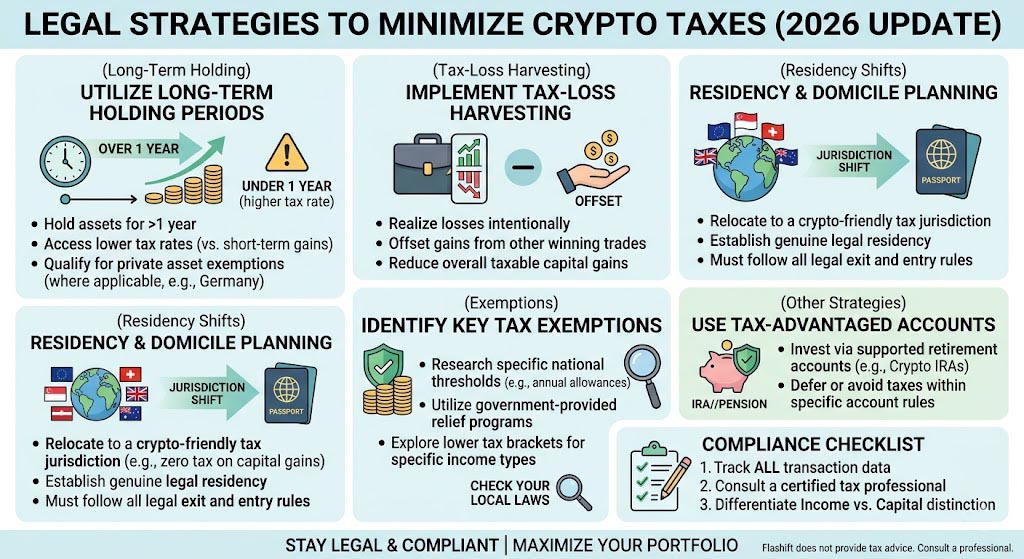
  3. Legal ways to minimize crypto taxes: long-term holding, residency shifts, exemptions
  4. Risky practices from forums & their dangers
  5. Actionable tax planning tips for 2025 investors
  6. Conclusion
  7. FAQ

Crypto Taxes in 2025: Legal Strategies vs Risky Loopholes | The rules for crypto tax 2025 are no longer a mystery — they’re a moving target that investors can’t afford to ignore. Governments around the world have tightened reporting standards, exchanges are sharing data, and the days of quietly pocketing untaxed gains are fading fast. Still, there’s a huge difference between building smart crypto tax strategies and falling into the trap of shady shortcuts.

The challenge for traders and long-term holders is clear: how do you minimize your tax bill without crossing into dangerous territory? The truth is that many so-called “loopholes” are nothing more than ticking time bombs. What looks like clever planning today could easily turn into a headline-making audit tomorrow. And the risks tied to crypto tax evasion in 2025 aren’t just financial — penalties, account freezes, and even criminal charges are very real possibilities.

This article breaks down where the line is drawn, what is the latest tax rules, how to use legal strategies to your advantage, and which practices to avoid if you want to protect your capital and, your freedom.

Flashift.app


Latest global tax regulations for crypto in 2025

Latest global tax regulations for crypto in 2025

1) OECD’s Crypto-Asset Reporting Framework (CARF)

CARF is the biggest global change shaping crypto taxation today. It standardizes how exchanges, custodians, and wallets must collect and report user transaction data. Dozens of countries have already committed, and the first international data exchanges are expected in the next few years. For investors, this means cross-border “hidden” gains will soon be far more visible to tax authorities.

Key point: If you use regulated exchanges or custodians in CARF jurisdictions, your transactions will likely be reported automatically.

2) European Union | DAC8

The EU’s DAC8 directive requires all crypto-asset service providers in member states to collect detailed customer and transaction data, then share it across borders within the EU. This eliminates the possibility of using another EU country as a tax shelter.

Key point: EU investors must assume their crypto activity is fully transparent to all member-state tax authorities.

3) United States | Broker Reporting and Form 1099-DA

In the U.S., crypto brokers and marketplaces now have to report transactions using new digital asset reporting forms. From 2025 onward, the IRS will receive more detailed information about crypto sales, swaps, and proceeds than ever before.

Key point: Expect 1099 forms from most major exchanges and tighter IRS scrutiny if you underreport gains.­

4) United Kingdom | HMRC Updates

The UK continues to refine how it treats different types of crypto activity. Capital gains rules apply to most disposals, while frequent trading, staking, or mining may fall under income tax. HMRC has also aligned with global reporting initiatives, so it increasingly receives data from service providers.

Key point: UK taxpayers must carefully track cost basis, holding periods, and distinguish between income and capital gains.

5) Germany | Detailed Guidance from BMF

Germany has clarified how private sales, staking, and mining are treated for tax purposes. The one-year holding period rule still plays a big role: profits from disposals after one year can be tax-free, but trades within that window remain taxable.

Key point: Proper record-keeping of acquisition dates and expenses is critical to prove eligibility for tax exemptions.

6) India | High Flat Taxes

India enforces one of the strictest tax regimes: 30% tax on all crypto gains, with a 1% TDS (withholding) on every transaction. Losses cannot generally be offset, making compliance expensive and burdensome.

Key point: Indian traders face high effective tax costs and cash flow issues due to the withholding rules.

7) Australia | CGT and Operator Oversight

Australia treats crypto disposals (whether selling, swapping, or spending) as capital gains tax events. The ATO has also clarified income tax rules for staking, mining, and trading as a business. Regulators are bringing more crypto operators under financial licensing, increasing compliance duties.

Key point: Nearly every movement of crypto in Australia is a taxable event, so detailed transaction records are essential.

8) FATF Pressure | AML Meets Tax

The Financial Action Task Force (FATF) continues to push countries to enforce the “travel rule” and strict customer due diligence for crypto providers. Tax authorities now often receive data flagged in AML monitoring, meaning attempts to hide taxable gains through unregulated services risk triggering both tax and criminal investigations.

Key point: Privacy-focused or offshore exchanges no longer offer the tax shield many expect.

9) Timing and Global Adoption

Different jurisdictions are implementing these frameworks at different speeds. Some plan their first data exchanges in 2027, others later, but the momentum is clear: more automatic reporting, tighter definitions, and greater penalties for non-compliance.

Practical Takeaways for 2025

  1. Track everything: dates, costs, wallets, transfers, swaps.
  2. Expect automatic reporting from most major exchanges and custodians.
  3. Differentiate income types: trading gains, staking rewards, mining, and airdrops may each be taxed differently.
  4. Avoid risky loopholes: “hiding” assets offshore or using unregulated exchanges carries high audit and penalty risk.
  5. Seek professional advice if you trade across borders, engage with DeFi, or earn multiple forms of crypto income.

Why tax evasion is risky? (user warnings: “can ruin your life”)

Why tax evasion is risky

In the world of crypto tax 2025, the temptation to look for shortcuts is stronger than ever. Prices swing wildly, profits can feel like “found money,” and some traders convince themselves that hiding gains is just part of the game. But here’s the blunt truth: tax evasion isn’t a clever move, it’s a direct path to consequences that can ruin your life.

The biggest mistake investors make is assuming the government won’t notice. That may have been easier five years ago, but today? Exchanges and brokers are required to report your trades. Countries are plugged into international data-sharing frameworks, and algorithms scan millions of records to flag mismatches automatically. If your tax return doesn’t line up with what the system already knows, it’s only a matter of time before you get a letter — or worse, an audit.

And the penalties aren’t just financial. Crypto tax evasion risks in 2025 include frozen accounts, asset seizures, travel restrictions, and even criminal charges. Once you’re flagged, every part of your financial life comes under scrutiny. The stress, legal costs, and damage to your reputation often outweigh any tax you thought you saved.

That’s why the smart play isn’t hiding, it’s planning. Building strong, legal crypto tax strategies means using the system to your advantage: offsetting gains with losses, structuring holding periods wisely, and leveraging exemptions you’re entitled to. These are the moves that keep your profits safe — and keep you out of the nightmare zone where tax evasion takes people who thought they’d never get caught.


Legal ways to minimize crypto taxes

1) Long-term holding (use holding periods to lower rates)

Holding crypto for the long haul usually changes the tax profile of a sale — in many jurisdictions long-term capital gains attract lower rates than short-term income. That simple timing decision can materially reduce tax bills if you plan exits around holding-period thresholds and your broader income situation. Be precise with timestamps and documentation so you can prove the holding period if questioned.

2) Tax-loss harvesting (realize losses to offset gains)

Selling losing positions to crystallize losses and offset gains is a widely used, legal tactic. In crypto this is often more flexible than in traditional securities because wash-sale rules don’t uniformly apply to crypto yet in many jurisdictions — but rules are changing fast, so treat repurchases with care and document everything. Tax-loss harvesting works best as part of an annual checklist before year-end.

3) Use of tax-advantaged accounts where available

Where national crypto tax systems allow, holding digital assets inside tax-favored wrappers (retirement accounts, pension vehicles, or other exempt vehicles) can defer or eliminate tax on appreciation. These accounts have different contribution and withdrawal rules, so match the vehicle to your investment horizon and liquidity needs. Check local rules carefully — not every country treats crypto the same inside these accounts.

Relocating to a jurisdiction with friendlier crypto rules — or changing your tax residency status — can be a valid, legal strategy for some investors. This is complex: tax residence is defined by domestic rules (days present, centre of vital interests, registration), exit taxes may apply, and international reporting is tightening. Residency moves should be real, well documented, and motivated by more than just tax (immigration and lifestyle factors matter). Use specialist advice to avoid triggering anti-abuse rules.

5) Choose compliant custodians/exchanges (data-friendly providers)

Using reputable, regulated platforms makes compliance easier and reduces surprise liabilities. Compliant providers increasingly offer better reporting statements, cost-basis tools, and API exports that simplify accurate filing — and the transparency helps you build defensible crypto tax strategies instead of scrambling after an audit. With global reporting frameworks coming online, this is becoming less optional.

6) Entity structuring (LLC, corporation, trust)

For active trading, business-style operations or pooled investments, using an entity can change how gains and income are taxed, shift liability, and allow more systematic expense deductions. Different entities suit different goals — trading as a business, holding passively, or running a fund all carry different tax consequences and administrative burdens. Always run entity structures past a tax lawyer; improper setup or abuse can be recharacterized by tax authorities.

7) Income vs capital distinction (classify activities correctly)

Treat staking, mining, airdrops, and earned crypto as income when rules require it — and plan accordingly. Reframing activity from “investment” to “business income” (or vice versa) has major tax consequences. Good crypto tax strategies separate buckets for income generation and capital appreciation, ensuring you report under the right regime and claim appropriate deductions. Use contemporaneous records (hours, intent, commerciality) to support your position.

8) Gifting and family transfers (use allowances and lower brackets)

Transferring assets to family members in lower tax brackets, or using gift allowances where legal, can reduce the overall tax burden on future disposals. Rules vary wildly: some countries have generous gift exemptions, others impose immediate tax or have anti-avoidance rules. Document the transfer, understand the donor/recipient tax treatments, and beware of claw-back or anti-abuse provisions.

9) Charitable donations and structured giving

Donating crypto directly to registered charities can provide a double benefit: you support causes and may receive a tax deduction based on fair market value (depending on local law). Structured giving (donor-advised funds, charitable remainder trusts) can be particularly tax-efficient for large, appreciated crypto positions — but the paperwork and valuation rules must be followed precisely.

10) Get professional help and build an audit-ready system

The single best legal strategy is having a process: consistent recordkeeping, robust cost-basis methods, regular reconciliations, and a qualified tax adviser who understands crypto and local rules. With global frameworks and broker reporting expanding in crypto tax 2025, mistakes are more likely to be caught; professional guidance helps you maximize legal savings while avoiding crypto tax evasion risks that can ruin your life if you cross the line.

Final note: these are lawful planning methods, not shortcuts. Given how reporting frameworks and enforcement have evolved, any aggressive or opaque scheme risks severe penalties, asset freezes, or criminal exposure.


Risky practices from forums & their dangers

Risky practices from forums & their dangers in crypto taxes

1) Using no-KYC bridges or non-custodial swaps to obscure origin

Many try routing crypto through bridges or non-custodial swaps thinking it hides who owns what. But transaction trails are still recorded on-chain and increasingly linked to user identities as exchanges or tax authorities analyze flows.

2) Relying on mixers or tumblers for “cleaning” funds

Mixing services try to hide the link between source and destination, but they are under growing regulatory scrutiny. Use of mixers can lead to accusations of money laundering, asset seizure, and possibly criminal charges.

3) Misclassifying trades, staking or income as capital gains

Declaring frequent trading, staking rewards or mining income under preferential capital gains rules seems tempting. But tax authorities look at intent, frequency, and activity — misclassification can lead to penalties or recharacterization as ordinary income.

4) Falsifying invoices, inflation of costs, or fake business expenses

Inflating costs or faking business-use claims can seem like easy deductions. But audits often catch inconsistencies, leading to denied deductions, penalties, and even fraud charges if intent is evident.

5) Using privacy coins or OTC trades thinking they’re untraceable

Some believe privacy coins or over-the-counter (OTC) trades evade all reporting. In fact, many jurisdictions don’t accept anonymity as a legal defense; coins acquired through OTC often eventually flow through regulated channels, triggering reporting.

6) Repeated small transfers (“smurfing”) to avoid reporting limits

Breaking up large transactions into many small ones hoping to stay under thresholds seems strategic. But authorities monitor patterns — smurfing is a known red flag and can lead to aggregate reporting, fines, or investigations.

7) Jurisdiction hopping or flimsy residency claims

Claiming tax residency in a low-tax location or using offshore service providers to dodge stricter home-jurisdiction rules might work temporarily. But with global reporting frameworks like CARF/DAC8, inconsistent residency, travel, banking and ties can expose you to back taxes plus penalties.

8) Delayed or missing record-keeping of trades, basis, wallet transfers

Skipping detailed records—dates, cost basis, wallet addresses—makes everything murkier. In an audit, if you can’t prove your basis or show when you held assets, authorities often disallow tax advantages or treat income as under-reported.

9) Blind trust in unregulated “privacy” tools or unverified apps

Using unverified wallets, apps or “privacy tools” without knowing their compliance record seems appealing. But many have hidden risks: some are sanctioned, some log user data, some are fronts that expose your on/off ramps to law enforcement or tax authorities.


Actionable tax planning tips for 2025 investors

Actionable tax planning tips for 2025 investors

1. Implement Tax-Loss Harvesting

Selling underperforming crypto assets to realize losses can offset gains, reducing your overall tax liability. Unlike stocks, crypto is not subject to the wash-sale rule, allowing you to repurchase the same asset after 31 days without triggering a disallowed loss.

2. Maximize Contributions to Tax-Advantaged Accounts

Contributing to retirement accounts such as IRAs or HSAs can lower your taxable income. While Roth accounts don’t provide immediate tax deductions, they offer tax-free growth and withdrawals, which can be advantageous for long-term crypto holdings.

3. Hold Assets for Over One Year

Assets held for more than a year are eligible for long-term capital gains tax rates, which are typically lower than short-term rates. This strategy is particularly effective for investors who can afford to hold their positions through market volatility.

4. Utilize Charitable Donations

Donating appreciated crypto assets to qualified charities can allow you to avoid capital gains taxes and potentially receive a charitable deduction. Ensure the charity is a registered 501(c)(3) organization to qualify for these benefits.

5. Stay Informed on Regulatory Changes

New regulations, such as the introduction of Form 1099-DA, require reporting of crypto transactions starting in 2025. Staying informed about these changes ensures compliance and helps avoid penalties.

6. Consult with a Tax Professional

Given the complexity of crypto tax laws and the evolving regulatory environment, consulting with a tax professional can provide personalized strategies to optimize your tax position and ensure compliance.

By implementing these strategies, you can effectively manage your crypto investments and minimize tax liabilities in 2025.


Conclusion

Navigating crypto tax 2025 is no longer optional; it has become a matter of protecting your investments and your financial freedom. Yet legitimate crypto tax strategies such as long-term holding, tax-loss harvesting, and exploiting exemptions can considerably diminish your fiscal responsibilities, whereas forum “hacks” or steep loopholes can land you in big trouble, the extreme penalties, frozen accounts, or criminal investigations.

With the line between smart planning and illegal tax evading now crisply set, global reporting frameworks, high-grade analytics, and cross-border enforcement have made concealment virtually impossible. The safest and most effective course, therefore, is made up of good recordkeeping, informed strategies, and professional guidance to maximize benefits while keeping you out of trouble.

In 2025, the pro-tip is: protect the gains, plan the moves, and avoid shortcuts that will destroy your life. Legal techniques are better from a safety standpoint, and they are the best way to gain and safeguard your crypto wealth long-term.


FAQ

1. Do I need to report every crypto transaction?

Yes. Every taxable event—such as selling, trading, or using crypto for goods or services—must be reported. Starting in 2025, U.S. exchanges are required to issue Form 1099-DA, detailing your transactions.

2. How long must I hold crypto to benefit from lower tax rates?

Holding crypto for over one year qualifies you for long-term capital gains tax rates, which are generally lower than short-term rates. In the U.S., these rates can be 0%, 15%, or 20%, depending on your income level.

3. Can I offset crypto gains with losses?

Yes. This strategy, known as tax-loss harvesting, allows you to sell underperforming assets to offset gains, reducing your taxable income. In the U.S., you can also deduct up to $3,000 in net losses against ordinary income.

4. Are crypto donations tax-deductible?

Yes. Donating appreciated crypto to qualified charities can allow you to avoid capital gains taxes and potentially receive a charitable deduction. Ensure the charity is a registered 501(c)(3) organization to qualify for these benefits.

5. Is using no-KYC platforms a safe way to avoid taxes?

No. Using platforms without Know Your Customer (KYC) procedures to hide transactions is risky and can lead to severe penalties. Authorities are increasingly able to trace such activities, and evasion can result in audits, fines, or criminal charges.

6. How can I ensure compliance with crypto tax laws?

Maintain detailed records of all transactions, including dates, amounts, and involved parties. Utilize reputable tax software to track your crypto activities and generate accurate reports. Consult with a tax professional specializing in cryptocurrency to navigate complex situations and ensure compliance.


Share

Write A Comment