
Why are Web3 developers still forcing users to manually bridge tokens, calculate slippage, and manage gas across isolated networks? The requirement of the modern market is Chain Abstraction, the ability to run a single logical application that natively spans multiple distinct ledgers.
The solution is moving past the primitive “lock-and-bridge” token migration phase and deploying unified execution networks where:
- A decentralized credit market on Arbitrum can dynamically evaluate collateralized positions on Ethereum mainnet.
- A gaming state machine on Avalanche instantly registers inventory updates and NFT transfers on Base.
- A single, unified DAO processes collective votes and executes state transitions across six distinct layer-2 networks simultaneously.
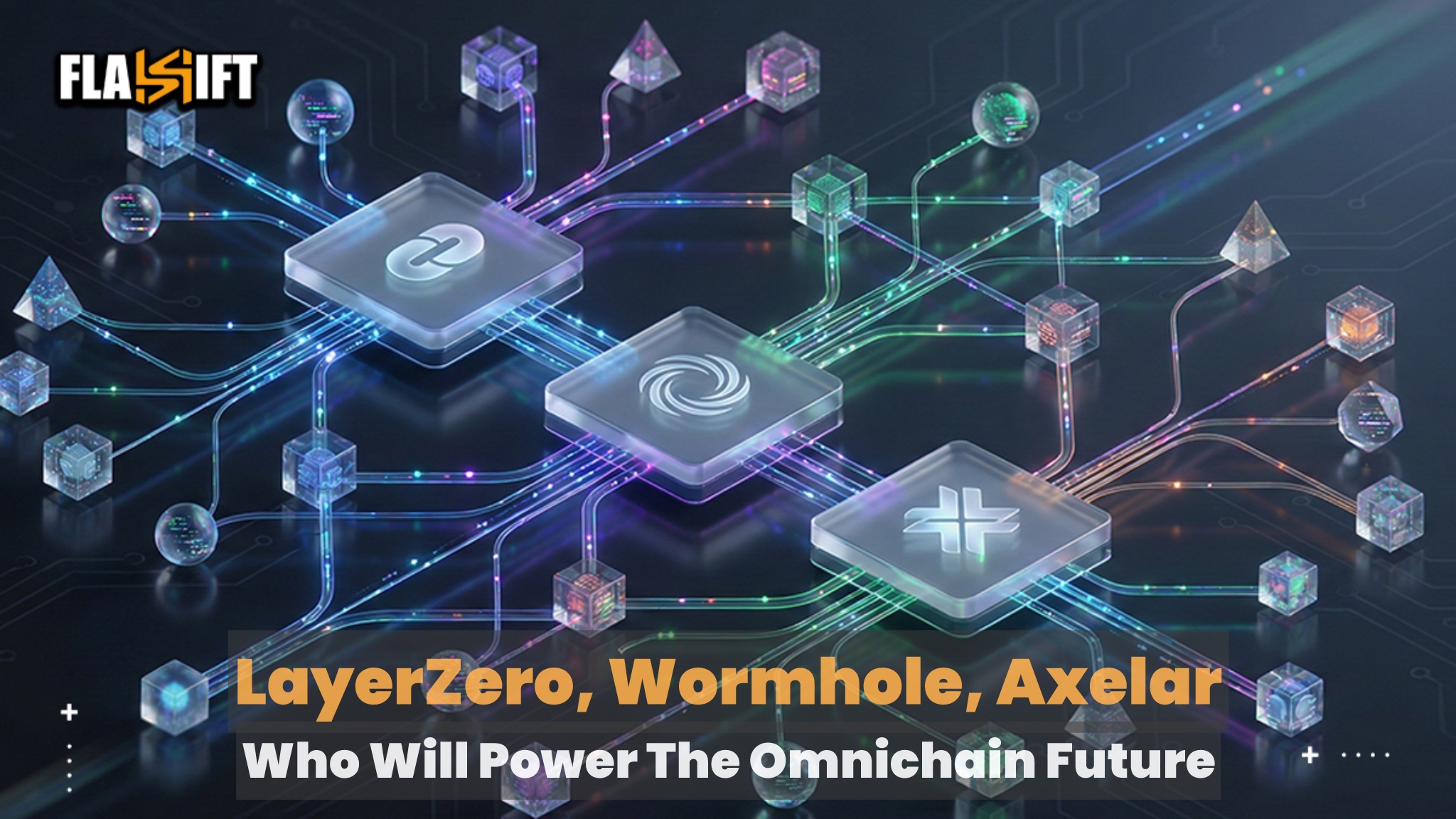
This paradigm shift relies on generic cross-chain message passing rather than static asset wrapping. In this high-stakes interoperability infrastructure race, three protocols dominate the architecture: LayerZero, Wormhole, and Axelar.
Understanding how these three networks handle arbitrary data verification, latency, and trust assumptions is paramount to designing a resilient application stack. When building for this multi-chain environment, developers also bypass the friction of managing fragmented native gas assets by utilizing an automated cross-chain routing gateway to handle instant conversions, keeping user experiences completely unified.
Quick Comparison: The 2026 Cross-Chain Messaging Stack 📊
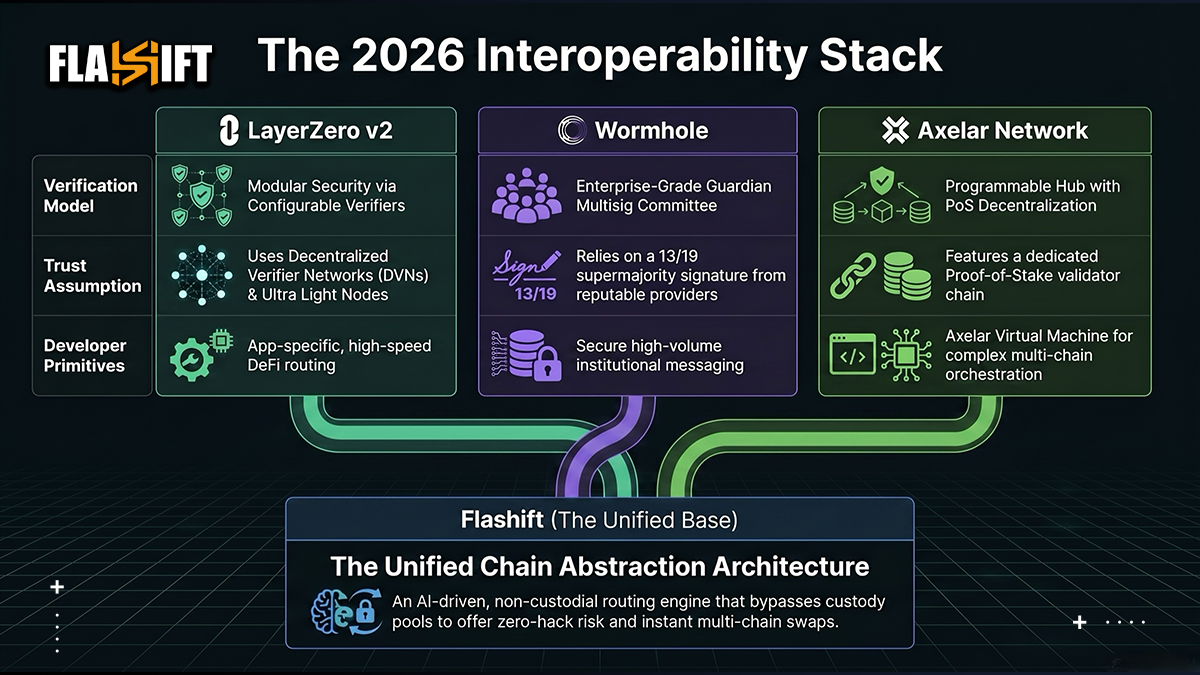
| Metric / Feature | LayerZero (v2) | Wormhole | Axelar Network |
| Verification Model | Configurable Verifiers (DVNs) | Guardian Multisig Committee | PoS Validator Chain (BFT Consensus) |
| Trust Assumption | App-configured verifier independence | Supermajority (13/19) of trusted operators | Decentralized economic security (AXL Staking) |
| Developer Primitives | OApp / OFT Standards | Verified Action Approvals (VAAs) | General Message Passing (GMP) & AVM |
| Primary Use-Case | Configurable high-speed DeFi routing | Enterprise-grade institutional messaging | Programmable multi-chain orchestration |
Core Mechanics: Arbitrary Message Passing vs. Asset Bridging
To build within an omnichain framework, one must understand the difference between basic asset bridging and generalized message passing.
- Asset Bridging: Represents a narrow, application-specific transaction type. It operates strictly by locking or burning an asset on a source chain to mint or release a corresponding asset on a destination chain.
- Arbitrary Message Passing (AMP): Allows any smart contract on a source chain to transmit arbitrary data payloads (including function calls, state parameters, and execution proofs) to a target contract on a destination ledger.
Read More About: Cross-Chain Bridges Explained: How They Work & Which Are Safe
State Synchronization Flow
A typical omnichain smart contract uses message passing to synchronize state across networks:
[Source Chain Contract] ► Emits payload (Function Call, Address, Data
▼
[Verification Layer] ► Decodes & Validates via Protocol Consensus
▼
[Destination Contract] ► Executes target logic (Mints, Updates, or Swaps)
For platform developers, choosing an interoperability partner is not a matter of comparing “token bridges”; it is a strategic decision regarding which cryptographic verification model your core application logic will depend on.
Read More: Wormhole, LayerZero, and Axelar: The Future of Cross-Chain Messaging
LayerZero: Modular Security and Configurable Endpoints
LayerZero defines itself as an omnichain interoperability protocol that prioritizes application-level customizability. It eliminates the need to run heavy light nodes on-chain by externalizing message verification to a dual-verifier framework.
The Ultra Light Node (ULN) Architecture
The ULN operates as a lightweight smart contract endpoint deployed on each supported chain. Instead of continuously syncing block headers (which is computationally expensive on layer-1 networks), the ULN fetches block headers on-demand via a decentralized network of verifiers.
Wormhole: Vetted Guardian Networks
Wormhole is an enterprise-grade messaging network that powers high-volume cross-chain ecosystems. It has processed over 1 billion cross-chain messages and secured over 60 billion dollors in transaction volume, making it one of the most operationally proven networks in production.
The Guardian Model
Rather than utilizing a dynamic proof-of-stake validator set, Wormhole relies on a fixed committee of 19 highly reputable infrastructure providers, known as Guardians.
- Verification: Guardians run full nodes across all connected blockchains. They observe transaction logs, verify that the state transition occurred on the source chain, and generate a multisig attestation known as a Verified Action Approval (VAA).
- The Threshold: A VAA requires a supermajority signature of 13/19 Guardians to be recognized as valid by destination smart contracts.
Because the Guardians are public entities with significant reputational and financial capital at stake, collusion is highly unlikely. This committee-based architecture offers predictable, sub-second latency and consistent throughput, making it a favorite for institutional asset managers and cross-chain liquidly networks.
Axelar: Programmable Interoperability and PoS Decentralization
Axelar approaches the cross-chain problem by deploying a dedicated Tendermint-based Proof-of-Stake (PoS) blockchain to act as a routing and validation hub.
Unlike Wormhole and LayerZero, which function as passive transport layers, Axelar is fully programmable. The AVM is a CosmWasm-based smart contract environment running directly on the interoperability hub.
- General Message Passing (GMP): Allows contracts to call functions across chains with structured data payloads.
- AVM Orchestration: Developers can write routing logic, aggregate incoming multi-chain messages, or build decentralized services (such as cross-chain DEX routers) directly inside the interoperability layer itself, treating cross-chain pipelines like microservices.
For teams requiring maximum decentralization, protocol-enforced slashing conditions, and programmable routing logic, Axelar’s PoS hub model is highly compelling.
The Reality of Bridge Security: Bypassing the Vulnerability Layer
When evaluating LayerZero, Wormhole, and Axelar, developers are often confronted with the historical specter of bridge hacks. Hundreds of millions of dollars have been drained from centralized custody pools and vulnerable lock-and-mint smart contracts over the years.
To mitigate these systemic risks, developers must design their execution layers around a crucial architectural truth: Vulnerabilities reside in custody pools, not in routing logic.
To establish an uncompromisable execution pathway, utilizing an anonymous cryptocurrency exchange layer removes these central attack surfaces entirely. Flashift operates strictly as a pure technology layer and intelligent routing engine. It does not deploy intermediate smart contracts, maintain centralized databases, or utilize locked liquidity custody pools (Custody Pools). Since there are no centralized funds to lock or databases to compromise, the risk of smart contract exploits or database hacks is absolute zero. Throughout the entire swap journey, your assets remain 100% non-custodial, leaving complete custody and control in your own secure wallet.
By executing cross-chain migrations directly from wallet-to-wallet, your capital remains native, sovereign, and entirely insulated from the technical debt of third-party smart contracts.
Implementing Chain Abstraction via Intelligent Routing
For developers and advanced platforms, interacting directly with raw messaging APIs or configuring complex multi-chain parameters introduces massive overhead. If your ecosystem only requires the native exchange of assets across distinct chains without the overhead of deploying dedicated DVNs, you do not need to build this infrastructure from scratch.
By leveraging an [instant multi-chain swap engine], you can abstract the entire cross-chain complexity into a single transaction. Flashift’s AI-driven smart routing engine automates this entire pipeline. The system dynamically queries over 50 decentralized liquidity networks to find the most cost-efficient, low-slippage execution path, handling all cross-chain messaging under the hood—completely No-KYC and with zero platform custody.
Whether you are routing stablecoins from Arbitrum to Solana, or migrating yield out of Ethereum DeFi into native assets, executing through an intelligent [non-custodial cross-chain router] ensures that your capital moves securely, privately, and at maximum velocity without ever sacrificing custody of your keys.
FAQ
- How do these cross-chain messaging layers compare to older token wrapping bridges? Older bridges relied on centralized multi-sigs or single-point lock-and-mint contracts. Modern cross-chain messaging transmits arbitrary data and function calls, allowing applications to natively interact across chains without creating synthetic “wrapped” representations of assets.
- Which protocol offers the lowest transaction fee and latency parameters? LayerZero often features low gas overhead due to its ultra-lightweight endpoint architecture. However, your actual transaction fee depends heavily on the gas costs of the destination chain and the specific Decentralized Verifier Networks (DVNs) configured for your application.
- Can an application combine multiple messaging protocols for redundancy? Yes. Many enterprise-grade applications utilize a multi-bridge design, routing high-value institutional transactions through Wormhole’s Guardian network while leveraging Axelar’s programmability for complex microservices, ensuring that a single protocol failure cannot compromise the entire platform.