
- From Bridge to Messaging Protocol
- Wormhole in DeFi Protocols
- Omnichain dApps Examples
- Benefits and Risks
- Future Interoperability
- Closing thought
- FAQs
- How many Guardians power Wormhole, and how do they validate messages?
- Are relayers trusted components in Wormhole’s architecture?
- Does Wormhole support messaging (beyond token transfers)?
- Are all DeFi / synthetic / NFT cross-chain use cases fully live today on Wormhole?
- What are the main benefits of Wormhole’s architecture?
- What are the key risks / attack surfaces in Wormhole’s design?
Wormhole is often introduced as a bridge — and it still is — but its real ambition is bigger: to become the messaging fabric beneath the multichain web. In 2025, the chains are multiplying, and DeFi wants to act like one unified network. Wormhole is one of the technologies trying to make that possible.
Let’s walk through how Wormhole is evolving, where it’s already used, and what to watch out for — especially in DeFi, NFTs, and omnichain dApps.
From Bridge to Messaging Protocol

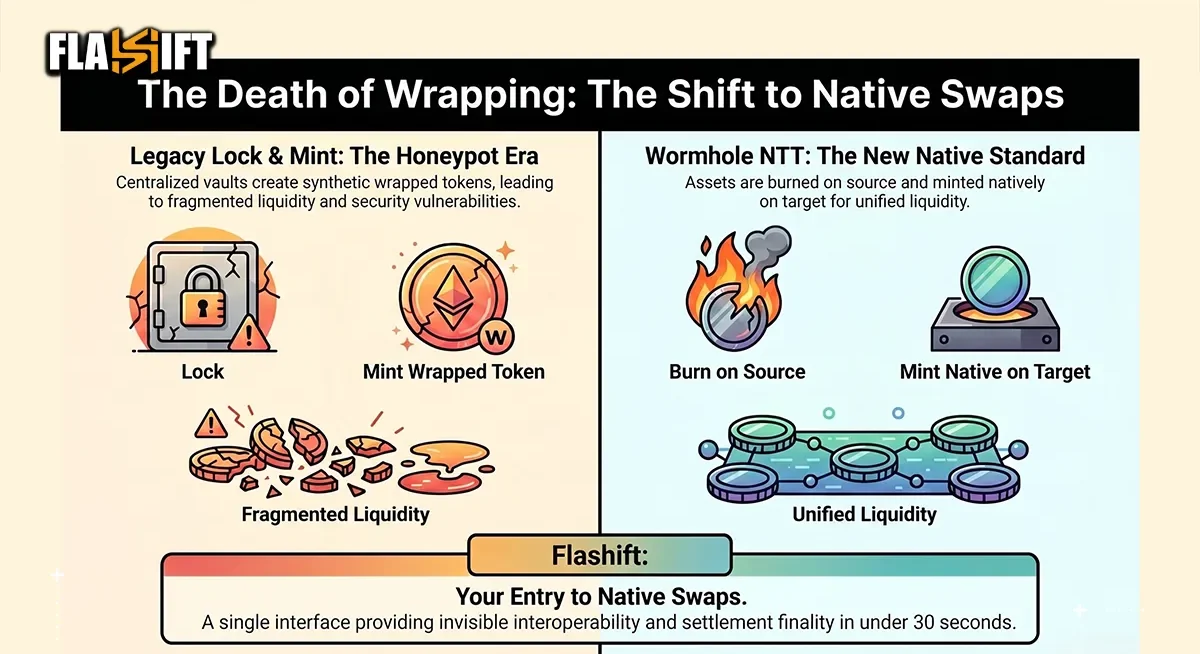
Why the old token-bridge model hit scalability and composability limits
Early cross-chain setups were simple: lock a token on chain A, mint a wrapped version on chain B. But over time this model showed its cracks:
-
Wrapped tokens fragment liquidity, creating pools of synthetic assets instead of unified value.
-
Many high-profile bridge hacks stemmed from vulnerabilities in custodial or semi-centralized systems.
-
Bridges often treated tokens only — not state, logic, or metadata — so DeFi composability remained stuck within chains.
That’s why the industry is pushing toward cross-chain messaging, not just token transfers.
Wormhole’s messaging architecture: what it really is
Wormhole now offers a Messaging product: a generic, multichain message-passing layer that allows smart contracts on different chains to send data, state updates, or commands to one another.
Here’s how it works under the hood (based on the official architecture docs):
-
A contract on the source chain emits a message via the Wormhole Core Contract.
-
The Guardian Network (a set of 19 validators) observes that event independently and signs off on it. When enough of them agree (≥ threshold), their signatures combine into a Verifiable Action Approval (VAA).
-
Relayers (off-chain or decentralized) transport that VAA to the target chain. The target chain’s Core Contract verifies the VAA and triggers the intended logic.
-
Because it passes data, not just token wrappers, Wormhole messaging can support cross-chain functions, metadata syncs, or more advanced application logic.
In sum, Wormhole messaging turns bridges from narrow pipelines into inter-chain communication layers.
How messaging transforms DeFi’s possibilities
With messaging, DeFi stops being siloed:
-
A solvency check on Chain A can trigger a liquidation or collateral shift on Chain B.
-
Governance actions can span multiple networks — proposals cast on one chain can execute on another.
-
Oracle and price feed data can be shared between chains, enabling unified markets.
This is how protocols begin to operate omnichain, not just multi-bridged.
Read More: Wormhole (W) Rallies 25% | Why the Ministry of Commerce Catalyst Signals a Bigger Trend
Wormhole in DeFi Protocols

Wormhole’s messaging isn’t hypothetical — it’s already being used in real protocols. That said, not every claim is live; some are in development or evolving.
Cross-chain liquidity & data sharing
-
Wormhole supports oracle messaging use cases — for example, price data can be delivered across chains via messaging to support futures or lending.
-
Wormhole’s docs list “Borrowing and Lending Across Chains” as a use case.
-
Some projects now support multichain deployment (e.g., wstETH) using Wormhole and other interop protocols.
These usages show DeFi logic increasingly distributed across chains.
Yield aggregation & liquidity flows
Staking derivatives and yield optimization protocols benefit:
-
When derivative tokens (e.g. wrapped stETH) are moved or mirrored across chains, messaging helps keep state, supply, and redemption logic coherent across different ledgers. Wormhole’s modular stack supports asset & data transfer tools built atop messaging.
-
Wormhole also has Settlement protocols (like Mayan Swift, MCTP) that build on messaging + intent-based execution to facilitate cross-chain swaps and settlement.
These advanced layers show messaging plus settlement logic enabling more than simple bridges.
Read More: Wormhole, LayerZero, and Axelar: The Future of Cross-Chain Messaging
Wormhole’s messaging mechanism is well-suited to NFTs and gaming, though the full ecosystem is still evolving.
NFT portability
The messaging infrastructure can allow metadata, ownership, and state to be mirrored across chains without fully burning and re-minting NFTs. The docs confirm arbitrary message payload capability.
Cross-chain game economies
-
Because Wormhole messages can carry state (e.g. in-game inventory, currency balances), developers can sync game assets and economy across chains. The docs list “multichain game” among use-cases.
-
This supports player continuity and shared item ecosystems across blockchains without fragmentation.
Omnichain dApps Examples
Some examples in the space are confirmed, others should be qualified.
Confirmed Wormhole-enabled dApps / tech
-
Wormhole’s Ecosystem Overview shows modular stack supporting Connect, Token Bridge, NTT, Queries, Settlement, MultiGov.
-
Tools like NTT allow tokens to exist natively across chains using messaging and settlement.
-
The Settlement product (Mayan Swift, MCTP) combines messaging with price discovery and intent execution across chains.
-
Wormhole supports > 25 chains, connecting assets and dApps via messaging.
These are solid, public facts to reference.
Composability in practice
-
Protocols can coordinate across chains: e.g. a cross-chain staking product, multisided liquidity routing, or cross-chain governance.
-
Because messaging is native to Wormhole, dApps can call remote logic rather than only bridging assets.
-
As more projects adopt these patterns, the vision of true omnichain dApps becomes viable.
I would drop or footnote speculative mentions of particular dApps not confirmed in the Wormhole blog unless you verify separately.
Benefits and Risks
Benefits (aligned with Wormhole docs)
-
True interoperability: Wormhole messaging enables arbitrary data / functions across chains, not just tokens.
-
Modularity & upgradeability: The architecture is designed so modules (bridges, messaging, settlement) can evolve without breaking integrations.
-
Unified liquidity: Contracts can share state and assets across networks, improving capital efficiency.
-
NFT & state continuity: Messaging opens doors to asset metadata, game states, and cross-chain utility for digital collectibles.
Risks (tempered by protocol realities)
-
Guardian trust and centralization: The Guardian network currently consists of 19 validators; collusion or outages (⅓ or more) can hamper message throughput.
-
Constraint of signature threshold model: The model assumes honest Majority; if >⅓ of guardians act maliciously, censorship or delays are possible.
-
Integration complexity & audit surface: Multi-chain deployments increase smart contract interactions and risk.
-
Regulatory uncertainty: Cross-chain messaging is still a gray zone with varying legal interpretations of cross-jurisdiction data flows or asset movement.
Future Interoperability
Toward shared messaging standards
-
Wormhole, LayerZero, Axelar, and similar projects are driving messaging protocols further into the infrastructure layer. Wormhole’s modular stack and messaging emphasis suggest it sees that integration path.
-
In time, bridges will be invisible — messaging + settlement layers will handle the heavy lifting, and users won’t think about which chain they used.
Closing thought
Wormhole has moved from “just a token bridge” to a full messaging infrastructure for multichain apps. It doesn’t just connect value — it connects logic, state, identity, and utility.
The omnichain future is no longer aspirational. It’s being built now.
And at Flashift, we’re weaving that connectivity into our next-generation platform — where users won’t see chains; they’ll only experience seamless, borderless DeFi.
FAQs
How many Guardians power Wormhole, and how do they validate messages?
Wormhole relies on a set of 19 Guardians (validator nodes) that monitor state across supported blockchains.
Each Guardian independently observes events from the Wormhole Core Contract on the source chain, signs the message payload, and then signatures are aggregated into a multisig (VAA — Verifiable Action Approval) once a supermajority (e.g. 13 out of 19) agree.
The Core Contract on the target chain verifies the VAA before executing the message logic.
Are relayers trusted components in Wormhole’s architecture?
No, relayers are untrusted in Wormhole’s model. Once guardians sign a VAA, any relayer can pick it up and submit it to the target chain. The integrity lies in the signed VAA, not the relayer.
Does Wormhole support messaging (beyond token transfers)?
Yes. Wormhole’s documentation lists Messaging as a core product: a general-purpose cross-chain message-passing layer.
This allows contracts to emit arbitrary data, state signals, or commands across supported chains — not just token transfers.
Are all DeFi / synthetic / NFT cross-chain use cases fully live today on Wormhole?
Not yet. Some use cases are confirmed to be live or partially deployed; others are still under development or in design.
Live / confirmed:
- Wormhole supports multichain deployment of staking derivatives (e.g. Lido’s wstETH usage) in its ecosystem overview.
- Wormhole’s “Ecosystem / Protocols” pages list many composability use-cases including messaging, bridging, NTT (native token transfers), and settlement.
In progress / speculative:
- Full synthetic-asset rebalancing, or some advanced DeFi workflows using messaging, are suggested in documentation but may not be widely deployed at scale.
- NFT bridging or gaming use-cases exist as supported possibilities (metadata sync, state messaging) in architecture, but specific projects (e.g. DeGods) aren’t explicitly confirmed in official Wormhole blog (based on what’s publicly indexed).
Thus, in your writing, frame some examples as “supported by Wormhole’s architecture or ecosystem plans” rather than always as fully deployed.
What are the main benefits of Wormhole’s architecture?
-
Interoperable logic and data transfer (not just assets) via messaging.
-
Modular, upgradeable stack: bridges, messaging, settlement, NTT are built as composable modules.
-
Unified liquidity and contract composability: contracts on different chains can share state or collateral flows.
-
Reduced friction in cross-chain development: the same protocol stack works across many chains.
What are the key risks / attack surfaces in Wormhole’s design?
-
Guardian network centralization risk: If a supermajority (>⅓) of guardians collude or fail, message execution may be delayed, censored, or under threat.
-
Signature threshold model assumption: The system assumes honest majority (≥2/3) of guardians. If that assumption breaks, integrity is threatened.
-
Contract integration complexity: multi-chain logic increases attack surfaces and complexity.
-
Dependence on chain security / finality: Guardians wait for source chain finality; if a chain suffers a consensus issue, it may be disconnected or message flow disrupted.
-
Governance risk: Upgrades or guardian rotations require supermajority approval. If governance is malicious or compromised, protocol change risk exists.