


- The Hidden Cost of Bridges When You Swap Ethereum for Bitcoin
- 🌉 How Cross-Chain Bridges Work (And Why They Get Hacked)
- 💀 Major Bridge Hacks That Shook the Crypto Market
- 🛡️ The Safer Alternative: AI Aggregators Instead of Manual Bridges
- Manual Bridges vs Swap Aggregator | Quick Comparison
- Final Thoughts: The Most Cost-Efficient Way to Move Between Ethereum and Bitcoin
- FAQ
Swapping ETH for BTC sounds simple until fees start stacking up. Gas costs on Ethereum and Bitcoin, bridge risks, exchange spreads, and hidden withdrawal fees can quietly turn a basic trade into an expensive move. If you’re searching for the cheapest way to exchange ETH to BTC in 2026, the short answer is clear: use a smart swap aggregator.
Instead of manually bridging assets or relying on a single exchange, AI-powered aggregators like Flashift scan multiple liquidity sources in real time to find the lowest total-cost route. That means better pricing, reduced slippage, and no need to manually move funds across chains just to swap Ethereum for Bitcoin.
In a market where every percentage point matters, routing intelligence beats manual execution.
The Hidden Cost of Bridges When You Swap Ethereum for Bitcoin
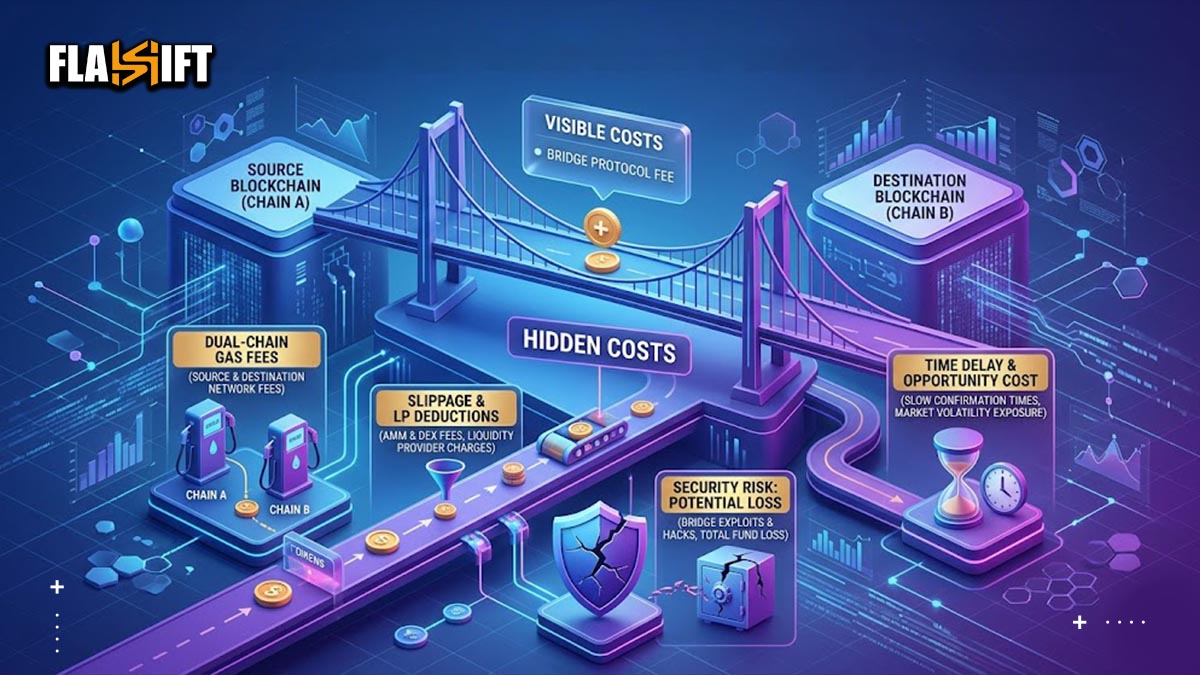
At first, using a bridge to exchange ETH to BTC seems logical. You move assets across networks, then convert. Simple, right? In reality, bridges add extra layers of cost, risk, and friction that most users underestimate.
- There’s the obvious expense: gas fees on Ethereum. Bridging requires at least one on-chain transaction and sometimes more. During congestion, that alone can make your attempt to swap Ethereum for Bitcoin significantly more expensive than expected.
- Then comes the less visible cost: bridge fees and spread inefficiencies. Many cross-chain bridges rely on liquidity pools or wrapped assets. That means slippage, pool imbalance, and price gaps between networks. You’re not just paying gas; you’re paying for liquidity mechanics you may not even see.
- Security is another factor. Bridges have historically been one of the most targeted components in crypto infrastructure. When you lock funds into a bridge contract, you’re trusting code, validators, and liquidity reserves. If something fails, funds can be frozen or worse.
- And finally, complexity itself is a cost. Multiple steps increase the chance of sending to the wrong network, choosing the wrong asset format, or miscalculating final output.
When the goal is simply to move from ETH to BTC, adding a bridge often creates more problems than it solves. The cheaper path in 2026 isn’t manual cross-chain routing; it’s intelligent aggregation that finds the most efficient swap route without forcing you through risky infrastructure.
Read More: Bitcoin vs. Ethereum: which one is the real king?
🌉 How Cross-Chain Bridges Work (And Why They Get Hacked)

When users try to exchange ETH to BTC, many assume assets can move directly between blockchains. They can’t. Ethereum and Bitcoin operate independently. Bridges exist to simulate that connection.
But the mechanism behind them is more complex (and more fragile) than most people realize.
How Cross-Chain Bridges Actually Function
A bridge typically locks your ETH in a smart contract on Ethereum. Then, it mints a “wrapped” or synthetic version of that asset on another network.
In simple terms:
- You deposit ETH into a bridge contract.
- The bridge verifies the deposit.
- A corresponding token is issued on the destination chain.
To complete the cycle, the wrapped asset must later be burned to unlock the original funds.
This system relies on smart contracts, validators, liquidity pools, and sometimes centralized operators. Every layer introduces dependency — and dependency increases attack surface.
Why Bridges Are Frequent Hack Targets
Bridges often hold massive pooled liquidity. That makes them attractive targets. If an attacker exploits a smart contract flaw, validator weakness, or signature verification bug, they can drain funds in a single exploit.
Historically, bridge hacks have resulted in hundreds of millions in losses because funds are concentrated in one place. Unlike decentralized swaps, bridges aggregate value into shared contracts, creating a single point of failure.
So when users attempt to exchange ETH to BTC through manual bridging, they’re not just paying extra fees. They’re interacting with one of the most attacked pieces of crypto infrastructure.
Understanding that risk is essential before choosing the path between chains.
💀 Major Bridge Hacks That Shook the Crypto Market

Cross-chain bridges were built to connect ecosystems. Instead, they became some of the biggest security liabilities in crypto. Here are five of the most damaging bridge exploits — and why they changed how users think about moving funds between chains.
1) Ronin Network (2022)
The Ronin Bridge, connected to Axie Infinity’s ecosystem, was exploited for over $600 million. Attackers compromised validator keys, allowing them to approve fraudulent withdrawals.
The incident exposed a core weakness in bridge design: validator centralization. Too few signing nodes meant once control was gained, funds could be drained.
2) Wormhole (2022)
Wormhole lost roughly $320 million after a vulnerability in its verification logic allowed attackers to mint wrapped ETH without proper collateral.
This wasn’t a liquidity failure — it was a smart contract validation flaw. It highlighted how complex cross-chain messaging can introduce subtle but catastrophic bugs.
3) Nomad (2022)
Nomad’s exploit was unusual. A faulty smart contract update made it possible for users to copy-paste a malicious transaction and drain funds.
Once the vulnerability became public, dozens of wallets joined the exploit. It turned into a chaotic liquidity rush that emptied nearly the entire bridge.
4) Harmony Horizon Bridge (2022)
Harmony’s bridge was compromised for around $100 million due to weaknesses in its multisig security. Only two private keys were needed to authorize withdrawals.
Again, validator design and key management were the failure points, not the underlying blockchain.
5) Multichain (2023 Crisis)
Multichain faced operational and security issues that led to frozen funds and large-scale losses. While not a single classic exploit like others, the result was the same: users lost access to bridged assets.
The deeper issue? Custodial dependencies within what many assumed was decentralized infrastructure.
Why This Matters
Each of these events reinforced the same lesson: bridges concentrate liquidity, complexity, and trust into one structure. When that structure fails, losses are amplified.
For users looking to move between major networks, understanding these historical failures is essential before choosing a method.
🛡️ The Safer Alternative: AI Aggregators Instead of Manual Bridges

If your goal is to exchange ETH to BTC, adding a bridge in the middle often creates more risk than value. More steps mean more smart contracts, more attack surface, and more fees. In 2026, there’s a cleaner option: AI-powered swap aggregators.
Platforms like Flashift.app eliminate the need for manual cross-chain bridging. Instead of locking funds into bridge contracts, an aggregator scans multiple liquidity partners in real time and finds the most efficient route to swap Ethereum for Bitcoin directly.
Here’s the difference:
- Manual bridge flow:
ETH → Bridge contract → Wrapped asset → Exchange → BTC - AI aggregator flow:
ETH → Optimized liquidity route → BTC
No wrapped tokens.
No bridge custody layer.
No validator risk.
Because Ethereum and Bitcoin run on separate networks, the challenge is matching liquidity intelligently. Flashift’s AI engine compares partner exchange rates, execution reliability, spread, and network costs instantly, then routes the transaction through the lowest total-cost path.
For users who want to exchange ETH to BTC without exposing funds to bridge exploits or unnecessary gas overhead, aggregation replaces complexity with optimization.
In short: fewer moving parts, fewer failure points, better pricing.
Manual Bridges vs Swap Aggregator | Quick Comparison
| Feature | Manual Bridge Method | Swap Aggregator |
| Steps Required | Multiple (Bridge → Wrap → Trade → Withdraw) | Single optimized swap |
| Smart Contract Exposure | High (bridge contracts + wrapped assets) | Minimal (direct liquidity routing) |
| Hack Risk | Higher (bridges are frequent targets) | Lower (no pooled bridge custody) |
| Gas Costs | Multiple on-chain transactions | Optimized routing to reduce total cost |
| Slippage Control | Depends on bridge liquidity | AI compares partner liquidity in real time |
| KYC / Freeze Risk | Possible if routed via CEX | Labeled options (No-KYC / Risk indicators) |
| Speed | Slower (multi-step confirmation) | Faster (single execution flow) |
| Best For | Technical users managing wrap mechanics | Users wanting to exchange ETH to BTC efficiently |
Final Thoughts: The Most Cost-Efficient Way to Move Between Ethereum and Bitcoin
If you strip away the noise, the objective is simple: move value from Ethereum to Bitcoin with the lowest total cost and the least amount of risk.
Manual bridges add layers: extra transactions, wrapped assets, validator dependencies, and additional fees. Centralized exchanges introduce custody risk, withdrawal limits, and possible account reviews. Both approaches work, but neither is optimized for efficiency.
In 2026, the smarter way to exchange ETH to BTC is through AI-driven aggregation. Instead of forcing users to manually route funds across chains, platforms like Flashift analyze liquidity sources in real time and execute the most cost-efficient path automatically.
When you swap Ethereum for Bitcoin, what matters isn’t just the headline rate, it’s the total execution cost: gas, spread, slippage, and risk exposure combined.
Fewer steps. Fewer contracts. Smarter routing.
That’s where real savings happen.
FAQ
- Why is bridging often more expensive than a direct swap when I exchange ETH to BTC?
Because you’re stacking costs. A bridge usually requires at least one on-chain Ethereum transaction, then a second trade after wrapping. That means double gas exposure on Ethereum plus liquidity spread on the wrapped asset. A direct aggregated route avoids that extra layer.
- Is using a centralized exchange cheaper than a bridge for swapping Ethereum for Bitcoin?
Sometimes on paper but not always in practice. Trading fees, withdrawal fees, spreads, and potential delays can offset the apparent savings. The cheapest method isn’t about one fee category; it’s about total execution cost from wallet to wallet.
- How do AI aggregators actually reduce the cost when I swap Ethereum for Bitcoin?
They compare multiple liquidity partners at once and factor in rate, depth, execution speed, and network costs. Instead of locking you into one venue, the system routes your swap through the lowest total-cost path available at that moment.
- Are bridge hacks still a serious concern in 2026?
Yes. Bridges remain high-value targets because they pool large amounts of liquidity in single contract systems. Even when security improves, concentration risk doesn’t disappear and, that’s the structural issue.
- Does transaction size affect the best way to exchange ETH to BTC?
Absolutely. Large swaps can cause slippage on shallow liquidity sources, while small swaps may be disproportionately affected by fixed withdrawal fees. The optimal route depends on size, timing, and current network congestion, which is why real-time routing matters.