

Looking for a secure Zcash bridge in 2026? Moving your ZEC across blockchains is now faster and more private than ever. Whether you want to access DeFi ecosystems or swap for lower fees, you need a bridge that guarantees absolute privacy and zero hidden costs.
In this guide, we’ll show you how to execute a seamless, No-KYC ZEC cross-chain swap using Flashift’s AI-driven Smart Routing. Learn how to bridge Zcash step-by-step, find the best exchange rates instantly, and keep your assets non-custodial without sacrificing your shielded privacy.”
The 2026 Tech Stack: ZK-Bridges and Intent-Based Routing for ZEC
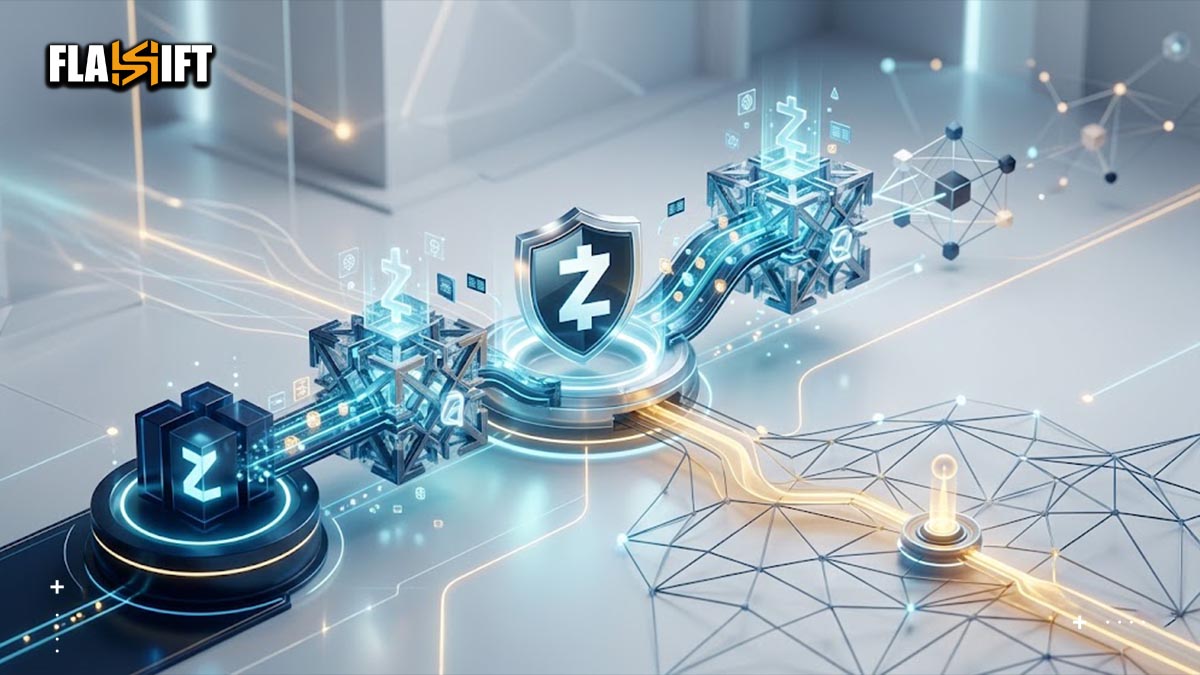
The infrastructure powering cross-chain ZEC transfers has fundamentally shifted in 2026. Older bridging models relied heavily on centralized “lock-and-mint” smart contracts, which were frequent targets for exploits and often stripped Zcash of its core privacy features by forcing conversions into transparent wrapped tokens.
Today, the standard is driven by Zero-Knowledge (ZK) Bridges and Intent-Based Routing architectures. Here is what makes the 2026 technical landscape different:
-
Trustless ZK-Verification: Modern decentralized protocols now utilize ZK-SNARKs not just for shielding the transaction on the Zcash network, but for verifying the cross-chain state. This means a swap can be validated on a destination chain (like Ethereum or Arbitrum) without ever exposing the sender’s original shielded address or transaction history.
-
AI-Optimized Intent Routing: Instead of manually searching for liquidity across vulnerable decentralized exchange (DEX) pools, platforms like Flashift use Intent-Based protocols. When you initiate a swap, you declare an “intent” (e.g., “I want to swap 10 ZEC for ETH at the best rate”). The AI Smart Routing engine instantly scans dozens of non-custodial exchanges (like FixedFloat or ChangeNOW) to execute that specific intent, bypassing slippage and front-running bots.
-
Direct Cross-Chain Liquidity (No Synthetic Wrappers): The 2026 standard minimizes the use of synthetic assets. By leveraging AI aggregators, you are engaging in direct native-to-native atomic swaps across chains, keeping your assets strictly non-custodial and 100% KYC-free.
A full guide: How to Buy Zcash Without KYC
Why bridge Zcash to other chains?
Bridging your Zcash (ZEC) to different blockchains (what we’ll call the “Zcash bridge 2026” move) offers a number of real advantages, if you’re thoughtful about it. Here’s a breakdown of the benefits of making a cross-chain ZEC transfer and why it may make sense for you.
- Access to more DeFi ecosystems
When ZEC sits only on its native blockchain, your options are somewhat limited. By bridging ZEC over to chains with rich DeFi infrastructures, you gain access to lending platforms, liquidity-pools, yield-farms and trading pairs that weren’t available on Zcash’s base layer. In other words: bridging Zcash gives your ZEC more places to work. This taps directly into the value of a cross-chain ZEC strategy.
- Lower fees or faster network performance (depending on chain)
Some blockchains offer lower transaction fees, faster confirmations or better throughput than others. By bridging ZEC into a chain optimized for speed or cost, you may enjoy smoother user-experiences (especially in times of congestion). As one interoperability write-up says: cross-chain technology improves efficiency and speed. If you care about timely trades, quick moves or staying nimble with your ZEC, that matters.
- Diversified blockchain exposure
Holding ZEC exclusively on one chain means your exposure is tied to that chain’s constraints (network fees, congestion, governance, risk). Bridging ZEC gives you optionality: the ability to participate in multiple chain ecosystems, pick the one with the best tools for your strategy, or hedge risk by not being locked into a single chain’s problems. You’re effectively moving from “ZEC only here” to “ZEC across networks”.
- Future-proofing and interoperability
In 2026 the multi-chain world is mature enough that interoperability isn’t just a buzzword, it’s becoming standard. By positioning your ZEC to move across chains when needed, you’re aligning with that evolution. Cross-chain moves help you keep pace with new protocols, yield opportunities, connectors and features in the crypto space. The “Zcash bridge 2026” is part of that evolution: making ZEC not just a one-chain asset but a multi-chain asset.
- Maintaining privacy while branching out (if done smartly)
One of Zcash’s core strengths is privacy. When you do a cross-chain move of ZEC, if you select the right bridge and destination chain, you can preserve or selectively use privacy features while still accessing broader networks. This gives you the choice: keep using ZEC for private-minded transfers, and also use it where it needs to work in more open DeFi environments.
In short: bridging Zcash in 2026 isn’t just a “nice-to-have”-it’s a strategic move. If you do it well, your ZEC becomes more flexible, more liquid, more useful. The key is picking the right bridge, understanding the chain destination and making sure you don’t inadvertently expose yourself to unwanted risk.
Supported networks and protocols of ZEC

When you talk about doing a “Zcash bridge 2026”, the first thing to nail is which networks and protocols actually support it; because that determines where you can take your ZEC, and what you can do with it once it arrives.
Networks you’ll find in play
- The fact is, Zcash is entering a more interoperable phase. There’s reported integration of ZEC into multi-chain DEXs like THORSwap, which supports swaps between ZEC and assets from chains such as Bitcoin, Ethereum, Solana, Avalanche among others.
- There’s a “RedBridge” style project between Zcash and Avalanche (the “Avalanche RedBridge”). It allows transferring ZEC onto Avalanche to tap its DeFi ecosystem.
- Also notable: NEAR Protocol’s “Intents” framework is reported to support ZEC for cross-chain swaps (permissionless, non-custodial) with multiple chains.
Protocols and technical layers
- On the Zcash side you’ll see references to things like ZIP 300 — a proposed standard for cross‐chain atomic transactions (XCAT) for Zcash. It lays the groundwork (though not yet widely adopted) for true “bridge” style transfers of ZEC.
- Because Zcash values privacy, any bridge or cross‐chain protocol also has to account for shielded vs transparent addresses, verification, trust assumptions, etc. The protocol side isn’t just “send here, receive there”; it’s “send here with your privacy intact (or choose not to) and receive there”.
What you should check
Before you initiate a “ZEC bridge”, ask:
- Do they support native ZEC (not some wrapped token)?
- Does the bridge preserve Zcash’s privacy mode (shielded addresses) or require conversion into transparent form?
- What networks will you land on? Are there destination chains that the bridge supports (and are they secure/trusted)?
- What protocols under the hood: is the architecture audited, is it trustless or semi‐custodial?
- Fees, times, and UI flows — multi‐chain moves always involve more steps.
In short: the “supported networks and protocols” piece is where the rubber meets the road for cross-chain ZEC. It tells you where you can move ZEC and how it’s being done. When you’re ready, I can check specific bridges that support “bridge Zcash to Ethereum” and “bridge Zcash to Polygon,” and we can pull up their exact routes, fees, limitations.
Read More: How Zcash is Re-defining On-chain Privacy
Step-by-step: bridging ZEC via Flashift
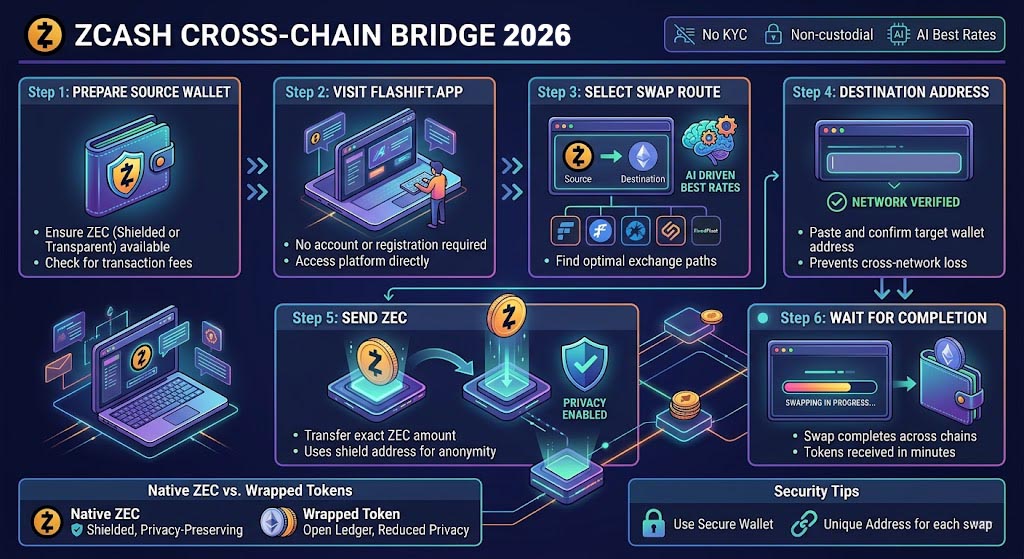
Choosing Flashift for your ZEC bridging makes sense if you value speed and privacy. You don’t have to sign up or complete any KYC; just select your coins, send from your wallet, and receive the destination asset with no account linking you.
Your funds remain in your wallet (non-custodial), which reduces counterparty risk and keeps you in control. On top of that, the platform emphasizes transparent, zero-commission swapping across many chains, which helps if you’re bridging ZEC in 2026 for cross-chain access.
Here’s the full guide to exchange ZEC anonymously .
Step 1: Prepare your source wallet
Ensure you hold ZEC in a compatible wallet (could be a shielded or transparent address depending on your privacy preference). Make sure you have some extra ZEC to cover any network deposit fees.
Step 2: Visit Flashift

Open Flashift.app in your browser. Confirm the URL is correct and secure. Since you don’t register or login, you’ll see a simple interface for “From” coin and “To” coin.
Step 3: Select the swap/bridge route

- Under “From”, choose ZEC (Zcash).
- Under “To”, select your desired target crypto (In this case, ETH). If bridging into another chain, you might pick that chain’s token or a wrapped version.
- Enter the amount of ZEC you want to move. Flashift may show you the rate or estimated output.
- Choose the exchange you want to use (Flashift’s AI makes it easier for you to identify the best option).
- Click “Swap via [Selected Exchange (FixedFloat in this example]“.
Note: Because you’re dealing with a bridge/swap, pay attention to network options, fees, and whether the destination chain is correctly selected.
Step 4: Enter your destination wallet address
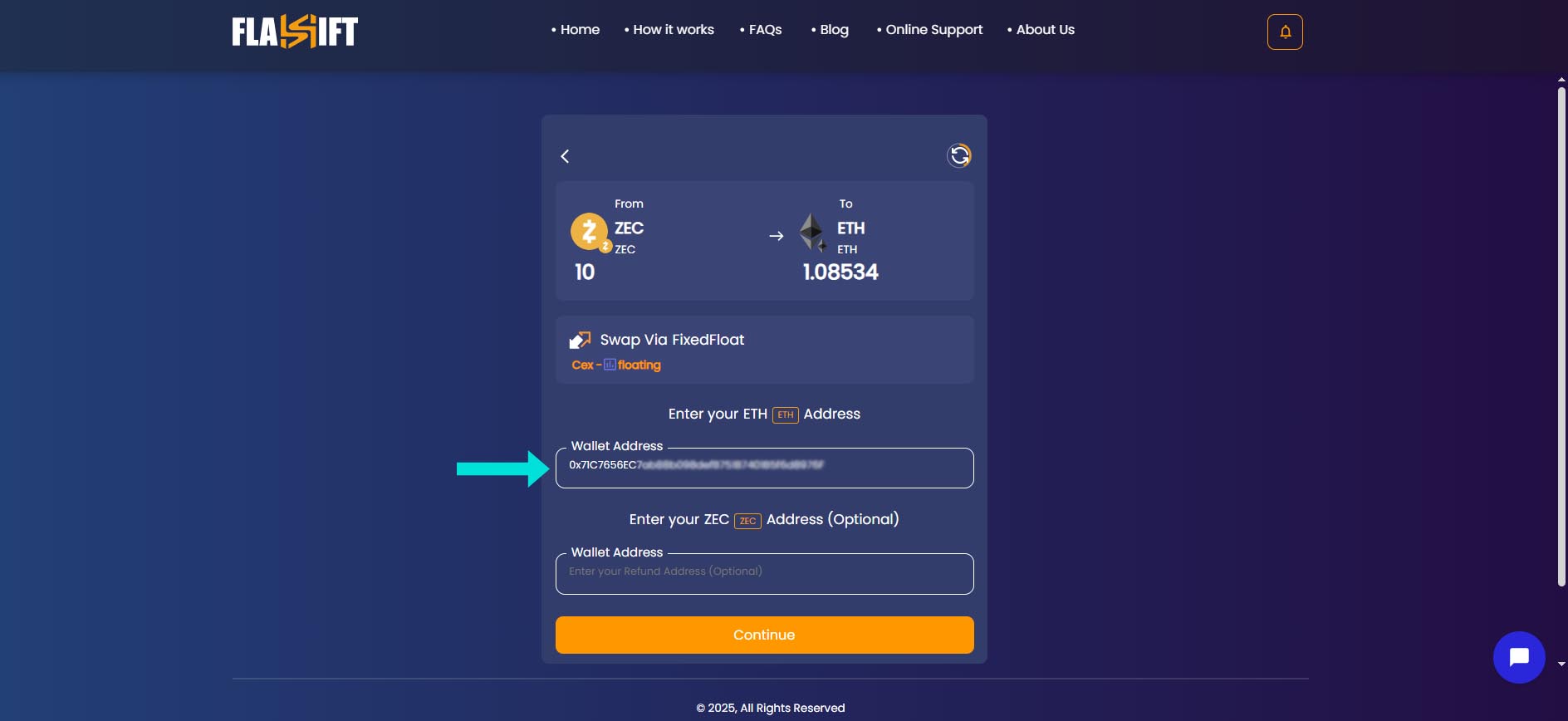
Input the address on the target chain where you want to receive funds (e.g., if you’re moving to another chain’s token).
Triple-check that it’s the correct chain and address type (wrong chain = lost funds).
Step 5: Send ZEC to the provided address
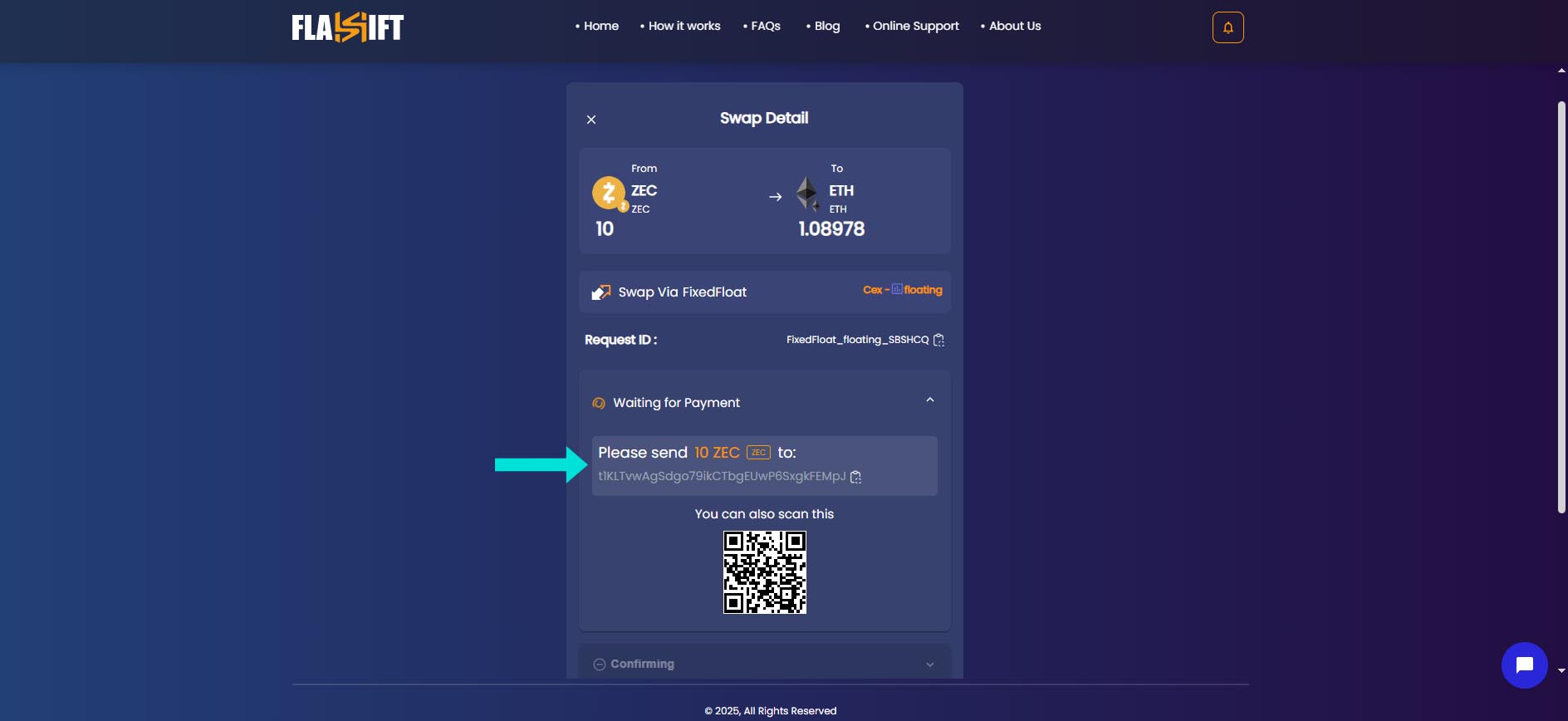
Flashift will show you an address to send your ZEC to. In your source wallet, send exactly the amount (or at least what was quoted) to that address. Flashift will do the rest automatically, after you send ZEC tokens.
Step 6: Wait for bridging/swap to complete
After Flashift sees your ZEC deposit and requirements met, they route the swap/bridge to the destination chain. Depending on network congestion and target chain, this can take minutes.
Once done, the funds will appear in your destination wallet.
Post-bridge steps & security
- Once funds are safely on the destination chain, you might want to move them to a secure wallet, especially if they sit long-term.
- If privacy is a concern, you may want to further shield the funds or avoid address reuse.
- Maintain good wallet hygiene: use fresh addresses when needed, avoid linking lots of traceable on-chain history if you aim for privacy.
Future of cross-chain ZEC interoperability

Looking ahead, the idea of “bridge Zcash 2026” is no longer purely aspirational. ZEC is moving from being a one-chain privacy coin into something that can live and work across multiple chains. We’re already seeing signs: for example, Zcash has integrated with NEAR Intents, allowing users to route ZEC across ecosystems like BTC, ETH and others. This is the heart of cross-chain ZEC — your ZEC isn’t stuck on the Zcash chain anymore; it can participate in DeFi, swaps or alternative networks while preserving its privacy core.
What makes this especially compelling is the technological convergence. Zcash’s privacy layers (shielded pools, zero-knowledge proofs) are now meeting interoperability protocols. That means bridging ZEC won’t just be about moving a token from chain A to chain B; it’s about doing it in a way that keeps the confidentiality and flexibility intact. If done well, “cross-chain ZEC” starts looking like a privacy-asset you can use everywhere.
Of course, there are hurdles. Bridges still bring risk (smart contract bugs, routing flaws, liquidity thinness). Privacy features complicate chains’ compliance and wallet integrations. But the momentum is real: being able to use ZEC across chains, rather than just hold it, is becoming feasible. If you’re watching the space for “Zcash bridge 2026,” this shift is exactly what “future of interoperability” means: ZEC that can roam, blend into other ecosystems and retain its privacy identity.
So if your goal is strategic moving ZEC into other chains, tapping DeFi and using it as liquidity across networks, this is the moment to pay attention. The paths are opening, the tools are developing, and the future is less “Will it happen?” and more “How fast can we use it?”.
FAQ
- Does bridging ZEC across chains mean I lose its privacy features?
Not necessarily. The bridge path matters: if your ZEC becomes a transparent or wrapped token on the destination chain, privacy may be reduced. Choose a bridge that supports shielded transfers to maintain privacy.
- Will the ZEC I receive on another chain still be “real” ZEC or a wrapped version?
It depends. Some bridges preserve native ZEC, while others mint a wrapped proxy. If you value ZEC’s original identity, use a bridge that supports native ZEC on the destination chain.
- Are cross-chain bridges for ZEC as secure as staying on the native network?
No. Bridges introduce additional risks—smart contract bugs, routing flaws and liquidity issues. Use small test amounts and verify audit history before sending large sums.
- What do I gain (and what might I lose) when I bridge ZEC to chains like Ethereum or Polygon?
You gain access to richer DeFi ecosystems, deeper liquidity and more protocol options. You might lose some privacy, pay extra fees or assume bridge-specific risks.
- How do I choose a good bridge for moving ZEC in 2026?
Check if it supports shielded ZEC transfers, confirms the asset is native or wrapped, compares fees and liquidity, reviews security audits and ensures there’s a clear exit route back to the original chain.