

Converting Bitcoin (BTC) to Monero (XMR) is the definitive on-chain privacy move. While Bitcoin operates on a fully transparent ledger where transaction histories can be mapped and analyzed, Monero encrypts senders, receivers, and transaction amounts by default.
The core challenge for privacy-focused holders in 2026 is avoiding centralized platforms that enforce intrusive identity checks, mandatory account creation, or post-deposit fund freezes.
In this technical guide, you will learn how to execute a frictionless, zero-KYC swap from BTC to XMR directly between your non-custodial wallets, preserving your operational security (OpSec) while securing optimal market execution rates.
📊 Comparing BTC to XMR Execution Methods
| Execution Method | Settlement Speed | KYC Friction | Liquidity Depth | OpSec Risk Profile |
| Instant Co-Aggregators (Flashift) | ⚡ 3–5 Mins | Zero (No Account) | Deep (Multi-Provider) | Low (Ephemeral API Routing) |
| Centralized Exchanges (CEXs) | Mostly they delisted XMR | Heavy (ID + Selfie) | Very High | Severe (Data Leaks & Delisting Traps) |
| Atomic Swaps (BTC-XMR) | 🐌 10+ Mins | Zero (Peer-to-Peer) | Low / Fragmented | High (Requires CLI & Local Nodes) |
Swap BTC to XMR
Bitcoin is transparent by design. Every transaction is recorded on a public ledger, which means your wallet activity can be traced, analyzed, and linked over time.
Monero is different. It’s built for privacy. Transactions are hidden by default; amounts, senders, and receivers are not visible on the blockchain. This makes Monero one of the strongest privacy-focused cryptocurrencies available.
That’s why many users choose to Swap BTC to XMR No KYC. It’s a direct way to move from a traceable asset to a private one, without exposing identity or relying on centralized exchanges.
The result is simple: more control, less surveillance, and true financial privacy.
Step-by-Step: Converting Bitcoin to Monero
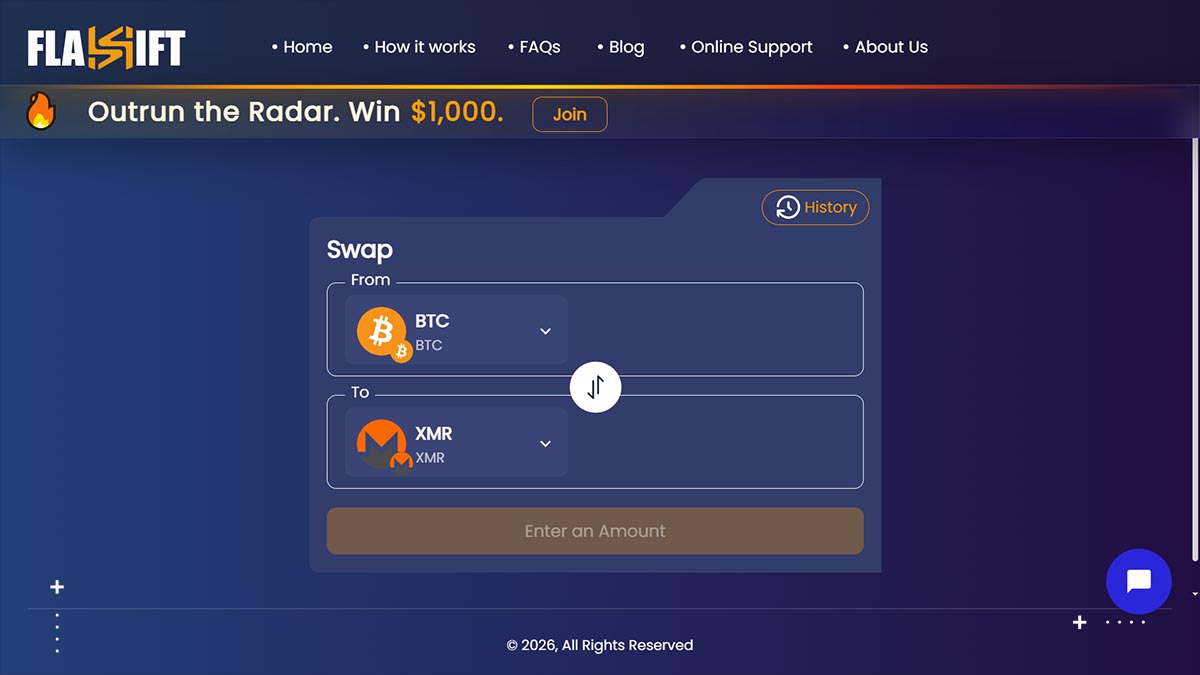
Step 1: Choose BTC to XMR pair
Go to Flashift and select Bitcoin (BTC) as the coin you send and Monero (XMR) as the coin you receive.
The platform automatically finds the best available rate across multiple exchanges. You don’t need to compare rates manually.
This initializes your non-custodial routing path. The platform instantly scans decentralized liquidity pools to lock in the optimal conversion rate—with zero login and absolutely no identity verification required.
Step 2: Enter your private Monero wallet address
Paste your Monero wallet address carefully.
💡 OpSec Rule: Never use your primary Monero address (starting with ‘4’) for receiving swaps. Always generate an ephemeral Subaddress (starting with ‘8’) in wallets like Cake Wallet, Feather, or Monerujo. This mathematically prevents external observers from linking independent swaps back to your master wallet balance. Adding an optional BTC refund address is also recommended to protect your capital against mempool congestion spikes.
Step 3: Complete the swap and track progress
Send the exact amount of BTC to the generated address provided by Flashift.
Once your deposit is confirmed on the Bitcoin network (typically requiring just 1 block confirmation), the execution engine finalizes the trade. Your Monero is deposited directly into your private wallet, securing your financial confidentiality seamlessly.
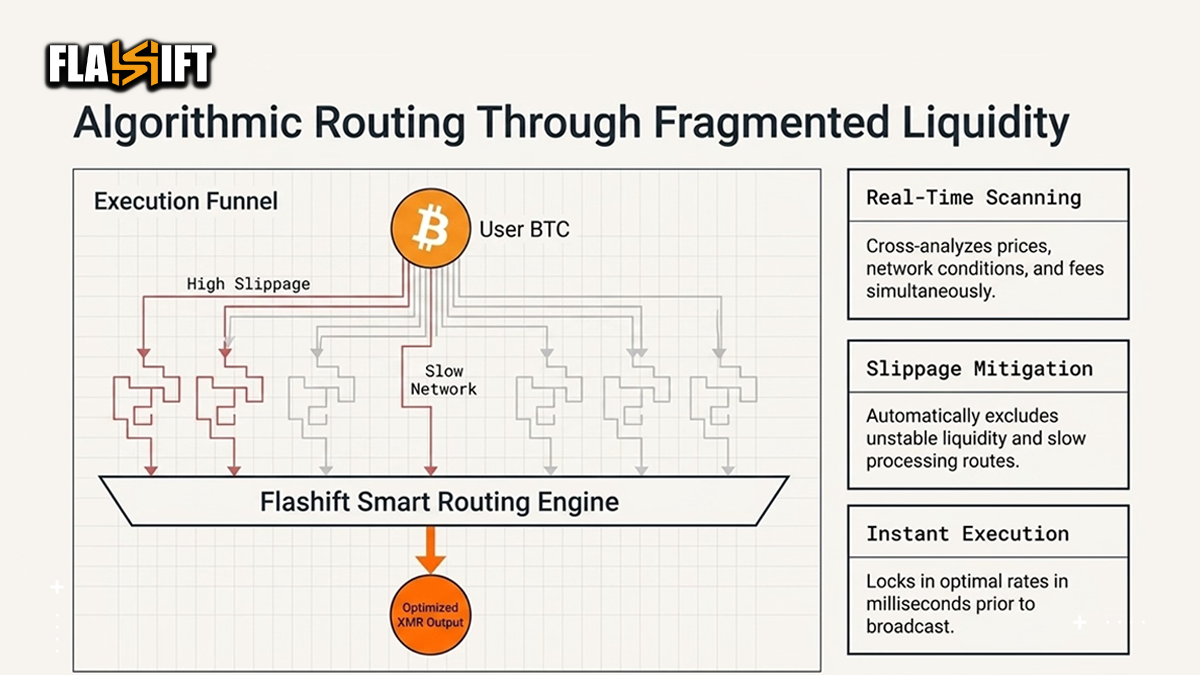
Best Rates for BTC/XMR: How Our Smart Routing Works
Getting a good rate on a BTC to XMR swap isn’t about luck. It’s about how the system searches, compares, and executes the trade in real time. That’s where Flashift’s AI-driven smart routing makes a difference.
Instead of relying on a single exchange, Flashift scans multiple liquidity sources at the same time. It checks prices, fees, network conditions, and execution speed and then, selects the best path for your swap.
This matters more than most users think.
BTC and XMR prices can vary across platforms. Add network fees and slippage, and the final amount you receive can change noticeably. Flashift’s AI reduces that gap by calculating the most efficient route before you even send your BTC.
It doesn’t stop at price comparison.
The system also filters out unreliable routes. If an exchange has slow processing times or unstable liquidity, it’s excluded automatically. The goal is simple: get you the best possible XMR amount without delays or failed transactions.
Instant Execution via Co-Aggregation
The entire cross-chain conversion executes in seconds. You are shielded from the underlying complexity of liquidity fragmentation; you simply receive a transparent quote and lightning-fast execution. No manual rate-checking across different decentralized exchanges (DEXs), and no hidden network fees.
For operators looking to execute a seamless BTC to XMR conversion, this architecture eliminates both liquidity friction and execution guesswork. You maintain absolute privacy while the AI dynamically optimizes your trade path in the background.
Conclusion
Swapping Bitcoin to Monero is one of the most practical ways to move from transparency to true privacy in crypto. With the right approach, the process is fast, simple, and doesn’t require giving up personal information.
Today, users expect more than just a working swap. They want speed, strong rates, and full control over their data. That’s exactly why tools like Flashift are gaining attention. They remove unnecessary steps and focus on what actually matters.
If your objective is to transition from a transparent public ledger into absolute financial confidentiality, the execution path is clear. No centralized accounts. No compliance delays. Zero identity exposure.
🛡️ Instant Sovereign Swap Checkpoint: Converting transparent Bitcoin into untraceable Monero should not mean risking your funds on low-liquidity peer channels or exposing your identity on centralized platforms.
You can execute your BTC to XMR conversion instantly via Flashift’s unified co-aggregation terminal. The smart routing engine cross-analyzes real-time rates across top non-custodial providers, picking the most cost-efficient path while executing the swap directly from wallet to wallet in under 30 minutes—with zero registration, zero account tracking, and absolute data privacy.
FAQ
- Can my BTC to XMR swap be traced after completion?
Bitcoin transactions are always traceable on its public ledger. But once your funds are swapped into Monero, the trail becomes private. Monero hides transaction details by default, making further tracking extremely difficult.
- What happens if I send the wrong amount of BTC?
If the amount is slightly off, the system may still process the swap but adjust the final XMR output. In some cases, the transaction may require manual handling or a refund process if a refund address was provided.
- How long does a BTC to XMR swap usually take?
It depends mostly on Bitcoin network confirmations. In most cases, the full process completes within 10 to 30 minutes after your BTC transaction is confirmed.
- Is there a risk of price changes during the crypto swap?
Yes, small fluctuations can happen due to market volatility. However, smart routing systems like Flashift are designed to minimize slippage and lock in competitive rates at the time of execution.
- Do I need a special wallet to receive Monero?
Yes. You need a Monero-compatible wallet to receive XMR. Standard Bitcoin or multi-chain wallets that don’t support Monero won’t work.
- Why do some swaps fail or get delayed?
Common reasons include low network fees, delayed confirmations on the Bitcoin network, or temporary liquidity issues on exchange providers. Using the correct amount and a proper fee usually prevents these issues.