

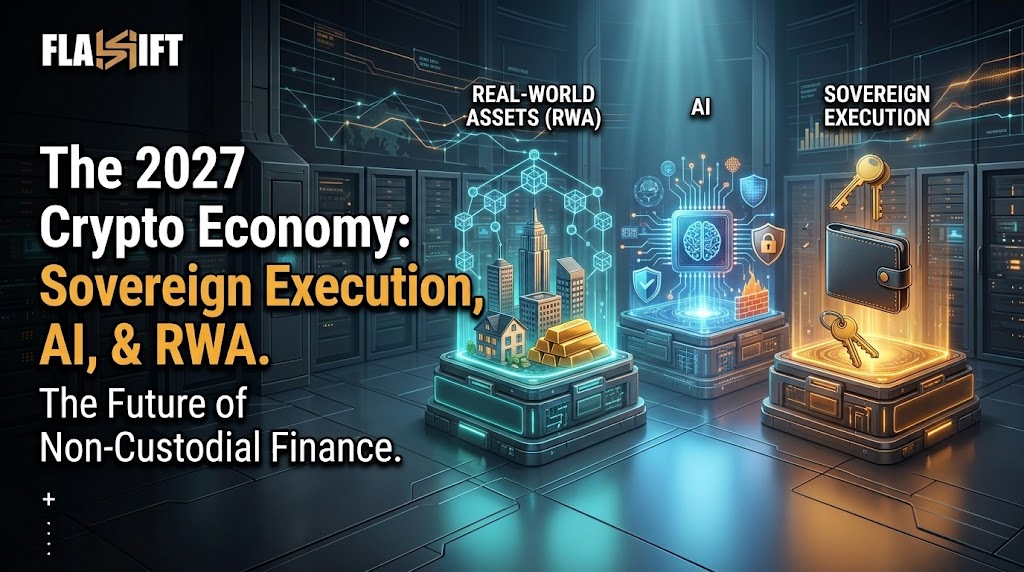
What began as a decentralized experiment has matured into the foundational infrastructure of the coming 2027 global economy. For active operators in Tier-1 markets (US, UK, DE), the future of cryptocurrency is no longer about speculative trends. It is defined by the convergence of Real-World Asset (RWA) tokenization, AI, and highly scalable Layer-2 networks.
However, navigating this future requires a fundamental shift in execution strategy. As governments and centralized entities expand their regulatory surveillance—manifesting in Central Bank Digital Currencies (CBDCs) and invasive KYC mandates on centralized exchanges (CEXs), investors are facing a critical choice. You either surrender your financial data to custodial platforms, or you adopt non-custodial, Sovereign Execution layers.
This guide breaks down the macro trends defining 2027 and exactly how advanced operators are positioning their portfolios without compromising their identity.
📊 2027 Financial Ecosystems: Custodial vs. Sovereign
As traditional finance merges with digital assets, the execution landscape has split into two distinct paths. Understanding where you deploy your capital is critical:
The Institutional Shift: Real-World Asset (RWA) Tokenization
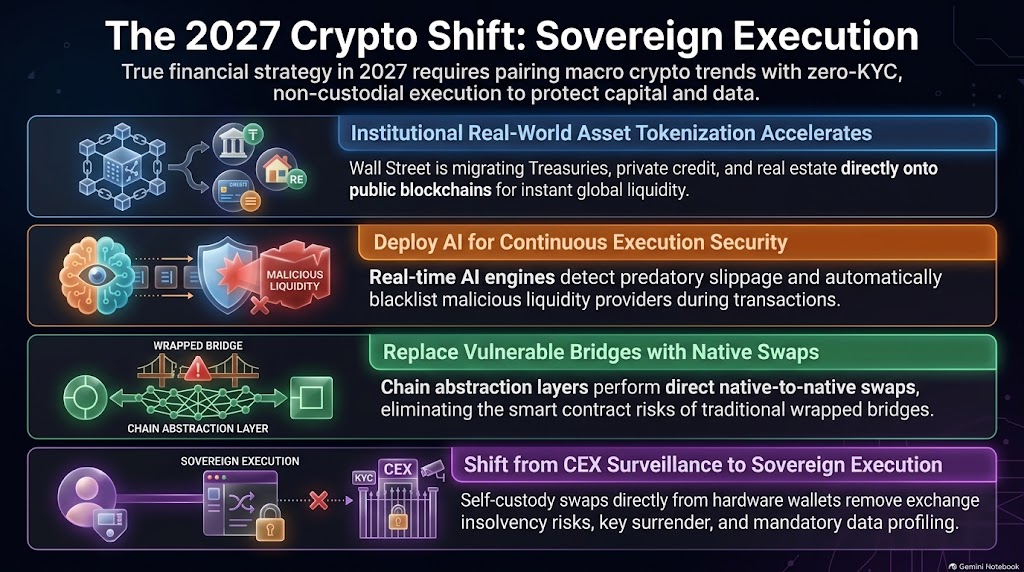
The most significant macro trend accelerating into 2027 is the tokenization of Real-World Assets (RWAs). Wall Street institutions, hedge funds, and asset managers are actively migrating traditional financial instruments, such as US Treasuries, private credit, and real estate, directly onto public blockchains like Ethereum and Solana.
This transition provides unprecedented global liquidity, sub-second settlement times, and absolute on-chain transparency. For retail and institutional investors alike, accumulating the native tokens of networks powering these RWA settlements represents the most fundamentally sound investment thesis of the decade.
AI-Driven Security and Sovereign Routing
Artificial Intelligence in 2027 has moved far beyond simple predictive trading analytics. Its most critical application is now network security and execution routing. In a highly fragmented decentralized market, liquidity is distributed across thousands of pools, some of which employ predatory tactics.
Forward-thinking platforms utilize AI not to predict prices, but to protect capital. Flashift, for example, deploys Continuous Post-Trade Analysis. If a third-party liquidity provider attempts a deceptive “bait-and-switch” maneuver, such as applying hidden slippage or halting a mid-flight transaction to demand sudden KYC documentation, the AI engine instantly detects the anomaly, blacklists the malicious provider, and secures the user’s execution path. This guarantees that your swap is completed safely without exposing your capital to centralized overreach.
Layer-2 Networks and the Cross-Chain Bridge Dilemma
Scalability is no longer the primary bottleneck for blockchain adoption. Layer-2 (L2) solutions have successfully driven gas fees down to fractions of a cent while delivering near-instant confirmation times.
However, this multi-chain expansion has introduced a severe security crisis: Cross-Chain Bridges. Traditional decentralized bridges and wrapped synthetic tokens (like WBTC) contain massive smart contract vulnerabilities, functioning as centralized honeypots that have led to billions in historical exploits.
The future of cross-chain liquidity relies entirely on Chain Abstraction Layers. Instead of locking capital in vulnerable bridges, modern routing protocols execute direct native-to-native swaps, delivering real assets on their respective chains without the counterparty risk of synthetic wrappers.
⚡ The 2027 Execution Challenge: Escaping the CEX Surveillance Trap
Identifying macro trends like AI and RWAs is only half the strategy; how you execute your trades dictates your actual risk. If you accumulate these trending assets through centralized exchanges, you instantly expose your portfolio to aggressive regulatory surveillance, mandatory tax reporting algorithms, and sudden account freezes during market volatility.
True financial sovereignty in 2027 requires utilizing non-custodial, No-KYC routing layers. You do not need to surrender your identity to participate in the future of finance.
Rotate Your Capital with Zero-Approval: Swap your digital assets directly from your hardware wallet using Flashift’s Chain Abstraction engine.
-
No Accounts Required: Execute instantly without invasive KYC.
-
24/7 Human Oversight: If blockchain congestion delays a cross-chain settlement, our dedicated operational desk actively monitors the transaction flow to guarantee secure delivery directly to your wallet.
❓ FAQ
What are the most significant cryptocurrency trends in 2027?
The dominant trends for 2027 include the mass institutional tokenization of Real-World Assets (RWAs), the integration of Artificial Intelligence for transaction security, and the migration of trading volume away from centralized exchanges toward sovereign, non-custodial execution layers.
Why are investors shifting from Centralized Exchanges (CEXs) to non-custodial platforms?
Investors in Tier-1 jurisdictions are reducing reliance on CEXs to avoid invasive KYC data collection, the risk of massive identity breaches, and arbitrary withdrawal freezes. Non-custodial aggregators allow users to swap assets while maintaining absolute control over their private keys.
How does AI improve cryptocurrency trading security?
Advanced execution platforms use AI for Continuous Post-Trade Analysis. This means the AI actively monitors decentralized liquidity pools during a swap. If a provider attempts hidden slippage or sudden KYC demands, the AI instantly blacklists them and secures the execution path.
Is it safe to use cross-chain bridges to access Layer-2 networks?
No. Traditional cross-chain bridges and synthetic wrapped tokens carry severe smart contract vulnerabilities and are frequent targets for hackers. The safest method is utilizing a Chain Abstraction Layer (like Flashift) that facilitates direct native-to-native swaps without locking funds in bridge contracts.
Can I invest in 2027 crypto trends without providing KYC identity documents?
Yes. By utilizing non-custodial aggregators like Flashift, you can seamlessly swap stablecoins or other digital assets directly from your self-custody wallet (like Ledger or Trezor) without ever creating an account or providing KYC documentation.