
Every time a global platform processes a cross-border transaction through a legacy, centralized intermediary, it accepts an invisible, existential threat.
Relying on standard custodial payment rails means giving a third party unilateral authority to freeze your operational liquidity. A sudden automated compliance sweep, a retroactive regulatory change, or an algorithmic database flag can instantly halt your business.
For product managers, SaaS founders, and platforms executing high-velocity transactions, knowing about Payment API is no longer just about convenience, it is a matter of business continuity and financial sovereignty.
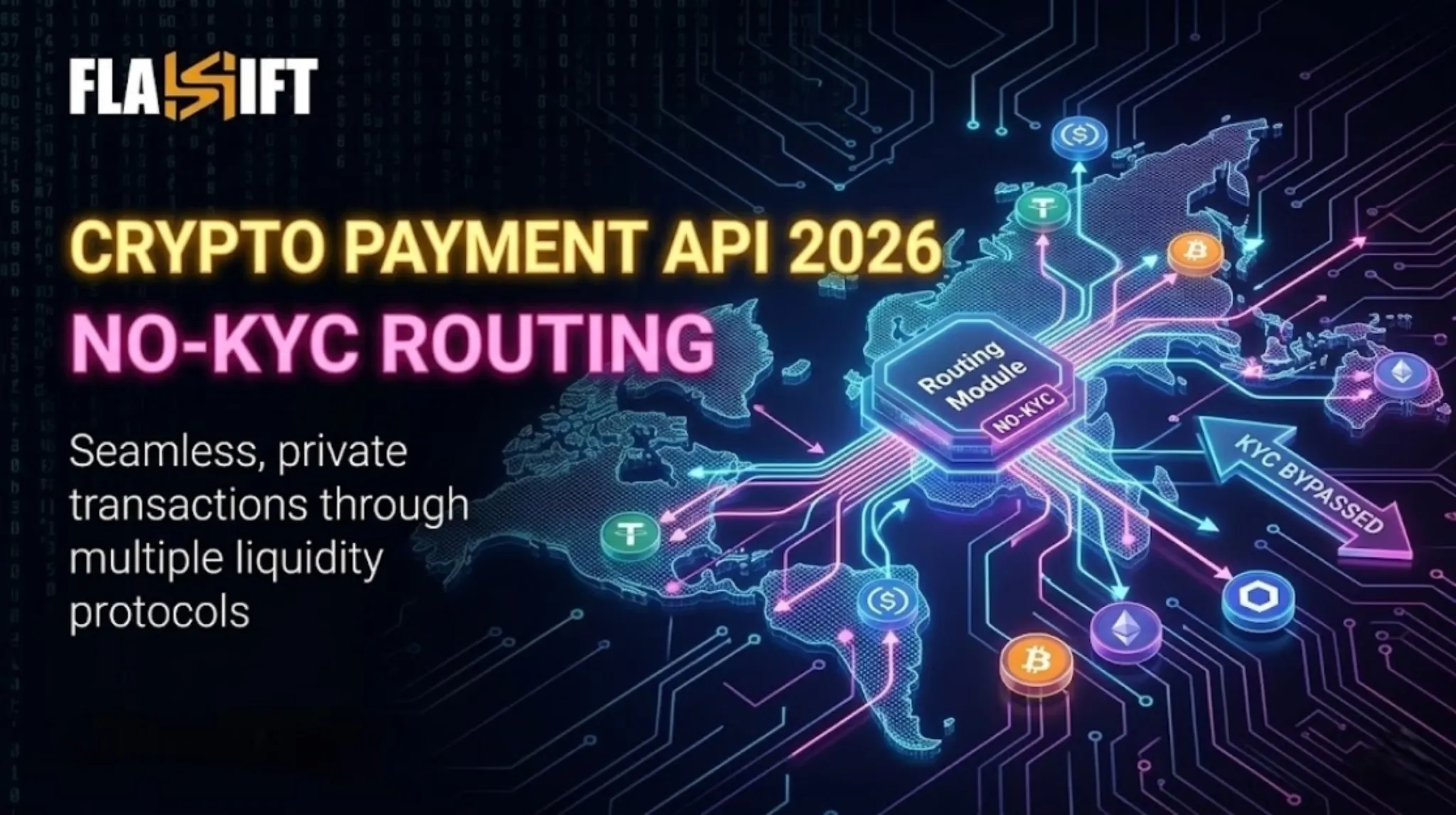
To scale globally without friction, modern platforms are abandoning rigid, single-provider models in favor of flexible, multi-chain, and white-label architectures.
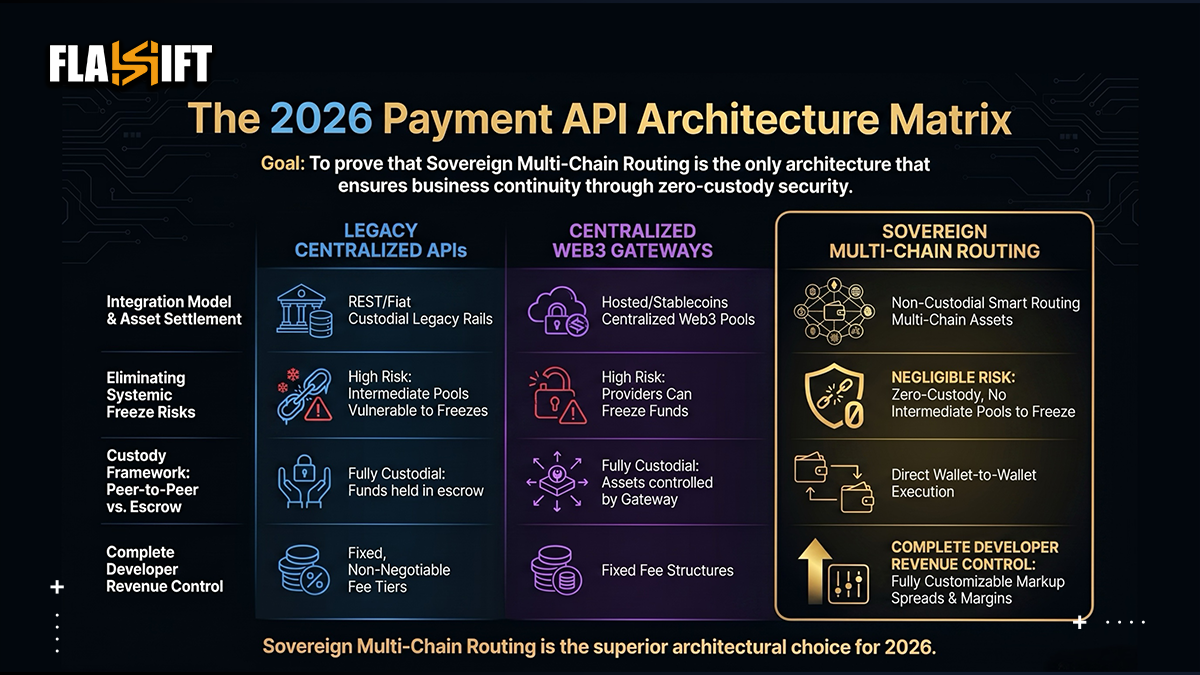
📊 The 2026 Payment API Matrix
Before selecting your gateway layer, analyze how different API integrations handle data, custody, and censorship risks:
| Architectural Metric | Legacy Centralized APIs (e.g., Stripe, Adyen) | Centralized Web3 Gateways (e.g., Custodial Crypto APIs) | Sovereign Multi-Chain Routing (e.g., Flashift Technology Layer) |
|---|---|---|---|
| Primary Integration Model | Native REST API / SDK | Hosted Checkout / Custodial API | Non-Custodial Smart Routing API |
| Settle-To Asset Class | Local Fiat currencies | Centralized Stablecoins / Native Crypto | Multi-Chain Assets (Direct Sovereign Wallets) |
| Systemic Freeze & KYC Risk | Absolute. Unilateral account freezes and mandatory retro-active KYC loops. | Extremely High. Subject to custodial database blocks and smart contract blacklist functions. | Negligible. Zero custody means no intermediate holding pools to freeze. |
| Custody Framework | Fully Custodial | Fully Custodial | Zero-Custody (Direct Peer-to-Peer Wallet Execution) |
| Developer Fee Control | Fixed, non-negotiable fee tiers | Rigid affiliate structures | Fully customizable markup spreads and margins |
🛠️ The Core Architecture of High-Yield Payments
Integrating a resilient payment gateway api integration requires looking beyond basic checkout interfaces. It requires a deep understanding of the underlying data layer.
For high-growth platforms, the standard payment service provider api must perform three core functions simultaneously to protect margins and convert users cleanly:
- Dynamic Transaction Pathing: The API must evaluate regional routes, processing fees, and network speeds to direct the payment payload through the most efficient clearinghouse or ledger.
- Unified Checkout Experience: Modern users expect multi-currency support (fiat and digital assets) without navigating clunky external redirections.
- Scalable Mass Disbursements: Utilizing a robust payout api for platforms is essential for marketplaces and SaaS systems that need to distribute affiliate payouts, developer splits, and supplier fees globally in seconds.
[User Checkout Option] ──► [REST API Integration Layer] ──► [Automated Route Optimization Engine]
                                                                        │
                                                ┌───────────────────────┴───────────────────────┐
                                                ▼                                               ▼
                                   [Fiat Payment Sync Pipeline]                 [Zero-Custody Multi-Chain Swap Router]
To prevent transaction drop-offs, modern developers implement a unified payment data layer sync. This ensures that checkout metadata, inventory systems, and accounting ledger inputs remain synchronized in real time, preventing double-spending and localized database errors.
🎨 The Power of Complete Branding: White-Label Customization
For scaling enterprises, third-party branding on checkouts is a major leak in the conversion funnel. Directing a customer away from your domain to a branded page breaks trust and introduces unnecessary friction.
This is why top-tier platforms utilize a white label payment gateway api to retain 100% control over their visual and operational footprint:
- Direct API Branding: The transaction process runs entirely behind the scenes via secure API handshakes. The end customer only interacts with your platform’s native interface, logo, and domain.
- Flexible Payout API Customization: Modern developers can easily adjust payout frequencies, currency conversions, and user portals on the fly without rewriting the core backend code.
- Adjusting Developer API Revenue Margins: By owning the white-label layer, you aren’t just paying fees—you can monetize the transaction stream. Platforms can easily integrate custom markup spreads (e.g., adding 0.5% to 1.5% margins on swaps or processing routes), creating a passive, highly scalable cash-flow engine.
🛡️ Mitigating Systemic Freeze Risks: The Sovereign Web3 Horizon
The breakout trend of 2026 is the rapid migration of global businesses toward decentralized, non-custodial payment rails. As centralized stablecoin issuers increasingly use contract-level blacklist functions to freeze user funds, having an alternative pathway is no longer a luxury.
If your platform relies on a cryptocurrency payment gateway api that holds your funds in an intermediate escrow wallet, you are vulnerable to custodial insolvency and sudden AML freezes.
🔴 Custodial Web3 Checkout:
User Wallet ──► Centralized Custodian Escrow Wallet (Risk of Blacklist/Freeze) ──► Merchant Destination Wallet

🟢 Sovereign, Zero-Custody Checkout:
User Wallet ──► Flashift Non-Custodial Multi-Chain Smart Router ──► Direct Native Sovereign Wallet
Sovereign businesses are bypassing this single point of failure by integrating a non custodial payment api that operates with absolute structural security:
- Zero-Custody Execution: At no point during the transaction lifecycle are funds held by a third-party wallet or an intermediate smart contract. The transaction processes directly wallet-to-wallet.
- Multi-Chain Asset Flexibility: Implementing a multi chain payment gateway api allows platforms to accept payments natively across multiple disparate networks (e.g., Ethereum, Solana, and Arbitrum) in a single unified gateway, eliminating liquidity fragmentation.
- Censorship-Resistant Infrastructure: By utilizing a censorship resistant payment api, global businesses protect their legitimate cash flow from arbitrary compliance sweeps and database leaks.
📈 Step-by-Step REST API Payment Integration Guide
To deploy a highly secure, non-custodial payment flow on your platform, follow these core payment gateway api integration steps under a clean architecture:
Step 1: Establish Your Native Webhook Sync
Before broadcasting payment requests, establish an automated webhook routing framework in your platform’s backend. This ensures that the moment a payment state changes (from pending to completed), your system instantly triggers downstream operational logic (like license delivery or shipping).
{
  "event_id": "tx_2026_99341",
  "status": "success",
  "source_asset": "USDT",
  "destination_asset": "LINK",
  "destination_address": "0x4f8...739",
  "timestamp": "2026-06-17T11:11:27Z"
}
Step 2: Integrate the Non-Custodial Swap Layer
Instead of building a highly complex cross-chain swap engine in-house, developers can integrate Flashift’s multi-chain non-custodial routing engine. Our developer-friendly APIs act as a pure, high-performance chain abstraction layer, enabling direct wallet-to-wallet cross-chain swaps without forcing users to sign hazardous, open-ended smart contract approvals.
Step 3: Broadcast the Payload securely
Using our secure HTTP API protocols, broadcast the transaction parameters. Flashift’s intelligent AI algorithms scan over 50 global liquidity providers in real time, automatically routing the payload through the most cost-efficient, secure, and low-slippage pathway available. Crucially, the engine performs continuous post-trade analysis to dynamically isolate and eliminate providers with a history of “bait-and-switch” pricing traps or sudden, friction-heavy post-deposit KYC holds, ensuring absolute payment continuity for your platform.
🏁 Conclusion: The Era of Sovereign Payments
Relying on payment infrastructure that can be disabled with a single centralized “red button” is a systemic risk that modern platforms can no longer afford to take.
By upgrading to non-custodial, white-label, and multi-chain payment architectures, you protect your business continuity, eliminate intermediary security risks, and take absolute control over your revenue margins. Build the future of sovereign commerce on your terms—secure your payments, protect your users’ financial sovereignty, and integrate next-gen routing gateways today.
FAQ
What is a white-label payment API?
A white-label payment API allows you to integrate a fully-functional, third-party payment processing gateway directly into your application while maintaining 100% control over the branding, styling, domain, and fee margins.
How does a non-custodial payment API eliminate freeze risks?
Standard payment gateways hold your funds in their own intermediate hot wallets before distributing them to your bank account or crypto address. A non-custodial gateway (like the Flashift routing API) never takes possession of your funds. It facilitates a direct wallet-to-wallet transaction, meaning there is no centralized custodian pool for regulators to freeze or for hackers to target.
Can I set my own processing fees using a custom payout API?
Yes. Modern white-label architectures allow platforms to integrate their own flexible markup spreads. You can dynamically adjust your transaction margins based on network gas conditions, giving you complete commercial control over your cash-flow streams.
Why is chain abstraction important for payment gateways in 2026?
Chain abstraction hides the complexities of cross-chain bridging, native gas requirements, and wrapped tokens. By using an AI-routed chain abstraction layer, a customer can pay with any digital asset on Solana, and the merchant can instantly receive settled native stablecoins on Ethereum—completely seamlessly, in a single fluid transaction.