

If you’re searching for a reliable ChangeNOW alternative, you’ve probably realized one thing: not all non-custodial exchanges work the same.
Both ChangeNOW and Flashift promise fast, account-free swaps. No deposits. No centralized custody. Just wallet-to-wallet transactions. But the real difference shows up in how they route liquidity, handle rates, and deal with edge cases like slippage or KYC triggers.
ChangeNOW has been around since 2017, supporting 1,500+ assets with swaps typically completed in minutes, all without holding user funds. It’s built for simplicity and scale. On the other hand, newer aggregators like Flashift focus on smart routing across multiple providers, aiming to consistently find better rates and reduce hidden costs.
So which one is actually better?
In this comparison, we break down both platforms from a practical user perspective (fees, execution, privacy, and real swap experience), so you can decide if the strongest ChangeNOW alternative fits your strategy or not😉.
Single Exchange vs Aggregator: The Core Difference
At first glance, most non-custodial exchanges look identical. You enter a pair, send funds, and receive your crypto. But under the hood, there’s a fundamental difference that directly impacts your final result: single-provider execution vs aggregated liquidity.

A platform like ChangeNOW operates primarily as a single exchange interface. Even though it connects to multiple liquidity sources, the routing logic is limited to its internal system. In practice, you’re relying on one platform to decide the rate, execution path, and fallback options. This works well for simplicity but it can sometimes mean less flexibility when market conditions shift fast.
An aggregator like Flashift takes a different approach. Instead of depending on one provider, it scans multiple exchanges in real time and selects the best available route for your trade. That means:
- Better chances of finding a higher rate
- Reduced slippage during volatility
- More consistent execution across different pairs
Think of it like this:
- Single exchange → one route, one pricing engine
- Aggregator → multiple routes competing for the best outcome
This difference becomes especially important in fast-moving markets or when swapping less liquid assets. A few percentage points in rate optimization might not seem like much; but over time, it compounds into a noticeable edge.
Comparison Table: Single Exchange vs Aggregator
| Feature | Single Exchange (e.g. ChangeNOW) | Aggregator (e.g. Flashift) |
| Routing Logic | Internal routing only | Multi-source smart routing |
| Liquidity Access | Limited to integrated pools | Access to multiple exchanges simultaneously |
| Rate Optimization | Fixed within platform logic | Dynamic, based on best available rate |
| Slippage Handling | Moderate control | Lower slippage via route selection |
| Speed Consistency | Stable in normal conditions | Adapts better in volatile markets |
| Pair Availability | Broad, but platform-dependent | Broader due to combined liquidity |
| Price Transparency | Shown before swap | Compared across multiple providers |
| Execution Flexibility | Single execution path | Multiple fallback routes |
| Best Use Case | Simple, fast swaps | Optimizing rate and efficiency |
The takeaway is simple:
A single exchange focuses on ease and consistency, while an aggregator focuses on optimization and flexibility.
If you’re seriously looking for a ChangeNOW alternative, this difference isn’t just technical; it directly affects how much crypto you end up receiving on every swap.
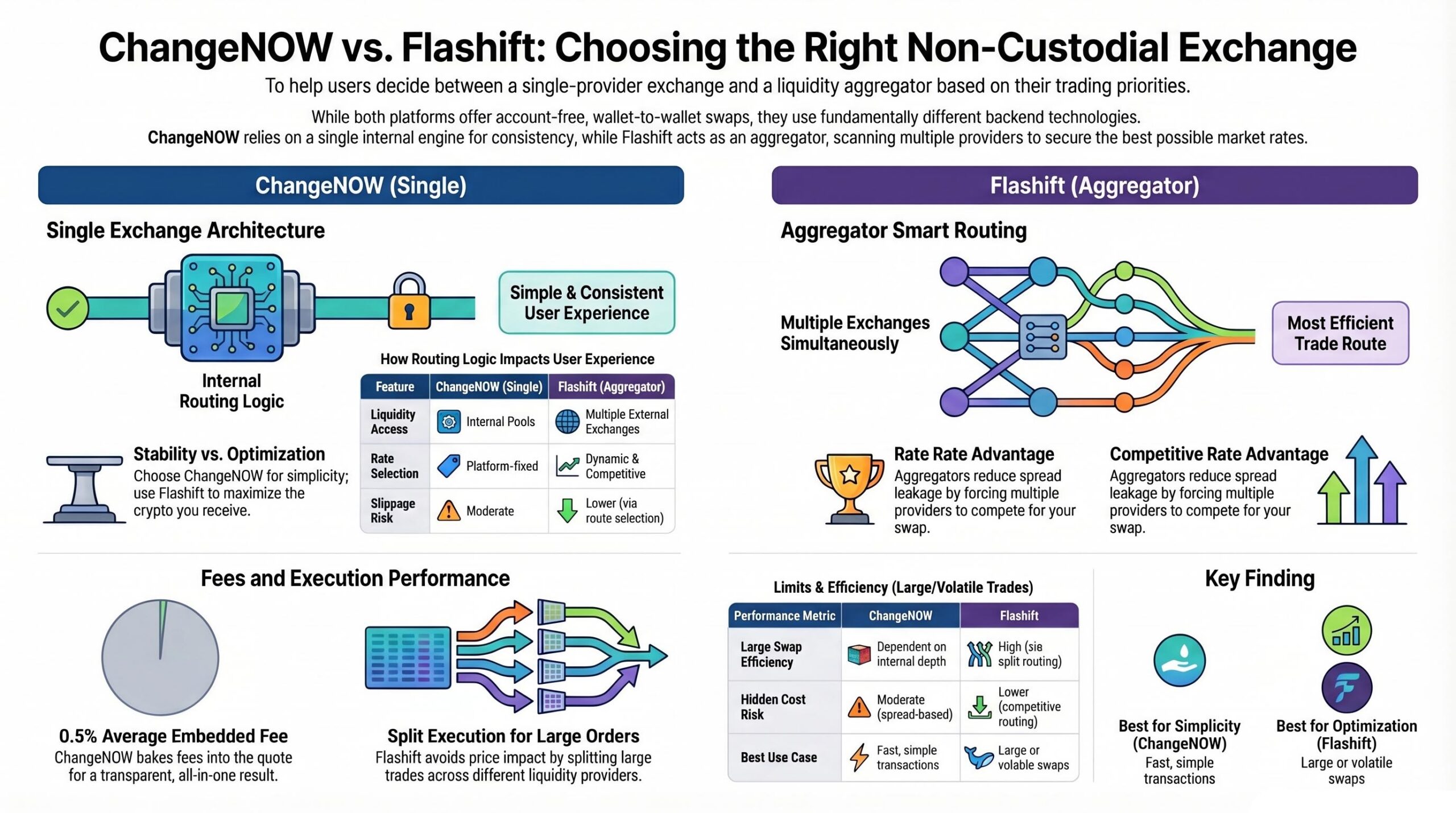
🔍 Comparing Swap Limits and Fees: ChangeNOW vs Flashift
When choosing a ChangeNOW alternative, two things matter immediately:
how much you can swap and how much you actually lose in fees (visible or hidden).
Quick answer:
- ChangeNOW: flexible limits, fees embedded in the rate
- Flashift: no hard limits + rate competition → usually better net outcome
Swap Limits (Execution Flexibility)
ChangeNOW markets itself as “no limits,” but in practice it works like this:
- No strict maximum for most pairs (especially floating-rate swaps)
- Minimum amounts exist and change dynamically based on network conditions
- Fixed-rate swaps may introduce caps depending on liquidity
This means:
You can swap large amounts but execution quality depends on market depth.
Flashift-style aggregators approach this differently:
- No platform-level limits (only liquidity-based constraints)
- Large swaps can be split across multiple providers
- Better handling of low-liquidity or cross-chain pairs
👉 In real trading conditions, this matters more than “no limits” marketing.
Execution depth > theoretical limits.
Fees (Where Most Users Lose Money)
ChangeNOW uses an embedded fee model:
- Around ~0.5% service fee included in the rate
- Network (gas) fees added separately
- Fixed-rate swaps include an extra spread buffer
- You don’t see a line-item fee; it’s baked into the quote
This model is transparent in UI, but not always optimal in outcome.
You see the result, but not how competitive it is. Flashift (aggregator model):
- Scans multiple exchanges in real time
- Competes rates across providers
- Selects the best net output after fees + slippage
👉 Instead of charging less, it focuses on finding better pricing.

Comparison Table: Limits & Fees
| Feature | ChangeNOW | Flashift (Aggregator Model) |
| Minimum Swap | Dynamic per asset | Dynamic (multi-provider optimized) |
| Maximum Swap | No hard cap (with conditions) | No hard cap (split routing possible) |
| Fee Structure | Embedded in rate (~0.5% avg) | Embedded, but optimized across providers |
| Fee Transparency | Shown in final quote | Compared across multiple quotes |
| Fixed Rate Option | Yes (higher spread) | Depends on provider selection |
| Slippage Risk | Medium (single route) | Lower (multi-route optimization) |
| Large Swap Efficiency | Depends on internal liquidity | Higher (split execution possible) |
| Hidden Cost Risk | Moderate (spread-based pricing) | Lower (competitive routing) |
Why Flashift Guarantees Better Rates?
This comes down to mechanics, not marketing. ChangeNOW already aggregates liquidity internally but it still executes within its own system boundaries. That means:
- Limited route comparison
- No external competition at execution level
- Rates depend on internal partnerships
Flashift changes the equation:
1. Real-Time Rate Competition
Instead of one quote, multiple providers compete instantly.
You get the best available rate at that moment, not just a “good enough” one.
2. Smart Routing Logic
Advanced aggregators evaluate:
- Liquidity depth
- Network fees
- Execution speed
- Slippage probability
Then choose the most efficient path, not just the fastest.
3. Split Execution for Large Orders
Large swaps are where most users lose money.
Flashift can split orders across providers, avoid price impact and, maintain a better average rate. Single-route systems can’t do this effectively.
4. Reduced Spread Leakage
With embedded-fee models, the real cost is often hidden in the spread.
Aggregators reduce this by:
- Comparing real market prices
- Minimizing unnecessary markups
- Optimizing final received amount
Bottom line:
- ChangeNOW is simple and reliable, with predictable execution
- Flashift is performance-focused, designed to extract the best possible rate
If your priority is convenience, both work; but If your priority is maximizing output per swap, an optimized ChangeNOW alternative like Flashift has a clear structural edge.
Read More: Flashift Vs Centralized Exchanges
How to Make Your First Swap on Flashift
If you’ve never used an aggregator before, the process is simpler than it sounds. No accounts, no deposits; just a direct wallet-to-wallet swap.
Quick overview:
You select a pair → send funds → receive crypto.
That’s it. The system handles routing in the background.
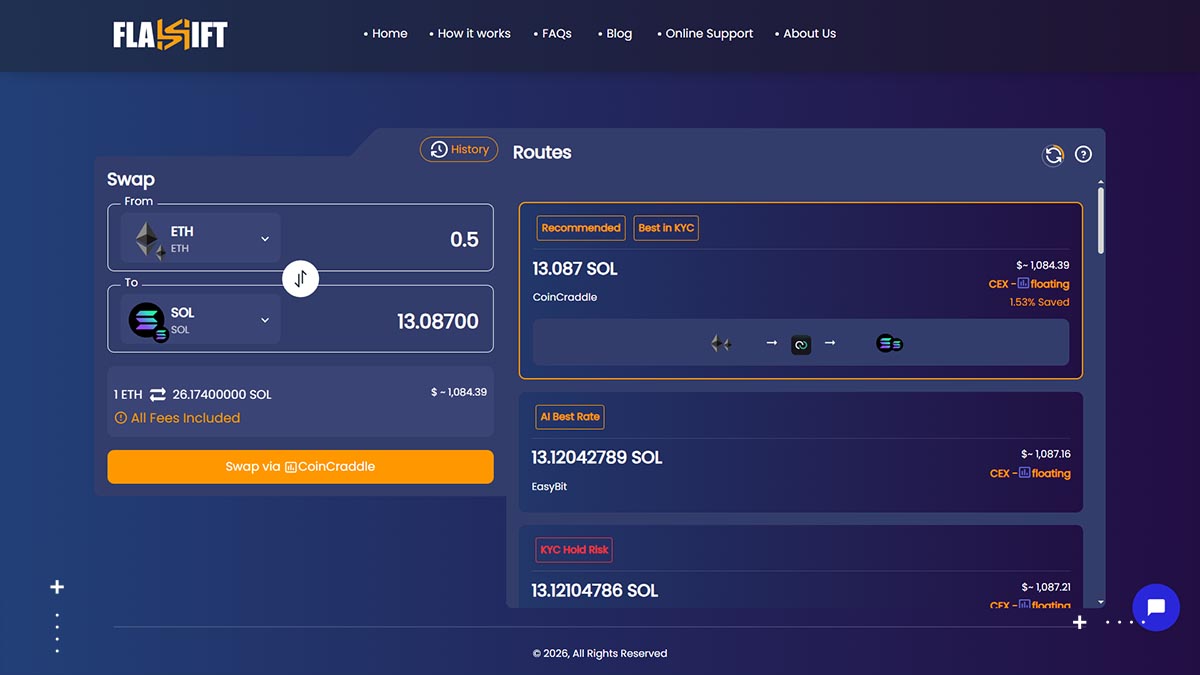
Step 1: Go to Flashift and Choose Your Pair
- Open Flashift.app
- Select the coin you want to send (e.g. BTC, ETH, USDT)
- Select the coin you want to receive
Enter the amount.
👉 The platform instantly scans multiple providers and shows you the best available rate.
Step 2: Compare Rates and Choose the Best Option
You’ll see:
- Estimated amount you’ll receive
- Network fees
- Execution time
Unlike single exchanges, this step matters.
You’re not locked into one quote, you’re choosing the most efficient route.
Step 3: Enter Your Wallet Address
- Paste your receiving wallet address
- Double-check it (this is critical—transactions are irreversible)
Some swaps may also ask for a refund address as a backup.
Step 4: Confirm the Swap Details
Before proceeding, review:
- Exchange rate
- Estimated output
- Network confirmations required
Once confirmed, Flashift locks in the route (depending on provider type).
Step 5: Send Your Crypto
- You’ll get a deposit address
- Send the exact amount from your wallet
⚠️ Important:
- Send on the correct network (e.g. ERC20 vs TRC20)
- Underpaying or overpaying can affect execution
Step 6: Wait for Confirmations
After sending:
- The network confirms your transaction
- Flashift executes the swap through the selected provider
This usually takes 5–20 minutes, depending on the blockchain.
Step 7: Receive Your Funds
Once completed:
- The swapped crypto is sent directly to your wallet
- No custody, no holding, no manual withdrawal
💎Pro Tips (Based on Real Usage)
- For volatile markets, avoid delays between quote and payment
- Use correct networks—this is the #1 mistake beginners make
- For large swaps, aggregators like Flashift perform better due to split routing
- Always test with a small amount if it’s your first time
Last words:…
Flashift removes complexity from cross-chain swaps while improving execution quality in the background.
If you’re looking for a practical ChangeNOW alternative, the real advantage shows up not in the interface; but in the final amount you receive after the swap.
Conclusion
Choosing between ChangeNOW and Flashift comes down to what you value more in your swaps.
If you want a straightforward, familiar experience, ChangeNOW delivers. It’s stable, easy to use, and gets the job done for most basic transactions.
But if your goal is to maximize what you receive, the difference becomes clear. Flashift’s aggregator model introduces real competition between liquidity providers, reduces hidden spread, and adapts better to market conditions, especially for large or volatile swaps.
This isn’t just a technical distinction. Over time, even small improvements in rate and execution can compound into a noticeable edge.
So if you’re actively comparing options and searching for a reliable ChangeNOW alternative, the smarter choice depends on your priority:
- Simplicity → ChangeNOW
- Optimization → Flashift
Today, use Flashift to swap your tokens anonymously:
FAQ
1. Is Flashift really better than ChangeNOW for every swap?
Not always. For small, simple swaps, the difference can be minimal. Flashift shows its advantage in volatile markets, large transactions, or less liquid pairs, where rate optimization and routing matter more.
2. Why do two platforms show different final amounts for the same swap?
Because pricing models differ. ChangeNOW calculates rates internally, while Flashift compares multiple providers. The difference usually comes from spread, liquidity depth, and routing efficiency, not just fees.
3. Can I trust the estimated amount shown before swapping?
It depends on the swap type.
- Fixed-rate swaps: closer to the final amount
- Floating-rate swaps: can change due to market movement
Aggregators like Flashift tend to reduce deviation by selecting more stable execution routes.
4. Do non-custodial exchanges ever require KYC?
In most cases, no. But in rare situations (like risk flags or compliance triggers), providers behind the scenes may request verification. This applies to both ChangeNOW and most ChangeNOW alternative platforms.
5. What causes slippage during a crypto swap?
Slippage happens when the market moves between the time you initiate and complete the transaction. It’s more common in low liquidity pairs, large orders and, slow network confirmations. Aggregators help reduce this by choosing faster and deeper liquidity routes.
6. Is there any risk of losing funds during the swap?
The main risks are user-side: Sending to the wrong address, Using the wrong network, Not matching the exact required amount. The platforms themselves don’t hold custody, so accuracy during the transaction is critical.