If you have to ask for permission to withdraw your own money, it isn’t yours. In April 2026, US traders are learning this the hard way.
As “Predictive Risk Scoring” turns major exchanges into digital gatekeepers, your “Verified” account is no longer a badge of trust, it’s a liability. If your capital is sitting on a CEX, you’re not trading; you’re holding a permission slip that can be revoked at any moment.
Financial sovereignty isn’t about hiding; it’s about control. As the window for private trading closes in the USA, the move to non-custodial platforms is the only way to keep your capital your own. Here is your roadmap to trading without the “Permission Slip” culture.
The Crypto Regulatory Landscape in the USA (2026 Update)
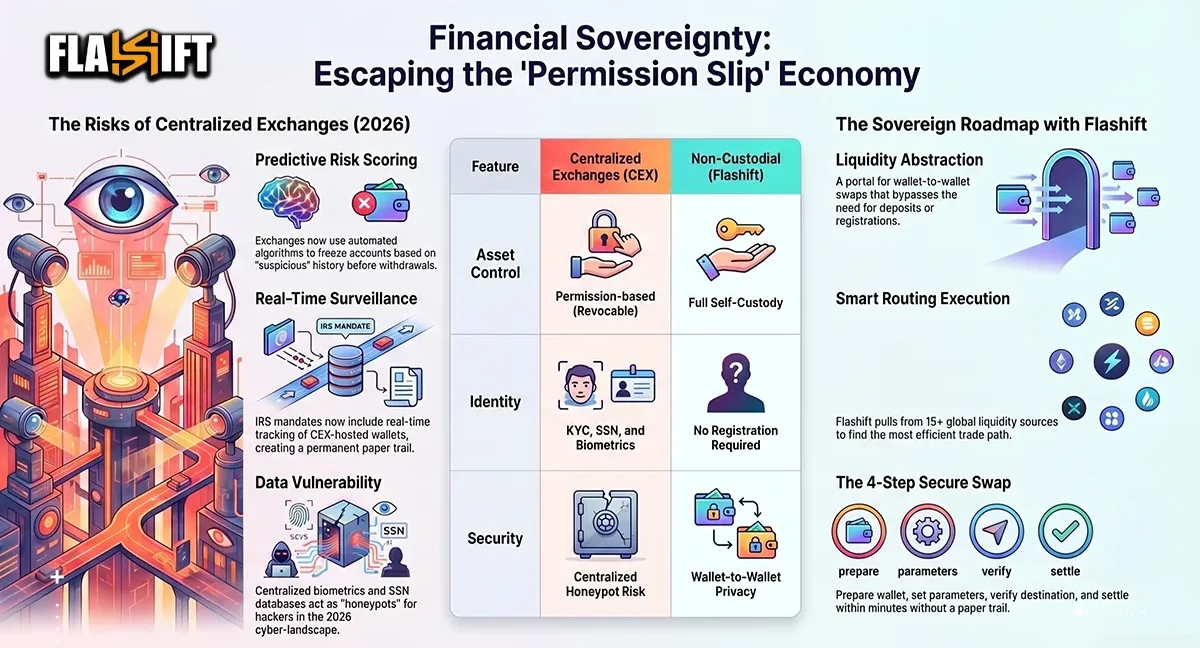
The landscape in 2026 is defined by the SEC’s expanded definition of “Broker.” This pivot has forced most centralized platforms to implement Predictive Risk Scoring, where accounts are frozen automatically based on “suspicious” on-chain history—often before the user even attempts a withdrawal.
With the latest April 2026 surveillance mandates, the IRS has begun real-time tracking of CEX-hosted wallets. For the American investor, this means that every trade is documented in a centralized database, creating a permanent “paper trail” that limits your strategic flexibility and exposes you to future regulatory pivots.
Best No-KYC Crypto Swaps UK & EU 2026: MiCAR Guide
Why US Investors are Leaving Centralized Exchanges (CEXs)
The migration toward privacy crypto platforms in America 2026 isn’t just about avoiding taxes—it’s about Counterparty Risk.
- Asset Freezes: US-based CEXs are now legally required to “lock first and ask questions later” during high-volatility events.
- Data Vulnerability: Centralized databases remain “honeypots” for hackers. In the current 2026 cyber-landscape, providing your SSN and biometrics to an exchange is a significant security liability.
- Exit Liquidity Risks: Many US users found themselves as “Exit Liquidity” for major platforms during the banking tremors of early 2026. Self-custody is the only way to ensure your capital remains yours.
What Makes a Non-Custodial Exchange the Best Choice?
A true non-custodial exchange is not a place where you “deposit” money. It is a portal for Liquidity Abstraction. For a US user, the best choice must offer:
- Wallet-to-Wallet Swaps: You keep your private keys. The tokens go from your wallet to the swap and back to your wallet.
- No Registration: No email, no KYC, and no “Level 2” hurdles that slow down your execution.
- Smart Routing: The ability to pull liquidity from multiple sources (DEXs and professional providers) to ensure you aren’t paying a “privacy premium” on the spread.
Better to read this full guide:  ChangeNOW vs Flashift: Which Non-Custodial Exchange is Better?
Flashift: The Ultimate Global Swapping Tool for Privacy Seekers
Flashift is not just an exchange; it is a Non-Custodial Aggregator designed for the “Sovereign Trade.” We understand that in 2026, the US market is the most restrictive environment in crypto history.
Flashift solves this by using Smart Routing across 15+ global liquidity sources. Our engine finds the most efficient path for your swap, bypassing the friction points that stop traditional US traders. Whether you are moving from ETH to Monero (XMR) for privacy or into PAX Gold (PAXG) for stability, Flashift executes with zero personal data exposure.
How to Execute a Secure Swap in 4 Steps
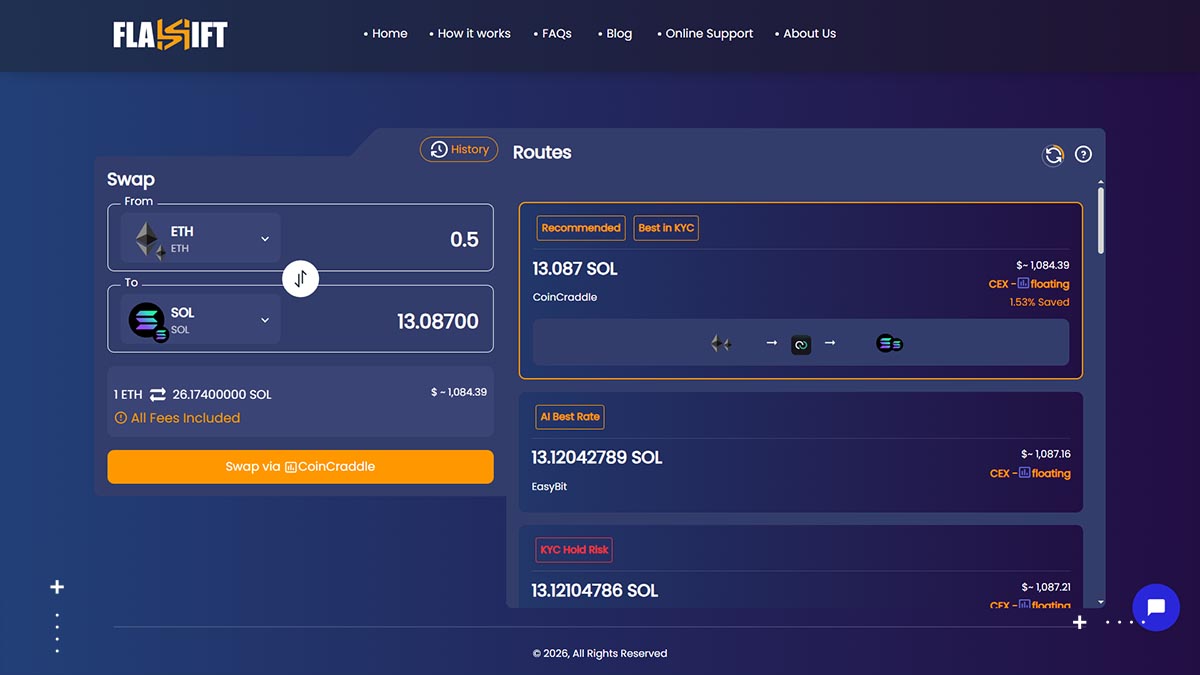
- Prepare Your Non-Custodial Wallet: Ensure your assets are in a private wallet (e.g., Ledger, Trezor, or Trust Wallet).
- Set Your Parameters: Select your pair (e.g., SOL to XAUT) and enter the amount. Flashift’s Smart Router will instantly calculate the best rate available globally.
- Verify the Destination Address: Provide the recipient address. Since Flashift is non-custodial, we deliver the assets directly to your possession.
- Send and Settle: Transfer the funds to the generated deposit address. Within minutes, your swap is complete, with Settlement Finality and no paper trail.
FAQs:
- Do US users need a VPN for Flashift?
While Flashift is a global, non-custodial tool that does not store your personal data, many US-based privacy seekers use a VPN (Virtual Private Network) as a standard security practice in 2026. This adds an extra layer of obfuscation to your IP address, ensuring that your crypto swap as a US user remains fully shielded from local ISP tracking.
2. Is Flashift compliant with US laws?
Flashift is a software-based aggregator, not a custodial broker. We do not hold user funds, nor do we manage user accounts. By providing a technical interface for wallet-to-wallet swaps, we empower users to exercise their right to Financial Sovereignty via self-custodial tools.
3. What is the fastest way to exit a “flagged” CEX account?
If your centralized account is still active but limited, the “Sovereign Play” is to withdraw to a non-custodial wallet immediately and use Flashift to bridge those assets into privacy-preserving tokens like Monero (XMR) or tokenized gold.