
- Quick Comparison: The 2026 Gold Standard 📊
- Key Differences Between the XAUt, Physical Gold and Gold ETF
- The “Zero-Fee” Advantage: Why XAUt Beats ETFs 💸
- Sovereignty & Privacy: The “Unfreezable” Asset 🛡️
- Expert Opinions on XAUt vs Gold
- How to Swap USDT/BTC for XAUt Instantly ⚡
- Conclusion: What’s the Best Gold Investment in 2025?
- FAQ
Gold is the ultimate store of value. But in 2026, how you hold it matters just as much as if you hold it.
The dilemma for modern investors is clear: Physical gold is sovereign but impossible to move quickly. Gold ETFs (like GLD) are liquid but trapped inside the traditional banking system—subject to fees, market hours, and regulatory freezes. You own a paper promise, not the metal.
XAUt has disrupted the centuries-old gold market by digitizing ownership. It offers the holy grail of hard assets: The stability of a London Good Delivery bar with the transactional speed of a stablecoin.
But is it safe? Can it really replace the trust of a physical vault or the ease of a brokerage account?
In this comparison guide, we strip away the marketing to analyze the hard data: Fees, Privacy, Liquidity, and Custody. We will breakdown why smart money is rotating from “Paper Gold” to “On-Chain Gold”—and how you can make the switch instantly using Flashift.

Quick Comparison: The 2026 Gold Standard 📊
| Feature | Tether Gold (XAUt) | Gold ETF (GLD) | Physical Gold |
| Storage Fee | 0.00% (Free) | ~0.40% / Year | High (Vault/Safe) |
| Privacy | High (If swapped on Flashift) | Zero (Full KYC) | High (Cash purchase) |
| Portability | Instant (Global) | None (Tied to Broker) | Difficult (Heavy/Customs) |
| Liquidity | 24/7 (DeFi/CEX) | Market Hours Only | Dealer Business Hours |
| Ownership | On-Chain Rights | Paper Contract (IOU) | Full Possession |
Key Differences Between the XAUt, Physical Gold and Gold ETF
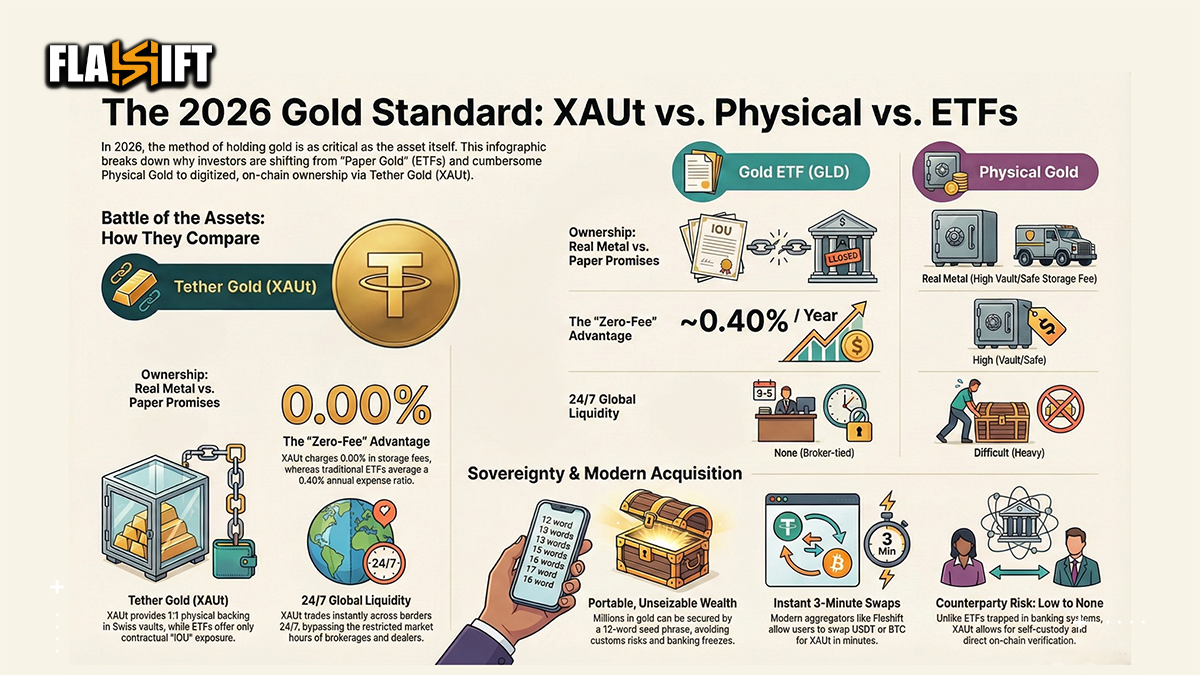
When comparing XAUt vs physical gold and XAUt vs ETF, it’s essential to understand how they differ across liquidity, storage, fees, and volatility. Here’s a quick breakdown:
Liquidity
Tether Gold (XAUt) offers 24/7 global trading on crypto platforms, making it the most liquid option. Physical gold is harder to sell and often involves in-person transactions. Gold ETFs are liquid during market hours but are limited to traditional trading systems.
Winner: XAUt for around-the-clock, borderless liquidity.
Storage and Custody
XAUt is backed by real gold stored in Swiss vaults, with no need for personal storage. Physical gold requires secure storage, which can be costly and risky. ETFs don’t give you physical ownership—just fund exposure.
Winner: XAUt, combining physical gold security with digital convenience.
Fees and Accessibility
Tether Gold investment has minimal fees—just small transaction costs. Physical gold comes with purchase premiums, storage, and insurance. ETFs are easy to access via brokerages but include management fees.
Winner: Tie between XAUt (for crypto users) and ETFs (for traditional investors).
Volatility
All three track gold prices, but XAUt may show small fluctuations due to exchange dynamics. Physical gold is the most stable, but pricing varies by seller, and ETFs can be affected by fund performance and market sentiment.
Winner: Physical gold for pure stability, but XAUt is close behind.

XAUt vs Physical Gold vs Gold ETFs Comparison | Take a Quick Look
| Feature | Tether Gold (XAUt) | Physical Gold | Gold ETFs |
| Ownership Type | Digital token backed 1:1 by real gold | Direct ownership of physical bullion | Shares in a fund that holds gold or gold-related assets |
| Storage | Stored in Swiss vaults by a custodian | Requires personal or third-party secure storage | Held by the ETF provider |
| Liquidity | High (can be traded 24/7 on crypto exchanges) | Low (requires physical handling to sell/trade) | High (traded during market hours like stocks) |
| Accessibility | Global, instant, and borderless via blockchain | Physical access only; location-dependent | Easily accessible via brokerage accounts |
| Transaction Speed | Near-instant transfers via blockchain | Slow (requires physical delivery/transportation) | Fast (market-based transactions) |
| Cost & Fees | Low fees; blockchain gas fees may apply | Premiums, storage, insurance, and shipping costs | Management and brokerage fees |
| Security | Secured by blockchain and institutional vaults | Security depends on owner (can be stolen or lost) | Fund security depends on custodian and management |
| Redeemable for Gold | Yes (minimum quantity applies for redemption) | Yes (you already own the gold) | No direct redemption—ETF holders don’t get physical gold |
| Transparency | On-chain verification and full audit trails | Depends on dealer/institutional trust | Varies by ETF; not fully transparent |
| Counterparty Risk | Low (backed by gold, verified reserves) | None (you own the asset directly) | Medium (subject to fund and market risks) |
The “Zero-Fee” Advantage: Why XAUt Beats ETFs 💸
When comparing XAUt vs Gold ETFs, most investors overlook the hidden cost of “Expense Ratios.”
Traditional Gold ETFs (like GLD or IAU) charge an annual management fee, typically around 0.40%. This sounds small, but it compounds over time, slowly eating away at your gold holdings. If you hold 4,000 just for the privilege of holding paper gold.
The Tether Gold Advantage:
XAUt charges 0.00% storage fees.
Because the gold is tokenized on-chain, Tether passes the efficiency savings to you. You pay a small gas fee once when you buy (or swap on Flashift), and then it costs you zero to hold it forever.
In the high-inflation environment of 2026, preserving every basis point of your wealth matters. XAUt is mathematically superior for long-term holding.
Sovereignty & Privacy: The “Unfreezable” Asset 🛡️
The biggest risk in 2026 isn’t the price of gold; it’s Counterparty Risk.
-
ETF Risk: If you hold a Gold ETF, your asset is trapped inside a brokerage account. During a banking crisis or regulatory freeze, your access can be suspended instantly. You own a claim, not the asset.
-
Physical Risk: Try crossing an international border with $50,000 in gold bars. You risk confiscation, heavy taxes, or theft.
The XAUt Solution:
Tether Gold allows you to carry millions of dollars in wealth across any border, secured by a 12-word seed phrase. It is portable, unseizable wealth.
By using a non-custodial aggregator like Flashift, you decouple your gold acquisition from your identity. You can swap USDT or Bitcoin for XAUt without linking your ID to the transaction, preserving your financial privacy in an era of increasing surveillance.
Pros and Cons of XAUt, Physical Gold and Gold ETF
| Asset Type | ✅ The Good (Pros) | ❌ The Bad (Cons) |
| Tether Gold (XAUt) | 🥇 1:1 Backed by physical gold
🕒 24/7 Trading (Global & Instant) ⚡ Fast Transfers & Low Fees 🏦 No Personal Storage headache |
🧠 Requires basic Crypto Knowledge
📉 Physical Redemption is hard (High minimums) |
| Physical Gold | 🤲 Tangible Asset (No digital reliance)
🛡️ Zero Counterparty Risk 💰 Historic Wealth Preservation |
🔒 Expensive Storage & Insurance
🐢 Difficult to Liquidate quickly ✈️ Hard to transport borders |
| Gold ETFs | 📈 Easy Access via stock brokers
💧 High Liquidity (During market hours) 🚪 Low Barrier to entry |
📄 No Physical Ownership (Paper Gold)
⚠️ Counterparty Risk & Management Fees 🚫 Subject to Freezes (Banking system) |
What Type of Investor Should Choose Each?
Choosing the best way to invest in gold depends on your goals, risk tolerance, and preferred platforms.
- Choose XAUt if you value digital convenience, want direct gold backing, and are comfortable using crypto exchanges. It’s ideal for tech-savvy investors or those seeking a hedge in a digital portfolio.
- Choose Physical Gold if you prioritize tangible assets and want to store wealth outside the financial system. It is excellent for long-term holders and legacy planning.
- Choose Gold ETFs if you prefer traditional markets, want to trade gold like stocks and value simplicity. They are best for stock market investors looking to compare gold options without dealing with storage or wallets.
Expert Opinions on XAUt vs Gold
The debate between XAUt and physical gold and XAUt and ETF has garnered attention from experts across traditional and digital finance sectors. Crypto analysts view the Tether Gold investment as a breakthrough that offers the best of both worlds: the stability of gold and the benefits of blockchain technology.
For those seeking decentralized control, XAUt provides a compelling option. However, traditional gold experts emphasize the security and tangible value of owning physical gold, free from digital risks and counterparty exposure.
Financial advisors often recommend Gold ETFs for beginners due to their ease of access and low fees but acknowledge the rising relevance of XAUt as a more secure, digital alternative for those who seek direct gold ownership.
While physical gold remains a safe bet for conservative investors, Tether Gold (XAUt) is quickly becoming a popular choice for digital-first investors.
How to Swap USDT/BTC for XAUt Instantly ⚡
Stop waiting for banking hours or broker approvals. The modern way to acquire gold is via a crypto-to-crypto swap.
Flashift aggregates liquidity from 15+ exchanges to give you the best rate on XAUt, ensuring you get the maximum amount of gold for your crypto.
Step-by-Step Guide:
-
Select: Choose your input currency (e.g., USDT TRC20 or Bitcoin) on the Flashift widget.
-
Target: Select Tether Gold (XAUt) as the output.
-
Address: Paste your Ethereum (ERC-20) wallet address (e.g., from Ledger or MetaMask).
-
Swap: Send the deposit. Flashift routes the trade through the cheapest path.
-
Receive: Within ~3 minutes, the gold tokens arrive in your self-custody wallet.
 Conclusion: What’s the Best Gold Investment in 2025?
The best 2025 gold investment depends on your preferences. If you prefer digital ownership, liquidity, and low fees, Tether Gold (XAUt) is the most futuristic option. It presents blockchain-backed gold in a convenient, accessible package. Physical gold is still a sound option for physical control and long-term stability despite the storage fees and hassle.
Gold ETFs are ideal for those who prefer simplicity and immediate market access but don’t have direct exposure to physical gold. Ultimately, the best investment will depend on your goals—whether you want the flexibility of XAUt, the security of physical gold, or the convenience of ETFs.
FAQ
- Can I redeem Tether Gold (XAUt) for real gold?
Yes, but only in large amounts (usually 430+ XAUt) and through authorized providers. Most retail investors use it for digital exposure rather than redemption.
- Does holding a Gold ETF mean I own actual gold?
No. You own shares in a fund that may or may not be backed by physical gold. You’re exposed to gold’s price, not the gold itself.
- Is XAUt affected by crypto market volatility?
Only slightly. While XAUt is traded on crypto exchanges, its value closely tracks the price of gold—not cryptocurrencies like Bitcoin or Ethereum.
- How private is each option for gold investment?
XAUt offers more privacy than ETFs, especially on decentralized exchanges. Physical gold offers the highest privacy if bought off the grid. ETFs are the most trackable.
- Which option offers better global accessibility?
Tether Gold (XAUt) is the most globally accessible, as it can be sent and received instantly across borders with no intermediaries. Physical gold and ETFs often face regulatory and logistical barriers.