
- The Anatomy of Modern Crypto Theft
- The Cryptographic Reality: Defeating Recovery Scams
- Sovereign Execution: Eliminating CEX Honeypots
- FAQS
- What is the safest way to store my cryptocurrency?
- How can I tell if a “crypto recovery expert” is a scam?
- Are non-custodial swaps safer than traditional exchanges?
- What should I do immediately if my crypto is stolen?
- How do SIM swap attacks steal crypto?
- Can Flashift be hacked?
- Do I need to complete KYC to use Flashift swaps?
- What’s the single best daily habit for crypto security?
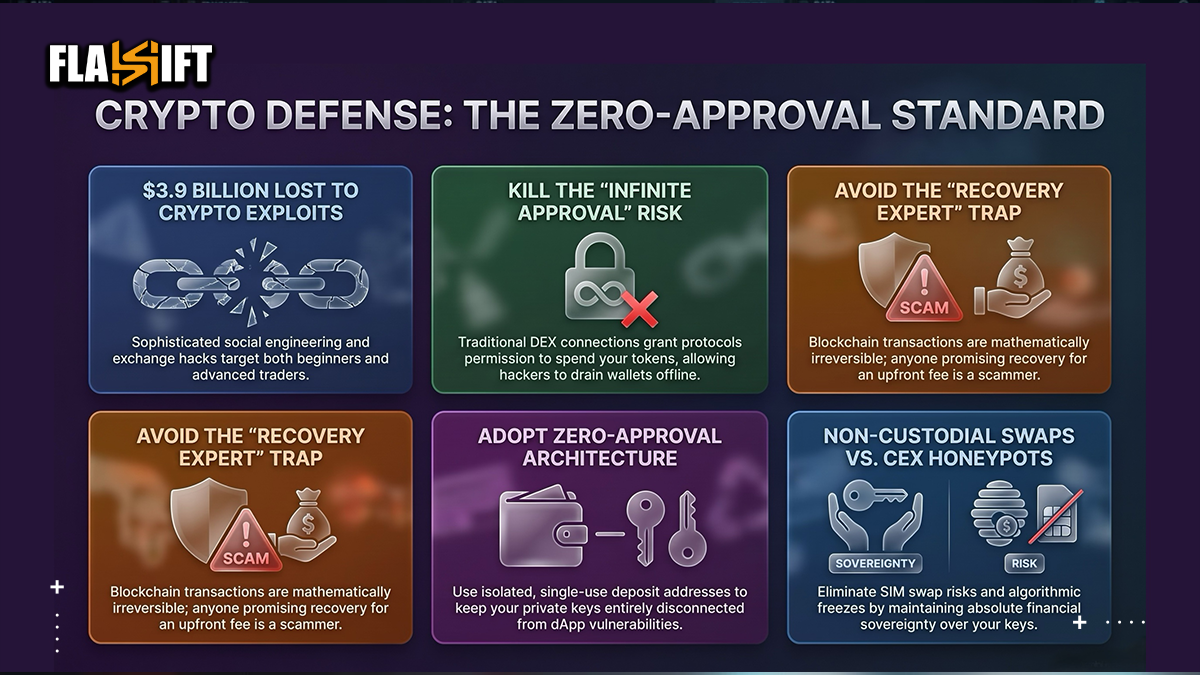
Protecting Your Crypto | In 2024, U.S. crypto operators lost over $3.9 billion to sophisticated on-chain exploits, exchange hacks, and malicious decentralized applications (dApps). To permanently protect your portfolio, the fundamental rule is to never sign infinite smart contract approvals, as these serve as the primary vector for silent wallet drainers. Furthermore, because blockchain transactions are mathematically irreversible, you must recognize that any “recovery expert” guaranteeing the retrieval of stolen funds for an upfront fee is an advance-fee scam.
The ultimate operational defense against these threats is utilizing a Zero-Approval execution layer, routing your cross-chain swaps via isolated, single-use deposit addresses without ever exposing your Web3 wallet to a frontend connection. Here, we break down the exact mechanics of modern crypto theft, how to identify algorithmic recovery fraud, and how to maintain absolute financial sovereignty in a high-risk market.
📊 Execution OpSec Matrix: CEX vs. DEX vs. Zero-Approval
| Feature | Centralized Exchanges (CEX) | Traditional DEX (e.g., Uniswap) | Flashift (Zero-Approval) |
| Wallet Connection | Custodial (They hold the keys) | 🔴 Requires Smart Contract Approval | 🟢 No Connection Required |
| Hack Vulnerability | Hot wallet hacks, SIM swaps | Malicious approvals, frontend hijacking | Immune (Isolated single-use routing) |
| KYC & Freezes | High risk of algorithmic account lockups | None | Absolute Financial Sovereignty |
The Anatomy of Modern Crypto Theft
Cybercriminals have evolved beyond simple password theft. Today, they target the structural vulnerabilities of Web3 infrastructure.
- Infinite Approval Exploits (The DeFi Silent Killer)
When you connect your MetaMask or Rabby wallet to a traditional DEX, you must sign a smart contract approval granting the protocol permission to spend your tokens. If that DEX is compromised, hackers exploit these “infinite approvals” to drain your wallet passively, even while you are offline.
- Liquidity Rug Pulls & Bait-and-Switch Routing
Fraudulent DeFi projects or malicious liquidity providers embed hidden functions in their code. When you attempt a swap, they execute a bait-and-switch, enforcing massive hidden slippage or freezing your capital mid-transaction.
- SIM Swap & CEX Account Takeovers
Centralized exchanges (CEXs) rely on traditional Web2 security. By hijacking your phone number via a SIM swap, attackers intercept your 2FA codes, reset your exchange passwords, and drain your custodial accounts before you even realize your phone lost signal.
The Cryptographic Reality: Defeating Recovery Scams
After a severe portfolio drain, panic sets in. This desperation is actively hunted by sophisticated fraud rings posing as “blockchain forensic experts” or affiliated law enforcement agents.
Advanced operators must accept the cryptographic reality: blockchain transactions are mathematically irreversible. Without the attacker’s private keys, no software, agency, or “hacker for hire” can force a reverse transaction.
The Anatomy of a Modern Recovery Scam:
- Fake Forensic Audits: Attackers provide doctored blockchain tracking graphs claiming your funds are “frozen” on a compliant exchange, demanding an upfront “legal fee” to release them.
- Deepfake Impersonation: Sophisticated syndicates now utilize AI voice and video deepfakes of exchange executives or federal agents to build false authority and gain your trust.
- The Hard Rule: If anyone guarantees the recovery of stolen digital assets in exchange for an upfront payment, it is an advance-fee scam designed to victimize you twice.
Sovereign Execution: Eliminating CEX Honeypots
Centralized exchanges operate as massive custodial honeypots. Storing your capital on a CEX means you are surrendering your private keys and trusting their internal Web2 security infrastructure against global, state-sponsored hacking syndicates.
Flashift redefines secure capital rotation through a pure Chain Abstraction layer, entirely bypassing the vulnerabilities of custodial platforms and traditional dApps.
- Zero-Approval Architecture: The only foolproof way to prevent a smart contract exploit is to never connect your wallet to one. Flashift never requires you to connect your Web3 wallet or sign dangerous spending approvals. You execute swaps exclusively via isolated, single-use deposit addresses, keeping your cold storage strictly disconnected from the internet.
- Bait-and-Switch Protection: Our AI routing engine performs continuous post-trade analysis on liquidity providers. It actively identifies and blacklists platforms attempting predatory slippage or mid-trade KYC lockups, ensuring your execution rate is secured.
- Active Human Oversight: Because milliseconds matter during volatile market shifts, Flashift deploys a 24/7 human support desk. If a decentralized liquidity pool fragments or fails, our team intervenes immediately to manage the transaction or safely refund your capital directly to your hardware wallet, ensuring your financial sovereignty is never compromised.
FAQS
-
What is the safest way to store my cryptocurrency?
The safest method is using a hardware wallet or a secure non-custodial software wallet where you control your private keys. Avoid leaving large amounts of crypto on centralized exchanges, as they are frequent targets for hackers.
-
How can I tell if a “crypto recovery expert” is a scam?
If they demand upfront payment, promise guaranteed recovery, or pressure you to act quickly, it’s almost certainly a scam. Legitimate recovery through law enforcement is slow, doesn’t require upfront fees, and rarely results in full asset return.
-
Are non-custodial swaps safer than traditional exchanges?
Yes. In a non-custodial swap (like those offered by Flashift), your funds remain in your wallet until the trade is executed directly with another wallet. This eliminates the risk of exchange hacks and withdrawal freezes common on custodial platforms.
-
What should I do immediately if my crypto is stolen?
- Stop further transactions from the compromised wallet.
- Document everything—transaction IDs, wallet addresses, communication logs.
- Report to authorities like the FBI IC3 and your local cybercrime unit.
- Warn others in online forums to prevent more victims.
-
How do SIM swap attacks steal crypto?
In a SIM swap, a hacker convinces your mobile carrier to transfer your phone number to their SIM card. This allows them to intercept SMS-based 2FA codes and reset your exchange passwords, giving them direct access to your funds.
-
Can Flashift be hacked?
Flashift’s non-custodial model means your funds are never stored on the platform. Even if Flashift were targeted, your crypto would remain safe in your personal wallet because the platform never has access to your private keys.
-
Do I need to complete KYC to use Flashift swaps?
No. Flashift offers instant, privacy-friendly swaps without requiring you to upload personal documents, reducing the risk of identity theft and data breaches.
-
What’s the single best daily habit for crypto security?
Spend 3 minutes each day checking for phishing attempts, verifying your wallet’s security status, and ensuring your accounts haven’t been accessed from unknown devices. Consistency is key to staying safe.