
Holding transparent assets like Bitcoin or stablecoins in 2026 means operating under continuous on-chain surveillance. With the aggressive enforcement of the EU’s MiCA Travel Rule and the systematic delisting of Monero (XMR) from centralized exchanges (CEXs), acquiring true financial privacy has escalated into a rigorous operational security (OpSec) challenge.
For the advanced operator, centralized platforms are compromised honeypots. If you want to buy Monero, utilizing legacy exchanges guarantees metadata exposure. Surviving this regulatory dragnet requires an uncompromising, strictly non-custodial architecture like Flashift, allowing you to convert transparent assets into native XMR instantly with zero metadata trails.
* Exchange your ETH for XMR and make your assets private.
Quick Comparison: Ways to Trade Monero (2026) 🕵️♂️
We tested these methods during April 2026 to provide real-world fee and speed data:
| Method | Avg. Fee | Settlement Time | Privacy Tech | Best For… |
| Co-Aggregators | NO hidden fee included | ⚡ ~180 Seconds | No-Log API / Ephemeral | Instant, high-liquidity swaps |
| P2P (Haveno/Bisq) | 3% – 8% | 🐌 20+ Minutes | Tor-Native / Multisig | Deep privacy & Fiat-to-XMR |
| Atomic Swaps | Network Gas | 🐌 60+ Minutes | HTLC (Script-based) | Tech-savvy BTC maximalists |
💻 How to Pay for VPS Hosting With Monero Anonymously Step by Step 2026
The demand for privacy extends beyond holding assets; it is about deployment. If you are securing offshore server infrastructure, follow this strict OpSec protocol:
- Generate a Subaddress: Open your Monero wallet and generate a one-time subaddress (starting with ‘8’). Never use your primary address (starting with ‘4’).
- Execute a No-KYC Swap: Use Flashift’s non-custodial engine to swap your standard assets (like USDT or BTC) into XMR, routing the output directly to your new subaddress.
- Mask Your Network: Access the hosting provider’s website using the Tor browser or a strict no-log VPN.
- Pay the Invoice: Send the exact XMR invoice amount directly from your wallet to the provider’s payment gateway, severing any cryptographic link to your core identity.
XMR OpSec: 3 Rules for Total Anonymity 🛡️
Using a secure non-custodial co-aggregator is step one. Step two is wallet hygiene.
-
Use Subaddresses: Never withdraw XMR to your main wallet address (starting with ‘4’). Always generate a Subaddress (starting with ‘8’). This prevents observers from linking multiple payouts to the same entity.
-
Tor/VPN: While Flashift doesn’t log IPs, your ISP does. Use a VPN or the Tor browser when accessing swap sites to hide your traffic.
-
Churning (Optional): After receiving XMR, send it to yourself once before spending it. This increases the cryptographic “distance” from the swap event.
Instant Execution Checkpoint: You now understand the required wallet hygiene, so it is time to execute safely. Whether you are looking for how to buy monero anonymously or how to send monero anonymously without leaving a centralized surveillance trail, Flashift is your gateway. Connect directly to our co-aggregation terminal to swap BTC, ETH, or USDT into native XMR in under 3 minutes. Zero accounts. Zero IP logging. Absolute financial sovereignty
Read More: How to get Monero transaction private key
The Privacy Spectrum: P2P vs. Co-Aggregation
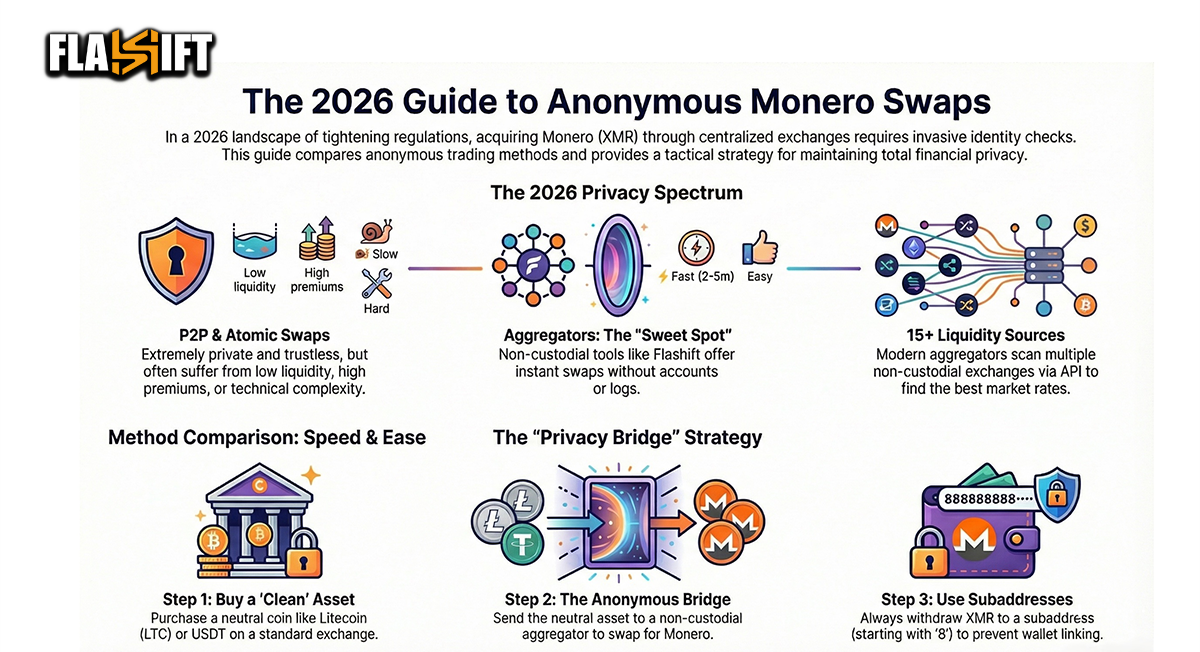
Not all “No-KYC” options are created equal. Here is the technical breakdown of how to get XMR in 2026.
1. Peer-to-Peer (P2P) Markets (Haveno/Bisq)
P2P platforms allow you to trade directly with another person.
-
Extremely private. No central server.
-
Low liquidity and high premiums. You might pay 10% above market price, and you have to wait for a peer to come online. It is slow.
2. Atomic Swaps
Trustless protocols that swap BTC for XMR without a middleman.
-
Cryptographically secure.
-
Often requires running command-line software or specific nodes. If the Bitcoin network is congested, swaps can take hours to settle.
3. Non-Custodial Co-Aggregation Terminal
For users searching for the best ways to buy Monero anonymously, co-aggregators bridge the gap by providing CEX-level volume without the custody risks. Platforms like Flashift do not collect emails, logged IPs, or document verifications. The routing layout is entirely ephemeral, scanning multiple non-custodial providers simultaneously to deliver the highest liquidity with zero permanent data trails.
⚠️ 2026 Privacy Alert: Avoiding “Spy Nodes”
Using a No-KYC exchange is step one. Step two is node security. In 2026, we’ve seen an increase in “Spy Nodes” designed to log IP addresses during transaction broadcasts.
-
Expert Tip: When swapping on Flashift, ensure your wallet (Cake, Monerujo, or Feather) is connected to a trusted, decentralized node to ensure your IP isn’t leaked after the swap is completed.
The “Fiat Hack”: How to Buy Monero with a Card
Direct fiat-to-XMR purchases without verification are mathematically impossible due to global MiCA regulations. To preserve privacy, experienced operators deploy a two-step migration:
-
Acquire a standard stablecoin (USDT/USDC) through a local P2P method.
-
Route that stablecoin through Flashift’s private co-aggregation engine to convert it instantly into native XMR.
Why Non-Custodial Swaps Are the Safest Option
Unlike centralized platforms that require personal data, non-custodial exchanges allow you to:
-
Keep full control of your wallet
-
Avoid unnecessary KYC exposure
-
Swap instantly with no account limits
-
Stay anonymous while still accessing liquidity
⚡ Execute Your Strategy: The Sovereign Swap Terminal
You now understand the required wallet hygiene and the risks of centralized honeypots. Instead of managing complex node setups or risking liquidity traps on peer networks, it is time to execute programmatically.
🛡️ Zero-Approval Privacy Execution: Whether you need to acquire XMR or cash out without leaving a surveillance trail, Flashift is your gateway. Connect directly to our co-aggregation terminal to swap BTC, ETH, USDT, or altcoins into native XMR in under 3 minutes. Zero accounts. Zero IP logging. Absolute financial sovereignty.
FAQ
1. Is Monero still legal to trade in 2026?
Yes, in most jurisdictions, owning XMR is legal. However, the “Travel Rule” has restricted how CEXs handle it, making non-custodial swaps the preferred method for privacy.
2. How do I verify my swap is private?
Use a block explorer to view your transaction hash. You will see that the amounts and addresses are completely hidden—unlike Bitcoin or Ethereum.
3. Can I swap Seraphis/Jamtis addresses?
Flashift is currently updated to support the latest Monero protocol enhancements as they roll out in 2026.