
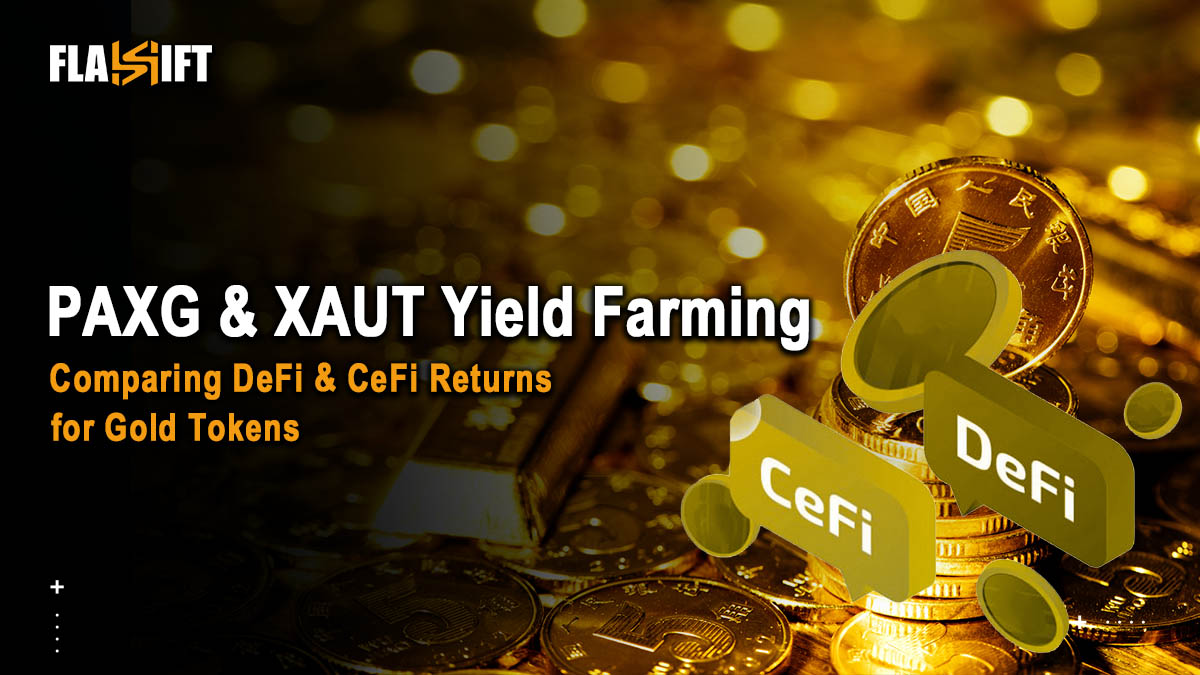
PAXG Yield Farming and XAUT Staking | Gold has always been the ultimate safe-haven asset, but in 2025 it’s no longer just about storing bars in a vault or buying traditional ETFs. With PAXG yield farming and XAUT staking, investors now have a way to earn passive income on their gold holdings while keeping the security of gold-backed tokens.
The big question is: should you lean into the flexibility and higher APYs offered by DeFi platforms, or choose the stability and managed risk of CeFi providers? In this guide, we’ll break down how PAXG and XAUT yield farming works, what returns look like in DeFi vs CeFi, and what smart investors are considering before locking in their gold-backed crypto.
Why tokenized gold matters?

Gold has always been the safe play—the asset people run to when markets wobble. But if we’re being honest, holding physical gold has its limits. You can’t easily move it across borders, you can’t plug it into digital markets, and it certainly doesn’t generate yield while sitting in a vault. That’s why gold-backed tokens like PAXG and XAUT are starting to matter more than ever. They give you the weight and trust of gold, while unlocking the liquidity and utility of crypto.
Think about it: with PAXG yield farming you’re not just owning digital gold, but you’re putting it to work in DeFi ecosystems that reward you for providing liquidity or staking. The mechanics might sound technical, but the concept is simple—your gold finally earns. Compare that to physical bullion collecting dust, and the difference is clear.
On the flip side, some investors lean toward XAUT staking through centralized platforms. It’s less adventurous but more controlled. CeFi providers wrap your tokens into lending or staking products, then share part of that return with you. It feels closer to a traditional savings product, except your base asset isn’t fiat—it’s tokenized gold.
So, the real question becomes: DeFi or CeFi? If you’re comfortable navigating smart contracts and chasing higher yields, DeFi has the edge. If you’d rather have predictability and professional custody, CeFi makes more sense. Either way, tokenized gold is what makes the choice possible. Without PAXG and XAUT bridging gold and crypto, we’d still be stuck in a world where gold could only protect wealth—but never grow it.
DeFi Yield Options: Stake Gold-Backed Tokens
The beauty of tokenized gold isn’t just that it can sit safely in your wallet. The real breakthrough is how DeFi protocols let you turn assets like PAXG and XAUT into yield-bearing positions. For investors who want more than just exposure to gold prices, PAXG yield farming and XAUT staking inside decentralized ecosystems open up an entirely new playbook. But the options vary widely, and the devil is always in the details.
Where can you farm PAXG in DeFi?
Liquidity pools are the most common entry point. For example, pairing PAXG with stablecoins or ETH on decentralized exchanges allows you to earn fees plus farming rewards. It’s the classic DeFi setup: your gold-backed tokens become liquidity, and the protocol compensates you for that risk. But here’s the catch—impermanent loss can eat into profits if PAXG’s price moves sharply compared to the paired asset. So before diving in, ask yourself: are you seeking pure gold exposure, or are you willing to balance gold against crypto volatility to boost yield?
What about staking XAUT in decentralized platforms?
Unlike yield farming, XAUT staking in DeFi often looks more straightforward. Some protocols allow you to deposit directly and earn governance tokens or a share of protocol revenue. The yields can be attractive, especially during high-liquidity cycles, but there’s always smart contract risk. In other words: you’re trading counterparty risk from banks for code risk from developers. For some, that’s liberating. For others, it’s unnerving.
Are DeFi returns really better than CeFi?
In most cases, yes. DeFi yields on PAXG yield farming and XAUT staking tend to outpace CeFi’s conservative offerings. But high yield isn’t free money—it reflects higher risk and complexity. You need to actively monitor the platforms, stay on top of audits, and understand how rewards are generated. If you’re not asking, “Where is this yield coming from?” you’re not doing proper due diligence.
Should every gold investor jump into DeFi?
Not necessarily. The honest answer depends on geography, regulations, and personal risk tolerance. In some regions, DeFi access is seamless and highly liquid. In others, it’s restricted or technically complex. That’s why DeFi vs CeFi isn’t about finding the universally “better” option—it’s about choosing the environment where your gold-backed tokens can perform without putting your portfolio at unnecessary risk.
At the end of the day, DeFi transforms gold from a passive store of value into an active, yield-generating instrument. Whether it’s through PAXG yield farming or XAUT staking, the opportunity is there—but only for investors willing to do the homework.
Read more: Top 5 DeFi Platforms for Staking PAXG
CeFi Platforms & APRs

While DeFi often grabs the headlines with its flashy APYs and experimental protocols, centralized finance (CeFi) still holds strong appeal for investors who prefer structure and predictability. When it comes to PAXG yield farming or XAUT staking, CeFi platforms step in to simplify the process, offering regulated custody, fixed returns, and customer support—things DeFi doesn’t always deliver.
Why consider CeFi over DeFi?
The answer is simple: not everyone wants to spend hours navigating liquidity pools, managing wallets, or worrying about smart contract audits. CeFi providers essentially package those complexities into user-friendly products. You deposit your gold-backed tokens, and they handle the mechanics of lending, staking, or rehypothecating assets behind the scenes. In return, you get a predictable APR. It’s less adventurous than DeFi, but for many investors, that’s exactly the point.
What APRs can you expect for PAXG and XAUT?
APRs vary across platforms, but generally, CeFi returns for gold-backed tokens are lower than their DeFi counterparts. For PAXG yield farming alternatives on CeFi, yields often range from 2% to 5% annually, depending on the provider and whether your tokens are locked or flexible. XAUT staking in centralized platforms can sometimes touch slightly higher rates, but they rarely match DeFi’s double-digit possibilities. The trade-off: you sacrifice upside for lower risk and stability.
Are CeFi yields safe?
No yield is ever “risk-free.” In CeFi, the biggest risks are custodial and counterparty risks—what happens if the platform itself collapses or mismanages funds? Unlike DeFi, where the risk lies in code, CeFi risk lies in trust. That said, many leading platforms use insured custody solutions and comply with financial regulations, making them a safer entry point for conservative investors. The key question you should ask before staking: is this platform regulated, transparent, and solvent?
Risk Comparison: DeFi vs CeFi, Staking Gold-Backed Tokens (Overview)
When choosing between PAXG yield farming in DeFi and XAUT staking in CeFi, it’s not just about chasing yield—it’s about understanding the risks behind each system. Below is a comparison that breaks down the core differences.
| Factor | DeFi (PAXG Yield Farming & XAUT Staking) | CeFi (Centralized Platforms) |
| Custody of Assets | You hold custody in your wallet; risk lies in smart contracts. | Platform holds custody; risk of insolvency or mismanagement. |
| Transparency | Protocols are open-source, but complex; audits needed. | Limited transparency; users rely on platform disclosures. |
| Returns (APY/APR) | Often higher (sometimes 6–15%+), but variable. | Lower (2–6% typically), but more predictable. |
| Accessibility | Global access, but may require technical know-how and DeFi tools. | Easier onboarding; fiat on-ramps and customer support available. |
| Security Risks | Smart contract exploits, liquidity drain, governance attacks. | Custodial failure, exchange hacks, regulatory crackdowns. |
| Flexibility | High—move assets across protocols, withdraw anytime (if pool allows). | Medium—depends on platform rules; some lock-up periods apply. |
| Regulatory Environment | Still evolving; uncertain legality in some jurisdictions. | More aligned with financial regulations; jurisdiction-dependent. |
| User Responsibility | High—self-custody, gas fees, managing risks. | Lower—platform manages technical aspects, but you give up control. |
Takeaway:
- DeFi gives you control, higher yields, and flexibility—but you shoulder technical and contract risks.
- CeFi offers stability, easier access, and managed custody—but you depend on the platform’s solvency and honesty.
Risk Comparison (Complete Review)
When you start exploring yield opportunities with gold-backed tokens, it’s easy to focus on the numbers—the APRs, the farming rewards, the staking bonuses. But the real story isn’t the percentage points on the screen; it’s the risk you’re taking to get them. That’s where DeFi vs CeFi diverge in ways every PAXG or XAUT holder needs to understand.
In DeFi, the appeal is obvious: you keep custody of your tokens, you choose the protocol, and you chase higher yields. But the fine print is written in code, not in contracts. Smart contracts can be exploited, liquidity pools can unravel, and “community governance” can sometimes mean decisions are made by a handful of whales. Even audited protocols have collapsed overnight. If you’re yield farming PAXG or staking XAUT in a decentralized environment, you’re essentially trusting that the code holds up and that other participants don’t pull the rug.
With CeFi, it feels safer—at least on the surface. You hand over your tokens, the platform does the heavy lifting, and you get a predictable APR without having to touch MetaMask or worry about gas fees. But the trade-off is trust. You’re relying on that platform to remain solvent, transparent, and compliant with whatever regulators knock on the door next. We’ve all seen what happens when centralized providers overextend or mismanage deposits—it’s a different kind of risk, but just as real.
And then there’s the psychology of it. DeFi demands constant vigilance: you watch pools, monitor rewards, stay on top of audits. CeFi lets you sleep at night, but you surrender control. The irony is that gold, in its physical form, has always been the ultimate “no counterparty risk” asset. Tokenizing it and pushing it into yield-bearing systems reintroduces risk—you just get to choose the flavor.
So, the question isn’t “which one is safer?” It’s more practical than that: which risks are you more comfortable managing—code and volatility, or counterparties and custody?
Read more: Comparing Tokenized Gold: PAXG and XAUT
DeFi Smart Contract: Is It Safe?
It’s impossible to talk about PAXG yield farming or XAUT staking in DeFi without addressing the elephant in the room: smart contract risk. The whole appeal of DeFi is that it removes middlemen, but it replaces them with code—and code isn’t perfect.
Even well-audited protocols can have hidden vulnerabilities. A single exploit in the contract governing your liquidity pool can drain funds in seconds, and there’s no FDIC or insurance policy to bail you out. Governance risks are another layer: some platforms allow token holders to vote on changes, but in practice, that often means a small group of large holders has the final say. If they vote to change reward structures or liquidity parameters, your strategy can shift overnight.
There’s also the risk of dependency. Many yield opportunities for gold-backed tokens are stacked on top of multiple protocols—lending markets built on DEXs, reward layers on top of liquidity pools. If one link in that chain fails, your entire position can be exposed. For an investor, that means higher yields in DeFi aren’t free—they’re the market’s way of compensating you for taking on risks most people don’t want.
Which Strategy Fits Investors?

So, where does this leave you? Should you lean toward PAXG yield farming in DeFi or keep it simple with XAUT staking on CeFi platforms? The honest answer is that it depends less on the tokens and more on who you are as an investor.
If you’re hands-on, comfortable with wallets and protocols, and don’t mind babysitting your positions, DeFi is where the real yield opportunities live. You get flexibility, transparency, and the thrill of controlling your own assets. But you also have to live with the possibility that a contract bug or governance vote could wipe out gains.
On the other hand, if your goal is to treat tokenized gold as a long-term, steady store of value with some added yield, CeFi makes more sense. You’ll likely earn less, but you won’t have to worry about contract audits, impermanent loss, or waking up to discover a pool has been drained. It’s closer to the old-school mentality of buying gold to protect wealth—just with a digital twist.
At the end of the day, DeFi vs CeFi isn’t about which is “better” universally—it’s about which matches your tolerance for risk and your style of investing. Gold has always been about preservation first. The yield is new. The key is deciding how much risk you’re willing to take for that extra return.
How to Buy PAXG and XAUT and Start Staking
If you don’t want to juggle multiple platforms, Flashift makes the process straightforward. It’s an all-in-one platform where you can:
- Buy XAUT and PAXG securely without the usual exchange headaches.
- It’s anonymous and you don’t even need to sign up.
- Swap between assets with speed and transparency, avoiding the hidden costs many platforms sneak in.
- Enjoy a simplified user experience that’s built for both DeFi explorers and conservative investors.
Buy PAXG or XAUT and Earn Easy Money!
FAQ
- Why do CeFi yields on PAXG/XAUT often look lower than DeFi?
CeFi relies mostly on lending and savings products, while DeFi adds trading fees, liquidity incentives, and reward tokens — making DeFi rates higher but less stable.
- What APY ranges are realistic today?
CeFi typically pays 1-7% on PAXG, sometimes up to 12% in promos. DeFi pools may range from 3% to 20%+, with spikes in special campaigns.
- Which hidden costs reduce DeFi yields?
Answer: Gas fees, impermanent loss in pools, volatile reward tokens, and lock-up rules can all cut into net APY.
- When should an EU investor prefer CeFi?
When predictability, simple tax reporting, and regulated custodians are more valuable than chasing higher returns.
- Does regulation affect PAXG/XAUT yields in Europe?
Yes. Under EU MiCA rules, CeFi platforms must comply with KYC/AML and reporting. DeFi remains open but with unclear legal protections.