
- The Architecture: Mid-Flight Execution vs. Counterparty Risk
- Eliminating the Sign-Up Wall: Maximizing App ROI
- Telegram Integration: Keeping Users Inside the Chat
- Solving DApp Isolation: AI-Powered Liquidity Aggregation
- The Limit Myth: Processing Institutional Volume
- Remove the Friction of Bridges and Protecting Privacy
- Get Started: Tool-Tip Integration
For Web3 founders, wallet developers, and Telegram Mini-App creators in 2026, integrating a native token swap feature presents a massive architectural dilemma. You want to offer global liquidity, but building a matching engine from scratch is prohibitively expensive. More critically, integrating a traditional centralized exchange API forces your platform to take custody of user funds, instantly triggering severe legal liabilities and classifying your startup as a Virtual Asset Service Provider (VASP).
Many developers begin their research by looking for an api to remove the friction of centralized exchange kyc for developers. However, it is vital to correct this terminology. In 2026, the goal is not to “bypass” or evade regulations illegally. The solution is utilizing advanced non-custodial software layers. Because these APIs never hold or control the end-user’s assets at any point, they fundamentally fall outside the legal definition of custody.
If you are a founder figuring out how to access a non-custodial crypto exchange api without the heavy overhead of compliance teams and order books, you need an infrastructure that eliminates counterparty risk entirely. Here is how modern API routing is solving the industry’s biggest development bottlenecks.
The Architecture: Mid-Flight Execution vs. Counterparty Risk
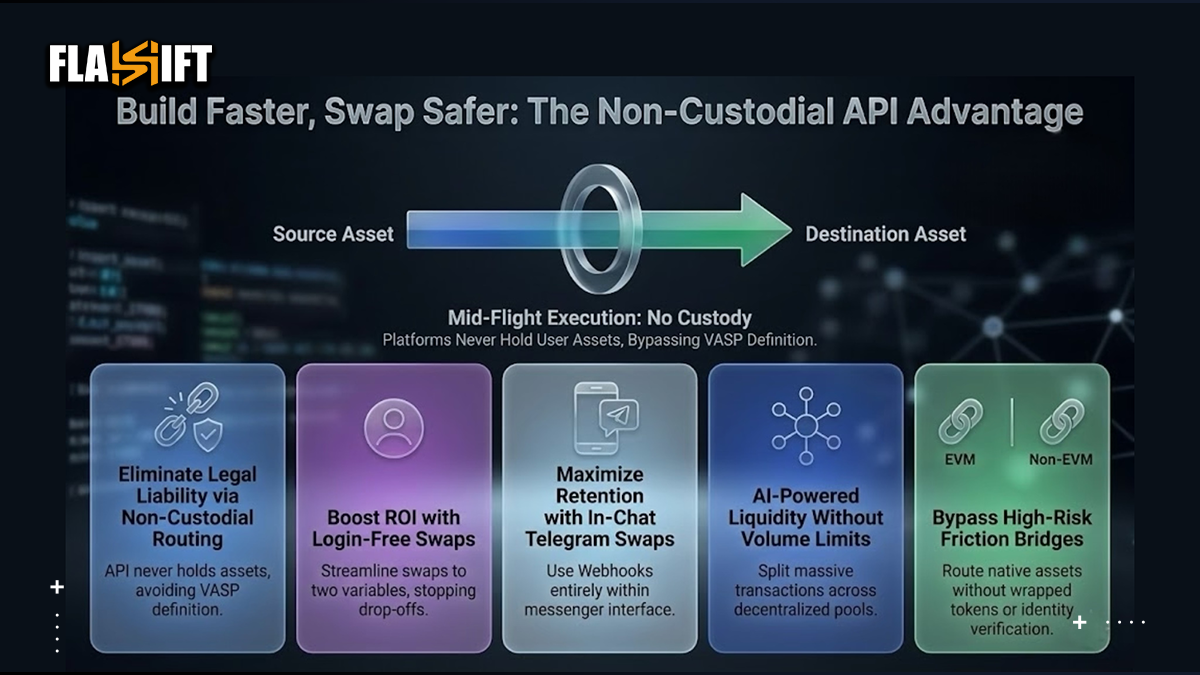
When evaluating the best non-custodial crypto swap api without kyc, developers are ultimately trying to solve one core pain point: the fear of counterparty risk. If an API requires you to deposit user funds into a central smart contract or platform wallet before executing a trade, your application inherits massive exploit vectors.
Flashift solves this through a strict “Mid-Flight Execution” model. We differentiate our API from centralized intermediary endpoints by ensuring capital never rests.
How it works: The user’s assets move directly from their source wallet, are routed seamlessly through decentralized and non-custodial liquidity providers via the API, and land instantly in their destination wallet. The API acts strictly as a secure communication and routing layer. Your backend never touches the capital, completely insulating your business from custodial risks.
Eliminating the Sign-Up Wall: Maximizing App ROI
Every additional step in your application’s user journey causes conversion drop-offs. Traditional authentication methods (OAuth, email verification, or document uploads) destroy Return on Investment (ROI).
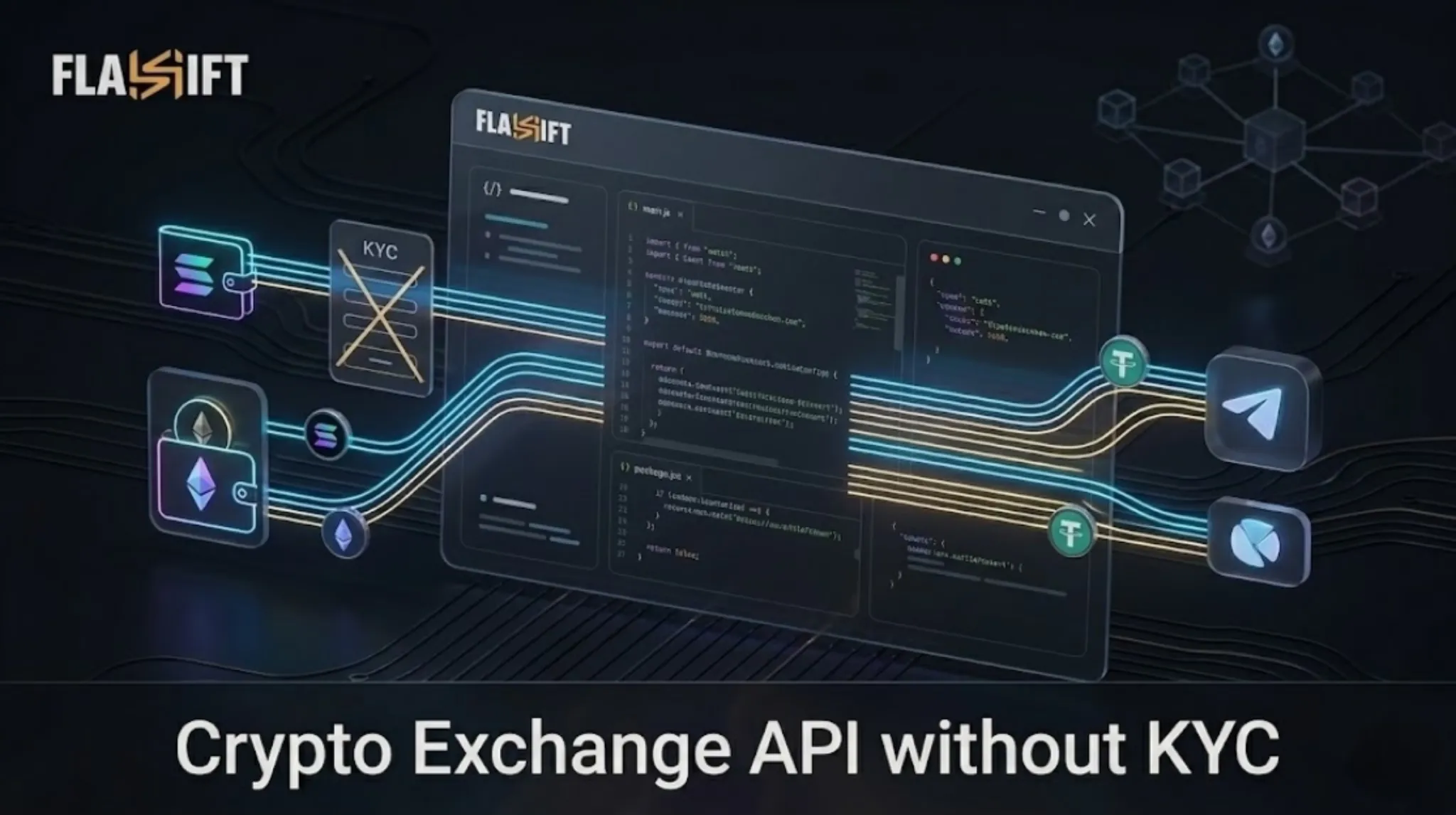
If you want to maximize retention, your platform needs a crypto swap api with no user login required. By entirely removing the sign-up wall, developers can streamline the user flow down to just two variables: Source Address and Destination Address.
This is the core reason why developers research how to integrate cross-chain exchange api no registration. It changes the transaction lifecycle fundamentally:
The ROI Flowchart Comparison:
- ❌ Traditional Login Model: User clicks swap, Redirected to OAuth/Email, Submits Documents, Waits for Approval, Deposits to Custodial Wallet, Executes Swap, Pays Withdrawal Fee, Assets arrive. (Result: High Friction, Massive Abandonment)
- ✅ Direct Wallet-to-Wallet via Flashift API: User clicks swap, API Endpoint calls Source/Dest Addresses , Mid-Flight Execution, Assets arrive natively. (Result: Zero Friction, Instant Settlement)
Telegram Integration: Keeping Users Inside the Chat
Telegram Mini-Apps (TMA) have dominated user acquisition in 2026. However, developers face severe user churn when a bot forces the user to exit the Telegram app, open an external browser, and undergo identity verification just to execute a trade.
Developers can eliminate this friction using Flashift’s lightweight REST API (/getProviders, /getEstimatedAmount, /createTransaction). The entire non-custodial swap workflow executes natively within the Telegram interface without external redirects or web3 wallet signatures:
-
Real-Time Rate Querying: The bot executes a lightweight
GETrequest to/getEstimatedAmountwith key parameters (symbol_from,network_from,symbol_to,network_to,amount) to display real-time execution quotes across varoius liquidity providers. -
In-Chat Order Generation: Calling the
/createTransactionendpoint generates a uniqueexchange_idalong with a dedicated deposit address returned directly to the user in the chat thread. -
Lifecycle Tracking: By polling
/getTransactionInfoor utilizing automated Webhooks, the bot updates the user on status progression (Awaiting Payment-Confirming-Exchanging–Finished) in real-time.
This API architecture keeps 100% of user engagement inside your Telegram application while keeping your backend completely isolated from asset custody.
* Full Guide for Developers: “How to Set a Telegram Bot for Exchanging using Flashift’s API“
Solving DApp Isolation: AI-Powered Liquidity Aggregation
If you are building an application isolated on a single network (like Arbitrum, Base, or Optimism), finding deep cross-chain liquidity without sending user data to centralized databases is a challenge.
Integrating a sovereign-grade liquidity aggregator api for dapps solves this isolation. Flashift’s AI engine goes far beyond simple rate-finding. It continuously performs post-trade analysis across hundreds of operational parameters. If our AI detects that a specific provider is utilizing bait-and-switch spread manipulation or flagging an anomalous percentage of transactions for sudden, post-deposit KYC holds, the system instantly isolates that route. Your DApp secures the best global rate while automatically filtering out problematic providers to ensure a seamless experience for your users.
The Limit Myth: Processing Institutional Volume
A common misconception among developers is that registration-free routing cannot handle heavy or institutional volume. Traders and platforms often search for the best decentralized swap api without kyc limits because legacy privacy platforms enforce strict daily withdrawal ceilings (e.g., maximum 1,000 per day).
With Flashift’s API infrastructure, this limit is a myth. By utilizing an AI-driven, multi-path routing algorithm, our API can split and execute massive transactions across multiple decentralized and instant liquidity pools simultaneously. This ensures deep liquidity execution without triggering artificial, centralized volume ceilings.
Remove the Friction of Bridges and Protecting Privacy
Moving native assets between non-EVM and EVM chains (e.g., swapping Solana to Ethereum natively) traditionally forces users into centralized cross-chain bridges. These bridges act as centralized honeypots and demand identity data.
By utilizing a cross-chain routing endpoint no identity verification, your application completely removes these “Friction Bridges.” The API coordinates the swap on both native chains simultaneously without issuing risky wrapped tokens.
Furthermore, if your application caters to users who demand absolute financial sovereignty, Flashift serves as the best privacy-preserving coin swap api no kyc 2026. By maintaining shielded address mechanisms and strictly avoiding platform-level freezes, your users can route native privacy assets like Monero (XMR) into stablecoins (USDT) cleanly, without fear of source-platform retaliation or tracking.
Get Started: Tool-Tip Integration
Your priority as a developer is to build exceptional, frictionless user interfaces. Our priority is to handle the complex, multi-chain execution behind the scenes securely.
💡 Ready to transform your DApp, Wallet, or Telegram bot into a non-custodial trading hub without the regulatory overhead? Explore the Flashift API Documentation to generate your API keys, test our Webhook environments, and launch your seamless swap integration today.