
You want to secure your Bitcoin profits into a stablecoin, but you refuse to hand over your passport to a centralized exchange—and you certainly aren’t going to pay $30 in Ethereum gas fees to do it. If you are searching for a true “BTC to USDT TRC20 swap no KYC” solution, you are in the right place.
Most crypto guides gloss over the realities of on-chain privacy. They recommend centralized platforms that freeze your funds, or they forget to tell you how Tron network fees actually work. In this guide, we are cutting the fluff. We will walk you through exactly how to execute a cross-chain transaction into USDT TRC20 without ID verification, compare the top platforms, and reveal the “hidden KYC traps” that other exchanges pray you never learn about.
Sovereign BTC to USDT Swaps
To understand how a sovereign crypto swap works, you have to understand the mechanics of non-custodial swaps.
Unlike Binance or Coinbase, which hold your private keys and require extensive identity verification, a non-custodial swap platform acts merely as a routing layer. You do not create an account. You do not deposit funds into a centralized wallet. Instead, the platform generates a temporary, one-time deposit address. You send your Bitcoin to that address, the decentralized routing system converts it via liquidity providers, and the resulting USDT is sent directly to your private Tron wallet.
Because the platform never takes permanent custody of your assets, it operates outside the strict regulatory bounds that force traditional exchanges to demand your ID. This ensures your financial sovereignty remains intact while providing high-speed execution.
Top Platforms for Sovereign Swaps Compared
When searching for a zero KYC crypto exchange, the market is flooded with options. However, not all non-custodial platforms are created equal. Here is a realistic comparison of major players in the space—including intelligent aggregators like Flashift—focusing on what actually matters to a privacy-conscious trader.
| Feature | ChangeNOW | SimpleSwap | FixedFloat | Flashift (AI Aggregator) |
| Speed | 5 to10 minutes | 10 to15 minutes | 2 to 5 minutes (Lightning fast) | 2 to5minutes (Smart routing) |
| Liquidity Limits | Very High (Millions) | Moderate to High | Lower (Best for small/medium swaps) | Maximum (Aggregates global liquidity) |
| KYC Strictness | Moderate (Will flag high-risk BTC) | Moderate | Very strict on high-risk deposits | Zero-custody (AI actively avoids KYC traps) |
| Best For | Whale-sized transactions | Wide variety of altcoins | High-velocity micro-swaps | Best rates, highest privacy, zero friction |
Pro Tip: Instead of guessing which individual platform has the best rate or lowest risk of freezing your transaction on any given day, Flashift acts as an intelligent layer above them. Flashift’s AI not only routes you to the best rate but actively filters out providers exhibiting high KYC-hold risks in real-time, delivering the ultimate sovereign swap experience.
Why Choose the Tron (TRC20) Network?
When you move out of Bitcoin, you have to choose a destination network for your USDT. While the Ethereum network is the most famous, it is structurally inefficient for everyday stablecoin transfers. The Tron network has become the dominant layer for USDT for two simple reasons: speed and cost.
While Bitcoin takes roughly 10 minutes to confirm a block, and Ethereum takes about 12seconds, the Tron network processes blocks in just 3 seconds.
Avoiding High Network Fees
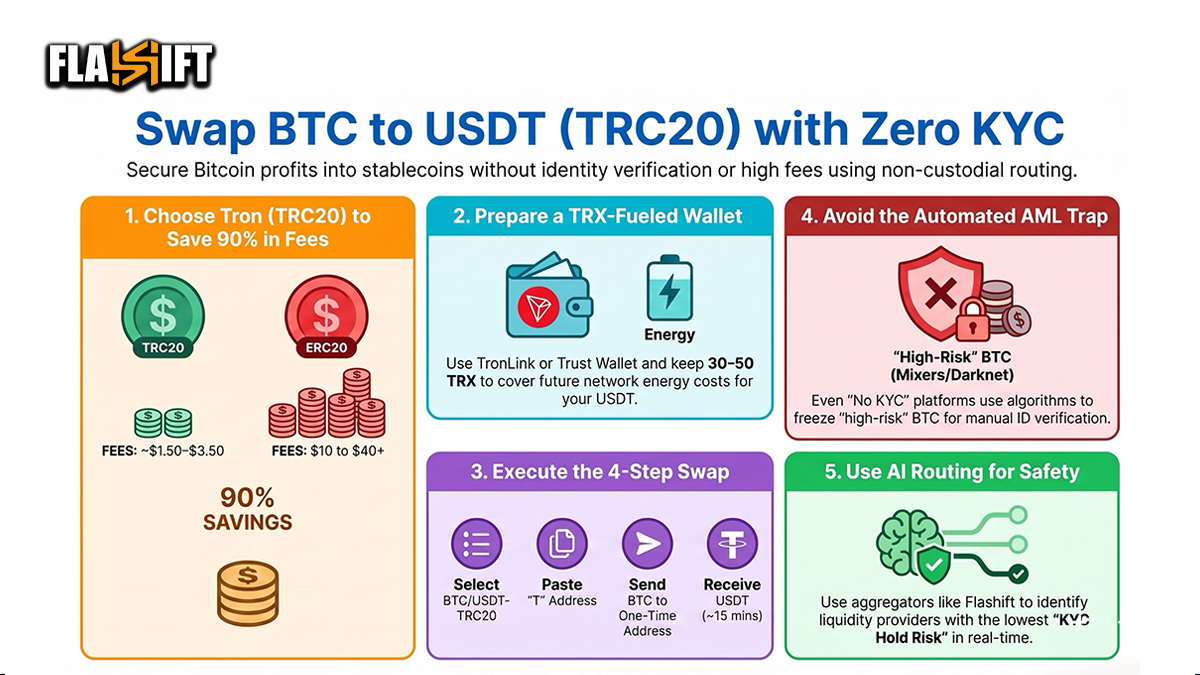
The most critical difference lies in the fees. Let’s look at the real-world numbers of an ERC20 vs TRC20 transfer:
- USDT (ERC20): Moving Tether on Ethereum requires ETH for gas. Depending on network congestion, a single USDT transfer can cost anywhere from 10 to 40+. This brutally destroys your margins on smaller trades.
- USDT (TRC20): Moving Tether on Tron requires TRX energy. A standard TRC20 transfer typically costs about 15 to 30 TRX (roughly 1.50 to 3.50). Furthermore, if you stake TRX in your wallet to generate your own Energy, your USDT transfers can literally be free.
A full guide: Swap USDT TRC20 to ERC20 Instantly: Lowest Fees Guaranteed
Step-by-Step Guide: How to Swap BTC for USDT (TRC20)
Executing a BTC to USDT TRC20 swap is straightforward, but making a mistake across two different blockchains can result in lost funds. Follow this exact flow:
Step 1: Prepare Your TRC20 Receiving Wallet:
You need a secure, non-custodial wallet that supports the Tron network. TronLink wallet and Trust Wallet are the industry standards. Crucial Warning: To move or sell your USDT later, you must have a small amount of native TRX (at least 30 to 50 TRX) in this wallet to pay for network fees. Do not trap your USDT in an empty wallet!
Step 2: Set Up the Swap:
Go to a zero-KYC aggregator (like Flashift).
- Select BTC as your “Send” currency.
- Select USDT (TRC20) as your “Receive” currency.
- Enter the exact amount of Bitcoin you wish to swap.
Step 3: Enter Your Destination Address:
Copy your USDT (TRC20) receiving address from your Trust Wallet or TronLink and paste it into the exchange platform. Double-check the first and last four characters. TRC20 addresses always start with a capital “T“.
Step 4: Deposit and Wait:
The platform will generate a one-time Bitcoin deposit address. Send your exact BTC amount to this address from your Bitcoin wallet. Once the Bitcoin network confirms the transaction (usually 1 block), the exchange will route the liquidity and deposit the USDT directly into your Tron wallet.
The “Hidden” KYC Trap: What You Need to Know About AML
Here is the truth that generic crypto blogs refuse to tell you: “No KYC” does not mean “No AML” (Anti-Money Laundering).
Even on platforms like ChangeNOW or SimpleSwap, your transaction is monitored by automated AML risk-scoring algorithms (such as Chainalysis). If you attempt to swap Bitcoin that has a high “Risk Score”—meaning it has recently passed through a darknet market, a known hack address, or certain coin mixers—the zero-KYC exchange will trigger an automated security hold.
What happens next? Your swap is frozen, and you will receive an email demanding a full KYC check (passport, selfie, source of funds) to unlock your money. This is the ultimate nightmare for the privacy-conscious trader.
How to protect yourself:
- Understand your UTXOs: Never send Bitcoin directly from a high-risk source to a swap platform.
- Use AI Routing: Platforms like Flashift use predictive AI to assign a “KYC Hold Risk” tag to different liquidity providers. By selecting routing paths optimized for minimal verification, you drastically lower your chances of triggering an automated AML trap.
FAQ
-
Can I swap BTC to USDT TRC20 with complete financial privacy?
Yes. By using non-custodial decentralized routing platforms or aggregators, you do not need to create an account or provide ID. However, your transaction is still subject to automated on-chain AML checks, so ensure your Bitcoin does not have a high-risk history.
- Do I need TRX to receive my USDT on the Tron network? You do not need TRX to receive the USDT into your wallet. However, you absolutely must have TRX in that wallet later when you want to send, swap, or move that USDT, as Tron network fees are paid exclusively in TRX energy.
- What happens if I accidentally send BTC to a TRC20 address? Your wallet software will almost certainly prevent this, as Bitcoin addresses (starting with 1, 3, or bc1) and Tron addresses (starting with T) have completely different cryptographic formats. If you somehow force the transaction, the funds will be permanently lost. Always verify you are sending native BTC to a native BTC address.
- How long does a cross-chain transaction from Bitcoin to Tron take? The bottleneck is always the Bitcoin network. It takes an average of 10 minutes to mine a Bitcoin block. Once the swap platform receives that 1-block confirmation, the actual exchange and Tron network payout usually take less than 2 minutes. Expect the total process to take between 10 and 20 minutes.