
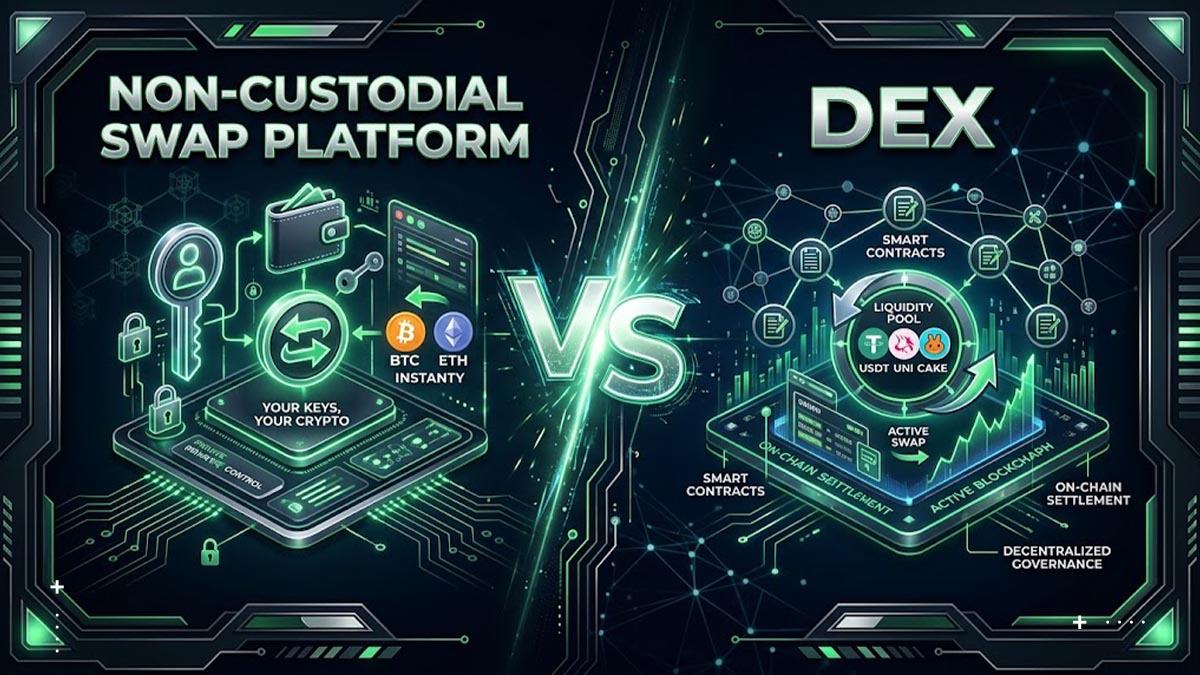
Choosing between a non-custodial swap and a DEX boils down to how you want your trades handled. A DEX relies purely on smart contracts and pools of crypto to make trades happen directly from your connected wallet. Meanwhile, a non-custodial swap acts more like a personal shopper. It hunts for the best prices across various places while still letting you keep total ownership of your crypto, so you never actually deposit anything into a central bank.
The real difference here is flexibility. While DEXs are amazing for trading directly within one single network, swaps make it super easy to trade coins across entirely different blockchains without messing with confusing bridges. Neither option is perfect. Your best choice just depends on fees, speed, privacy, and your own personal comfort with risk.
Continue reading to gain more detailed and specialized information about them.
Non-Custodial Swap Service vs DEX: A Simple Definition
To understand the difference between a non-custodial swap and a DEX, just look at what happens between clicking “Swap” and the new coins hitting your wallet.
A DEX is fundamentally an on-chain AMM (Automated Market Maker). You connect your wallet, pick a trading pair, and a smart contract executes the trade directly against the protocol’s own liquidity pools. The trade relies entirely on the blockchain and the AMM algorithms of that specific network.
A non-custodial swap works primarily as a routing aggregator. Instead of running its own AMM pools, it utilizes API-based routing and RFQ (Request for Quote) systems. It queries multiple external exchanges or market makers in milliseconds, secures the best rate, and routes your trade. You send your crypto to a designated smart address, and the routed funds are forwarded directly to your destination wallet.
Basically, a DEX is a direct on-chain trading venue, while a non-custodial swap platform acts as a router to gather liquidity and execute the trade for you.
A Full Comparison Table for Non-Custodial Swap Platform vs DEX
| Factor | Non-Custodial Swap | DEX |
| Basic role | Executes and routes a swap between supported assets | Provides an on-chain marketplace for trading assets |
| Liquidity source | May aggregate liquidity from multiple external providers | Usually relies on its own on-chain liquidity pools or protocol mechanisms |
| Trade execution | Often handled through APIs, liquidity providers, or automated routing | Executed through blockchain smart contracts |
| Wallet custody | User retains control before and after the swap; no trading-account balance is required | User keeps control of their wallet and signs on-chain transactions |
| Account requirement | Often no account or wallet connection is required, depending on the service | Usually requires connecting a compatible crypto wallet |
| KYC | Some services support swaps without KYC, subject to transaction and compliance requirements | Usually no traditional account-based KYC, although blockchain activity remains publicly visible |
| Cross-chain swaps | Can potentially route between different blockchains without requiring the user to operate a bridge manually | Usually limited to assets and networks supported by the DEX; cross-chain trading may require a bridge or specialized infrastructure |
| Slippage | Can reduce slippage by comparing or routing across available liquidity sources | Depends largely on pool depth, trading pair liquidity, and the chosen execution route |
| Smart-contract exposure | May be lower when the swap does not require direct interaction with a DEX contract, but depends on the provider’s architecture | Direct interaction with the DEX’s smart contracts is normally part of the trade |
| User experience | Often designed around a simple send-and-receive flow | More trading-oriented, with pools, price impact, gas settings, and transaction parameters |
| Best suited for | Straightforward asset swaps, cross-chain conversions, and users who want minimal trading complexity | On-chain traders who want direct access to decentralized liquidity and trading mechanisms |
The important point is that “non-custodial” describes custody, while “DEX” describes a trading infrastructure model. They are therefore not perfect opposites. A DEX can be non-custodial, and a non-custodial swap service can use DEX liquidity as part of its routing process. The real distinction is where liquidity comes from, how the transaction is executed, and how much of that process the user has to manage themselves.
Asset Coverage: Cross-Chain Swaps vs DEX Liquidity Routing
Asset coverage is one of the most practical differences between a non-custodial swap vs DEX. A DEX normally operates within the networks and assets its smart contracts support. If you want to trade two tokens on the same chain, this can work extremely well because the DEX can route your order through one or more liquidity pools.
But when the assets live on different blockchains (for example, swapping an Ethereum-based asset for a Solana-native token) the process becomes more complicated. You may need a bridge, a cross-chain protocol, wrapped assets, or multiple transactions.
The DEX itself does not make two separate blockchains speak to each other.
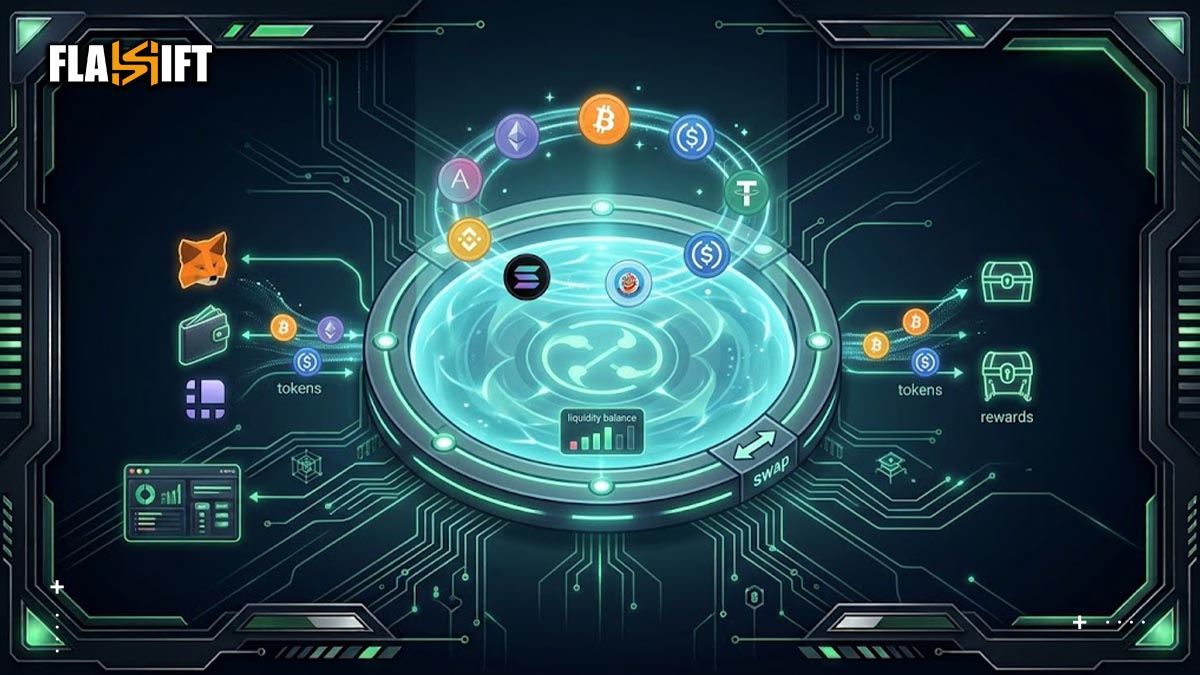
A non-custodial swap service solves the problem of cross-chain liquidity routing. Instead of requiring the user to find a compatible pool and manually move assets between networks, the service can coordinate liquidity from different providers and deliver the requested asset to a destination address on another chain.
This is particularly useful for less liquid or harder-to-pair assets, including privacy-focused coins where conventional DEX liquidity may be limited. The practical advantage is not simply “more coins”; it is more possible routes between assets.
Instead of asking, “Does this DEX have a pool for my pair?” you can ask, “Can this swap infrastructure find a viable route between these two assets?” 👍
Gas Fees: DEX vs Non-Custodial Swap Service
On a DEX, you’re footing the bill for the network fees yourself because your wallet is talking directly to the smart contracts. Depending on the trade, you might be routed through a few different steps, meaning your final cost can easily end up higher than the sticker price. And if the network is slammed? That gas bill can spike faster than you can hit confirm.
With a non-custodial swap, you get to skip wrestling with smart contracts. The service handles the heavy lifting behind the scenes and bakes the costs right into your quoted rate. It’s not that the swap is magically gas-free (the backend providers are still paying those network costs), but it gives you a much more predictable bottom line and saves you a ton of hassle.
| Cost Factor | DEX | Non-Custodial Swap |
| Blockchain gas | Usually paid directly by the user | May be incorporated into the swap quote |
| Smart-contract interactions | Usually required | May be handled by the routing/execution infrastructure |
| Fee predictability | Can change with network conditions | Often easier to see in the final quote |
| Cross-chain costs | May require additional bridge transactions | Can potentially be consolidated into the swap flow |
| Main advantage | Direct control over execution | Simpler fee and execution experience |
Final Verdict: When Is a DEX Better? What Is the Best Non-Custodial Swap Service?
Go with a DEX if you want to be in the driver’s seat for direct on-chain trading. If you already know the ropes when it comes to wallets, gas fees, slippage, and smart contracts, a DEX gives you total, hands-on control and transparency.
On the flip side, if you’re looking for a professional swap service, you can use a non-custodial exchange aggregator like Flashift. It shops around behind the scenes to score you competitive rates, and it handles a ton of different assets and cross-chain swaps without forcing you to sign up for a traditional account.
FAQ
- Can I swap coins across different blockchains on a DEX?
Usually, no. Most traditional DEXs only let you trade tokens that live on the exact same network (like swapping two Ethereum-based tokens). If you want to trade Bitcoin for Ethereum on a DEX, you typically have to mess with complex “crypto bridges” first. Non-custodial swaps, on the other hand, handle cross-chain trades natively behind the scenes, letting you swap across networks in one step.
- Which option is actually cheaper: a DEX or a non-custodial swap?
It depends entirely on the network and the exact coins you are trading. If you are trading on a low-cost network (like Solana or Polygon), a DEX is often cheaper because the direct smart-contract fees are pennies. But if you are trading on Ethereum during a busy time, network gas fees on a DEX can be brutal. Non-custodial swaps bake the network costs into their quoted rate, which can sometimes save you money and definitely saves you from surprise gas spikes.
- Do I lose my network fee if a trade fails on a non-custodial swap?
One of the biggest frustrations with a DEX is that if a trade fails (usually due to high slippage), you still lose the gas fee you paid to try and execute the smart contract. With most non-custodial swaps, if the rate suddenly drops or the trade can’t be completed, the service simply refunds your original coins back to your wallet. You only lose the tiny initial fee it took to send the funds.
- If there’s no account, do I need to do KYC for DEX and Non-custodial Swap Services?
The core appeal of both models is privacy. True DEXs run entirely on smart contracts, meaning there is no company to collect your ID or enforce KYC rules. Non-custodial swaps operate similarly. But some exchanges might have KYC policies. Flashift marks these exchanges to show users. So, you can avoid them.
- Who actually holds my money while the trade is happening?
On a DEX, your funds never leave your wallet until they are instantly swapped with a decentralized liquidity pool via a smart contract. With a non-custodial swap, you send your funds to a temporary, system-generated address. The service instantly routes those funds to a liquidity provider, makes the trade, and sends the new crypto directly to your receiving wallet. Neither option requires you to leave your crypto sitting on an exchange where it could be hacked or frozen.