

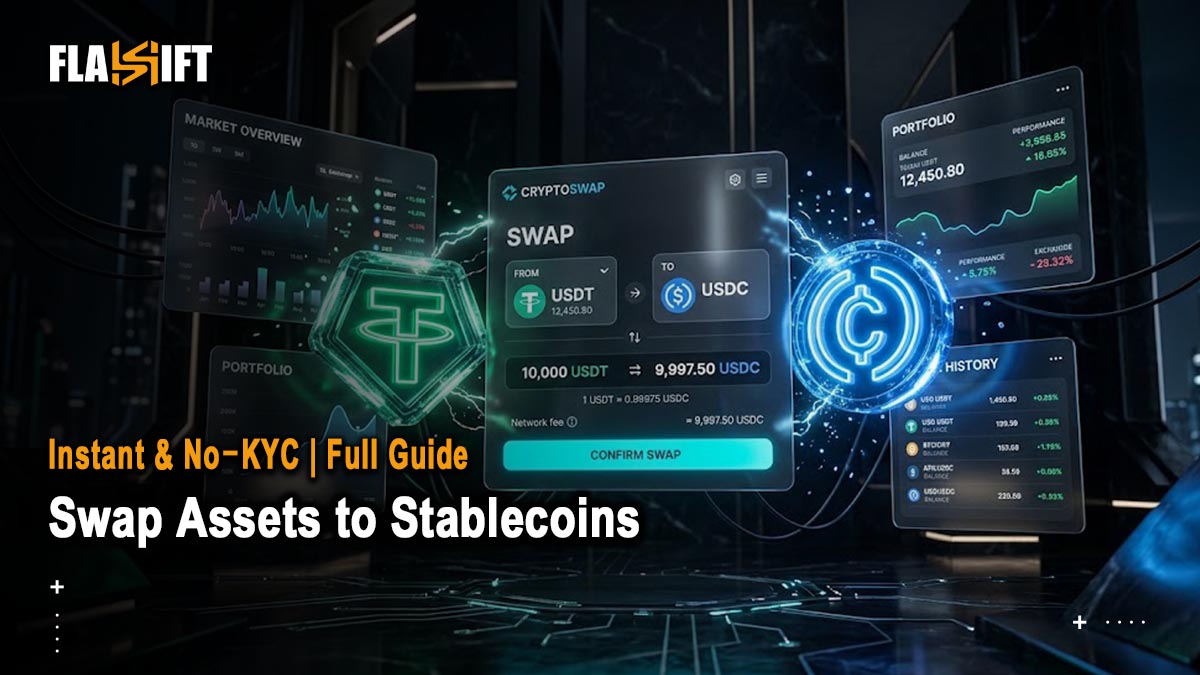
What if securing your crypto profits didn’t require sending sensitive documents to a centralized exchange?
For many crypto users, converting volatile crypto assets into stablecoins such as USDT or USDC is the most capital-efficient way to lock in value without the friction of cashing out directly to fiat bank accounts. A no-KYC, non-custodial swap accelerates this process by allowing you to exchange assets directly from your decentralized wallet, entirely bypassing the need to create accounts or deposit funds on a custodial platform.
However, the efficiency of your swap depends heavily on the execution route. Exchange rates, liquidity pools, network gas fees, and transaction limits vary significantly across the decentralized market. In this guide, we will explain how to navigate these variables and convert your crypto to stablecoins securely and anonymously in minutes.
How to Swap Your Crypto Earnings in Self-custody
Let’s assume you’ve made a profit from crypto and want to shield it from market volatility. The most straightforward strategy is swapping a portion of your holdings into a stable asset like USDT or USDC. The challenge for privacy-conscious users is doing this without registering on traditional exchanges and submitting personal identification (KYC).
This is where a non-custodial, no-KYC crypto swap is essential. By utilizing a non-custodial aggregator, you send crypto from your self-hosted wallet and receive stablecoins directly to another address of your choosing. Your funds are never held on a centralized order book.
Instead of manually checking individual swap services to find the best rate, an aggregator like Flashift simplifies this process by querying multiple liquidity providers simultaneously, ensuring you select the optimal route for your specific transaction.
Instant Swap Crypto to Stablecoins (USDT/USDC) using Flashift
Transitioning a volatile position into USDT or USDC should be frictionless. With Flashift’s infrastructure, you can compare real-time swap offers and execute the exchange instantly without an account.
- Choose your crypto and stablecoin
Select the asset you are selling (e.g., BTC, ETH, or Monero) and choose your target stablecoin (USDT or USDC). Enter the exact amount you wish to convert.
- Pick the offer that works best
Flashift aggregates data from multiple exchange providers. This allows you to transparently compare rates and choose between fixed-rate (guaranteed amount) or floating-rate (market-dependent) options based on current volatility.
- Add your receiving wallet
Input the exact wallet address where you want your USDT or USDC delivered. Crucial step: Verify both the wallet address and the specific blockchain network (e.g., ERC-20, TRC-20, Polygon) before confirming.
- Send and receive
Flashift will generate a specific deposit address for the selected liquidity provider. Send your crypto to this address. Once the blockchain confirms your transaction, the provider automatically routes the stablecoins to your receiving wallet. Depending on network congestion, this process typically finalizes within minutes.
Best Stablecoins to Hold in 2026 | Your Guide to Asset Preservation

Not all stablecoins are identical, even if they all track the $1 mark. The underlying collateral, reserve transparency, and network availability dictate their best use cases.
For 2026, these four stablecoins dominate the market for different reasons:
- USDT (Tether)
USDT remains the industry standard when sheer liquidity and cross-market availability are the priorities. It is deeply integrated across centralized exchanges, DeFi protocols, and payment gateways. If you are an active trader who needs to move between assets rapidly, USDT provides the least friction. (Swap USDT cross-chain with lowest fees)
- USDC (USD Coin)
USDC is the premier choice for users prioritizing regulatory compliance and reserve transparency. Issued by Circle, USDC is backed by cash and cash-equivalent assets, with its reserves independently audited and published regularly. Supported natively across 35 blockchain networks, it bridges the gap between traditional finance and DeFi.
- USDS (Sky)
USDS offers a DeFi-native architecture. As the core stablecoin of the Sky ecosystem, it relies on diversified, over-collateralized on-chain assets that anyone can verify in real-time. USDS is ideal for users looking to generate native yield rather than letting assets sit idle, acting as a gateway to protocols like the Sky Savings Rate.
- USDe (Ethena)
USDe operates differently than traditional fiat-backed tokens. Ethena designed it as a synthetic dollar, utilizing a mix of crypto collateral and delta-hedging derivative strategies to maintain its peg. While this introduces a different structural risk profile, it offers high capital efficiency and unique yield opportunities for advanced DeFi participants.
Stablecoin Comparison at a Glance
| Stablecoin | Main Strength | Backing Model | Best For | Risk Profile |
| USDT 💵 | Liquidity & availability | Reserve-backed | Trading and everyday crypto transfers | Traditional issuer/reserve risk |
| USDC 🛡️ | Transparency & regulatory focus | Cash & cash equivalents | Payments, trading & DeFi | Issuer/regulatory risk |
| USDS 🏦 | DeFi integration | Diversified on-chain collateral | DeFi users & stablecoin strategies | Smart-contract & collateral risk |
| USDe ⚡ | Capital efficiency & DeFi utility | Synthetic/hedged backing | DeFi, trading & yield strategies | Higher structural/strategy risk |
Bottom line: If you require maximum market liquidity, USDT is the logical choice. USDC excels in transparency and regulatory trust. USDS is tailored for pure DeFi integration, while USDe is strictly for advanced users comfortable with synthetic mechanisms.
Final Thoughts
While stablecoins share the goal of parity with the US dollar, their mechanical differences are significant. When converting your crypto holdings, look beyond the ticker symbol. Always verify the network compatibility, assess the liquidity depth, and calculate the net amount received after routing fees.
Manually comparing these metrics across multiple decentralized exchanges is time-consuming. Flashift’s AI Smart Routing automates this comparison, scanning the market to secure the most capital-efficient route available for your non-custodial swaps.
FAQ
- Can I hold USDT and USDC on the same wallet?
Yes, assuming your self-custodial wallet supports both assets and the respective blockchain networks they are issued on. Note that USDT on the Tron network (TRC-20) is not natively interchangeable with USDT on Ethereum (ERC-20).
- Why can a stablecoin swap cost more even when the price is still $1?
The $1 parity refers to the asset’s value, not the cost of acquiring it. Your final received amount is impacted by network gas fees, liquidity provider (LP) fees, exchange spreads, and slippage.
- Is USDT or USDC better for moving crypto between exchanges?
This depends entirely on the specific networks supported by both the sending and receiving platforms. USDT generally has broader global exchange support, whereas USDC is heavily favored in major DeFi ecosystems and regulated platforms.
- What happens if I send USDC to a USDT-only deposit address?
Funds sent to an incompatible address or network may be permanently lost. While some advanced wallets can recover misrouted tokens, standard exchange deposit addresses cannot automatically process incorrect assets. Always match the exact token and network before executing a transfer.
- Is converting crypto to USDT or USDC the same as cashing out to fiat?
No. Swapping Bitcoin or Ethereum for a stablecoin is simply trading one digital asset for another to stabilize value. Cashing out to fiat involves converting that stablecoin into physical currency (like USD or EUR) through an off-ramp, which typically requires bank integration and mandatory KYC verification.