

Monero has had a loud year, and not always for good reasons. In June, CoinDesk reported that about $120 million in USDT was pushed through a chain of swaps, including large XMR purchases that moved the price from roughly $330 to $438. Tether later froze $72 million of it.
If you hold XMR and want out, the cleanest route is a direct crypto-to-crypto swap into BTC or a stablecoin, with no account to open. Pick your pair in the widget below, paste your receiving address, and send.
👉 [Swap XMR to BTC now] or any other cryptos; No-KYC, No Sign-up
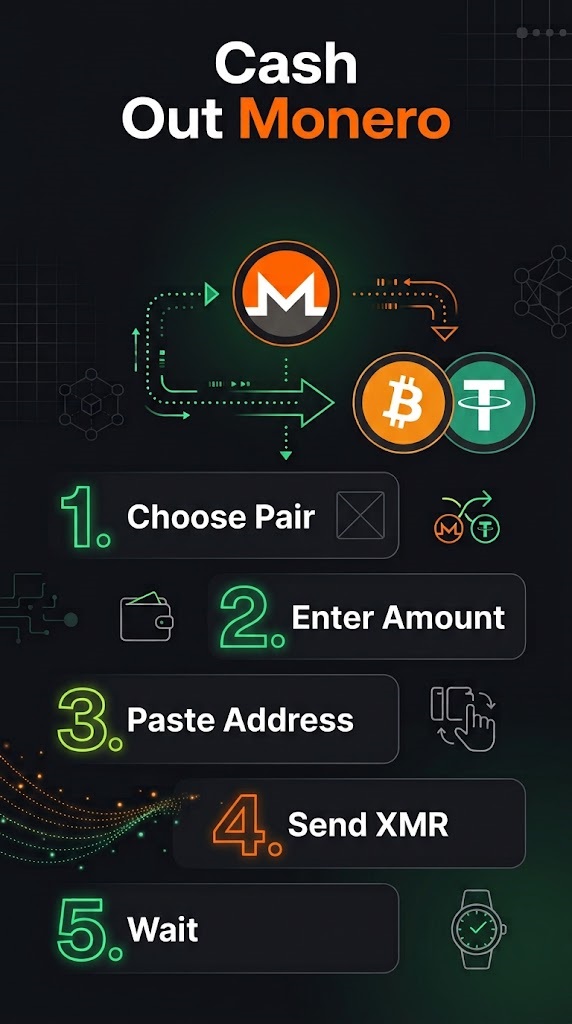
Quick answer
| Question | Short answer |
| Can I sell Monero directly for cash? | Not through a swap. A swap turns XMR into another crypto asset. |
| What’s the fastest way out of XMR? | Swap to BTC or a stablecoin such as USDT, then decide what to do next. |
| Do I need an account? | Not for a standard swap here. You enter an address and send. |
| Which is better, BTC or stablecoin? | BTC if you plan to hold or move it elsewhere. A stablecoin if you want a dollar-pegged balance. |
| What’s the biggest mistake? | Pasting the wrong address or picking the wrong network. Swaps can’t be reversed. |
What “Cash out Monero” actually means
People search for “sell Monero for cash” or “turn Monero into cash,” but those phrases cover two separate steps.
Step one is leaving Monero. XMR has limited liquidity compared with BTC, and many large exchanges have dropped it, so the usual path is a swap into something more widely supported.
Step two is whatever you do with that BTC or stablecoin afterward. That could be holding it, paying for something, or moving it to a service in your country that handles bank transfers. This guide covers step one. Flashift is a crypto-to-crypto service and doesn’t pay out cash or fiat, so anything that touches bank money happens elsewhere, under that provider’s rules.
What to do right now: Swap XMR in five steps via Flashift
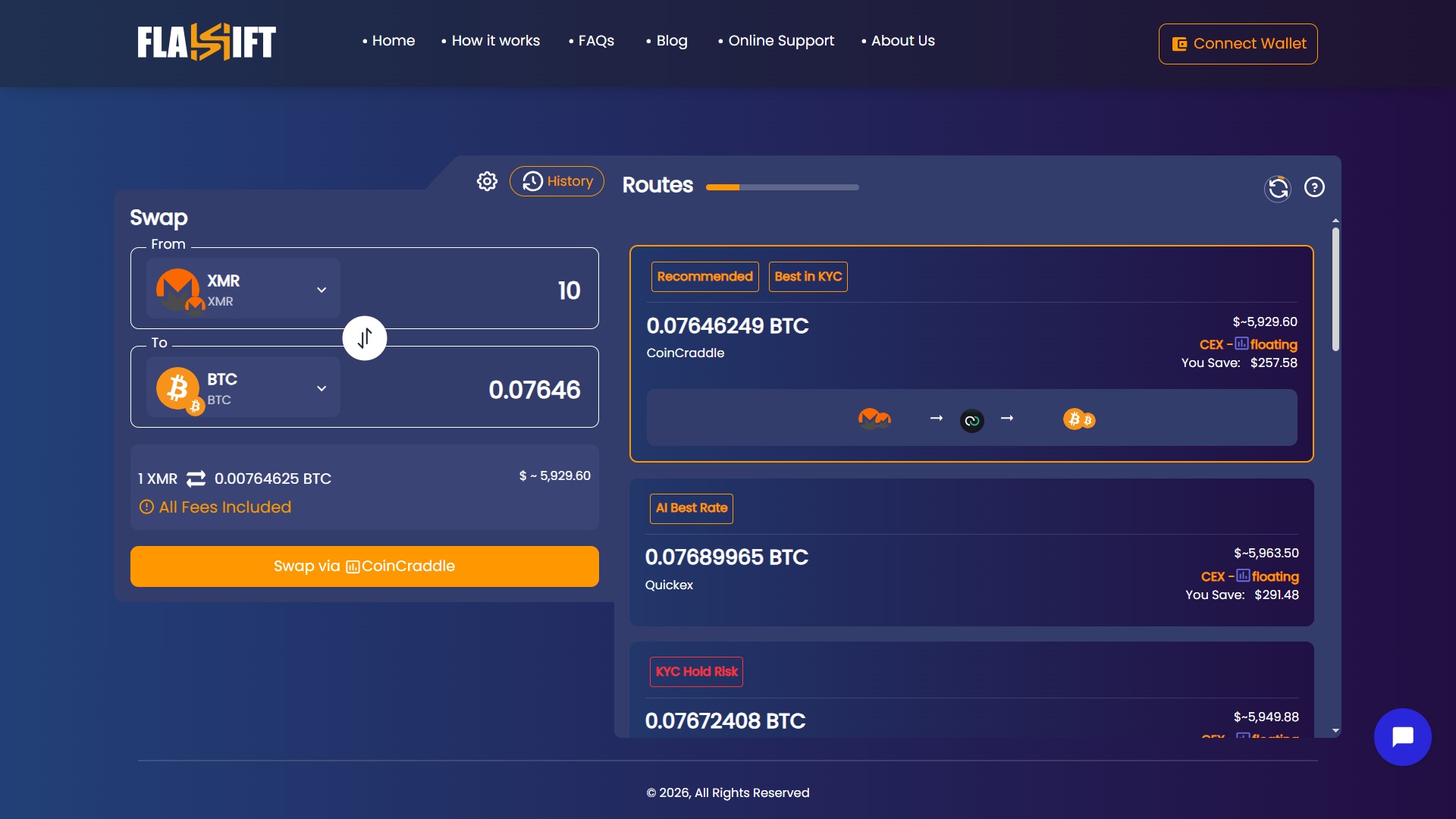
- Visit Flashift.app & Choose your pair. Open Flashift website and set XMR as the asset you send. Choose BTC, or a stablecoin, as the asset you receive. If you’re leaning toward BTC, the XMR to BTC page shows that pair directly.
- Enter the amount. The widget displays the estimated amount you’ll receive before you commit. Check it against the rate type shown, fixed or floating.
- Paste your receiving address. Copy it from your own wallet and compare the first and last characters after pasting. If you’re receiving a stablecoin, confirm the network (Tron, Ethereum, and so on) matches what your wallet expects.
- Send XMR to the deposit address. Use the exact address the order gives you, from a wallet you control. Don’t send from an exchange account if you can avoid it, since some exchanges attach withdrawal conditions or delays.
- Wait for confirmations. Monero requires a few confirmations before funds count, then the swap completes and your coins arrive. Keep the order ID until you see them in your wallet.
Not sure about the privacy side? Our guide on how to exchange Monero anonymously explains what a swap does and doesn’t hide.
XMR to BTC vs. Stablecoins: Which is the Safest Cash-Out Route?
There’s no universal answer. It depends on what you want to do after the swap.
| Swap to BTC | Swap to stablecoin (USDT, etc.) | |
| Good for | Holding, or sending to wallets and services that accept Bitcoin | Parking value in a dollar-pegged asset |
| Price movement after swap | BTC still moves | Designed to stay near $1 |
| Network choice | One main network | Several networks; you must pick correctly |
| Main risk | Volatility | Issuer control and address freezes |
That last row matters more than most guides admit. The CoinDesk story above notes that Tether can blacklist a specific address and freeze the USDT in it, after which the tokens can’t be moved or cashed out. For most people holding ordinary funds this never comes up, but it’s a real feature of how some stablecoins work. If you’d rather not depend on an issuer, BTC avoids that particular issue.
If you’ve decided on a stablecoin, the guide to swapping crypto to stablecoins without KYC covers network choices and receiving addresses in more detail.
Checks that save you from expensive mistakes
- Match the network exactly. USDT on one network isn’t spendable on another. This is the most common way people lose funds.
- Copy addresses from your own wallet, not from chat messages or emails.
- Read the rate type. A fixed rate locks the quote. A floating rate can change slightly before your deposit confirms.
- Mind the minimums. Very small swaps may fall below a pair’s minimum.
- Keep your records. Save the order ID and transaction hash until the swap shows as complete.
A note on responsible use
Swaps are a normal tool, but the June story shows how scrutiny works in practice: large, fast movements between assets, instant swap services and bridges get noticed by investigators and issuers. If your funds are legitimate, your best protection is simplicity. Use your own wallets, don’t split a single balance into dozens of rushed hops, and keep your own records. Rules about reporting and taxes differ by country, and we can’t advise on them, so check with a qualified professional where you live.
FAQ
1. Can I convert Monero to cash with Flashift?
No. Flashift swaps one cryptocurrency for another, so you can receive crypto assets, not fiat. If you want money in a bank account, that requires a separate service that handles withdrawals in your region.
2. Is swapping XMR to BTC private?
A swap breaks the direct link between your Monero wallet and the coins you receive, but it doesn’t make you invisible. The receiving blockchain, such as Bitcoin’s, is public, and anyone watching an address can see what happens to it afterward.
3. What if I choose the wrong network or address?
Crypto transactions can’t be reversed. If you send to the wrong address or the wrong network, recovery depends on who controls that address and is often impossible. That’s why the small test swap is worth the extra minute.
4. How many network confirmations does Monero require before the swap completes
Monero requires a few confirmations on its blockchain before the funds count and the swap is processed. This ensures network security, so you should keep your order ID until the coins arrive in your wallet.
5. Can a floating rate change my final payout when cashing out XMR?
Yes, a floating rate can change slightly before your deposit confirms on the network. If you want to lock in the exact quote, make sure to choose a fixed rate when setting up your swap.