
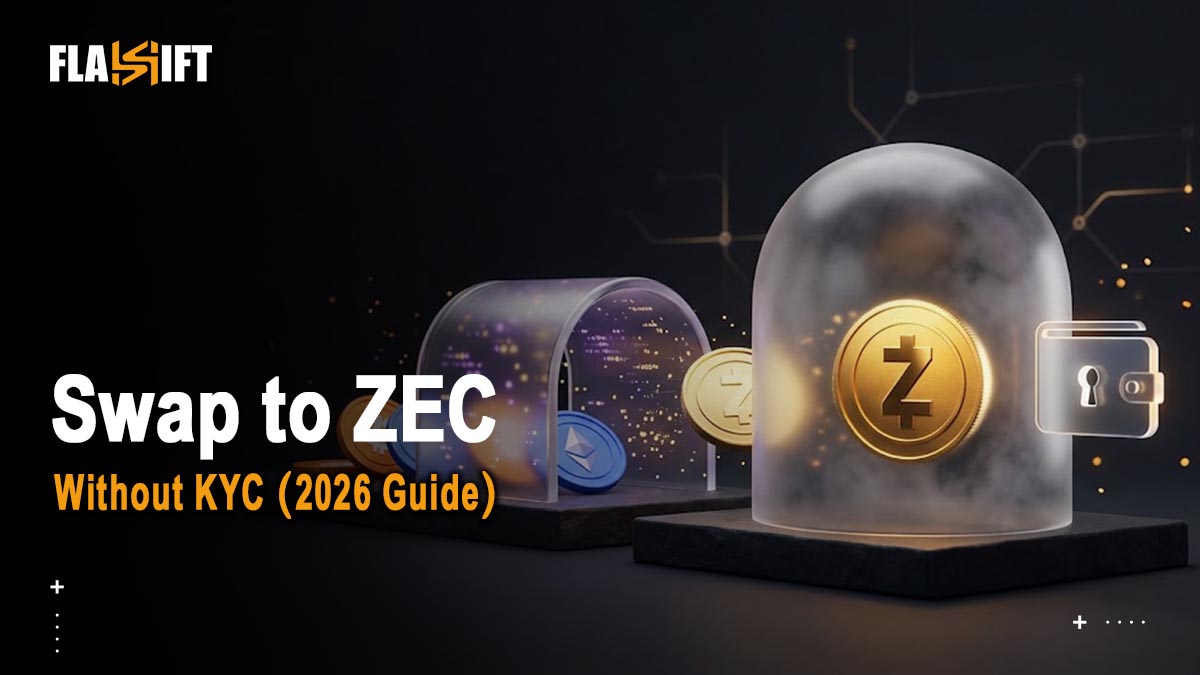
To swap to ZEC without KYC, use a non-custodial swap aggregator such as Flashift. Choose the coin you already hold, set ZEC as the destination, paste your Zcash address, and send the deposit to the address shown. No account is created and no ID is requested at the aggregator level.
Searches for “swap to ZEC” or “bridge to ZEC” both describe roughly the same goal: getting Zcash into a wallet you control without filing an identity dossier along the way. The routes differ, and so do the trade-offs. This guide walks through the process on Flashift, explains what stays private and what doesn’t, and flags the situations where a no-KYC swap can still run into a verification check.
Exchange ETH to ZEC on Flashift →
Swap, bridge: what the words mean for ZEC
People use these terms loosely, which causes real confusion.
| What happens | KYC likely? | |
| Swap to ZEC | You send one crypto (BTC, ETH, USDT, SOL and so on) and receive ZEC at your address | Usually no, for crypto-to-crypto |
| Bridge to ZEC | A swap that crosses blockchains. Zcash is its own chain, so you receive native ZEC, not a wrapped token | Usually no |
The “bridge” label deserves a note. A classic bridge locks tokens on one chain and mints a representation on another. Moving into ZEC doesn’t work that way, because Zcash has its own network. A cross-chain swap delivers actual ZEC. Bridging out of ZEC works the same way in reverse.
Before you start: get a wallet that can receive ZEC
You need a Zcash wallet where you hold the keys. Options that support shielded ZEC include Zodl (the wallet formerly known as Zashi, renamed in early 2026), Zingo and Ywallet. Hardware wallet users can manage ZEC through Ledger, though check what address types your setup supports.
Write your seed phrase on paper. Not in a notes app, not in a screenshot. Anyone who has it controls the funds, and no legitimate service will ever ask for it.
Then look at the address you’ll receive on. Zcash has two broad families:
- Transparent addresses start with t1 or t3. They behave like Bitcoin addresses, and everything is public on-chain.
- Shielded and unified addresses (unified ones start with u1) support private transactions, where sender, receiver and amount are encrypted.
Which one the swap form accepts matters, and we’ll come back to it.
How to swap to ZEC on Flashift
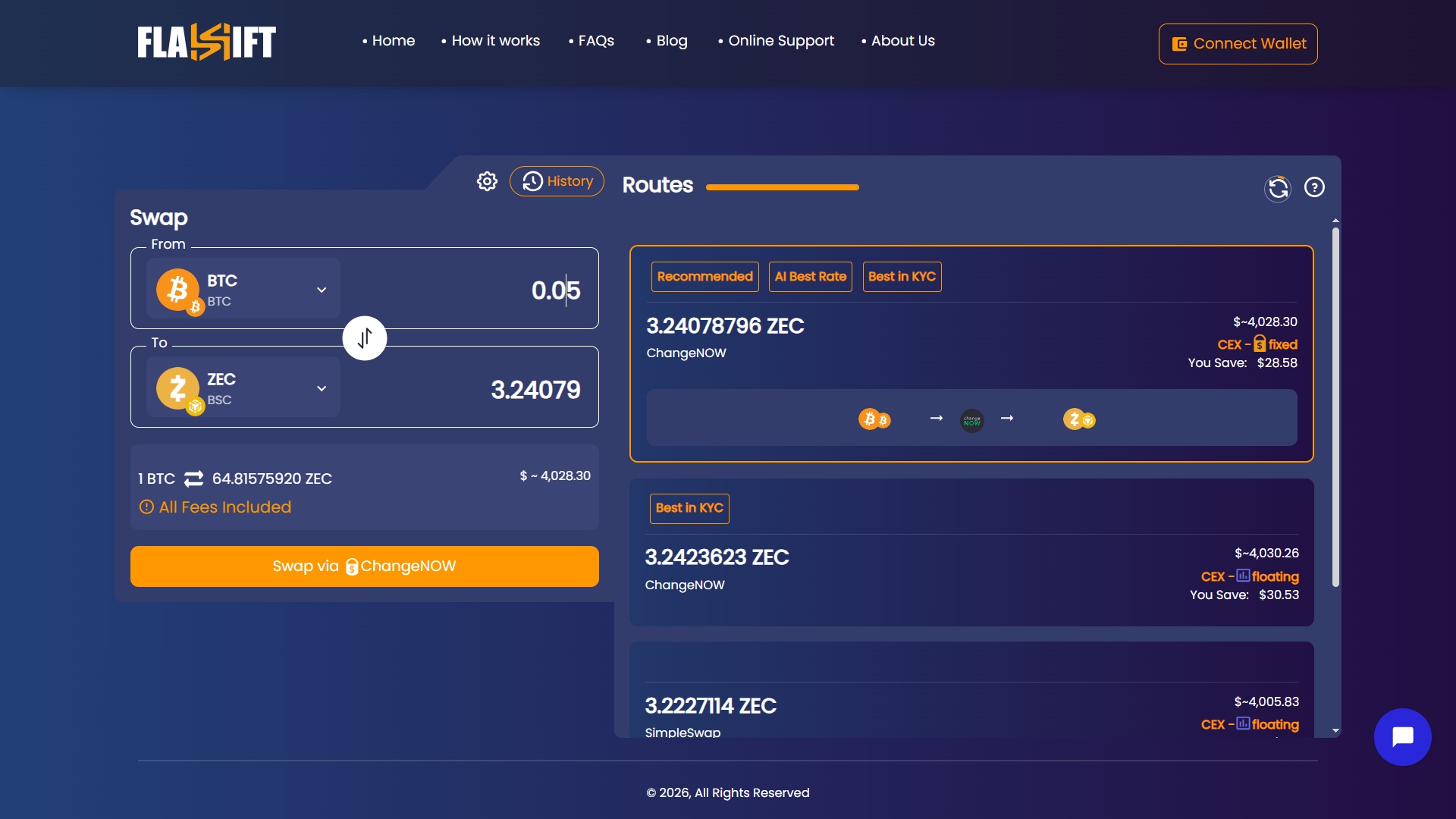
Flashift doesn’t hold your funds. It compares offers from partner swap services and routes your order to the one you pick. The steps below match the current flow, though the interface changes from time to time, so trust what you see on screen over any screenshot.
- Open Flashift.app.
Type the address yourself or use a bookmark. Fake swap sites are one of the most common ways people lose money in crypto.
- Set the pair.
Under “From”, choose the asset you hold. If it exists on several networks (USDT is the classic case), select the exact network your funds are on. Under “To”, choose Zcash (ZEC).
- Enter the amount and compare offers.
Flashift lists quotes from several providers and tags them, for example Recommended, Best Rate, No Hold and Best in KYC. A higher number isn’t automatically the better choice. A slightly lower rate from a provider with a clean track record often beats a flashy rate with a history of holds.
- Paste your ZEC address.
Copy it straight from your wallet and check the first and last characters after pasting. If the form rejects a unified or shielded address, use your wallet’s transparent address for this step and shield the funds afterwards (see the next section).
- Add a refund address if asked.
It costs ten seconds and saves a lot of grief if the order fails.
- Send the deposit.
Flashift shows a deposit address and an exact amount. Send from your own wallet, on the right network, and send the full amount. Sending less usually means the order stalls or refunds. Fixed-rate quotes also carry a time window, so don’t start the order and then walk away.
- Track the order and receive ZEC.
Once the deposit confirms on the source chain, the provider sends ZEC to your address. Timing depends mostly on the source network; swaps often finish within minutes, but congestion can stretch that. Keep the order ID until the ZEC shows up.
What stays private and what doesn’t
This is the part many guides gloss over.
The transaction on the source chain is public. If you pay from Bitcoin, that payment lives on Bitcoin’s ledger forever. Zcash’s privacy applies to what happens on Zcash, and only for shielded funds.
If your swap pays out to a transparent address, the incoming ZEC is visible on-chain. The usual fix is to move it from the t address to a shielded address in your own wallet, a step known as shielding. After that, your balance and future transactions are hidden. Many centralized exchanges still can’t withdraw directly to shielded addresses, which is one reason people use swap routes in the first place.
A few habits help in practice:
- Use a fresh receiving address for each swap.
- Avoid sending the shielded funds straight back to an exchange deposit address.
- Don’t reuse the same round amounts in and out, which makes matching easy.
Shielded ZEC has grown a lot. Reports in early 2026 put it at roughly 30% of circulating supply, which helps, since a bigger shielded pool means a bigger crowd to blend into.
Is Flashift really no-KYC?
Flashift itself requires no registration and no ID. But Flashift routes orders through partner providers, and those providers run their own risk systems. Large amounts, flagged source addresses or unusual patterns can trigger a hold or a verification request on their side, regardless of what the aggregator asks of you.
The solution: Prefer offers tagged “Best In KYC” & avoid offers tagged “KYC Hold Risk” by our system.
Mistakes that cost people money
- Choosing the wrong network for a token
- Sending a different amount than the order specifies
- Pasting an address without checking it
- Using a lookalike website
- Skipping the refund address
- Leaving ZEC parked on a service instead of moving it to your own wallet
- Trusting “support agents” who message you first
Legal and tax notes
Swapping crypto for crypto without identity verification is legal in many countries, but not everywhere, and rules on privacy coins vary. Some jurisdictions restrict them or have pushed exchanges to delist them. Skipping KYC doesn’t remove tax obligations: in many places a swap counts as a taxable disposal. Check local rules, and talk to a tax professional if the amounts are significant. This article is general information, not legal, tax or financial advice.
🚀 Are you ready to try Flashift? Swap your crypto to Zcash less than 5 minutes.
FAQ
- Why do some exchange forms reject my shielded or unified Zcash address?
Many centralized exchanges still can’t withdraw directly to shielded addresses. If the swap form rejects a unified or shielded address, use your wallet’s transparent address for this step. Once received, you can move the funds from the transparent address to a shielded address in your own wallet, a step known as shielding.
- Is my cross-chain swap to ZEC completely untraceable?
No, the transaction on the source chain is public. For example, if you pay from Bitcoin, that payment lives on Bitcoin’s ledger forever. Zcash’s privacy applies only to what happens on the Zcash network itself, and specifically only for shielded funds.
- What happens if my “No-KYC” swap gets flagged for verification?
While Flashift itself requires no registration and no ID, the partner providers process the trades and run their own risk systems. Large amounts, flagged source addresses, or unusual patterns can trigger a hold or a verification request on their side. To mitigate this risk, always add a refund address when asked, which saves a lot of grief if the order fails. Furthermore, prefer offers tagged “Best In KYC” and avoid offers tagged “KYC Hold Risk” by the system.
- Do I receive native ZEC or a “Wrapped” token when bridging?
A cross-chain swap delivers actual ZEC. Because Zcash is its own separate chain, you receive native ZEC directly to your network address, not a wrapped representation of the token on another blockchain.
- What are the most common mistakes to avoid during a ZEC swap?
To avoid losing money, make sure you never send a different amount than the order specifies, and always check the first and last characters of your address after pasting it. Additionally, avoid using lookalike fake swap websites, do not skip adding a refund address, and never leave your ZEC parked on a service instead of moving it to your own self-custodial wallet.