

If you’re holding USDT and want Monero instead, the process is shorter than most guides make it sound. Choose USDT as the coin you send and XMR as the coin you receive, paste a fresh Monero address from your own wallet, send the deposit, and wait. On Flashift that usually takes 3 to 5 minutes, and there’s no account to create.
Exchange USDT to XMR on Flashift →
The swap itself is the easy part. What actually goes wrong is everything around it: the wrong network, the wrong kind of address, or expecting your XMR to be spendable the second it shows up. This guide walks through the full USDT to XMR swap and points out those spots as we reach them.
Why people swap USDT to XMR
USDT is convenient, and that’s about as far as its privacy goes. Every transfer sits on a public chain, so anyone who gets hold of your address can see what’s in it and where it’s been. Tether, the company behind USDT, can also freeze tokens at a specific address. That doesn’t matter until the day it does.
Monero works differently. Sender, receiver and amount are hidden by default through ring signatures, stealth addresses and RingCT, so privacy isn’t something you have to remember to switch on.
There’s a practical reason as well. Several large exchanges have limited or dropped XMR in some regions, and plenty of people already hold USDT, so converting it directly skips the detour through Bitcoin.
How to swap USDT to XMR, step by step
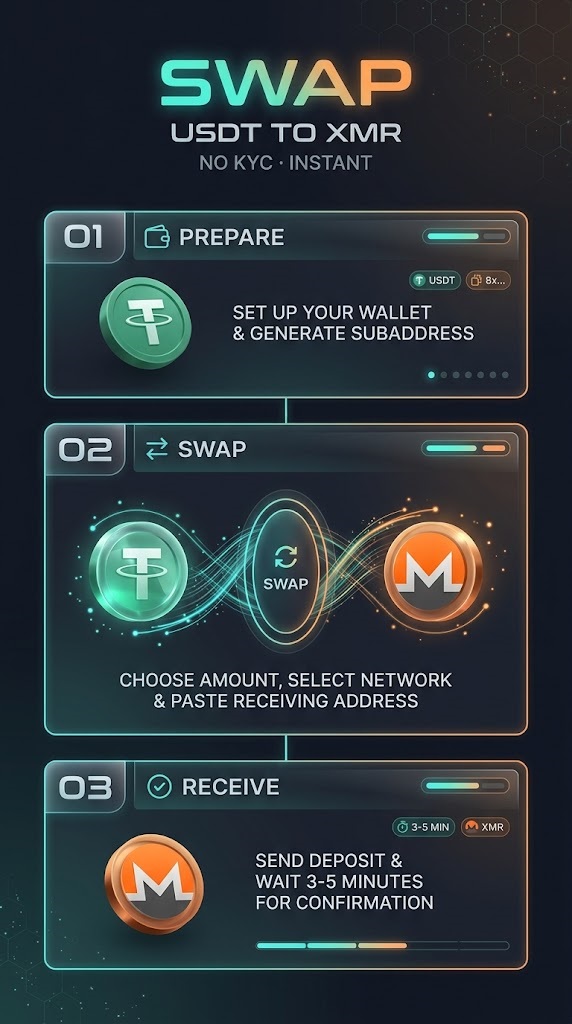
- Set up a Monero wallet you control. Feather, Cake Wallet, Monerujo and the official Monero GUI all work. Write the seed phrase on paper, keep it offline, and don’t type it into anything.
- Generate a new subaddress. Subaddresses begin with 8, while your main address begins with 4. Use a fresh one for each incoming payment so separate payments can’t easily be tied to the same wallet.
- Open the Flashift and set USDT as what you send and XMR as what you get. Pick the network your USDT is actually on (more on that in a moment). The estimated XMR amount appears before you commit to anything.
- Paste your subaddress as the destination. Compare the first and last few characters with your wallet. Crypto transfers can’t be reversed, so this is the moment to slow down.
- Send the USDT to the deposit address shown, on the same network you chose in step 3.
- Wait for the swap to finish. Once your deposit is confirmed, the exchange runs and the XMR is sent to your subaddress. You can follow progress on the same page.
Which USDT network should you pick?
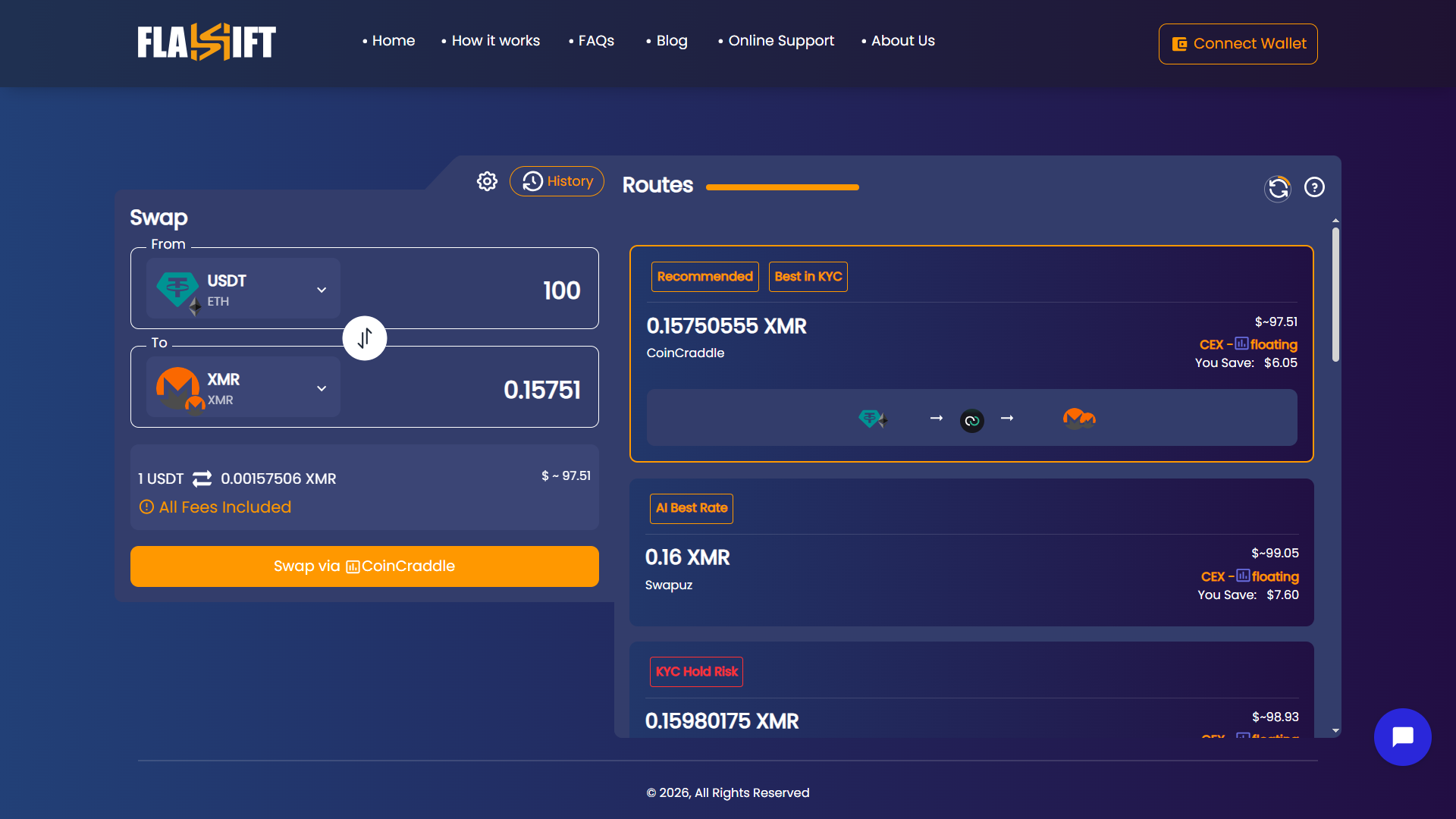
USDT lives on several blockchains, and the swap form asks which one you’re sending from. One rule matters: choose the network your USDT is on right now, and send the deposit through that same network.
The confusing part is that “USDT” on its own doesn’t tell you the chain. When you withdraw from an exchange or send from a wallet, look for the network label next to the token. Not sure? Send a small test amount first. A few dollars of patience is cheaper than a lost deposit.
How long does a USDT to XMR swap take?
Usually 3 to 5 minutes from the moment your deposit is detected. The biggest variable is how quickly your sending network confirms the transfer, and congestion can stretch it a little.
One thing catches newcomers out. Monero locks incoming funds for 10 confirmations, roughly 20 minutes, before you can spend them. That’s a protocol rule rather than a delay on the swap side, so your balance may appear quickly and then sit as locked for a while. Nothing is wrong.
Mistakes worth avoiding
- Sending on the wrong network. The costliest error, and the easiest one to make when you’re moving fast.
- Reusing your main address. It works, but it makes your incoming payments easier to link together. Subaddresses cost nothing.
- Copying the address from anywhere except your wallet. Clipboard-swapping malware exists. Check the start and end of the address after you paste it.
- Connecting to a random public node. A node you don’t trust can see your IP address when you broadcast transactions. Run your own if you can, or use one you have a reason to trust.
- Closing the tab because it feels slow. Keep your swap ID and check the status before doing anything else.
Swap, P2P or exchange: which route fits
| Route | Account needed | Speed | Fits best when |
| Instant swap service | None | Minutes | You already hold USDT and want XMR now |
| P2P markets (Haveno, Bisq) | No central account | Slower, depends on the other side | You prefer trading peer to peer and can wait |
| Centralized exchange | ID verification | Varies | XMR is listed in your region and verification doesn’t bother you |
For someone starting with USDT, an instant swap is normally the shortest path. Atomic swaps are mostly built around BTC and XMR, so they don’t help much here.
After the swap
Getting the XMR is only half the job. Keep using subaddresses, keep the seed phrase offline, and be picky about which node your wallet talks to. Avoid posting your addresses anywhere they can be tied to your name. None of this is complicated, but it’s the difference between owning Monero and actually benefiting from its privacy.
Is it legal to exchange USDT to XMR?
In most countries, owning and exchanging crypto, Monero included, is legal. Rules vary by location and change over time. Some regions restrict how regulated exchanges handle privacy coins, and tax or reporting duties can still apply to you personally. This article is general information, not legal or tax advice, so check what applies where you live.
FAQ
1. Can I exchange USDT to XMR without KYC?
Yes. Non-custodial swap services let you convert USDT to XMR without registering or uploading documents. Terms differ between providers, so read the rules of whichever one you use.
2. How long does it take to swap USDT to XMR?
At Flashift, typically 3 to 5 minutes. The XMR becomes spendable after Monero’s standard 10-confirmation lock, which takes about 20 minutes.
3. Do I need an account to swap USDT to XMR on Flashift?
No. You pick the coins, enter your Monero address, send the deposit and receive XMR in your own wallet.
4. Which network should I send my USDT from?
The one your USDT is already on. Select that network in the form and send the deposit through it. Mixing networks can mean lost funds.
5. Why can’t I spend my XMR yet?
Monero holds incoming funds for 10 confirmations, around 20 minutes. It’s a normal part of the protocol.
6. What’s a Monero subaddress, and do I really need one?
It’s an extra receiving address generated by your wallet, starting with 8. You don’t strictly need one, but using a separate subaddress per payment keeps outside observers from linking those payments to one wallet.
7. Can Tether freeze my USDT?
Tether, as the issuer, can freeze USDT at specific addresses. That’s one reason some holders move part of their balance into assets they control more directly.
🔎 Ready to try it?
Prepare the wallet, double-check the network and the address, and the swap takes a few minutes. Swap USDT to XMR on Flashift →
Related Posts: How to buy Monero anonymously · How to get a Monero transaction private key · Swap crypto to stablecoins without KYC · getmonero.org