

- What Is Solana Alpenglow, and When Did It Go Live?
- How Fast Is Solana Finality After Alpenglow?
- Finality vs Confirmation: What’s the Difference on Solana?
- Are SOL Swaps Faster After Alpenglow?
- Does Alpenglow Make Bridging to Solana Faster?
- TowerBFT vs Alpenglow: What Actually Changed Under the Hood?
- Should You Buy SOL Because of Alpenglow?
- What to Watch Over the Next Few Weeks
- FAQ
On live Solana, the finality mechanism has changed. If you have made a swap or sent assets onto Solana, here is a summary. The target finality length is reduced. However, initial times on Mainnet were higher than expected. Bridges will be faster on the Solana side, but not on the other chain.
TL;DR → Alpenglow reduces the finality time for transactions on Solana to 150ms (from 12.8s). This means faster settlement times for SOL swaps, and faster completion of bridges on the Solana side. No changes to fees and pricing. We are targeting 150ms however we will update once we have data from live.
What Is Solana Alpenglow, and When Did It Go Live?
Solana has upgraded its consensus mechanism to Alpenglow. This upgrade means that validators will come to an agreement on which transactions have been processed. The previous consensus mechanism was ‘TowerBFT’. The upgrade went live on mainnet at approximately 1:54pm UTC on 21st October, according to the Solana Foundation’s Alpenglow dashboard.
In this upgrade, the first component that has been updated is ‘Votor’. This change allows a direct voting process between validators and uses certificates. Previously, with multiple rounds of validation, a committee would need to pass through several rounds of agreeing to form a finalized decision. With this update, fewer rounds are needed to reach this finalization.
The report is here: Cointelegraph on the Alpenglow mainnet launch.
How Fast Is Solana Finality After Alpenglow?
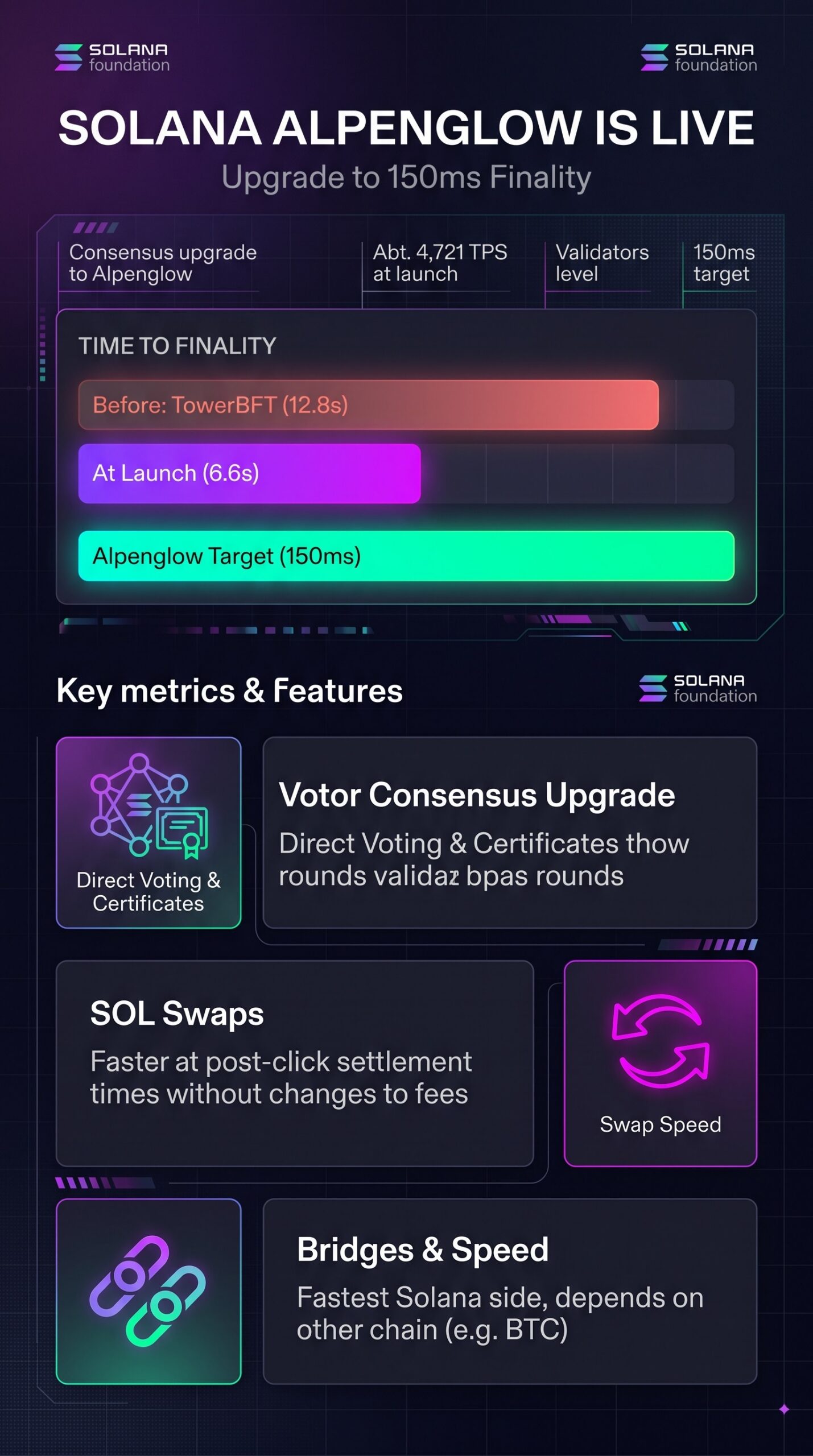
The headline number and the dashboard don’t quite agree yet. When Cointelegraph published, the Foundation’s dashboard showed finality at 6.6 seconds, with throughput around 4,721 transactions per second. That is about half the old figure, which is a genuine improvement, but it’s a long way from 150 ms.
| TowerBFT (before) | Alpenglow (target) | Reading at launch | |
| Time to finality | about 12.8 s | about 150 ms | about 6.6 s |
| How validators vote | multiple rounds | direct votes with certificates | n/a |
It’s worth being a little skeptical when an app advertises “150 ms Solana swaps” today. That figure describes what the protocol is designed to reach, and the live dashboard is where you check whether the network gets there.
Finality vs Confirmation: What’s the Difference on Solana?
Most people never felt the old 12.8 seconds. Wallets flash “confirmed” within a second or two, so everything looks instant. But confirmed only means the network has probably accepted your transaction. Final means it can’t be undone, however the validators vote afterward.
The gap rarely matters for a casual swap. It starts to matter when money keeps moving. A service that credits you only after a transaction is irreversible has to wait for finality. So does a bridge deciding whether to release funds on the other side. Shortening that wait helps most where one transaction leads straight into the next.
Are SOL Swaps Faster After Alpenglow?
A bit, and mostly in the stretch after you click. Say you swap 10 SOL into another token on a choppy afternoon. The trade shows as done on your screen, but until it’s final there is a short window where it isn’t fully settled underneath. Shrink that window and you can move the proceeds on sooner, with less worry about what happens in between.
What doesn’t change is the price you get. That still comes down to liquidity and how well the route is built. A thin pair will slip on a big order no matter how quickly the chain finalizes. Alpenglow also rewrites how validators agree rather than how fees work, and nothing in the launch coverage suggests swap costs moved because of it. Treat fees as a separate question.
If you’re still getting your bearings with SOL itself, our walkthrough on whether Solana is worth buying and how to swap SOL covers the basics before you worry about consensus protocols.
Does Alpenglow Make Bridging to Solana Faster?
Half of it. Every bridge has two ends, and Alpenglow improves only one of them.
When you bridge into Solana, the final step lands sooner, but the source chain’s own confirmation rules still come first. When you bridge out, a bridge that waits for Solana finality before releasing funds can now do it earlier than it used to. The slowest chain in the route decides the total time.
Bitcoin shows this clearly. It produces a block roughly every ten minutes on average, and no Solana upgrade changes that. If you’re planning to bring BTC across, the upgrade helps at the edges, but the long part of the trip is still on the Bitcoin side. We broke down the cheapest approach in our guide to bridging BTC to SOL instantly with the lowest fees. And if you’d rather skip bridge mechanics, you can convert in one step on the BTC to SOL exchange page.
TowerBFT vs Alpenglow: What Actually Changed Under the Hood?
Although we do not need to be too precise, it is worth noting that in TowerBFT, the probability of finality increases gradually as blocks are added. It takes some seconds for finality to converge. In contrast, Alpenglow reaches consensus by combining direct votes from validator nodes into a certificate.
This means that this is a design improvement. Real performance data is important because although you may be able to get a number from a protocol spec, only running a network on real validator hardware will tell you if you can actually achieve that number.
Should You Buy SOL Because of Alpenglow?
This is not necessarily a price driver. While price will be driven by demand and the general market sentiment, much more than any technical developments, many high quality technical upgrades have had very little impact on price. The opposite is also true.
When considering buying, it is important to consider your personal risk profile and time horizon. This upgrade should be considered in combination with other factors. As finality is remaining at 6 seconds, the key consideration is whether you would still like to hold SOL.
What to Watch Over the Next Few Weeks
The next stretch will tell you more than the launch announcement did. A few things are worth checking yourself:
- The live finality reading on the Solana Foundation’s Alpenglow dashboard, to see whether it drifts toward 150 ms or settles somewhere higher.
- How your usual apps behave. If your wallet or swap tool starts finalizing noticeably faster, that is your real-world answer.
- Whether platforms back their speed claims with numbers you can verify, or just repeat the target.
If the readings settle near the target, Alpenglow will have delivered what it promised. If they hover around six seconds, it’s still progress, just a smaller step than the headlines suggested.
FAQ
- Will my deposit to an exchange show up faster now?
Not necessarily. Exchanges set their own rules for how many confirmations they require, and many haven’t changed them. Faster finality only helps if the exchange chooses to credit deposits earlier.
- Do I need to do anything with my wallet or staked SOL after the upgrade?
The launch coverage doesn’t describe any action required from ordinary holders, since the change happens at the validator level. If your wallet or staking provider sends specific instructions, follow those.
- Why might two explorers show different times for the same transaction?
Some report when a transaction is confirmed, others when it is final, and dashboards can measure from different points. Check which stage each one is showing before comparing numbers.
- Is faster finality the same thing as higher TPS?
No. Finality measures how long until a transaction is irreversible, while TPS measures how many transactions the network handles per second. A chain can improve one without changing the other.
- My bridge transfer is taking longer than expected. Should I blame Solana?
Look at the source chain first. For bridges coming from slower networks, most of the delay usually sits there, so check how many confirmations that side still needs.
- How can I check the real finality time myself?
Open the Solana Foundation’s Alpenglow dashboard and compare its live finality reading with whatever number a platform advertises. If they differ a lot, trust the dashboard.