
Quick answer: The best THORChain alternatives in 2026 are Chainflip, Maya Protocol, NEAR Intents, LI.FI and Flashift. Chainflip and Maya offer native cross-chain swaps with their own liquidity pools, NEAR Intents and LI.FI focus on intent-based and aggregated routing, and Flashift compares rates across non-custodial providers with AI-assisted routing, no registration and no extra platform fees. Which one is fastest depends on the asset pair, the amount and current network conditions.
THORChain earned its reputation by letting people swap native assets, such as BTC for ETH, without wrapping tokens or trusting a centralized exchange. That idea still matters. But many traders now want faster confirmations, simpler interfaces and more predictable pricing. This guide explains where THORChain falls short and which non-custodial options are worth comparing today.
The Limitations of THORChain
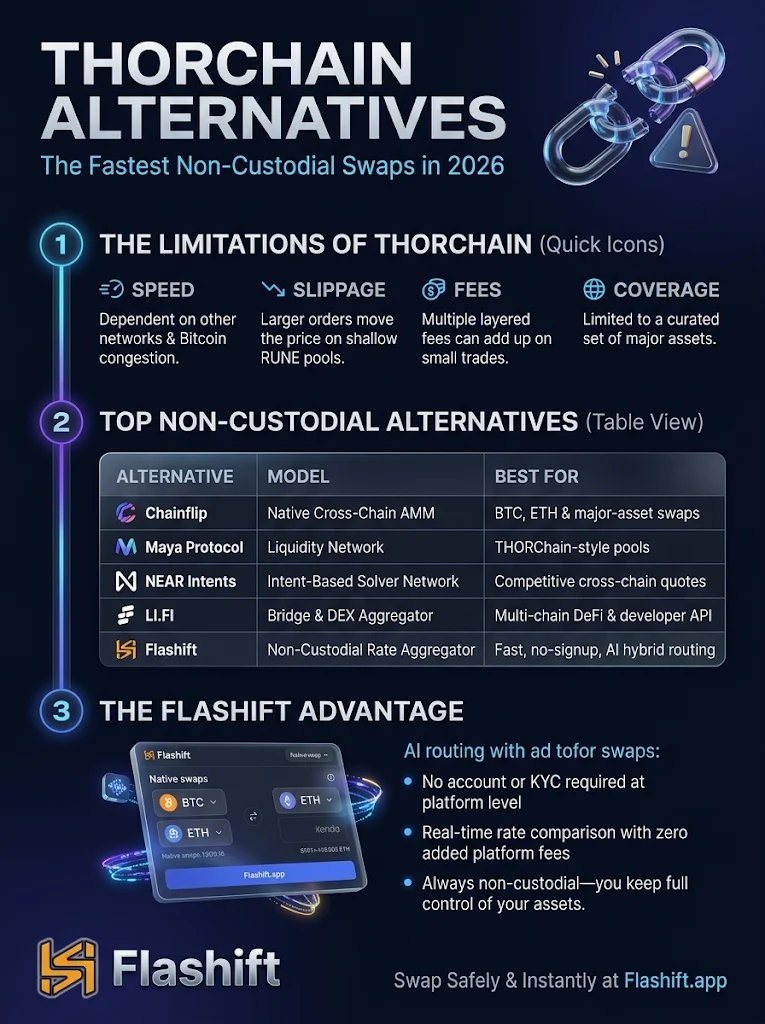
THORChain is a pioneering cross-chain protocol, but its specific architectural trade-offs can create friction for high-frequency or retail traders. If you are exploring alternatives, these are the primary limitations driving that shift:
- Network-Dependent Settlement Speeds: A THORChain swap is not a single, isolated transaction. It requires source-chain confirmation, validator observation, internal processing, and destination-chain outbound. If you swap from Bitcoin during peak congestion, your trade is bottlenecked by Bitcoin’s block times.
- High Slippage on Whale Orders: Swaps on THORChain are routed through liquidity pools paired with its native RUNE asset. While streaming swaps (Time-Weighted Average Price) help mitigate price impact, executing large-volume trades in shallow pools still leads to noticeable slippage or forces users into longer wait times.
- Layered Fee Structures: Cost efficiency drops on smaller trades. Users often face a compounded fee structure: an inbound network fee, a liquidity fee, potential front-end affiliate fees, and an outbound fee.
- Protocol Complexity and Tail-Asset Limits: For a newcomer, navigating memos, vaults, and inbound addresses presents a steep learning curve. Furthermore, THORChain’s strict curation means users seeking long-tail tokens or emerging Layer-2 assets will find its coverage limited compared to modern aggregators.
- Historical Protocol Risks: Past security exploits in 2021 and the eventual wind-down of its lending and savers products serve as a reminder that complex cross-chain protocols carry inherent smart-contract and ecosystem risks.
None of this means you should avoid THORChain. It means the best tool depends on what you are swapping and how much you value speed, price and simplicity.
Top Non-Custodial THORChain Alternatives
The table below gives a fast side-by-side view. Details for each option follow.
| Alternative | Model | Best for | Standout feature |
| Chainflip | Native cross-chain AMM | BTC, ETH and major-asset swaps | Just-in-time liquidity model |
| Maya Protocol | THORChain-style liquidity network | Users wanting a close THORChain equivalent | Wider asset mix, including Dash and Cacao pools |
| NEAR Intents | Intent-based solver network | Cross-chain swaps with competitive quotes | Solvers compete to fill your order |
| LI.FI | Bridge and DEX aggregator | Developers and DeFi users | One integration across many chains |
| Flashift | Non-custodial rate aggregator | Fast, no-signup swaps | AI-assisted hybrid routing |
Features and supported assets change often. Check each platform for current details before swapping.
- Chainflip
Chainflip is a decentralized protocol built for swapping native assets across chains without wrapped tokens. Its design uses an automated market maker and a validator network that controls vaults through threshold signatures. Chainflip is a strong choice for major pairs like BTC, ETH and stablecoins, where it aims to offer competitive pricing and a clean user experience. Its main limitation is a narrower asset list than an aggregator.
- Maya Protocol
Maya protocol started from THORChain’s codebase and developed its own liquidity network and ecosystem. If you like THORChain’s native-asset concept but want a different pool structure and some different supported assets, Maya is the nearest relative. Because it is architecturally similar, many of the same trade-offs, such as multi-step settlement, can still apply.
- NEAR Intents
Near intent-based systems change the swap flow. Instead of choosing a route yourself, you state what you want, and a network of solvers competes to fulfill it. Done well, this can improve pricing and remove most of the manual work. It suits users comfortable with newer infrastructure and wallets that support the flow.
- LI.FI
LI.FI aggregates bridges and decentralized exchanges and powers the swap features inside many wallets and apps. It is especially useful for EVM and multi-chain DeFi activity, where it finds a route across bridges and DEXs in one flow. It is generally less suited to simple Bitcoin-style native swaps, and you usually need a connected wallet.
- Flashift
Flashift is a non-custodial swap aggregator that compares rates from partner exchanges and routes your order to the offer that fits. Its biggest practical advantage is simplicity: you choose a pair, enter a receiving address and send funds. We cover how it works in detail below.
Flashift’s Hybrid Routing Engine
Most swap tools force a choice: either a single protocol with one liquidity source, or a manual aggregator where you compare tabs yourself. Flashift takes a hybrid approach. It acts as a routing layer on top of existing non-custodial exchange providers rather than as an exchange of its own.
How it works in practice:
- Pick your pair. Choose the coin you hold and the coin you want. Flashift reports access to more than 1,000 coins and tokens.
- Compare live offers. The platform pulls rates from multiple non-custodial partners and shows them in one place.
- Let the AI weigh the options. Flashift describes its AI-driven system as evaluating rates in real time so you see strong offers without checking each provider manually.
- Send and receive. Provide your destination address, send the deposit, and the swap is completed by the chosen partner.
Why the AI routing matters. Swap rates shift within minutes. A rate that looks best now may not be best by the time you confirm. Automated comparison reduces the chance you overpay because you looked at only two or three providers. It also saves time, which is the point of an instant swap.
Other features worth knowing:
- No registration and no KYC at the platform level. You can swap without creating an account.
- No extra platform fee. Flashift states that it does not add its own commission on top of partner rates.
- Non-custodial design. Flashift does not hold your funds. Your assets move between your wallet and the partner provider.
- Developer API. Businesses can embed the same routing and rate-comparison logic into their own products.
- Transaction history without an account. You can track an order without logging in.
Fair caveats. Because Flashift routes to partner services, execution and any partner-specific rules (such as limits or compliance checks) depend on the provider handling your order. It is also not a protocol with its own liquidity pools, so it is best viewed as a smart front door to the ecosystem rather than a replacement for on-chain liquidity networks.
How to Choose the Right Alternative
Use this short checklist:
- Swapping a large amount of BTC or ETH? Compare Chainflip and THORChain directly, and check the quote for slippage.
- Want the least effort and no signup? An aggregator like Flashift lets you compare offers and finish quickly.
- Building a wallet or app? LI.FI or an aggregator API will save development time.
- Prefer the THORChain model with different pools? Look at Maya Protocol.
Whatever you choose, test with a small amount first, double-check the destination address, and compare the final received amount rather than the headline rate.
FAQ
- Is a non-custodial swap always safer than using a centralized exchange?
Not automatically, but it removes one major risk: a company holding your funds. You still face smart contract, provider and user-error risks, such as sending to the wrong address. Safe use means verifying addresses, starting small and using reputable providers.
- Why does the amount I receive differ from the quoted rate?
The final amount reflects network fees, provider spreads, slippage and market movement between quote and execution. Fixed-rate options lock a price for a short window, while floating-rate options update until the swap completes.
- How long should a cross-chain swap take?
Often anywhere from a few minutes to around half an hour. The main drivers are source-chain confirmations, provider processing and the destination network. Bitcoin deposits typically take longest to confirm.
- Are swap aggregators and decentralized exchanges the same thing?
No. A decentralized exchange has its own liquidity or trading logic. An aggregator compares and routes across several providers. Some products combine both ideas.
- What should I check before swapping an unfamiliar token?
Verify the contract address or network from an official source, confirm both coins are supported on the chain you plan to use, check minimum and maximum limits, and review the estimated fees. If anything is unclear, swap a small test amount first.
This article is for information only and is not financial advice. Crypto swaps carry risk, and platform features change. Verify details on each official website before transacting.