
- 📊 On-Chain Visibility: Public Data vs. Private Secrets
- Can You Convert a Wallet Address to a Private Key?
- Can You Generate a Private Key from a Public Key?
- Theoretical Threats: Quantum Computing & The Road to 2026
- Why Your Assets are Sovereign on Flashift
- Conclusion, Why Your Private Key Is Still Safe
- FAQ
- Can someone derive my private key from a blockchain transaction?
- Does a new private key get created for every transaction?
- What happens if I lose my private key or seed phrase?
- Is quantum computing a real threat to my private key?
- What are the biggest real-world risks to private key security?
- How can I securely store my private keys?
- Are there any signs someone is trying to brute-force my private key?
Derive a Private Key from a Blockchain Transaction | Every time you broadcast a transaction, you expose your wallet address, public key, and cryptographic signature to a global public ledger forever. For high-volume traders and long-term HODLers, this visibility triggers a critical anxiety: Could an observer, an advanced blockchain analytics firm, or a malicious actor analyze this public data to reconstruct your private key?
With sovereign custody being the only defense against centralized platform freezes in 2026, understanding exactly where public transaction data ends and your private seed phrase begins is a matter of financial survival.
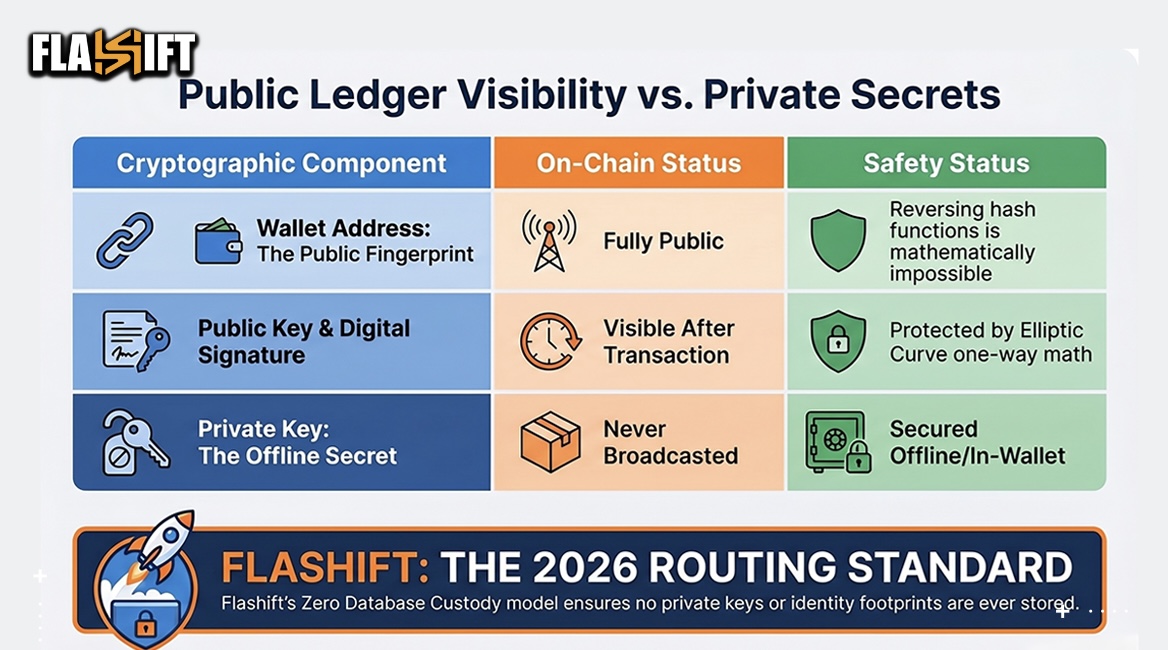
📊 On-Chain Visibility: Public Data vs. Private Secrets
| Cryptographic Component | On-Chain Status | Visibility Level | Can It Reveal the Private Key? |
|---|---|---|---|
| Private Key (Seed Phrase) | Never Broadcasted | $100\%$ Offline (In Wallet) | No. It never touches the internet or the blockchain. |
| Public Key | Visible After Transaction | Publicly readable on-chain | No. Mathematically secured by one-way functions. |
| Wallet Address | Fully Public | Publicly readable on-chain | No. Reversing it requires breaking cryptographic hash functions. |
| Digital Signature (ECDSA) | Fully Public | Unique per transaction | No. Built with randomized nonces to prevent correlation. |
Can You Convert a Wallet Address to a Private Key?
The short answer: No, it is mathematically impossible.
A wallet address isn’t a “version” of your public key; it is a cryptographic fingerprint of it.
When your wallet creates an address, it runs your public key through a one-way hashing function. Think of it like a digital fingerprint. A fingerprint identifies you perfectly, but if someone only has your fingerprint, they cannot reconstruct your physical body from it. Hashing works the same way—it converts your public key into a compact, fixed-length code.
The math is specifically designed to be a one-way street. It effectively destroys the original data structure in a way that simply cannot be reversed. Even if an attacker had the computing power to somehow “reverse” that hash—which no machine on earth is currently capable of—all they would recover is your public key. They would still be mathematically light-years away from your private key.
Security shouldn’t feel like a guessing game. By routing your trades through Flashift, you keep your wallet’s activity isolated from centralized logs and prying eyes.
Start your first private, non-custodial swap on Flashift here.
Can You Generate a Private Key from a Public Key?
No. Your public key (K) is generated from your private key (k) using Elliptic Curve Cryptography :
Reversing this, dividing the public key by G to find the private key, is the Elliptic Curve Discrete Logarithm Problem (ECDLP). It is computationally intractable for any classical system. Knowing the public key gives an adversary zero mathematical leverage.
Read More: How to get Monero transaction private key
Theoretical Threats: Quantum Computing & The Road to 2026
While classical computers pose zero threat to elliptic curve cryptography, the rise of quantum computing represents a looming theoretical shift.
Shor’s Algorithm and Quantum Readiness
Quantum computers utilizing Shor’s Algorithm can theoretically solve the discrete logarithm problem, allowing them to reverse-engineer a private key if the public key is exposed on-chain.
- The Vulnerability Window: Your public key is only exposed on-chain after you send a transaction from an address. If you reuse the same address, your public key becomes permanently visible, making it vulnerable to future quantum attacks.
- The Q-Day Estimate: Security analysts in 2026 estimate that quantum systems capable of breaking $256$-bit ECC keys (requiring roughly $2,300$ logical qubits) are still at least a decade away.
- Post-Quantum Cryptography (PQC): Blockchain networks are already developing hybrid, lattice-based signature schemes designed to resist quantum decryption.
To mitigate these future risks today, the baseline standard is avoiding address reuse. By utilizing new addresses for every transaction, your public key is never exposed on the ledger until the moment of transaction finalization.
Why Your Assets are Sovereign on Flashift
Understanding that on-chain transactions never leak private keys highlights the safety of utilizing modern, non-custodial routers.
Flashift is engineered as a pure technology layer, adhering strictly to the principles of absolute financial sovereignty:
- Zero Database Custody: Flashift does not deploy intermediate smart contracts that hold your assets, nor do we run centralized hot wallets. We never ask for, store, or have access to your private keys or seed phrases.
- Safe-Haven Routing: Because our AI engine continuously monitors the operational health of over $50+$ independent liquidity providers, we route your swaps through clean, secure paths, ensuring your private transactions settle directly into your cold storage.
- Direct Wallet-to-Wallet Execution: Your swaps execute in mid-flight and are delivered straight to your Ledger or Trezor, leaving zero administrative records or identity footprints on centralized servers.
Conclusion, Why Your Private Key Is Still Safe
Key Takeaways for Beginners and Traders
Your private key is the bedrock of your cryptocurrency security. Generated via strong cryptographic methods and stored privately in wallets or hardware devices, it is never broadcasted or exposed through blockchain transactions. The mathematics behind elliptic-curve cryptography (ECC) ensures that reconstructing your private key from on-chain data is effectively impossible, making your funds safe as long as you follow good security practices.
Best Practices to Keep Your Wallet Secure
- Use cold storage for significant holdings; keep private keys offline where they’re immune to online attacks.
- Segment your usage: Use hot wallets for small, everyday needs, and separate “vault” wallets for savings.
- Enable two-factor authentication (2FA) and strong passwords; never reuse credentials.
- Safeguard your seed phrase offline—never store it digitally or online.
- Avoid phishing attacks and connection to risky dApps — be wary of unfamiliar links or browser pop-ups.
- Quick breach response: if you suspect compromise, transfer funds to a new wallet immediately.
Don’t Trust, Verify: Know What’s Actually Possible
There’s no way to derive a private key from a transaction or a public address—it’s mathematically and cryptographically barred by design. Even in extreme cases like physical tampering or future quantum threats, these risks remain speculative and remote. Still, staying informed, using high-quality wallets (like hardware or multisig devices), and remaining cautious reflects an empowered, security-savvy mindset.
Final Word
Rest easy: your private key remains safe today. But true digital security is a journey, not a destination. Be proactive and diligent—combine cryptographic trust with real-world best practices—and you can confidently hold and use crypto with peace of mind.
FAQ
-
Can someone derive my private key from a blockchain transaction?
No. Private keys are never included in transaction data. Blockchain only shows public keys, addresses, and signatures—but not your secret key. Thanks to one-way cryptography (ECC and hash functions), it’s practically impossible to reverse-engineer them.
-
Does a new private key get created for every transaction?
Not usually. Most wallets use hierarchical deterministic (HD) structures—papers say each new address uses a new key pair, but all keys are derived from a single seed phrase. You won’t see a new private key every time you send a transaction unless your wallet specifically does it.
-
What happens if I lose my private key or seed phrase?
If you lose the private key or seed phrase, you lose access to your funds. There’s no way to recover or regenerate them without the original information.
-
Is quantum computing a real threat to my private key?
It’s a theoretical future risk. Current quantum computers aren’t powerful enough to break ECC. Experts estimate we’re still 10+ years away from plausible quantum attacks—and blockchains are prepping with post-quantum cryptography .
-
What are the biggest real-world risks to private key security?
Most breaches happen due to human error: malware, phishing, poor storage methods, or hacked custodial services. Blockchain itself isn’t the weak link—wallet management is.
-
How can I securely store my private keys?
Best practices include using hardware wallets (cold storage), paper or metal backups, multisig setups, and keeping keys offline. Protect them with strong passwords, 2FA, and secure backups in multiple safe locations.
-
Are there any signs someone is trying to brute-force my private key?
Not directly. Because brute-forcing ECC keys is practically impossible, if someone had access, it would more likely come from malware, leaked keys, or compromised devices—not blockchain transactions.