
Decentralized trading is the baseline for anyone seeking total control, anonymity, and transparency. But if you are still manually connecting wallets, calculating gas fees, and suffering from high slippage, you are doing it the hard way.
This guide is not just about understanding the basics. Whether you are searching for the best DEX trading tools or comparing leading decentralized exchanges, we will break down the exact strategies to optimize your trades. Read on to discover how to navigate the decentralized landscape, avoid common smart contract pitfalls, and execute zero-friction swaps using advanced multi-chain aggregators.
How to Trade on DEXs:The Traditional Method vs. The Advanced Method
There are two ways to execute a deep dex trade today: the traditional manual route, and the optimized aggregator route.
Method 1: The Traditional Route (e.g., Uniswap + MetaMask)
While platforms like Uniswap pioneered the space, using them directly requires technical setup and exposes you to single-pool slippage. Here is the standard step-by-step process:
Step 1: Install and Set Up MetaMask
- Go to https://metamask.io and download the MetaMask extension for your browser or mobile device.
- Create a new wallet and securely back up your seed phrase.
- Once set up, fund your MetaMask wallet with ETH (for gas fees) or any token you want to trade.
Step 2: Connect MetaMask to a DEX
- Click “Connect Wallet” in the top-right corner.
- Choose MetaMask and approve the connection in the popup window.
- Once connected, you’ll see your wallet address and balances reflected on the interface.
Step 3: Choose Tokens to Trade
- In the “Swap” tab, select the token you want to trade From (e.g., ETH).
- Select the token you want to receive To (e.g., USDC, UNI, etc.).
- If the token isn’t listed, you can paste its contract address to import it manually.
Step 4: Set Amount and Review Transaction
- Enter the number of tokens you want to swap.
- The exchange will automatically calculate the output based on real-time market prices and liquidity.
- Check slippage tolerance and gas fee under “Settings” (gear icon).
- Review the trade details and click “Swap.”
Step 5: Confirm in MetaMask
- A MetaMask window will pop up showing gas fees and transaction details.
- Click “Confirm” to authorize the transaction.
- Wait for the blockchain to process the swap. You’ll see a confirmation once it’s completed.
Step 6: View Transaction & Tokens
- You can check the transaction on Etherscan.
- The swapped token will now appear in your MetaMask wallet. If it doesn’t, you may need to add the token manually using its contract address.
Method 2: The Smart Routing Route
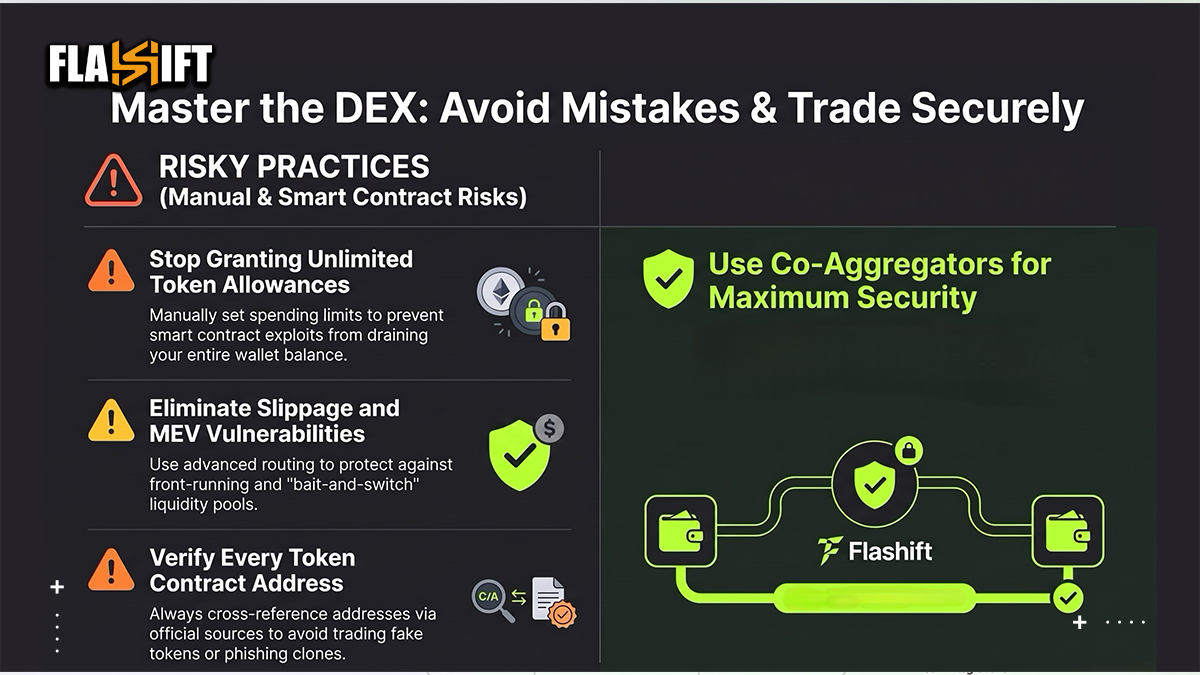
Instead of manually importing tokens, paying network gas fees across multiple chains, and granting dangerous unlimited contract approvals to random platforms, modern traders use advanced co-aggregators. By utilizing platforms like Flashift, you can see all possible fees and the exact execution amount upfront.
The engine scans all leading decentralized exchanges and instant non-custodial cross-chain providers simultaneously. This allows you to compare all rates and choose your preferred execution path: secure the lowest friction via instant providers with absolutely zero wallet connection, or safely connect your Web3 wallet to access deep on-chain DEX liquidity—all from one secure, unified terminal without ever visiting multiple sites.
Best DEX Trading Tools and Platforms in 2026
As DEX trading continues to evolve in 2026, a variety of platforms and tools have emerged to enhance the decentralized trading experience. Whether you’re looking for better analytics, reduced slippage, advanced trading options, or real-time insights, these tools and platforms can give you a significant edge. Below are the top 5 DEX trading tools and platforms in 2026, each offering unique value to DeFi traders.
-
Uniswap v4
The platform introduced customizable smart contracts that allow developers to modify how liquidity pools’ function.
-
1inch
1inch isn’t a DEX itself, but an aggregator that sources liquidity from multiple decentralized exchanges (including Uniswap, SushiSwap, PancakeSwap, and more) to ensure the best prices and lowest slippage for traders.
Ideal for traders who want to optimize swap prices and reduce transaction fees across multiple DEXs.
-
dYdX v4
dYdX v4 launched in late 2024 as a fully decentralized order book-based DEX for perpetual futures trading, operating on its own Cosmos-based chain. Unlike AMMs, dYdX offers high-performance trading with low latency and no gas fees.
Perfect for advanced traders who want CEX-like performance in a decentralized environment.
-
Matcha by 0x
Matcha is a user-friendly DEX aggregator developed by the 0x Protocol. It simplifies DEX trading by offering a clean interface, real-time price comparison, and seamless multi-chain support. It’s known for smart order routing to split trades across multiple DEXs for the best execution.
Great for both beginners and pros who want ease of use without compromising on price efficiency.
-
DeFiLlama Swap
DeFiLlama, long known for its DeFi analytics, now offers a Swap tool that combines real-time data with price aggregation across multiple DEXs. It’s especially useful for users who want transparency in slippage, routing, and liquidity.
Ideal for traders who want full transparency and on-chain trade analytics before executing swaps.
6. Flashift
While platforms like 1inch strictly aggregate DEXs, they still require wallet connections and native gas tokens. Flashift represents the next evolution of DEX trading tools by acting as a Co-Aggregator.
Best for: Privacy-focused traders who want the deep liquidity of leading decentralized exchanges without the smart contract exposure or KYC requirements.
Common Mistakes and Safety Tips for DEX Traders

- Ignoring Slippage Settings
Always adjust your slippage tolerance before confirming a trade, especially for volatile or low-liquidity tokens. A high slippage can result in significantly worse trade execution and potential losses.
- Trading Fake Tokens
Verify token contract addresses from trusted sources like CoinGecko or the official website of the project. Token names and logos can be duplicated—never rely on visual appearance alone.
- Approving Unlimited Token Allowance
Set custom spending limits when approving tokens in your wallet (e.g., MetaMask). Unlimited approvals can expose your funds to smart contract exploits. Use tools like Revoke.cash to review and revoke unnecessary permissions.
- Falling for Phishing Sites
Always double-check the URL of the DEX before connecting your wallet. Bookmark official platforms like https://app.uniswap.org and avoid clicking on links from unverified or random sources.
- Forgetting Gas Fees
Keep enough native tokens (like ETH for Ethereum, BNB for BNB Chain, or MATIC for Polygon) to cover gas fees. Transactions may fail if you lack funds for gas, potentially resulting in wasted time and missed opportunities.
- Not Using a Hardware Wallet
If you frequently trade large amounts or hold valuable assets, consider using a hardware wallet. Devices like Ledger or Trezor significantly reduce the risk of hacks or malware compromising your private keys.
- Trading Illiquid Pairs
Before trading, check the liquidity and volume of the token pair. Illiquid pairs can lead to major slippage, poor price execution, and difficulty exiting your position.
- Overlooking Front-Running and MEV Risks
DEXs are vulnerable to front-running and Miner Extractable Value (MEV) attacks. To protect yourself, use platforms like 1inch or CowSwap that offer MEV protection and better trade routing.
- FOMO Into New Tokens Without Research
Avoid rushing into newly launched or trending tokens without proper research. Many such tokens are scams, rug pulls, or highly volatile assets designed to exploit emotional trading behavior.
- Using Public Wi-Fi While Trading
Never perform wallet transactions or DEX trades over public or unsecured networks. Use a secure internet connection and consider using a VPN for an added layer of protection.
By following these best practices and avoiding common errors, you can trade more securely and effectively in the world of DEX trading.
Conclusion: The Complete Guide to DEX Trading
Decentralized trading is no longer just about interacting with a single smart contract; it is about securing the best execution price across a fragmented multi-chain universe. As you navigate the leading decentralized exchanges, remember that limiting yourself to one platform or a pure on-chain aggregator leaves you vulnerable to slippage and smart contract exploits.
The smartest deep dex trade strategy in 2026 is leveraging infrastructure that does the heavy lifting for you. Stop granting infinite token approvals and manually calculating gas fees. Experience the next generation of decentralized execution by comparing rates across both DEXs and instant non-custodial partners simultaneously with Flashift.
FAQ
- Is DEX trading only for advanced users?
No. While some platforms offer advanced features, many DEXs like Uniswap and Matcha are beginner-friendly with intuitive interfaces and simple wallet connections.
- Can I use a DEX without creating an account?
Yes. DEXs require no registration or KYC. You can start trading directly from your non-custodial wallet like MetaMask or Rabby.
- How do DEXs handle price discovery without centralized order books?
Most use Automated Market Makers (AMMs) or aggregators to determine pricing based on liquidity pools and smart contract algorithms.
- What happens if a trade fails on a DEX?
If a trade fails (often due to slippage or gas limits), your funds remain safe in your wallet, though you may still lose gas fees.
- Are all tokens available on DEXs safe to trade?
No. Many tokens on DEXs are unverified. Always confirm contract addresses and avoid trading newly listed tokens without proper research.
- Can I set limit orders on a DEX?
Some DEXs and aggregators like 1inch and dYdX offer limit orders, but most AMM-based platforms like Uniswap do not natively support them.