

If you’ve spent any real time in crypto, you already know the trade-off most traditional exchanges force on you: convenience in exchange for control. You deposit your assets, complete KYC, wait for approvals, and trust that nothing goes wrong on the other side. That model worked in the early days, but it’s starting to feel outdated, especially for users who understand why custody and privacy matter. This is where the comparison between Flashift vs centralized exchanges becomes interesting.
Flashift operates as a non-custodial aggregator, meaning your funds never sit in someone else’s wallet. You connect, swap, and move on. No accounts, no frozen balances, and no paperwork. For traders and everyday users who want to swap crypto without KYC, this isn’t about avoiding rules, it’s about reducing unnecessary risk and friction.
Of course, that leads to the question experienced users always ask first: is Flashift safe? The answer lives in how non-custodial swaps work under the hood; it means on-chain execution, limited exposure time, and no centralized pool of user funds waiting to be targeted. Once you understand that structure, the appeal of no-KYC swaps stops being ideological and starts being practical. So, let’s see how it works.

What is Flashift?
Flashift is a different kind of crypto swapping tool. It’s not like a centralized exchange where you open an account and hand over custody of your assets. Flashift is a non-custodial aggregator that brings together liquidity from multiple swap services so you can trade directly from your own wallet. Rather than hosting your funds, it scans offer rates from a range of partners and presents them in one interface so you can pick the best deal quickly and easily.
What sets Flashift apart is that it lets you swap crypto without KYC or registration. You don’t create an account, fill in personal information, or wait for verification. You simply choose the tokens you want to exchange, connect your wallet, and execute the swap on the best route found by the platform. Your funds stay under your control until the moment the swap happens.
Under the hood, Flashift taps into both decentralized and other exchange partners to pull live rate data and optimize trades. It handles swaps across multiple blockchains, supports hundreds of coins and tokens, and displays both fixed and floating rate options so you can choose the route that works best for you. By keeping the process non-custodial and eliminating sign-ups and identity checks, it lets traders focus on the trade itself rather than the paperwork.
In short, Flashift is designed for users who want privacy, control, and competitive pricing in their crypto swaps, leveraging aggregation rather than centralized custody to make the process smoother.
Try Flashift and Swap Your Privacy Coins Anonymously
Flashift vs Centralized exchanges | Flashift Plays in Another League
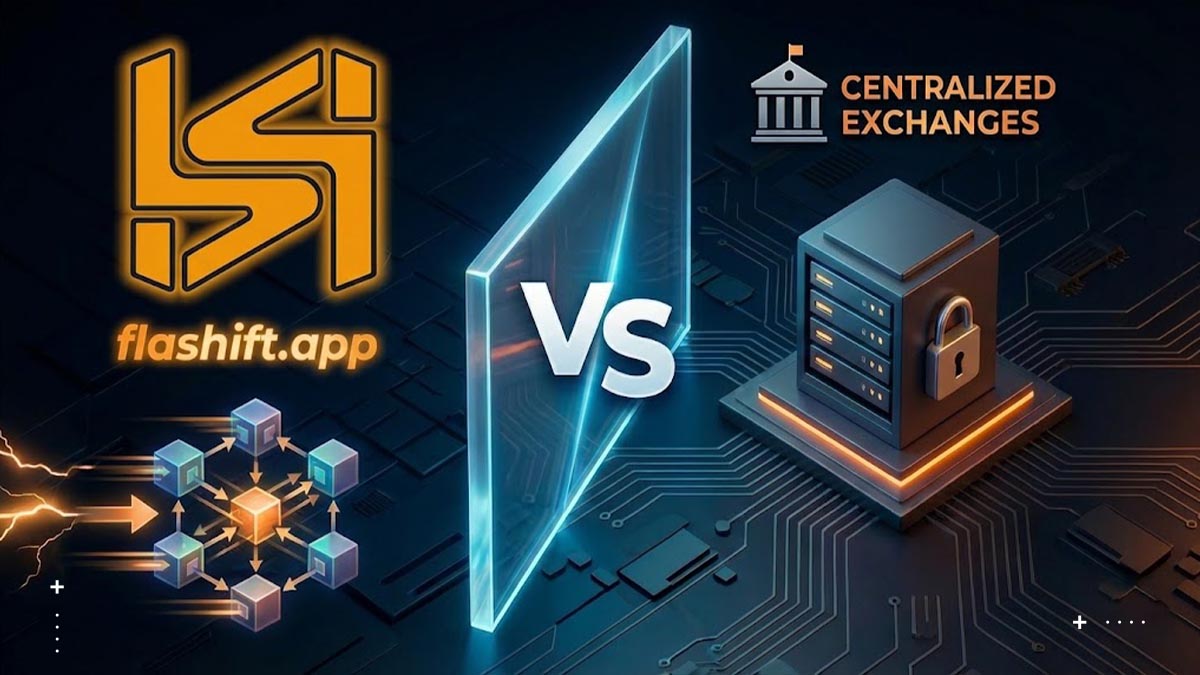
When people compare a centralized exchange (CEX) with Flashift, the real difference isn’t the interface or the number of coins—it’s where trust actually sits. A CEX asks you to trust the platform first. You deposit funds, complete KYC, and rely on internal systems to safeguard your assets and process withdrawals. Most of the time it works, but history has shown that when something breaks, users are usually the last in line.
Flashift flips that dynamic. It doesn’t act as a custodian or a gatekeeper. As a non-custodial aggregator, Flashift never holds your funds and never asks you to open an account. You initiate a swap directly from your own wallet, Flashift finds the best available route across multiple liquidity providers, and the transaction happens on-chain. Control stays with you from start to finish. There’s no balance sitting on a dashboard, and nothing for the platform to freeze or mismanage.
Feel the real Privacy with Flashift.app
Privacy is another clear dividing line. On a CEX, identity verification is non-negotiable. Even a simple swap can mean uploading documents, waiting for approval, and accepting withdrawal limits. Flashift is built for users who want to swap crypto without KYC. No accounts, no personal data stored, no risk of sensitive information becoming a liability later.
So, is Flashift safe? Safety here doesn’t come from promises or brand size; it comes from structure. Because Flashift doesn’t custody funds, it doesn’t present a single honeypot for attackers. There’s no centralized pool of user assets and no long-term storage of value. Each swap is a discrete transaction with limited exposure time, which naturally reduces risk compared to platforms that hold billions in user deposits.
In short, a CEX asks you to trust the company. Flashift asks you to trust the process. For many experienced crypto users, that distinction is exactly why non-custodial swaps feel like the more mature evolution of exchanging digital assets. So, you will experience safe crypto swaps using Flashift.
At a Glance; Flashift vs Centralized Exchanges
| Feature | Centralized Exchanges (CEX) | Flashift |
| Custody of funds | Exchange holds user funds in internal wallets | User keeps full control of funds at all times |
| Platform model | Centralized intermediary | Non-custodial aggregator |
| Account requirement | Mandatory account creation | No account needed |
| Identity verification | KYC is required in most cases | Swap crypto without KYC |
| Fund exposure risk | High — large pooled balances attract attacks | Lower — no pooled custody or stored balances |
| Withdrawal control | Platform can delay, limit, or freeze withdrawals | No withdrawals — swaps execute directly |
| Privacy level | Personal data stored and managed by exchange | No personal data collected |
| Single point of failure | Yes — platform, wallets, and databases | No centralized fund storage |
| Swap execution | Internal matching + external liquidity | Aggregates multiple liquidity providers |
| Speed of use | Slower due to login, checks, and limits | Instant access, wallet-to-wallet swaps |
| Regulatory interruptions | Possible account suspensions or restrictions | Not account-based, fewer access disruptions |
| Transparency of flow | Mostly internal and opaque | On-chain, traceable transactions |
Benefits of no-KYC exchanges
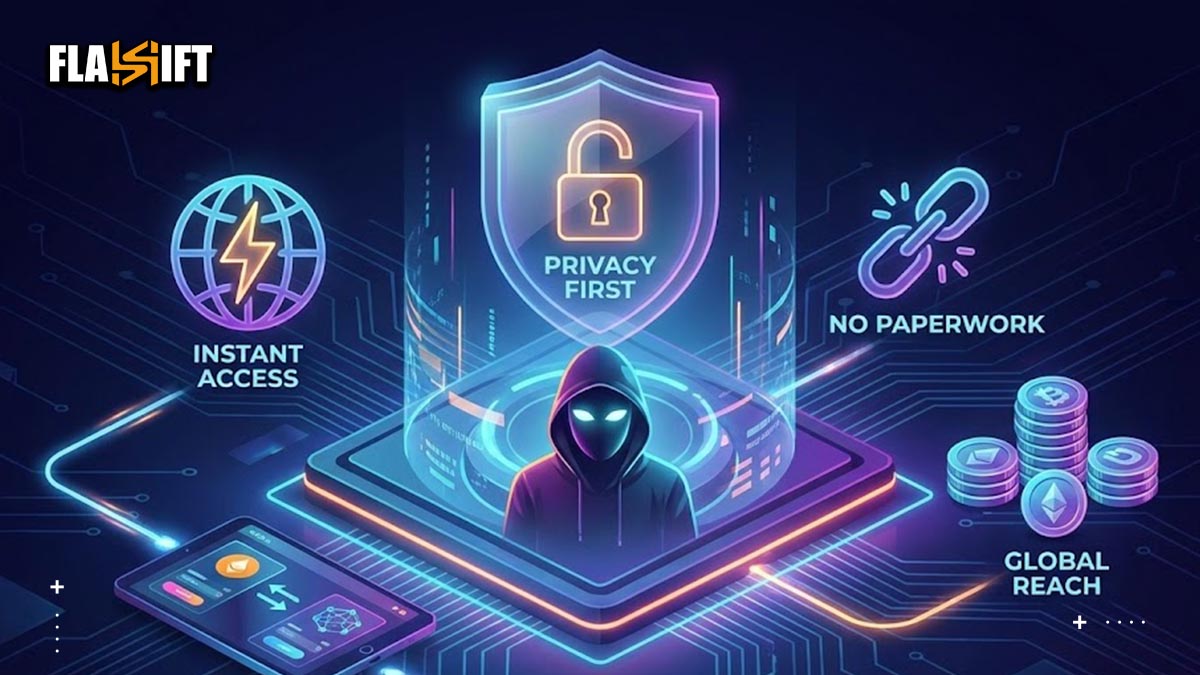
No-KYC exchanges aren’t about cutting corners—they’re about removing friction that doesn’t add real value to the trade. For experienced crypto users, the appeal comes down to control, efficiency, and risk management. Below are the most practical cases where a no-KYC model makes sense, explained in real-world terms.
- Faster Access When Timing Matters
Markets don’t wait for verification emails or document reviews. With a no-KYC platform, you can swap crypto without KYC the moment you decide to act. There’s no onboarding delay, no approval queue, and no sudden trading lock because a document needs rechecking. This speed is especially valuable during high-volatility moments, where execution timing directly affects outcomes.
- Reduced Counterparty Risk
Traditional exchanges require you to trust a centralized entity with both your funds and your identity. A no-KYC platform built as a non-custodial aggregator reduces that exposure. Since funds never sit in a platform-controlled wallet, there’s no large pool of user assets waiting to become a target. Each swap is a standalone transaction rather than a long-term deposit.
- Better Privacy by Design
KYC doesn’t just verify identity—it creates a permanent data footprint. No-KYC exchanges avoid collecting sensitive personal information in the first place. That means no document storage, no identity databases, and no long-term liability if a third party is compromised. Privacy here isn’t a feature; it’s a structural choice.
- No Account, No Lockouts
Account-based systems come with account-based problems: frozen balances, regional restrictions, sudden policy changes, or compliance reviews triggered without warning. No-KYC platforms don’t rely on user accounts at all. You connect your wallet, execute the swap, and move on. There’s nothing to suspend because nothing is stored.
- Global Accessibility Without Friction
Many users face limited access to centralized exchanges due to location, documentation requirements, or local regulations. A no-KYC exchange removes most of these barriers. As long as you have a compatible wallet and network access, you can use the service without explaining who you are or where you’re from.
- Cleaner Asset Ownership
Using a non-custodial aggregator keeps the ownership line clear. Your assets stay in your wallet before and after the swap. There’s no temporary “platform balance” and no internal ledger you have to trust. This aligns with the core principle of crypto: if you control the keys, you control the funds.
- Lower Long-Term Operational Risk
Over time, centralized platforms accumulate legal, regulatory, and operational pressure. These risks eventually flow down to users through restrictions, shutdowns, or forced migrations. No-KYC exchanges minimize this exposure by avoiding custodial responsibility and personal data handling altogether, keeping the service lightweight and resilient.
In short, no-KYC exchanges aren’t just about anonymity—they’re about efficiency, ownership, and reducing unnecessary risk. When built as a non-custodial system, they offer a cleaner, more direct way to swap crypto without adding layers that don’t serve the user.
Make Your First no-KYC Swap via Flashift
Supported Coins: CEX Listings vs Swap Aggregators Like Flashift
When users compare platforms, the range of supported coins often looks like a simple numbers game. In reality, the way those coins are supported matters just as much as how many appear on the list. Centralized exchanges (CEXs) and swap aggregators like Flashift approach asset support in fundamentally different ways—and that difference directly affects flexibility, access, and risk.
On a typical CEX, supported coins are limited to what the exchange has officially listed. Each new asset goes through internal approval, legal review, wallet integration, and ongoing maintenance. This process keeps the list curated, but it also means slower adoption of new tokens and frequent delistings when volume drops or regulations change. If a coin doesn’t meet the exchange’s internal criteria, users simply can’t trade it there.
A swap aggregator like Flashift works from the opposite direction. Instead of listing assets one by one, it connects to multiple liquidity providers and decentralized sources at the same time. As a result, Flashift can support a much broader and more dynamic range of tokens across different blockchains. When a token becomes available through its connected providers, users can often access it immediately—without waiting for a centralized listing decision.

This difference becomes even more noticeable with long-tail assets. On a CEX, lower-volume coins are often unavailable or removed to reduce operational overhead. On Flashift, those same assets may still be swappable because liquidity exists elsewhere in the ecosystem. The platform isn’t maintaining wallets or order books; it’s routing swaps where liquidity already lives.
There’s also a practical risk angle. On centralized platforms, your access to supported coins depends on the exchange’s policies and your account status. On a non-custodial swap aggregator, supported coins are tied to networks and liquidity, not user profiles. As long as a token is supported by connected providers, you can swap directly from your wallet—no listings drama, no account-level restrictions.
In fact, CEXs offer a controlled and static selection of coins, while swap aggregators like Flashift provide broader, more flexible access that evolves with the market itself. For users who want exposure beyond the top-tier assets, that structural difference can matter more than the raw coin count.
Conclusion
At a certain point, the comparison stops being about features and starts being about philosophy. Centralized exchanges are built on the idea that users are willing to trade custody and privacy for convenience. Sometimes that’s acceptable. Other times, it becomes a hidden cost that only shows up when withdrawals are delayed, assets are delisted, or access suddenly changes.
Flashift represents a more direct model. As a non-custodial aggregator, it doesn’t ask you to park funds or create an identity just to make a swap. You stay in control, execute the trade, and move on. The ability to swap crypto without KYC isn’t a loophole, it’s a design choice that reduces friction, data exposure, and dependency on a single platform.
What ultimately makes this model compelling is how risk is handled. Instead of concentrating trust in one place, Flashift spreads execution across existing liquidity and keeps user funds out of its custody entirely. For users who value ownership, flexibility, and a cleaner exchange process, that difference matters. As crypto continues to mature, solutions that prioritize structure over promises are likely to feel less like an alternative, and more like the natural next step.
FAQ
- Can I use Flashift for frequent swaps, or is it only suitable for occasional trades?
Flashift works well for frequent swaps because it doesn’t rely on accounts or balances. Each transaction is independent, so you’re not affected by usage limits, account flags, or profile-based restrictions that often apply on centralized exchanges.
- How does Flashift decide which rate I get during a swap?
As a non-custodial aggregator, Flashift compares live offers from multiple liquidity providers at the moment you initiate a swap. The rate you see is based on available on-chain and partner liquidity, not an internal order book or manual pricing model.
- What happens if a token is removed or restricted on major CEXs?
Delistings on centralized exchanges don’t automatically affect Flashift. If liquidity for that token still exists through connected providers, you can often continue swapping it without interruption, regardless of CEX policies.
- Is swapping without KYC less secure than using a centralized exchange?
Security doesn’t come from identity checks; it comes from how funds are handled. Flashift’s non-custodial structure means your assets aren’t stored on the platform, which reduces the risk associated with centralized fund custody.
- Are there situations where a CEX might still be the better option?
Yes. If you need fiat on-ramps, margin trading, or complex order types, a CEX may be more suitable. Flashift is optimized for straightforward crypto-to-crypto swaps rather than full trading dashboards.
- How do I verify a swap if something goes wrong?
Every Flashift swap is tied to an on-chain transaction. This allows you to track and verify the process transparently using blockchain explorers, rather than relying on internal exchange records or support tickets.