


- 🛡️ Protecting Your Profits: Why Swap to USDC/USDT?
- How to Swap Volatile Assets to Stablecoins Without CEX Limits
- What This Looks Like in Practice
- A Real Case Study: My Partner Falls
- ⚡️ Pro Tips From Real Trading Experience
- Speed beats perfection
- Break large swaps into smaller ones
- Know when to use USDC vs USDT
- Watch the network, not just the asset
- Avoid unnecessary complexity
- Why you must consider to switch to Stablecoins in time?
- Supported Stablecoins on Flashift (USDT, USDC, DAI)
- Stablecoin Comparison: USDT vs USDC vs DAI
- Conclusion
- FAQ
Turning crypto profits into stable value shouldn’t come with friction, delays, or identity checks that compromise your privacy. Today, many traders are actively searching for ways to move funds quickly while staying in control. This is where crypto to stablecoin No KYC solutions come into play.
If your goal is swap crypto to USDC or another stablecoin without handing over personal data, you’re not alone. The demand for fast, private off-ramps has grown alongside tighter regulations and exchange restrictions.
But here’s the challenge: not all methods are equal. Some routes expose your data, others add hidden fees, and many slow you down with unnecessary steps.
In this guide, you’ll learn how to cash out crypto into stablecoins efficiently and anonymously without sacrificing speed, security, or control over your assets.
🛡️ Protecting Your Profits: Why Swap to USDC/USDT?

Crypto markets move fast and, profits can disappear just as quickly. Converting volatile assets into stablecoins is one of the simplest ways to lock in gains without fully exiting the market.
Stablecoins like USDC and USDT are designed to track the value of the US dollar. This means when you swap your crypto to USDC, you’re essentially stepping out of price swings while keeping your capital on-chain and ready to move.
There are a few key reasons traders prioritize this move:
- Preserve gains instantly
Instead of timing the perfect exit to fiat, you can secure your profits in seconds. No exposure to sudden dips.
- Stay liquid and flexible
Stablecoins can be used across exchanges, DeFi platforms, and wallets. You’re not locked into one system.
- Avoid banking friction
Traditional cash-outs often involve delays, limits, and identity checks. Stablecoins remove that layer while still holding dollar value.
- Fast re-entry into the market
When a new opportunity appears, you can deploy capital immediately; no need to wait for deposits or approvals.
For anyone focused on convert your crypto to stablecoin No KYC strategies, USDC and USDT offer a practical middle ground: stability without losing control or speed.
How to Swap Volatile Assets to Stablecoins Without CEX Limits

When the market turns, timing matters more than anything. The problem with centralized exchanges isn’t just KYC, it’s the delay. By the time you verify, transfer, and withdraw, the price you were trying to protect is already gone.
That’s why many experienced traders don’t rely on CEXs when they need to move fast. Instead, they use non-custodial swap methods to convert assets into stablecoins instantly. No accounts, no limits, no waiting.
What This Looks Like in Practice
Let’s say you’re holding ETH and the market starts dropping fast. Instead of sending funds to an exchange, waiting for confirmations, and dealing with withdrawal restrictions, you simply:
- Open a no-KYC swap aggregator
- Connect your wallet
- Choose ETH → USDC (or USDT)
- Confirm the transaction
Within a few minutes, your volatile asset is converted into a stablecoin, sitting safely in your own wallet.
No custody risk. No frozen funds. No friction.
A Real Case Study: My Partner Falls
A trader I worked with was holding a mid-sized ETH position during a sudden market reaction to inflation data.
- ETH dropped around 7% in less than two hours
- Instead of moving funds to a centralized exchange, he swapped directly to USDC using a non-custodial tool
- The full process took under 4 minutes
The key part? The market kept falling.
By the time many traders completed KYC or withdrawals, ETH was down another ~3–4%. He avoided that entire second leg of the drop, and later re-entered at a better price.
This is a small window, but in crypto, those windows define your P&L.
⚡️ Pro Tips From Real Trading Experience
Speed beats perfection
Waiting for the “best rate” often costs more than a slightly worse execution. In volatile conditions, execution time is your real edge.
Break large swaps into smaller ones
If you’re moving size, splitting the trade reduces slippage and improves final outcomes.
Know when to use USDC vs USDT
- USDC is often preferred for transparency and lower perceived risk
- USDT usually has deeper liquidity across more trading pairs
Smart traders use both, depending on the situation.
Watch the network, not just the asset
Sometimes the delay isn’t the swap, it’s the blockchain. High gas fees or congestion (especially on Ethereum) can slow things down.
Avoid unnecessary complexity
Bridges, multiple hops, or manual routing increase risk. Simpler execution usually wins.
Why you must consider to switch to Stablecoins in time?
Stablecoins have become the backbone of crypto trading. They’re not just a “safe option”, they’re how capital moves efficiently across the market.
When you focus on crypto to stablecoin No KYC, you’re not just protecting privacy. You’re removing friction, reducing risk exposure, and keeping full control over your funds.
And in fast markets, that combination is what separates reactive traders from prepared ones.
Supported Stablecoins on Flashift (USDT, USDC, DAI)

When you’re swapping volatile assets, the choice of stablecoin isn’t just a technical detail; it directly impacts liquidity, flexibility, and even risk exposure. Flashift supports the three most widely used stablecoins (USDT, USDC, and DAI) each serving a slightly different role in the ecosystem.
Understanding how they differ helps you make smarter, faster decisions when executing a crypto to stablecoin No KYC strategy.
USDT (Tether): Maximum Liquidity, Fastest Execution
USDT remains the most traded stablecoin globally, and that liquidity matters.
- Available on multiple networks (ERC20, TRC20, BEP20, and more)
- Deep order books across almost all exchanges
- Typically offers the fastest execution with minimal slippage
In real trading conditions, USDT is often the “go-to” when speed is critical. If you’re exiting a volatile position and want immediate stability with the least friction, USDT usually delivers the smoothest experience.
Best use case:
High-speed swaps, arbitrage, and moving funds across platforms quickly.
USDC (USD Coin): Transparency and Institutional Trust
USDC is designed with a stronger focus on regulatory compliance and reserve transparency.
- Backed by audited reserves and widely used in institutional flows
- Strong integration with DeFi protocols (lending, staking, payments)
- Preferred in ecosystems where compliance and clarity matter
For traders who prioritize security and long-term holding stability, USDC often feels like the safer parking zone after exiting volatile assets.
Best use case:
Holding profits, interacting with DeFi, or reducing counterparty concerns.
DAI: Decentralized Stability Without Custodial Risk
DAI operates differently from USDT and USDC. It’s decentralized and backed by crypto collateral rather than fiat reserves.
- Governed by smart contracts instead of a central issuer
- Resistant to censorship and centralized control
- Integrated deeply into DeFi ecosystems
However, DAI can occasionally deviate slightly from the $1 peg during extreme market stress due to its collateral mechanics.
Best use case:
Users who value decentralization, on-chain autonomy, and censorship resistance.
Real Execution Insight: Functional Example
In practice, experienced traders don’t stick to one stablecoin; they switch based on context.
For example:
During a sharp market drop, a trader may swap ETH → USDT for instant execution due to liquidity. Later, once the market stabilizes, they might rotate part of that capital into USDC for holding or into DAI for DeFi strategies.
This layered approach balances speed, safety, and flexibility, instead of relying on a single stablecoin for every situation.
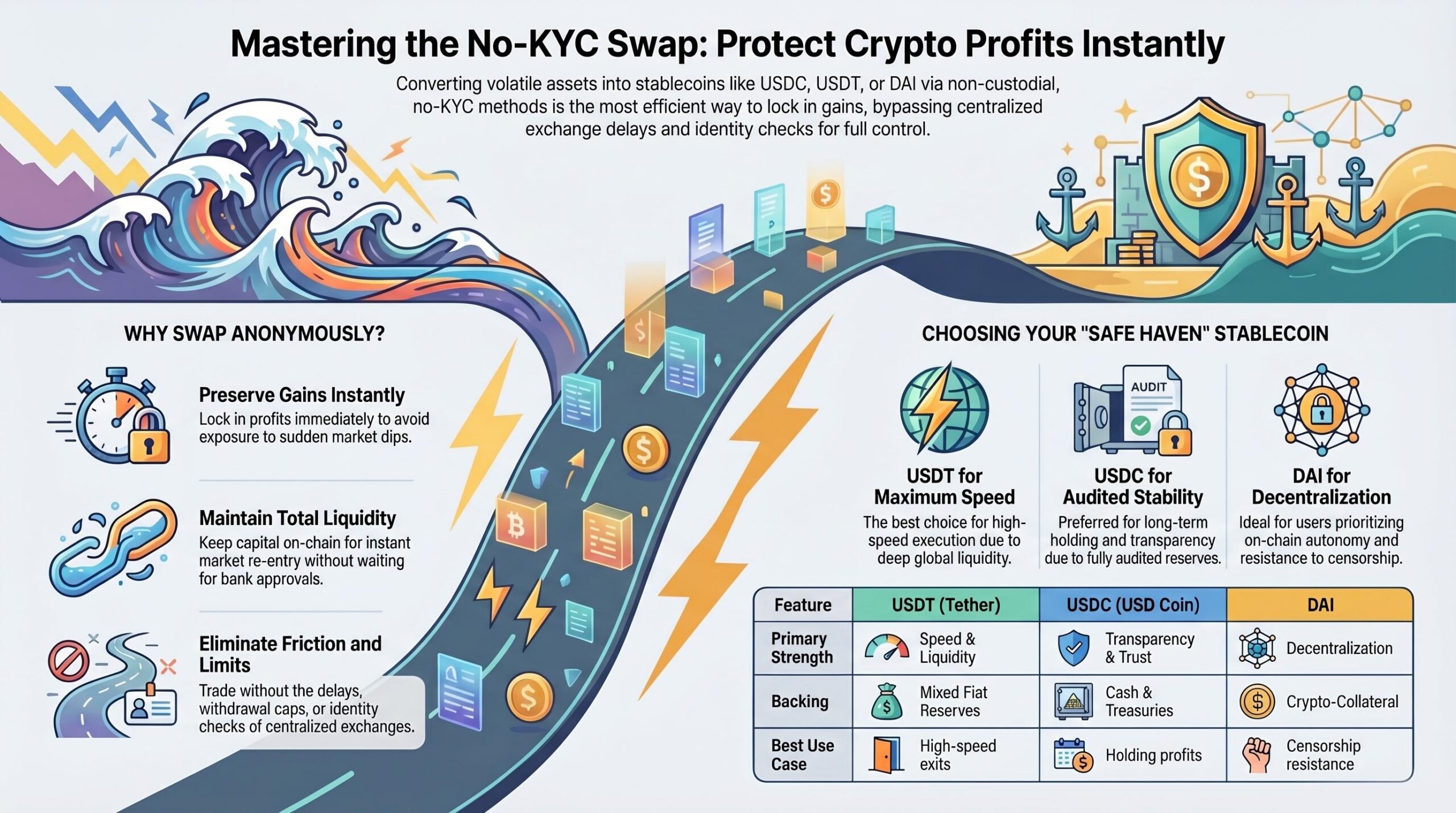
Pro-Level Tips for Choosing the Right Stablecoin
Match the coin to your intent
- Quick exit → USDT
- Capital preservation → USDC
- On-chain independence → DAI
Check network compatibility before swapping
Not all stablecoins behave the same across chains. Fees and confirmation times can vary significantly.
Watch liquidity during high volatility
Even stablecoins can experience temporary imbalances. USDT usually holds the strongest depth during extreme conditions.
Avoid overcomplicating your stack
Holding too many stablecoins across too many networks can create friction when speed matters.
Final Perspective
Flashift’s support for USDT, USDC, and DAI gives you a flexible toolkit—not just a single option. The real advantage isn’t just swapping into “a stablecoin,” but choosing the right one based on market conditions and your next move.
That’s what separates basic users from traders who operate with precision.
Stablecoin Comparison: USDT vs USDC vs DAI
| Feature | USDT (Tether) | USDC (USD Coin) | DAI |
| Type | Centralized | Centralized | Decentralized |
| Backing | Fiat reserves (mixed assets) | Fully backed by cash & short-term treasuries | Crypto-collateralized (overcollateralized) |
| Transparency | Moderate | High (regular audits) | On-chain, fully transparent |
| Liquidity | Very high (most traded) | High | متوسط (depends on DeFi markets) |
| Best Use Case | Fast swaps, trading, arbitrage | Holding profits, DeFi, lower risk exposure | DeFi, censorship resistance |
| Network Support | Very wide (ERC20, TRC20, BEP20, etc.) | Wide (mainly ERC20 + L2s) | Primarily Ethereum & L2 ecosystems |
| Depeg Risk | Low (historically stable, but debated) | Very low | Slightly higher during extreme volatility |
| Speed of Execution | Fastest (due to liquidity depth) | Fast | Moderate (depends on liquidity pools) |
Quick takeaway:
- Choose USDT when speed and liquidity matter most
- Choose USDC when you want more transparency and stability
- Choose DAI when decentralization and on-chain control are your priority
Conclusion
Cashing out into stablecoins isn’t just a defensive move—it’s a strategic one. In fast-moving markets, the ability to convert assets instantly, without delays or restrictions, can be the difference between protecting profits and watching them disappear.
By focusing on Crypto to stablecoin No KYC methods, you remove the usual friction: no account creation, no withdrawal limits, no exposure to centralized control. Instead, you stay fully in charge of your funds while moving at market speed.
Whether you choose USDT for liquidity, USDC for stability, or DAI for decentralization, the key is execution. The traders who consistently stay ahead aren’t the ones predicting perfectly but they’re the ones reacting efficiently.
If you wanna swap Crypto to USDC or any stablecoin quickly and privately, then using a non-custodial, smart-routing platform is no longer optional. It’s the standard for anyone serious about control, speed, and capital protection in today’s crypto landscape.
FAQ
- Can I swap crypto to stablecoins without leaving a trace on-chain?
No transaction on a public blockchain is completely invisible. However, using a Crypto to stablecoin No KYC method ensures your identity isn’t directly tied to the transaction. Your wallet activity remains public, but not personally identifiable unless linked elsewhere.
- Why does the final amount sometimes differ slightly from the estimated rate?
This usually comes down to slippage and network conditions. In fast markets, prices shift between the moment you initiate and confirm the swap. High-quality aggregators reduce this gap, but they can’t eliminate real-time volatility.
- Is it safer to swap directly to USDC instead of USDT?
“Safer” depends on your goal. USDC is often preferred for transparency and reserves, while USDT offers deeper liquidity. Many experienced users split funds between both to balance risk and flexibility.
- What’s the biggest mistake traders make when swapping to stablecoins?
Waiting too long. Trying to time the exact top often leads to missed exits. In volatile conditions, execution speed matters more than squeezing out a slightly better rate.
- Do no-KYC swaps work the same across all blockchains?
Not exactly. Network fees, confirmation times, and liquidity vary between chains like Ethereum, Tron, or BNB Chain. The same swap can feel instant on one network and slow or expensive on another.
- Can I move stablecoins back into volatile assets instantly after swapping?
Yes, that’s one of the biggest advantages. Once you swap crypto to USDC or another stablecoin, your capital stays liquid and ready. You can re-enter the market at any moment without waiting for deposits or approvals.