
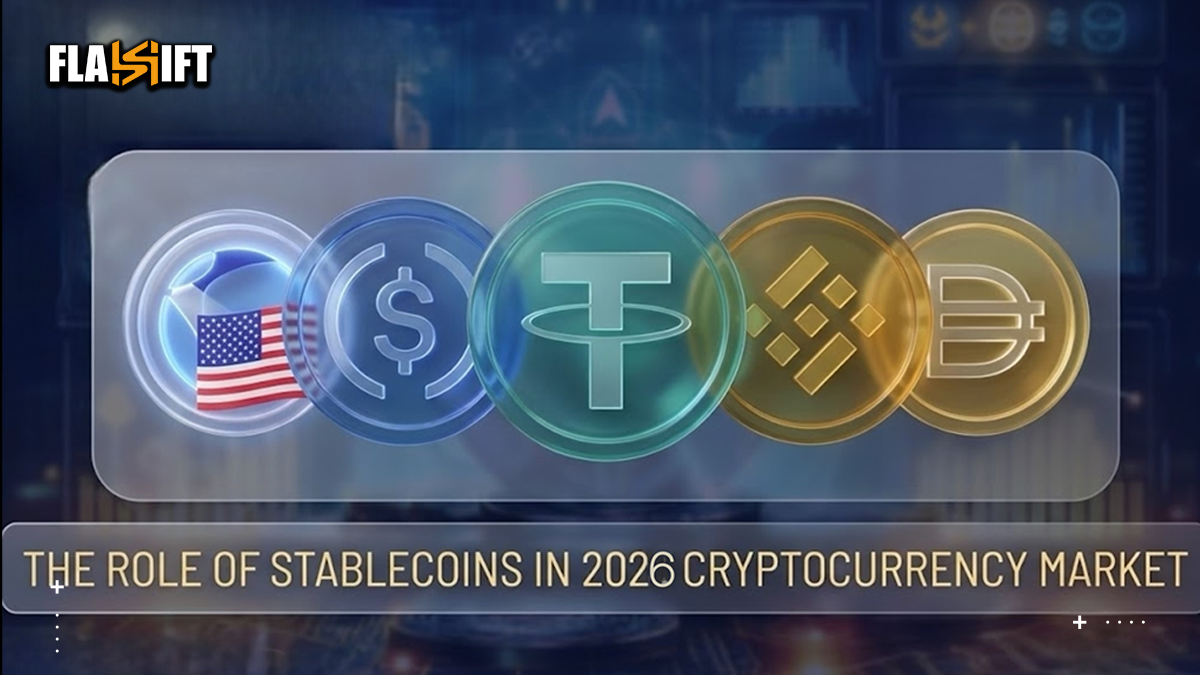
The most dangerous line of code in Decentralized Finance (DeFi) is the blacklist function embedded directly inside centralized stablecoin contracts.
In 2026, holding stablecoins like USDT is no longer a risk-free strategy for parking sidelined capital. As regulatory frameworks like MiCA in Europe and strict OFAC rules in the United States tighten their grip, centralized issuers are under unprecedented pressure to unilaterally freeze wallet addresses. A single arbitrary flag, an automated compliance mistake, or an unexpected interaction with a tainted address can instantly lock you out of your assets.
True Financial Sovereignty is no longer just about avoiding market volatility, it is about keeping your capital censorship-resistant. For elite on-chain participants, surviving the 2026 landscape requires moving beyond blind trust in centralized backing. It demands a technical understanding of stablecoin freeze risks, the utilization of decentralized architectures, and the ability to dynamically rotate assets across chains via non-custodial routing.
📊 2026 Stablecoin Sovereignty Matrix
| Stablecoin Type | Market Representatives | Censorship & Freeze Risk | Primary Backing Mechanism | Sovereign Swap Pathway |
| Centralized Fiat-Backed | USDT
USDC PYUSD |
Extremely High (Unilateral blacklist contract functions) | Cash & short-term U.S. Treasuries (1:1) | Fast rotation into censorship-resistant assets |
| Decentralized Overcollateralized | DAI
Sky crvUSD |
Low to Moderate (Mitigated by decentralized on-chain governance) | Crypto assets (ETH, LST) and real-world assets (RWA) | Direct peer-to-peer liquidity pools |
| Synthetic Delta-Neutral | USDe Ethena | Very Low (Crypto-native, derivative-backed) | Delta-neutral hedging (1:1 short perps vs. staked spot ETH | Non-custodial cross-chain arbitrage |
The Hidden Vulnerability: Why “Stable” Does Not Mean “Safe”
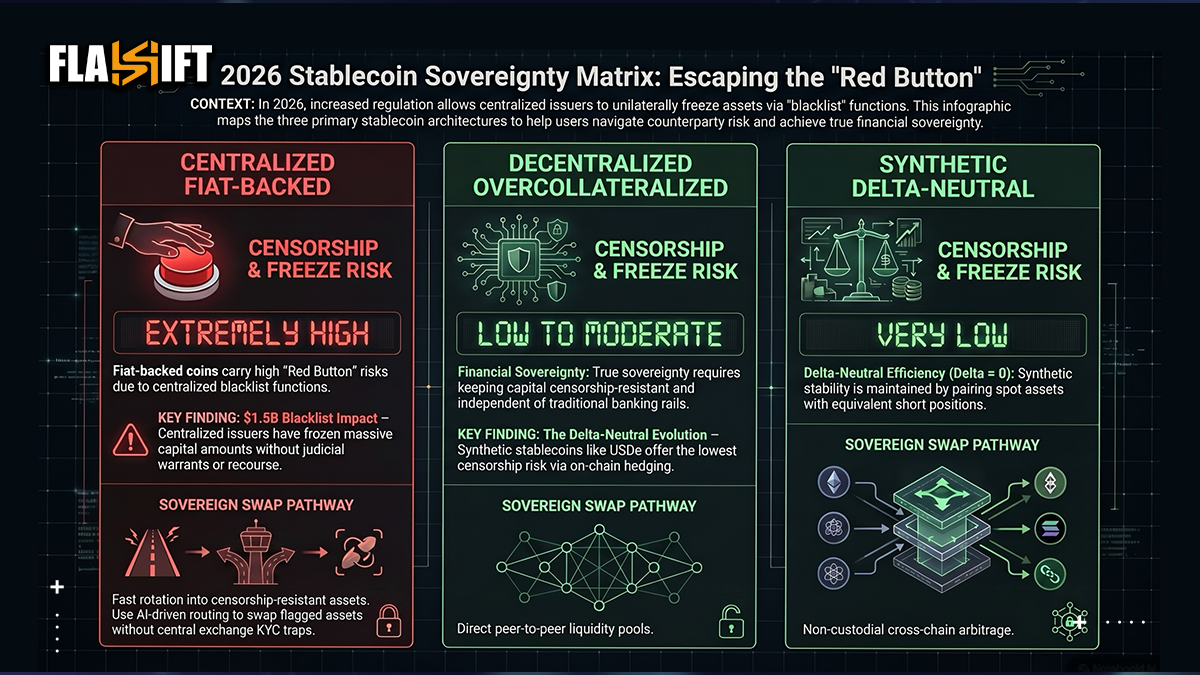
For years, traders treated centralized stablecoins as digital cash. However, at their core, fiat-collateralized coins are centralized debt instruments wrapped in blockchain code.
The Mechanics of the “Freeze”
Both Tether (USDT) and Circle (USDC) maintain a centralized blacklist function within their smart contracts. When called by the issuer, this function blocks specific Ethereum, Solana, or Tron addresses from transferring, receiving, or burning the token.
- The Scale of the Problem: By 2026, centralized issuers have blacklisted over 1.5B worth of stablecoins globally, often without prior notice, judicial warrants, or a clear path to recourse.
- The Surprise KYC Trap: Triggering an automated compliance flag can lock your funds instantly. Users are increasingly forced into retroactive, invasive identity verification loops simply to unlock their own long-term savings.
For high-net-worth individuals and institutional desks in Tier-1 jurisdictions, this creates a catastrophic counterparty risk. The only way to eliminate this single point of failure is to strategically diversify into censorship-resistant stablecoins or maintain the infrastructure to instantly swap out of flagged pools.
Stablecoin Taxonomy & Mechanism Breakdown in 2026

To hedge against systemic blacklisting, you must align your treasury with the correct backing architectures. The 2026 market is divided into three distinct mechanisms:
- Centralized Fiat-Backed (High Stablecoin Freeze Risks)
Backed 1:1 by traditional reserves, these tokens offer the deepest on-chain liquidity but act as a direct extension of the traditional banking system.
- Mechanisms: Audited centralized bank reserves and short-term debt instruments.
- Censorship Risk: Absolute. Issuers can—and do—freeze assets at the request of international law enforcement, tax agencies, or algorithmic risk-scoring engines.
- Crypto-Collateralized (Decentralized & Censorship-Resistant)
These protocols use smart contracts to mint stablecoins against overcollateralized decentralized pools, completely bypassing the traditional banking system.
- Mechanisms: Overcollateralized pools of ETH, Liquid Staking Tokens (LSTs), and yield-bearing assets.
- Censorship Risk: Minimal. Because there is no centralized custodian, there is no “red button” to freeze individual wallets.
- Synthetic Delta-Neutral Hedging (Yield-Optimized & Scalable)
The breakout narrative of 2026. Instead of relying on banks or overcollateralization, synthetic stablecoins use automated financial derivatives to maintain stability.
- Mechanisms: The protocol maintains a delta-neutral position by pairing spot assets with equivalent short perpetual futures contract positions:
Delta = Spot Long + Perpetual Short = 0
- Censorship Risk: Exceptionally low. Operating natively on-chain via derivative markets, these assets generate high yield while remaining completely independent of traditional banking rails.
Strategic Asset Rotation: Bypassing the Freeze Button
When compliance policies shift or localized network risks spike, speed is your only shield. Manually moving assets to centralized exchanges to rebalance your stablecoin portfolio is a self-defeating strategy—it exposes you to the very KYC blocks and holding periods you are trying to avoid.
Experienced on-chain participants utilize Flashift’s AI-driven routing engine to execute direct, non-custodial stablecoin swaps.
[Risky Centralized Asset] ──► [Flashift AI Smart Router] ──► [Censorship-Resistant Asset]
          │                                                               │
  (High Freeze Risk)                (Zero-Custody, No KYC)             (Financial Sovereignty)
By leveraging Flashift, you protect your capital through several architectural advantages:
- Zero-Custody Execution: The swap happens directly between peer-to-peer liquidity networks and your self-custody wallet, eliminating centralized honeypots.
- Proactive “Bait-and-Switch” Protection: Flashift’s AI engine monitors partner liquidity pools in real time. If a provider advertises an attractive exchange rate but historically enforces hidden slippage, sudden KYC holds, or transaction delays, the router automatically reroutes your transaction through a cleaner, more reliable path.
- Financial Sovereignty Over Anonymity: We do not offer anonymity as a loophole; we provide financial sovereignty as a fundamental right. By avoiding unnecessary database registration, you protect your wallet addresses from global data leaks and arbitrary blacklisting.
Advanced Advantages of Censorship-Resistant Stablecoins
Deploying your capital into decentralized or synthetic stablecoins like DAI or USDe offers distinct advantages for global traders:
Pure Capital Efficiency
Centralized stablecoins hold billions in low-yield traditional instruments. Decentralized stablecoins allow you to capture on-chain yield natively. By integrating yield-bearing variants into your strategy, your collateral actively compounds on-chain, bypassing the fee-skimming intermediaries of traditional finance.
Shielding Against Systemic Bank Runs
If a commercial partner bank of a centralized issuer experiences a liquidity crisis, the pegged asset is vulnerable to immediate de-pegging. Censorship-resistant stablecoins backed by delta-neutral hedging or decentralized crypto-collateral remain decoupled from legacy banking vulnerabilities, keeping your purchasing power intact during banking panics.
Instant, Frictionless B2B Settlements
Traditional cross-border payments are plagued by correspondent banking fees and multi-day settlement delays. By routing transactions through high-speed Layer-2 networks using non-custodial aggregators, global enterprises can settle transactions in seconds for less than a penny—free from geographical restrictions or corporate gatekeepers.
Conclusion: The Sovereign Path Forward
In the mature crypto economy of 2026, stablecoins are no longer just a passive safe haven—they are active battlegrounds for financial control. Relying entirely on centralized fiat-backed stablecoins means accepting the permanent risk of unilateral asset confiscation.
Securing your portfolio requires proactive diversification. By pairing decentralized stablecoins with non-custodial, intelligent routing layers like Flashift, you regain complete ownership over your digital wealth. Protect your capital, avoid centralized bottlenecks, and claim your financial sovereignty today.
FAQ
How can a centralized stablecoin freeze my wallet?
Centralized stablecoins like USDT and USDC contain built-in blacklisting code. If an issuer receives a regulatory request or flags your wallet address through automated compliance scanning, they can execute a smart contract function that permanently freezes your assets in that address.
How does Flashift protect me from stablecoin freeze risks?
Flashift is strictly non-custodial and registration-free. Because we never take custody of your funds or maintain centralized user databases, there is no platform-level choke point for regulators to target or for hackers to exploit. Your swap executes directly, wallet-to-wallet, minimizing exposure.
What are the main risks of synthetic stablecoins like USDe?
Synthetic stablecoins rely on delta-neutral hedging using derivatives. While they are highly censorship-resistant and bank-independent, they carry smart contract risks, execution risks on centralized derivative exchanges, and the potential for negative funding rates during extreme bear markets.
Can I swap centralized stablecoins for decentralized ones without KYC?
Yes. By using Flashift’s AI-driven routing engine, you can swap assets like USDT directly for decentralized assets like DAI or USDe natively across multiple chains with zero registration, zero contract approvals, and absolute privacy.
What is the difference between anonymity and financial sovereignty?
Anonymity focuses on hiding identity, which often carries negative connotations. Financial sovereignty is about control and self-ownership. It ensures that you—and only you—have the keys to your financial destiny, protecting your legitimate capital from arbitrary censorship and surveillance.