
In 2026, privacy is becoming a serious priority in crypto. As blockchain tracking tools grow more advanced, many investors )including Whales) are moving part of their transparent holdings into privacy-focused assets. That’s why searches for ETH to XMR are rising.
By moving funds into Monero, “Whales” protect transaction details and portfolio size from public tracking and blockchain surveillance.
Ethereum transactions are fully visible on-chain, while Monero hides sender, receiver, and amount by default. Converting ETH to XMR isn’t about leaving Ethereum; it’s about protecting financial privacy in a more regulated and traceable 2026 landscape.

The Trap of Centralized Exchanges for XMR Swaps
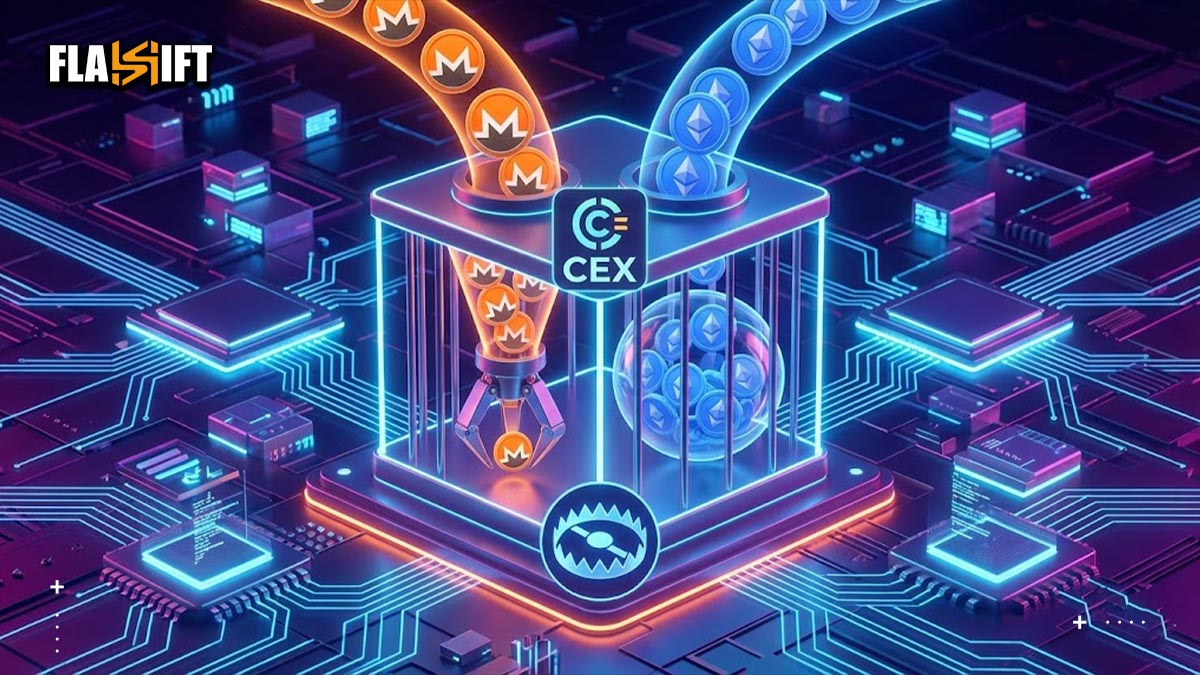
At first glance, using a big exchange for an ETH to XMR conversion feels convenient. Log in, click trade, done. But when privacy is the goal, centralized platforms can quietly defeat the entire purpose.
When you swap ETH for XMR on a centralized exchange, you’re not just making a trade; you’re creating a full identity link between your wallet, your account, and your transaction history.
Ethereum is transparent by design. Every deposit to an exchange is traceable. Once that ETH hits your exchange wallet, it becomes tied to your profile, IP logs, and verification data. Moving into Monero afterward doesn’t erase that record. The trail already exists.
Another issue? Custody risk. When you use centralized exchanges, you don’t control the swap, they do. That means:
- Withdrawal delays
- Extra compliance checks
- Source-of-funds questions
- Sudden account reviews
Privacy coins like Monero often trigger internal monitoring systems. Even if XMR trading is listed, it doesn’t mean it’s frictionless.
And here’s the practical risk most people ignore:
If you try to convert ETH to XMR on exchanges like Binance or Kraken, there is always the possibility of temporary freezes, mandatory KYC verification, or withdrawal restrictions — especially if the activity flags compliance filters.
For users who value discretion, that defeats the reason they searched for ETH to XMR in the first place.
How to Swap ETH to XMR Instantly (Step-by-Step)

If your goal is speed and privacy, the process is simpler than most people think. Here’s the clean, practical flow to convert ETH to XMR without unnecessary exposure.
- Visit Flashift.app and Choose Your pair
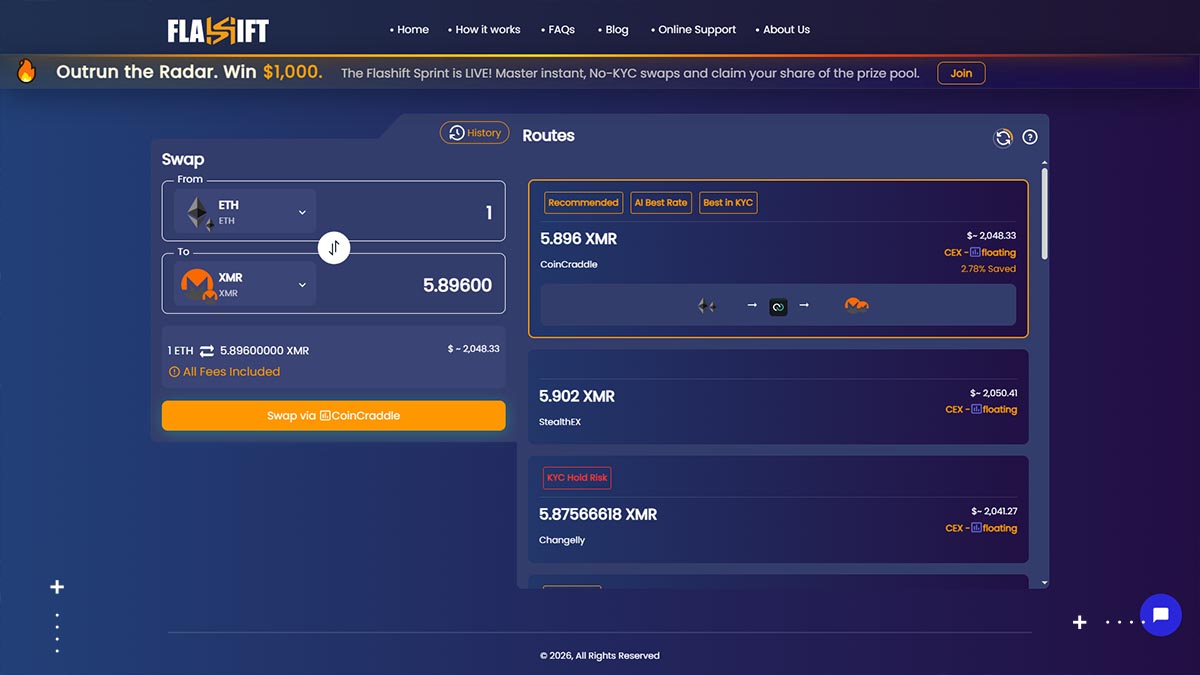
First of all, you need to open “Flashift.app” website. After that, choose Ethereum (ETH) as input token and Monero (XMR) as output token in swap section.
Then, enter the ETH amount you want to swap, select the Exchange based on your metrics (Flashift’s AI helps you to choose the best options) and click “Swap via …”.
- Enter Your Wallet Address
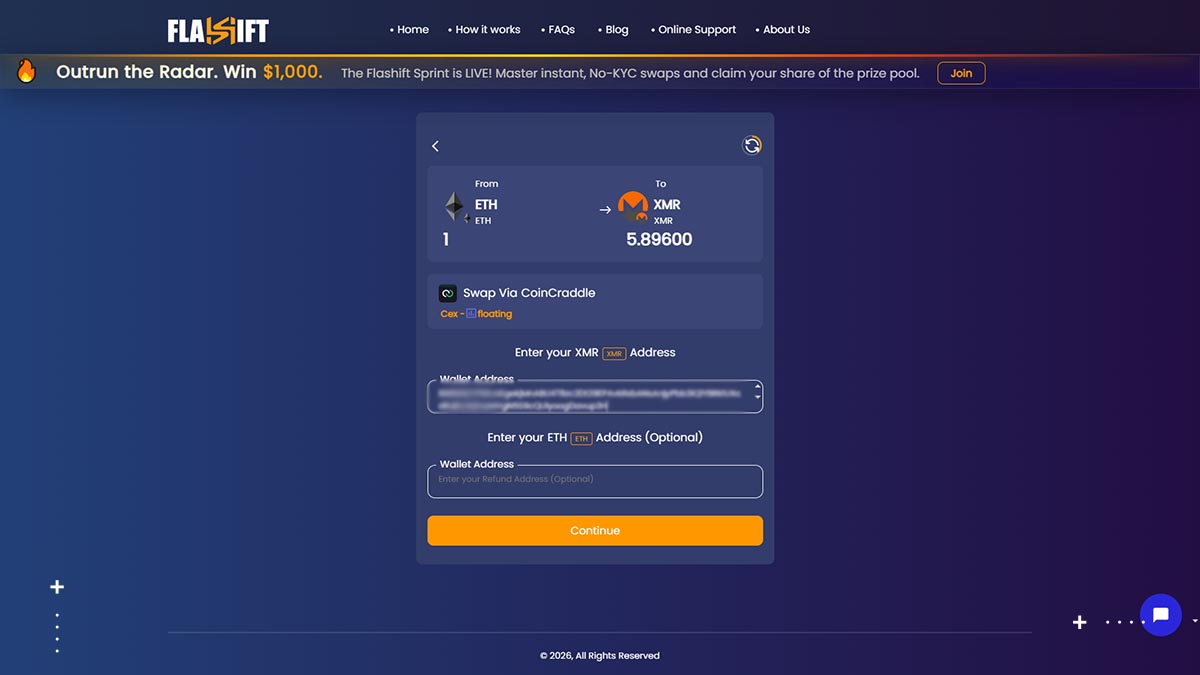
After transaction done, Monero (XMR) will be sent to your wallet. So in this step, you need to provide your Monero wallet address. Enter your wallet address, double check and continue.
- Deposit Your ETH
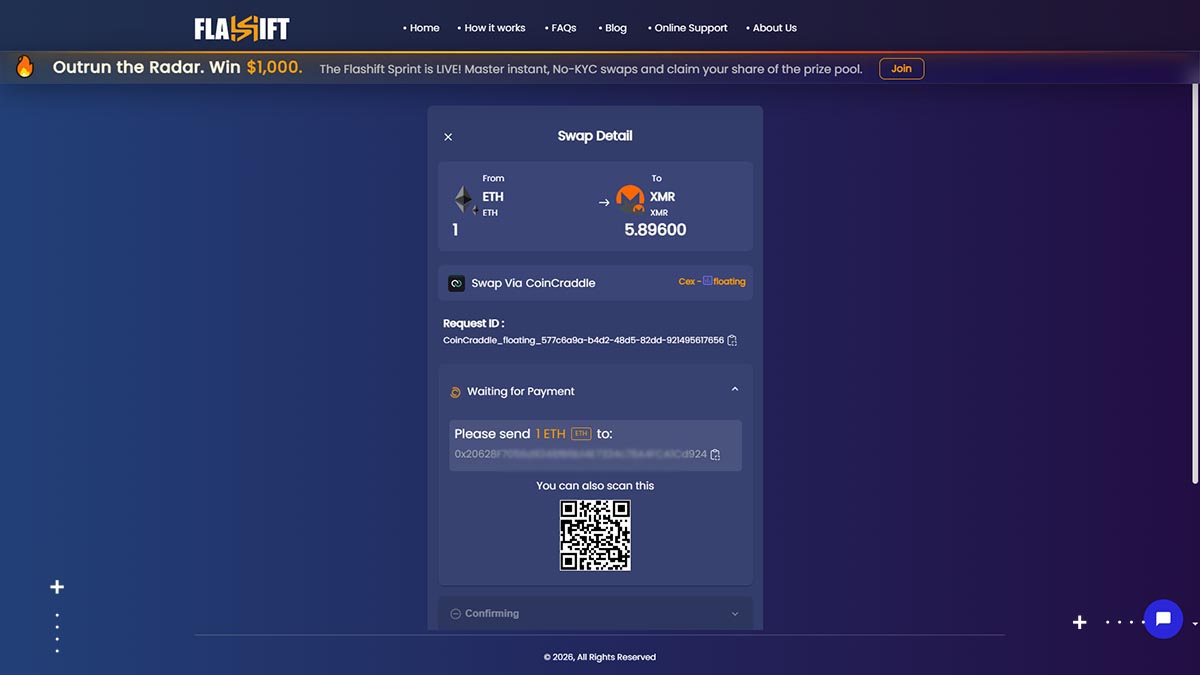
Here, you should deposit ETH to the wallet address provided by Flashift. This amount is equal to the value of Monero you want to receive.
- Review the Details and It’s Done
In this step, check the details and if all are correct and, continue. Flashift will swap your tokens and send Monero to your wallet automatically.
This swap/bridge is fast, secure and without any other requirements. It’s too simple as we said. Try Flashift once, you won’t use any other platforms.
Beating High Gas Fees: Inside Flashift’s AI Decision Engine

When users search for ETH to XMR, they usually focus on the exchange rate. But the real cost of a swap isn’t just the number you see; it’s the route behind it.
Flashift’s AI continuously monitors rates across its partner exchanges in real time. It doesn’t rely on a single liquidity source. Instead, it compares:
- Live exchange rates
- Network fees
- Liquidity depth
- Execution speed
- Historical reliability
Then it labels the options clearly.
You’ll see tags like:
- Recommended – balanced between rate, speed, and reliability
- Best Rate – highest output at that moment
- No-KYC – partners that do not require identity verification under normal conditions
- KYC Hold Risk – exchanges with a higher probability of triggering compliance checks
That last tag matters.
When converting from Ethereum to Monero, compliance filters can become sensitive. Some exchanges may temporarily freeze funds or request verification if a transaction is flagged. Flashift’s AI factors in that behavioral history and surfaces the risk transparently.
So when you swap ETH for XMR, you’re not guessing which route is safer or cheaper. The system has already evaluated the trade-offs, and shows them upfront.
It’s not just smart routing. It’s informed decision-making, in real time.
Conclusion
Swapping ETH to XMR in 2026 isn’t just a technical move, it’s a strategic one. Between rising surveillance, exchange compliance pressure, and volatile gas fees, the method you choose matters as much as the asset itself.
We covered the risks of centralized platforms, the mechanics of instant swaps, and how Flashift’s AI evaluates partner exchanges in real time (tagging options like Best Rate, No-KYC, and KYC Hold Risk). So, you can make informed decisions before you swap ETH for XMR.
Privacy isn’t automatic just because you end up in Monero. The path from Ethereum to Monero determines your exposure. Choose the wrong route, and you leave a permanent footprint. Choose intelligently, and you minimize cost, friction, and risk.
If you want a broader breakdown of XMR conversions beyond ETH specifically, refer to the General Monero Swap Guide for a complete overview of privacy-focused swap strategies.
FAQ
- Is it possible to swap ETH for XMR without registering?
Yes, using non-custodial platforms (e.g. Flashift.app).
- If I swap ETH to XMR, can the transaction still be traced back to me?
Yes, partially. Ethereum is fully transparent, so the outgoing ETH transaction is always visible on-chain. Once funds arrive in Monero, future movements are private by default. The critical factor is how you perform the swap and whether the route links your identity.
- Why does the final XMR amount sometimes differ from the estimated rate?
Because real-time variables shift during execution. Gas fees, liquidity depth, and spread volatility can all impact the final output. Smart routing engines reduce this gap by selecting the most efficient path at the moment of confirmation.
- Is “No-KYC” the same as zero risk of account review?
Not exactly. “No-KYC” typically means no identity verification is required upfront. However, some exchanges may still trigger compliance checks under certain conditions. That’s why seeing a “KYC Hold Risk” indicator before you swap matters.
- Why would an exchange freeze an ETH to XMR swap?
Privacy coins often trigger stricter monitoring rules. If compliance systems detect unusual volume, flagged wallet exposure, or internal policy thresholds, withdrawals can be paused. This is more common on centralized custodial platforms.
- Does splitting a large ETH to XMR swap into smaller transactions reduce risk?
Sometimes. Smaller transactions may lower the chance of automated compliance flags and reduce slippage in thin liquidity conditions. However, splitting trades also increases cumulative gas costs on Ethereum, so the trade-off should be calculated carefully.