


Have you seen how a U.S. government data initiative just turbocharged Wormhole’s token rally? When a government agency like the U.S. Department of Commerce steps into blockchain, the market pays attention. That’s exactly what happened last week when the Commerce Department announced that Pyth Network would start verifying and distributing official economic data — like GDP figures — directly on-chain.
Wormhole’s token shot up nearly 25% in a matter of days, fueled by the recognition that its technology now sits at the intersection of government data and decentralized infrastructure. It wasn’t just a quick pump either — trading volumes exploded, derivatives activity spiked, and the rally signaled a deeper shift: institutional and public-sector players are beginning to rely on Wormhole as critical infrastructure, not just a speculative bridge protocol. This rally feels less like hype and more like the early signs of a bigger trend in how blockchain will handle real-world data at scale.
Wormhole’s Current Price Snapshot and Trend
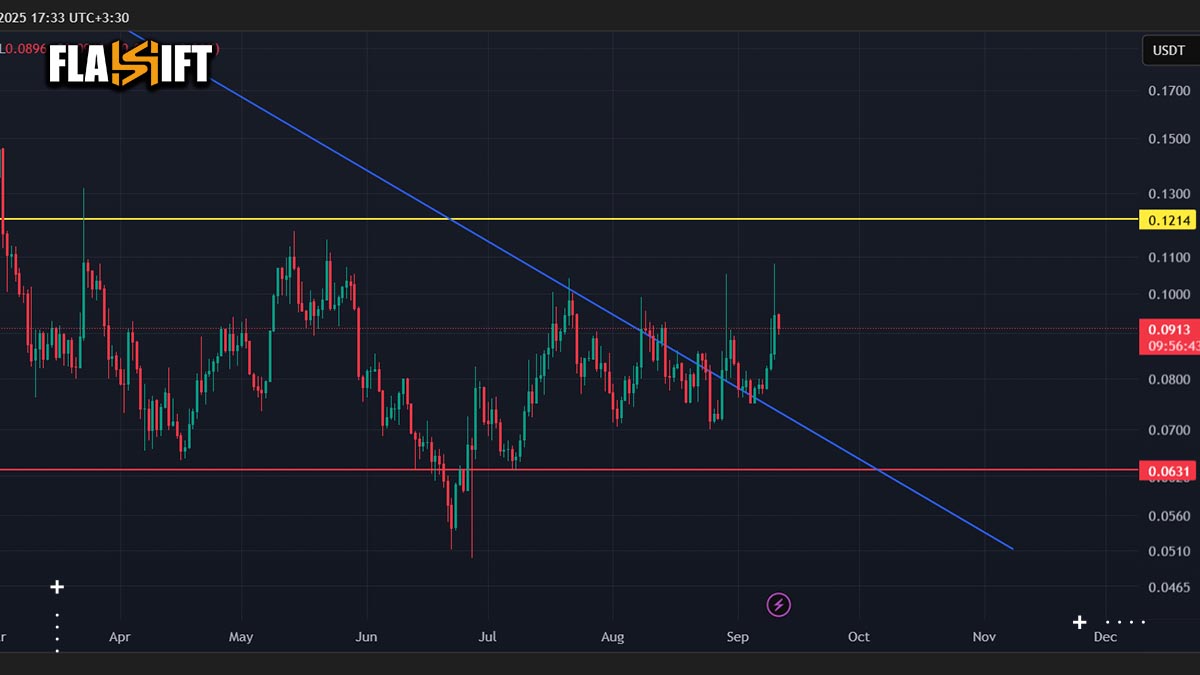
Wormhole is sitting close to the $0.09 mark, a level that has quietly become the new line in the sand for traders. The token’s daily volume shows there’s still meaningful activity around it, even if the noise isn’t as loud as it was during the big spike. With a supply in the billions, moves here don’t happen unless there’s conviction behind them, and that makes every uptick or dip more telling than it seems at first glance.
On the charts, the picture feels split. Short-term momentum indicators lean slightly negative, hinting that pressure from sellers hasn’t fully faded. Yet, when you zoom out, the two-month view still paints a healthier story, with double-digit gains intact. That’s why this $0.078 zone is important—it isn’t just a random price; it’s a test of whether recent enthusiasm was a blip or the start of something more sustained.
Among users and traders, the mood is cautious but engaged. People aren’t rushing to load up, but they’re not walking away either. It’s the kind of environment where sentiment builds quietly in the background, ready to flip quickly if a fresh catalyst arrives. In other words, Wormhole feels like it’s catching its breath—stabilizing before the market decides which way it really wants to push next.
Current Technical Landscape of WUSDT
Right now, W/USDT is hovering around $0.078, a price point that feels like a battleground between cautious sellers and opportunistic buyers. The short-term data from multiple platforms shows a rather bearish skew—there are more “sell” signals than “buy,” especially when looking at moving average crossovers and oscillators.
Digging deeper, the RSI sits squarely in neutral territory, suggesting that the market isn’t overbought or oversold—it’s simply undecided. Other indicators such as Stochastic, CCI, RSI, and MACD lean toward mild bearishness. That said, the 60-day chart has held up better, even showing a moderate gain—not a breakout, but not a collapse either.
What Lies Ahead & Future Price Forecast
The short-term horizon looks a bit cloudy—many forecasting models hint at a potential pullback, possibly into the $0.06–$0.059 range within the next month. That zone would take us back to recent swing lows and could serve as a deeper support test.
Beyond that, many models suggest that Wormhole could trade sideways through the end of the year, somewhere between $0.055 and $0.078, stabilizing before whatever comes next. Medium-term patterns (into 2026 and 2027) are more optimistic. Some projections expect prices potentially rising toward $0.11–$0.14 in optimistic scenarios, though there are also downward projections closer to $0.06—so the playing field here is wide.
Best Entry & Exit Strategy
Entry Zone
If you’re looking to enter, the $0.060–$0.062 range presents a more conservative, lower-risk entry point. This aligns with both technical support levels and bearish forecasts. If you’re slightly more aggressive, a move in around $0.070–$0.072 might work—but be prepared for volatility—that region acts as a buffer, not firm ground.
Exit Targets
For those entering early, it’s reasonable to target exits around $0.085–$0.090, which would represent a modest 10–15% upside from today’s levels—likely aligning with light resistance zones. If momentum returns and broader conditions improve, pushing further toward $0.11–$0.14 could bring home stronger gains—though that would require better market sentiment or fundamental updates to back it.
Stop-Loss & Risk Management
If entering around the $0.060–$0.062 level, putting a stop-loss slightly below—say $0.058—would help limit downside risks. If entering higher (around $0.070), use a tighter stop—like $0.068—because you’re buying into thinner territory. Always size your position according to your risk tolerance.
Final Thoughts
The technical picture for W/USDT is balanced on a knife’s edge. Momentum indicators suggest caution, but history shows there’s room for recovery or sideways consolidation. A dip into the low-$0.06 area could offer a compelling entry, particularly for traders with medium-term patience. The path from there up to $0.09 feels achievable if market sentiment brightens—especially as interoperability and ecosystem developments catch headlines again.
Just remember: all projections are probabilistic, not guaranteed. Manage your position sizes, respect your stop-losses, and keep an eye on developments—whether macro moves or project-specific updates—before committing. Want further breakdowns—like on-chain flows or peer comparison? Always happy to dive deeper.
FAQ
- Why is a government partnership with Pyth significant for Wormhole investors?
Because Wormhole isn’t just another token—it’s the infrastructure layer that carries Pyth’s verified government data across chains. When a federal agency validates this ecosystem by pushing GDP numbers on-chain, it shows Wormhole’s tech isn’t hypothetical anymore; it’s operating in the real economy. That credibility often translates into investor confidence and price movement.
- Is this rally purely speculative, or does it reflect lasting demand?
The initial jump was driven by news and momentum, but the sustained trading volume suggests real demand. Investors aren’t just chasing a headline—they’re betting that Wormhole’s role in distributing official data creates a longer-term use case, potentially attracting institutions that need reliable cross-chain access.
- How does Wormhole benefit if Pyth is the one chosen by the Commerce Department?
Think of Pyth as the data provider and Wormhole as the logistics network. The Department of Commerce’s choice indirectly boosts Wormhole because verified information must travel through multiple blockchains, and Wormhole is the trusted bridge enabling that. Without Wormhole, Pyth’s impact would be siloed.
- Could this move change how governments or institutions view blockchain infrastructure?
Yes. Up until now, much of DeFi was dismissed as speculative finance. Having an official body release data through decentralized networks reframes protocols like Wormhole as infrastructure, not experiments. It sets a precedent for governments globally to treat bridges and oracles as tools, not toys.
- What risks remain despite the surge in Wormhole’s price?
Two stand out: first, price rallies based on news can fade quickly without follow-through. Second, bridges like Wormhole carry technical and security risks that institutions will scrutinize heavily. The upside is clear, but investors should remember adoption and trust take time to solidify.
- How might this trend influence Wormhole’s future value beyond the $0.10 mark?
If adoption deepens, Wormhole could see a new trading floor around $0.10–$0.12, with upside toward $0.15 if institutions begin relying on it. But the bigger story isn’t about a short-term target—it’s about Wormhole transitioning from a “crypto bridge” to critical infrastructure for real-world data flows. That narrative has the power to reshape its valuation over the next cycle.