

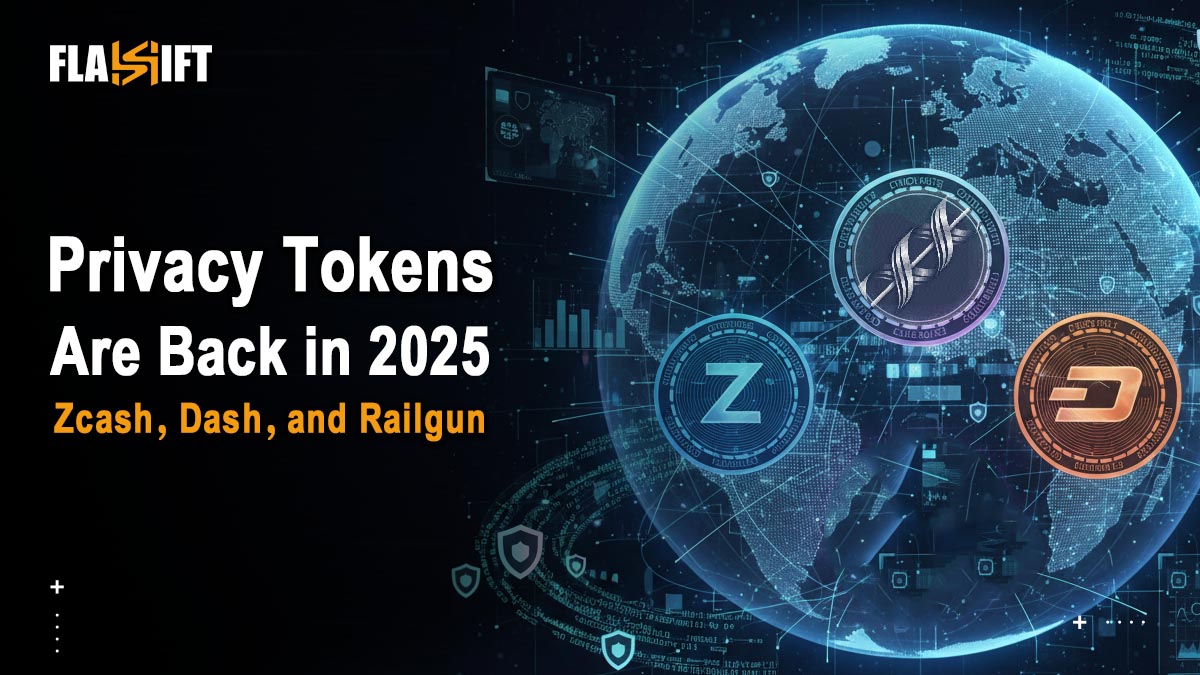
The crypto market has a funny way of resurrecting narratives we thought were buried. And in Privacy Tokens 2025, that resurgence is unmistakable. After spending nearly two years in regulatory limbo, names like Zcash, Dash, and Railgun are suddenly back on traders’ radars. Not because of hype, but because the market is quietly pricing in a shift: users want control over their financial data again.
You can feel the momentum in the charts. Zcash is flirting with its strongest volume profile since 2021, Dash is reclaiming its identity as a payments-focused privacy layer, and Railgun — the zk-based upstart — is carving out a completely new category for on-chain stealth. Each one is moving for different reasons, and that’s exactly what makes this new wave interesting. The catalysts aren’t synchronized; they’re structural.
In this article, we’ll break down why privacy coins are becoming impossible to ignore, what’s driving money back into these ecosystems, and how their market setups differ as we head deeper into 2025.

Why privacy tokens are rallying in 2025?
The rally in privacy tokens this year is the result of a slow burn that finally caught fire. Markets usually move when narratives, tech upgrades, and real-world pressure line up at the same time, and that’s exactly what happened with Zcash, Dash, and Railgun in 2025. After years of regulators tightening the screws on centralized exchanges, users have started looking for ways to move value without broadcasting their entire financial history. When people feel watched, interest in privacy becomes less of a niche preference and more of a necessity.
At the same time, the tech behind these tokens has matured. Zcash’s efficiency upgrades cut transaction overhead, Dash refined its hybrid privacy/payments positioning, and Railgun’s zk-layer went from “experimental” to something serious traders actually rely on. That combination of practical utility and stronger infrastructure brought in a different crowd — not just privacy purists, but swing traders, liquidity seekers, and even funds that see privacy as the next untapped narrative after the L2 boom cooled off.
And finally, the macro angle matters. Governments pushing tighter tracking rules, exchanges delisting coins without warning, and more people shifting to non-custodial setups created a perfect psychological backdrop. What you’re seeing in the charts is simply the market reacting to a growing feeling that financial privacy is becoming scarce. When scarcity shows up, price follows — and 2025 is proving that privacy tokens are no longer just ideological tools; they’re becoming valuable assets.
Read More: Zano (ZANO), The Overlooked Privacy Coin You Should Know in 2025
Buy Zcash and Enter The Private Crypto World!
Market Catalysts of Privacy Tokens 2025: Dash, ZEC, and Railgun
The surge in 2025 didn’t happen because traders suddenly felt nostalgic. Each of these privacy tokens has its own set of catalysts — some technical, some narrative-driven, and some pure market psychology — and together they’ve created a unified wave of demand across the privacy sector.
Dash: Renewed relevance through payments pressure
Dash’s rally is largely tied to the comeback of fast, low-fee payments. With networks like Ethereum still struggling under congestion and regulators tightening their grip on centralized ramps, Dash quietly slid back into the spotlight as a practical settlement layer. Merchant adoption in a few emerging markets ticked up, liquidity improved, and traders started treating Dash like a hedge against the increasingly visible financial footprint that most blockchains leave behind.
Zcash (ZEC): Tech upgrades and institutional curiosity
Zcash tends to move when its technology narrative gets strong, and 2025 delivered exactly that. Efficiency improvements, lighter proofs, and better wallet integrations made shielded transactions feel less “research-lab-only” and more ready for actual users. On top of that, institutions began exploring compliant zero-knowledge payment channels — something that indirectly puts a spotlight back on ZEC as the benchmark of zk-based privacy. Once volumes picked up, the price action followed quickly.
Railgun: The trader’s privacy tool of choice
Railgun is rallying for a completely different reason: traders realized it works. Instead of being a standalone coin with ideological baggage, Railgun became a practical layer for stealth trading on Ethereum and EVM chains. Its private smart contract interactions, private swaps, and cross-chain stealth mechanics turned it into a “must-know” tool for anyone who wants to avoid being tracked by bots, copy-traders, or analytics firms. As more liquidity flows through it, RAIL becomes a leveraged bet on the growth of the entire privacy infrastructure market.
In short, each token has its own ignition point — Dash from payments utility, Zcash from tech legitimacy, and Railgun from on-chain stealth for power users — but all three are riding the same macro tailwind: people are waking up to how exposed their blockchain footprints really are.

Comparing 2018 vs 2025: How the Markets of Dash, Zcash, and Railgun Have Evolved
The privacy landscape in 2018 and 2025 might share the same names, but the market realities behind them are completely different. Back then, privacy coins were riding on ideology and early tech hype; today, they’re moving because the market finally understands the value of privacy as a practical necessity.
Dash (2018 vs 2025): From “digital cash experiment” to functional settlement layer
In 2018, Dash’s identity was tied tightly to its branding as digital cash. It had strong community energy, a couple of merchant pilots, and plenty of speculation — but the real-world usage was shallow. By 2025, the story has flipped. Dash isn’t competing with Bitcoin anymore; it’s filling the gap that congested networks and over-regulated exchanges created. Fees are predictable, confirmations are fast, and a handful of high-inflation markets actually rely on it. The price action feels healthier too, driven more by usage and liquidity cycles instead of pure hype.
Zcash (2018 vs 2025): From promising zk-science to a mature privacy benchmark
Back in 2018, ZEC was essentially a science project wrapped in a token. It had groundbreaking cryptography, yes — but shielded transactions were heavy, wallets were clunky, and adoption was thin. Most of the market value came from its reputation as the “smartest tech in the room.”
In 2025, Zcash feels like it finally caught up with its own vision. Proofs are lighter, integrations smoother, and the toolset is no longer stuck behind a wall of complexity. Institutions don’t use ZEC directly, but they reference its model, and that credibility has quietly pushed demand back into the ecosystem. Instead of being a theoretical privacy coin, it’s now viewed as a proven zk-standard.
Railgun (2018 vs 2025): A token that didn’t exist vs a stealth layer traders actually depend on
Railgun wasn’t even part of the conversation in 2018. Privacy meant coins — full stop.
By 2025, that entire assumption has changed. Railgun shows that privacy doesn’t need to be a separate currency; it can be a layer that slots directly into the existing liquidity of Ethereum, Arbitrum, BSC, and other EVM chains. That shift alone reshaped the privacy market. Instead of convincing people to adopt a new currency, Railgun offers privacy to traders where they already are. The jump from “ideological coins” to “practical stealth infrastructure” is one of the biggest differences between the two eras.
The bottom line
2018 was about ideas: big visions, groundbreaking theories, and early adoption hopes.
2025 is about utility: actual usage, market-driven demand, and privacy becoming a fundamental trading tool rather than a fringe ideology.
Dash matured into a payments layer, Zcash became a refined zk-standard, and Railgun emerged as the stealth engine of on-chain liquidity. Privacy tokens aren’t repeating the past cycle; they’re evolving beyond it.
Should you invest in Privacy Tokens?
When you look at Dash, Zcash, and Railgun through an investor’s lens, the question isn’t just “Will they go up?” It’s “What kind of exposure do they actually give me?” Privacy tokens aren’t a single-type investment — each of these three offers a different angle on the same narrative, and that’s where the opportunity lies.
Dash: A stability play inside the privacy sector
If you want something closer to a utility-driven, payments-focused asset, Dash fits that profile. It behaves more predictably than the other two, and its real-world usage gives it a built-in resilience during market rotations. For investors who like the idea of exposure to privacy but don’t want extreme volatility, Dash is the calmer side of the spectrum.
Zcash (ZEC): The intellectual, long-term zk bet
Zcash appeals to people who think in cycles — especially those who believe zero-knowledge technology will be one of crypto’s core pillars. When ZEC moves, it usually does so on strong catalysts: protocol upgrades, regulatory shifts, or renewed institutional interest in zk-payments. It’s a bet on the tech, not the hype. If you’re confident zk-privacy becomes mainstream infrastructure, ZEC gives you that structured, long-term exposure.
Railgun: High-beta play with real trader demand
Railgun is for investors who understand how on-chain liquidity behaves. It’s the fastest mover of the three because its value is directly tied to trader activity: the more people use stealth swaps, MEV-protected trades, and private smart contract interactions, the more value flows into the ecosystem. Railgun is less about ideology and more about solving an urgently growing problem — the fact that every on-chain action is becoming trackable. If usage keeps rising, RAIL benefits disproportionately.
Who should consider investing?
- Anyone who believes privacy will become a stronger narrative as surveillance tightens.
- Traders looking for “asymmetric upside during” narrative cycles.
- Long-term holders who want exposure to different layers of privacy tech (payments, zk-standards, stealth infrastructure).
- Portfolios that need diversification beyond L1s, L2s, and memecoins.
The takeaway
You don’t need to pick a winner. Each token covers a different corner of the privacy market:
Dash gives you real-world utility, ZEC gives you tech credibility, and Railgun gives you direct exposure to the rise of private on-chain execution.
If 2025 is truly the comeback year for privacy, holding a balanced slice of all three can position you ahead of a narrative that still feels early, but no longer invisible.
Try Flashift.app! Buy Your Privacy Token with any Cryptocurrency you want.
Glossary
Privacy Tokens: Cryptocurrencies designed to hide transaction information such as sender, receiver, amount, or on-chain interaction patterns. Examples: Zcash, Dash, and privacy layers like Railgun.
Zero-Knowledge Proofs (ZKPs): Cryptographic techniques that allow one party to prove something is true without revealing the underlying data. Used heavily in Zcash and Railgun.
zk-SNARKs: A specific type of zero-knowledge proof used by Zcash for shielded transactions. They allow private, verifiable payments on a public blockchain.
Shielded Transactions: Zcash transactions where sender, receiver, and amount are hidden using zk-SNARKs. Represent the “private” side of the Zcash network.
Settlement Layer: A blockchain optimized for fast, low-fee, final settlement of transactions. Dash’s role in 2025 is as a stable and predictable settlement layer for users outside of congested L1s.
MEV (Maximal Extractable Value): Profit extracted by validators or bots by rearranging or exploiting transaction order. Private execution layers like Railgun help traders avoid being targeted by MEV bots.
Cross-Chain Stealth: Railgun’s ability to provide privacy across multiple EVM networks (Ethereum, Arbitrum, BSC, etc.), enabling users to maintain privacy across ecosystems.
Narrative Cycle: A market phase where a theme (like privacy) becomes temporarily dominant, attracting capital, media coverage, and speculative attention.
Liquidity Cycles: Fluctuations in trading volume and liquidity that strongly affect privacy tokens, which tend to move sharply during narrative upswings and cool down quickly afterward.
High-Beta Asset: An asset that amplifies market moves; up or down. Railgun behaves like a high-beta asset because its value increases as private trading volume increases.
Narrative Scarcity: The idea that privacy is becoming a rare resource in the crypto ecosystem. As transparency becomes unavoidable, private rails gain value.
FAQ
- Why are privacy tokens moving now and not during the 2021 bull market?
Because in 2021 nobody cared about data exposure and everyone was chasing L1 speed wars, NFTs, and memecoins. In 2025, the pressure flipped: tighter regulations, aggressive on-chain analytics, and exchange delistings pushed traders to actively seek privacy. The catalysts simply didn’t exist before.
- Can privacy tokens rally even if regulations get harsher?
Ironically, yes. Historically, every time new tracking rules appear, demand for private rails increases. Traders don’t migrate because they want to ‘hide’. They migrate because they don’t want every wallet hop mapped and catalogued forever.
- Is Railgun competing with Dash and Zcash, or complementing them?
Railgun isn’t trying to replace those coins. It sits on top of chains where liquidity already lives. Dash and ZEC are currencies; Railgun is infrastructure. Investors usually mistake them for rivals, but they occupy different layers of the privacy stack.
- Do these tokens still have room to grow after the recent 2025 surge?
If the privacy narrative becomes a multi-quarter theme instead of a quick spike, yes. These tokens aren’t momentum-only assets anymore. Their real upside depends on how deeply privacy tools integrate into everyday trading and payments — something that’s accelerating, not slowing.
- What’s the biggest risk investors underestimate with privacy tokens?
Liquidity cycles. Privacy assets often move in violent bursts when narratives heat up and then cool off just as abruptly. The challenge isn’t buying; it’s surviving the quiet periods without overexposing yourself.