

- Why is everyone asking “USDT or USDC?” right now?
- MiCA Regulation Impact: USDC vs USDT in Europe
- USDT vs USDC: side-by-side comparison
- Which stablecoin is safer: USDT or USDC?
- Do the Visa and Mastercard USDC moves matter to you?
- Which stablecoin should you hold? A decision guide
- How to switch from USDT to USDC without an account
- What’s the cheapest way to move USDT between networks?
- What are the risks of switching stablecoins?
- The bottom line
- FAQ
If you live in or deal with the EU, or you want the most regulation-friendly dollar stablecoin, hold USDC. If you trade across many exchanges, use Tron for cheap transfers, or need the deepest global liquidity, USDT is still the practical choice. Many people split between the two. Either way, you can switch between them with a no-account swap in a few minutes.
Why is everyone asking “USDT or USDC?” right now?
October 2026 gave stablecoin holders three reasons to reconsider. Europe’s regulator singled out USDC. Card networks keep building USDC into their payment plumbing. And a lot of USDT has been moving off exchanges as traders reposition.
Nothing here makes either coin unsafe overnight. But the gap between “regulated in Europe” and “dominant everywhere else” is wider than it was a year ago, and that gap is the whole USDT vs USDC debate.
MiCA Regulation Impact: USDC vs USDT in Europe
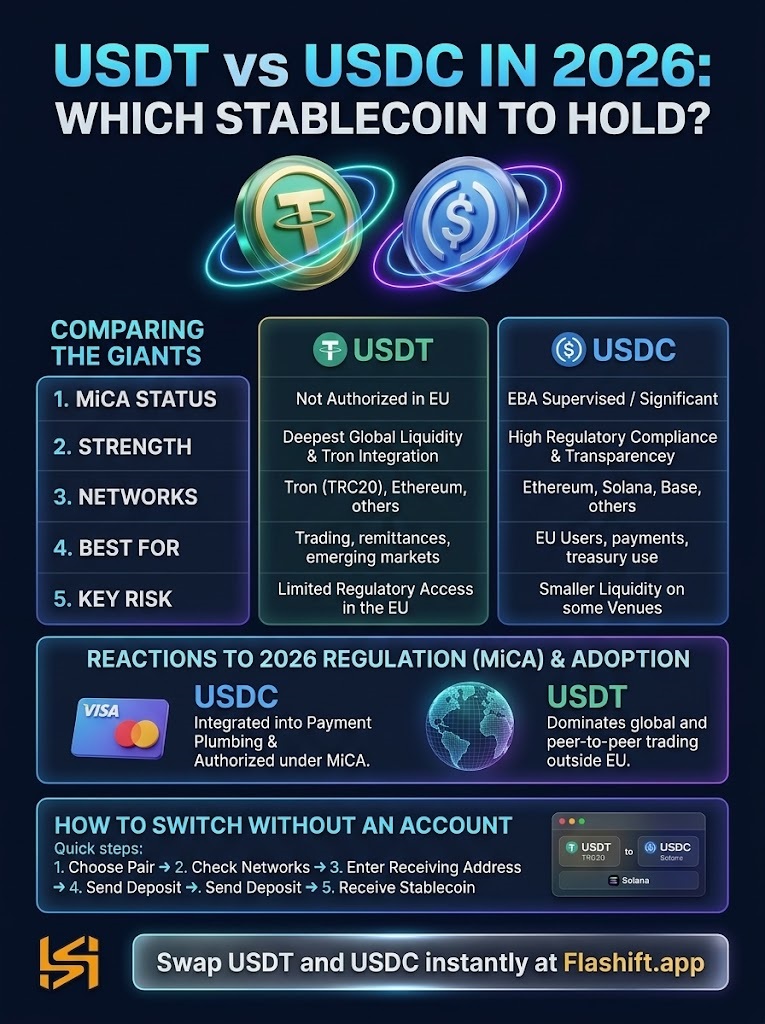
On October 14, the EBA announced that USDC is the first of the 45 e-money tokens notified under MiCA to be classified as significant. From November 12, 2026, the EBA takes over direct supervision of own funds, reserve assets, liquidity requirements, and recovery and redemption plans. You can read the EBA announcement for the primary details.
In plain terms, the token doesn’t change, but the oversight gets heavier. USDC keeps its dollar peg and its issuer. What changes is who checks the reserves, and how closely.
Is USDT banned in Europe?
No. USDT isn’t authorized as an e-money token under MiCA, so regulated European platforms have restricted trading it. That is a rule for platforms and service providers. It doesn’t make private ownership illegal, and USDT still works in self-custody wallets and on offshore venues.
USDT vs USDC: side-by-side comparison
| Factor | USDT (Tether) | USDC (Circle) |
| Approx. market cap (mid-Oct 2026) | ~$184B | ~$73B |
| MiCA status | Not authorized as an EU e-money token | Authorized, now “significant” |
| Main strength | Liquidity and global reach | Regulatory clarity and transparency |
| Popular networks | Tron (TRC20), Ethereum, others | Ethereum, Solana, Base, others |
| Typical transfer cost | Very low on Tron | Low on Solana/Base, higher on Ethereum |
| Best for | Trading, remittances, emerging markets | EU users, payments, treasury use |
| Main risk to watch | Regulatory access in the EU | Smaller liquidity on some venues |
Figures are approximate and move daily, so check live data before you decide.
Which stablecoin is safer: USDT or USDC?
“Safer” depends on which risk you care about.
- Regulatory risk: USDC has the edge, especially for anyone connected to Europe.
- Liquidity risk: USDT has the edge. It’s accepted almost everywhere, and large trades usually fill with less slippage.
- Freeze risk: Both issuers can blacklist addresses linked to hacks or sanctions. Both did so during late-October exchange incidents. If your funds are clean and self-custodied, this rarely matters, but it’s a real feature of both coins.
- Peg risk: Both have held close to $1 in normal markets. Neither is a bank deposit, and neither is insured.
If you want a short rule: USDC for compliance comfort, USDT for reach.
Do the Visa and Mastercard USDC moves matter to you?
Both networks now support USDC in settlement, which is how banks and acquirers pay each other behind the scenes. Mastercard added several regulated stablecoins to its settlement options in June, and Visa has been expanding USDC settlement through 2026.
This doesn’t mean you can tap a card and spend USDC directly. It affects institutions, not your wallet. The signal for holders is indirect: USDC is being wired into mainstream finance, which supports its long-term utility. It also means USDC’s fortunes are tied more closely to regulated players.
Which stablecoin should you hold? A decision guide
Match the coin to the job:
- Living in the EU or paying European vendors: USDC, because regulated platforms support it fully.
- Moving money cheaply between exchanges: USDT on Tron, because fees are usually tiny.
- Holding a savings buffer for months: USDC, or a split, to spread issuer risk.
- Trading across many pairs: USDT, which has the deepest order books.
- Wanting privacy and no paperwork: either one, held in your own wallet and swapped through a non-custodial route.
A 50/50 split is a perfectly reasonable answer. Diversifying issuers is the oldest advice in stablecoins, and it costs you almost nothing.
How to switch from USDT to USDC without an account
You don’t need to open an exchange account, upload documents, or leave funds on a platform. Visit “Flashift.app“, then:
- Choose your pair. Select USDT as the coin you send and USDC as the coin you receive.
- Pick the networks carefully. USDT on Tron and USDC on Ethereum are different assets on different chains, so the network matters more than the ticker.
- Paste your receiving address. Double-check the first and last characters, and confirm it supports the chosen network.
- Send the exact amount to the deposit address shown.
- Receive your USDC at your own wallet once the transaction confirms.
What’s the cheapest way to move USDT between networks?
Fees depend on the chain, not the coin. Sending USDT on Tron is usually the cheapest. Ethereum is usually the most expensive during busy periods. If you need USDT on a different chain, such as TRC20 to ERC20, a direct swap avoids the extra step of selling and rebuying. We cover this in detail here: swap USDT TRC20 to ERC20 instantly at the lowest fees.
If you’re comparing rates, check the total you actually receive after network fees, not just the headline rate.
What are the risks of switching stablecoins?
Switching is simple, but a few mistakes cost real money:
- Wrong network: sending to an address on a different chain can mean lost funds.
- Dust and minimums: very small amounts can be eaten by fixed fees.
- Rate drift: use a fixed-rate option when the market is moving fast.
- Local rules: privacy tools don’t override your local tax or reporting obligations. Check what applies where you live.
- Phishing: only use links you’ve verified yourself.
Treat your first swap as a test. Send a small amount, confirm it arrives, then move the rest.
The bottom line
USDT vs USDC isn’t a winner-takes-all question. USDC now has the strongest European regulatory position, and USDT still has the broadest liquidity. Pick by use case, hold some of each if you want resilience, and keep your funds in a wallet you control. When you do want to switch, a no-account swap keeps it fast and private. Start with our no-KYC stablecoin guide, then run a small test swap.
This is general information, not financial advice.
FAQ
- If I hold USDT in the EU, do I need to sell it before November 12?
No. The November 12 date relates to how USDC is supervised, not to a deadline for USDT holders. The practical issue is that regulated European platforms may limit USDT services, so you may find fewer on-ramps and off-ramps. - Does “significant” status make USDC riskier?
Not by itself. The label means the token is large enough to get extra supervision. For holders, it mostly means more scrutiny of reserves and liquidity. The risk profile of the peg doesn’t change on that date. - Can a stablecoin issuer freeze my balance even if I use a self-custody wallet?
Yes, in principle. Both Tether and Circle can blacklist specific addresses at the contract level. Self-custody protects you from exchange failure, but not from an issuer freeze tied to flagged activity. - Why does my USDC arrive on one network but my wallet shows nothing?
Wallets display tokens per network. If you received USDC on Base or Solana but your wallet is set to Ethereum, the balance appears empty. Switch networks in the wallet before assuming anything is missing. - Is it smarter to swap at a fixed rate or a floating rate?
The difference is usually small. A fixed rate gives certainty on the amount you receive. A floating rate can occasionally land slightly better. For larger amounts, certainty usually wins. - How much of my stablecoin savings should sit in each coin?
There’s no universal number. A common approach is to size each position by the risk you’re hedging, such as regulation, liquidity, or issuer failure. Many people start with an even split and adjust as their needs become clearer.