
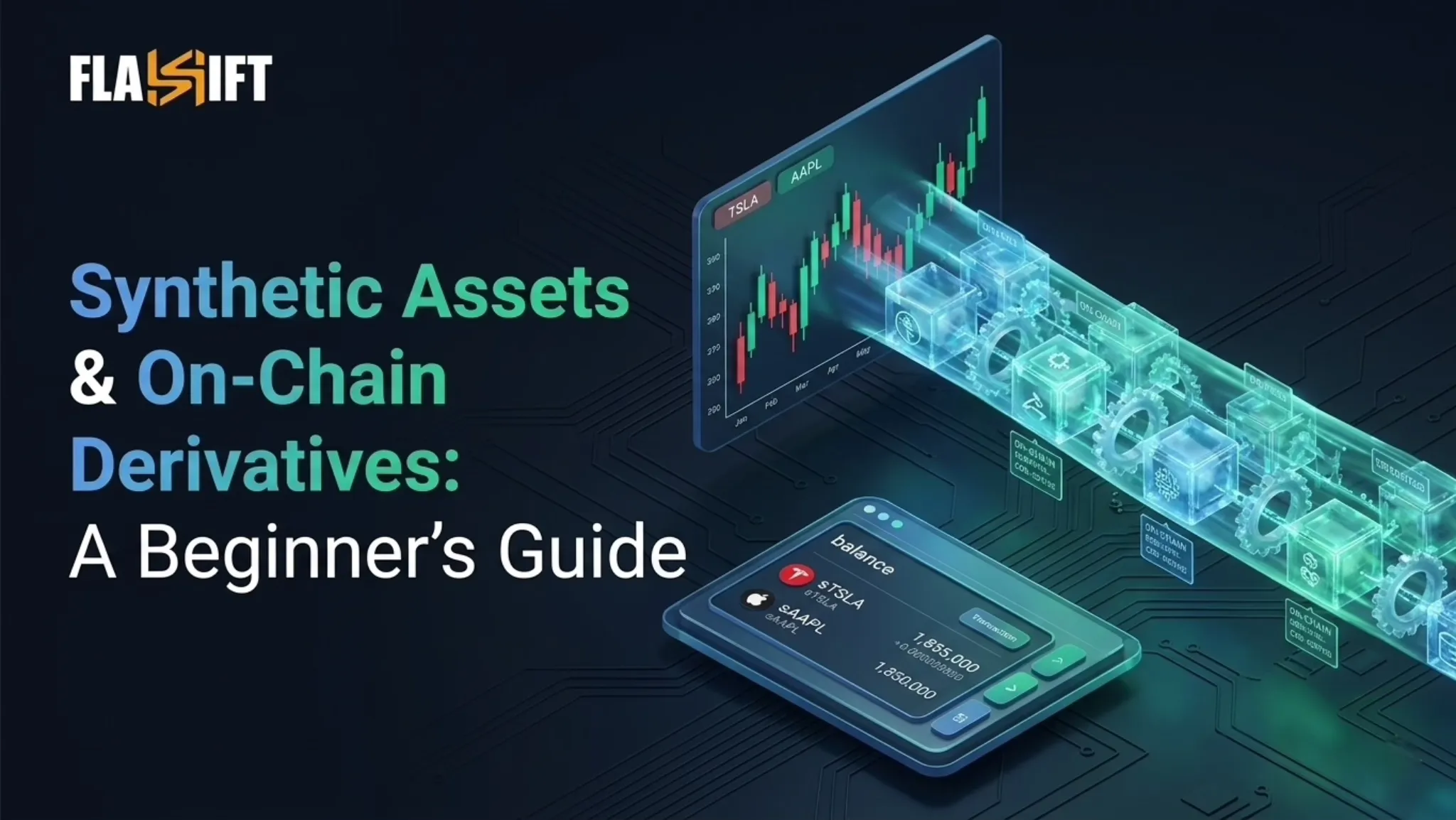
Synthetic Assets | Imagine trading Tesla stock, gold, or the U.S. dollar—without ever leaving the blockchain. That’s the promise of synthetic assets, and by 2025, they had become one of the fastest-growing frontiers of decentralized finance (DeFi).

Synthetic assets are digital tokens that replicate the value of real-world assets, ranging from equities to commodities and currencies, utilizing smart contracts and on-chain collateral. They’re the foundation of on-chain derivatives, giving crypto users exposure to traditional markets without going through banks or brokers.

For beginners, understanding synthetic assets isn’t just optional—it’s essential. They’re reshaping global access to finance, and learning how they work will prepare you for the next wave of blockchain-driven opportunities.

In this guide,  Flashift will explain:

  • what synthetic assets are,
  • how on-chain derivatives work, the platforms leading the trend,
  • and how you can start experimenting, starting with a simple token swap through Flashift.

Flashift.app

What’s New in 2025: Synthetic Assets on the Rise

The world of synthetic assets has changed dramatically since the early DeFi experiments of 2020–2022. In 2025, they are no longer just niche tokens for crypto insiders — they’re becoming a gateway for everyday U.S. traders to access global markets.

  • Tokenized U.S. Treasuries: With interest rates high, tokenized T-bills have exploded in popularity. Investors can now hold and trade short-term government debt directly on-chain.

  • Gold & Commodities on Blockchain: Assets like Paxos Gold (PaxG) and Tether Gold (XAUT) are proving that physical commodities can thrive in digital form, giving traders an easy hedge against inflation.

  • Synthetic Stocks & Forex: On-chain derivatives allow exposure to companies like Apple or Tesla, and even foreign exchange pairs, without a traditional brokerage account.

  • Institutional Attention: Hedge funds and fintech firms in the U.S. are testing synthetic assets as part of broader real-world asset (RWA) tokenization strategies.

  • Regulatory Spotlight: U.S. regulators are paying close attention, especially to synthetic stocks and forex markets. While the future framework is still unclear, 2025 has marked a turning point in mainstream awareness.

 For traders, synthetic assets in 2025 are more than just an experiment — they’re a serious alternative to traditional finance, offering global access with nothing more than a crypto wallet.

What Are Synthetic Assets in Crypto?

What Are Synthetic Assets in Crypto?

Synthetic assets are one of the most exciting innovations in DeFi. They allow users to gain exposure to traditional markets—stocks, commodities, currencies—without leaving the blockchain. Let’s break it down step by step.

The Simple Definition of Synthetic Assets

A synthetic asset is a blockchain-based token that represents the value of another asset. Instead of holding the “real” stock or commodity, you hold a crypto token that tracks its price.

  • Example: sUSD is a synthetic version of the U.S. dollar.
  • Example: A synthetic Tesla token (sTSLA) tracks the price of Tesla shares.

These tokens are backed by collateral (like ETH, USDC, or SNX) and controlled by smart contracts, ensuring the synthetic price remains accurate.

How They Mirror Real-World Assets On-Chain

Synthetic assets use price oracles—trusted feeds of market data—to keep their value synced with the underlying real-world asset.

  • If the price of gold rises, the value of a synthetic gold token rises too.
  • If Tesla stock drops, the synthetic Tesla token mirrors that drop.

This allows crypto traders to gain exposure to assets they couldn’t normally access on a blockchain, all without leaving DeFi.

Read More: Understanding the Role of Oracles in DeFi: A Beginner’s Guide

Why They’re Important for Financial Innovation

Synthetic assets matter because they bridge traditional finance (TradFi) and DeFi:

  • Global Access: Anyone with a wallet can gain exposure to U.S. stocks, commodities, or currencies—even if they live outside traditional markets.
  • Composability: Synthetic tokens can be used in DeFi apps—borrowed, staked, or swapped just like regular crypto.
  • Innovation: They pave the way for entirely new financial products—AI-driven risk models, programmable portfolios, and cross-border synthetic derivatives.

📌 Synthetic assets make it possible to trade the world’s markets from your crypto wallet—no broker, no bank, no paperwork required.

Read More: DeFi Yield Farming Without KYC: Risks & Rewards in 2025

How Do On-Chain Derivatives Work?

photo output 37

On-chain derivatives are the backbone of synthetic assets. They turn blockchain tokens into powerful financial instruments that behave more like contracts than simple coins. Here’s how they work step by step.

The Difference Between Derivatives and Traditional Tokens

  • Traditional tokens (like ETH or SOL) have intrinsic value within their networks—they’re used for gas fees, staking, or payments.
  • Derivatives, by contrast, are contracts that derive their value from another asset—such as a stock, commodity, or currency.
  • On-chain derivatives don’t exist in isolation; they are programmed to mirror the performance of the underlying asset, whether that’s Tesla stock, the S&P 500, or gold.

This makes them more like a financial agreement than a currency.

Smart Contracts as the Engine of Synthetic Markets

The magic of on-chain derivatives comes from smart contracts:

  • They mint synthetic tokens when collateral is deposited.
  • They track prices in real time using oracles (trusted data feeds).
  • They enforce rules automatically, such as liquidating collateral if it falls below required levels.

Think of smart contracts as the automated clearing house of synthetic markets—no banks, no brokers, no paperwork. Just code.

Collateralization and Risk Management Explained Simply

Every synthetic asset needs collateral to back it up. This protects the system and ensures tokens don’t lose their peg.

  • Collateralization: You deposit assets like ETH, USDC, or SNX into a protocol. In return, you can mint synthetic assets (e.g., sUSD, sGold).
  • Overcollateralization: To stay safe, most systems require you to lock more value than you mint. For example, to mint $1,000 worth of synthetic USD, you might need to deposit $1,500 worth of ETH.
  • Risk Management: If the value of your collateral drops too low, the system automatically liquidates part of it to maintain stability.

📌 On-chain derivatives work because smart contracts enforce the rules and collateral keeps the system solvent.

photo output 39

Synthetic assets aren’t just theory, they’re already live in DeFi. Several protocols have pioneered the space, each offering unique approaches to on-chain derivatives. Here are some of the most influential platforms.

Synthetix (SNX) and Its Synthetic USD/Stocks

Synthetix, built on Ethereum and Optimism, is one of the earliest and most established synthetic asset platforms.

  • It allows users to mint Synths—synthetic versions of USD, gold, Bitcoin, or even equities.
  • All assets are collateralized by SNX tokens or ETH, ensuring they stay pegged to real-world values.
  • Traders can gain exposure to traditional markets without leaving the blockchain, making Synthetix a cornerstone of synthetic finance.

Mirror Protocol and Synthetic Equities

Mirror Protocol (on Terra, later mirrored on other chains) popularized the idea of synthetic stocks.

  • Users could mint and trade tokens representing companies like Apple, Tesla, and Google.
  • Although the original protocol faced challenges after Terra’s collapse, the idea of synthetic equities continues to inspire new DeFi projects.
  • It demonstrated how synthetic assets can open Wall Street-style investing to anyone with a crypto wallet.

Benefits and Risks of Synthetic Assets

Benefits and Risks of Synthetic Assets

Synthetic assets unlock powerful opportunities for global finance, but they also come with serious risks. Understanding both sides of the equation is key for beginners before getting involved.

Borderless Access to Stocks, Commodities, and FX

  • Synthetic assets allow anyone, anywhere, to gain exposure to U.S. equities, gold, or foreign currencies without going through banks or brokers.
  • This levels the playing field, giving people in emerging markets access to investment opportunities that were once limited to Wall Street.
  • They also integrate seamlessly with DeFi, meaning your synthetic gold or synthetic USD can be staked, swapped, or lent just like ETH or USDC.

The Risks of Overcollateralization and Liquidation

  • To mint synthetic assets, you must overcollateralize, depositing more value than the assets you create.
  • If your collateral (e.g., ETH) drops sharply in price, the protocol may liquidate your position to protect the system.
  • This means synthetic assets carry the same volatility risks as crypto, plus the added risk of liquidation if markets move against you.

Regulatory Uncertainty and Compliance Questions

  • Because synthetic assets mirror traditional financial instruments, regulators are paying close attention.
  • In some regions, synthetic stocks may be treated as unlicensed securities, raising compliance risks for platforms and users.
  • Until clear regulations are in place, there’s uncertainty around how governments will classify and enforce synthetic asset trading.

📌Synthetic assets provide borderless, innovative access to global markets, but they are not risk-free. Smart users should start small, understand collateral rules, and stay informed about regulatory changes.

How to Create and Use Synthetic Assets (Beginner’s Walkthrough)

For beginners, the idea of minting synthetic assets may sound complicated—but in practice, it’s straightforward. Here’s a simple step-by-step guide to help you understand how it works.

Step 1: Choose a Synthetic Asset Platform

Start with a trusted protocol such as Synthetix (Ethereum/Optimism) or newer AI-driven synthetic markets. Always check:

  • If the platform is audited and reputable.
  • What kinds of assets are supported (USD, commodities, stocks, crypto indexes).
  • Community activity and liquidity depth.

Step 2: Deposit Collateral (ETH, USDC, etc.)

You’ll need to lock up collateral to mint synthetic assets.

  • Common collateral types include ETH, USDC, or SNX tokens.
  • Remember: most platforms require overcollateralization (e.g., deposit $1,500 worth of ETH to mint $1,000 in synthetic USD).

Step 3: Mint or Trade Synthetic Assets

Once collateral is deposited, you can:

  • Mint synthetic tokens (e.g., sUSD, sGold, sBTC).
  • Trade existing synthetic assets on decentralized exchanges (DEXs) or within the protocol itself.
  • Use synthetics in DeFi apps for staking, lending, or yield farming.

Step 4: Manage Positions and Avoid Liquidation

Synthetic assets require active management:

  • Monitor your collateralization ratio—if your collateral drops in value, you could be liquidated.
  • Add more collateral or repay part of the loan to stay safe.
  • Use tools like DeFi dashboards (Zapper, DeFi Saver) to track your health.

📌 Don’t overextend. Start with small amounts until you’re comfortable managing collateral and tracking liquidation risks.

Swap Tokens to Get Started with Synthetic Assets Today (Flashift)

Before you can mint or trade synthetic assets, you’ll need the right collateral—usually ETH, USDC, or SNX. The challenge for beginners? You may not already hold those tokens in your wallet. That’s where Flashift comes in.

Why You Need the Right Collateral Before Minting

Synthetic asset platforms won’t accept just any token. If you’re holding altcoins, stablecoins, or assets on another chain, you’ll first need to swap into the correct collateral.

  • ETH for minting on Synthetix.
  • USDC for synthetic USD or stable pairs.
  • SNX if you want to participate directly in the Synthetix ecosystem.

Without the right token, you can’t even start.

Exchange TETHER to ETHEREUM in one ssecond with Flashift.

How Flashift Lets You Swap Instantly into ETH, USDC, or SNX

With Flashift, you can:

  • Convert any major token into ETH, USDC, or SNX instantly.
  • Swap across multiple chains (Ethereum, BNB Chain, Polygon, Arbitrum, Solana, and more).
  • Stay in control of your funds with non-custodial swaps—your assets never leave your wallet until the transaction is complete.

Secure, Non-Custodial Swaps for Synthetic Asset Beginners

Flashift is designed for speed, safety, and simplicity:

  • No centralized custody.
  • No lengthy KYC delays.
  • No bridge vulnerabilities.

Just seamless swaps that prepare you for the next generation of DeFi trading.

📌 Swap tokens now with Flashift and start exploring synthetic assets today.

Try Flashift Multi-Chain Swap

Final Thoughts: The Future of On-Chain Derivatives

Synthetic assets and on-chain derivatives are no longer niche experiments—they’re becoming one of the most important tools for global finance. By letting anyone trade representations of stocks, currencies, or commodities directly on the blockchain, they expand access to markets that were once gated behind banks, brokers, and geography.

For beginners, the opportunity is real but so are the risks. Overcollateralization, liquidation mechanics, and regulatory uncertainty mean you should approach synthetic assets with caution. Start small, learn the mechanics, and focus on building confidence before committing larger amounts.

If you’re curious and ready to take your first step, the simplest way to begin is by preparing the right collateral. With Flashift, you can swap into ETH, USDC, or SNX instantly—giving you everything you need to explore synthetic assets securely and without delay.

FAQ

  1. What are synthetic assets in crypto?

Synthetic assets are blockchain-based tokens that mirror the value of real-world assets such as stocks, commodities, or currencies. For example, a synthetic Tesla token tracks the price of Tesla stock, while sUSD represents the U.S. dollar. They allow crypto users to gain exposure to traditional markets without going through brokers or banks.

  1. How do on-chain derivatives work?

On-chain derivatives are created and managed through smart contracts. You deposit collateral (like ETH, USDC, or SNX), and the protocol mints synthetic tokens that follow the price of an underlying asset using price oracles. If the value of your collateral falls too much, the contract can liquidate it to keep the system stable.

  1. Are synthetic assets safe for beginners?

They’re innovative but not risk-free. Synthetic assets carry volatility risks, liquidation risks, and regulatory uncertainty. Beginners should start with small amounts, learn how collateralization works, and use reputable, audited platforms like Synthetix.

  1. Which platforms offer synthetic assets today?

Some of the most established protocols include:

  • Synthetix (SNX): Offers synthetic USD, commodities, and crypto indexes.
  • Mirror Protocol (historical): Popularized synthetic stocks like Tesla and Apple.
  • New AI-driven platforms: Experimenting with automated risk management for synthetic derivatives.
  1. How do I create or mint synthetic assets?

To mint synthetics, you:

Choose a platform (e.g., Synthetix).

Deposit collateral (ETH, USDC, SNX).

Mint synthetic tokens such as sUSD or sGold.

Manage your collateralization ratio to avoid liquidation.

Share

Author

Write A Comment