

When a central exchange announces a coin delisting, order book liquidity thins out and slippage spikes almost instantly—but your capital isn’t lost unless you wait past the withdrawal cutoff.
To protect your portfolio, immediately verify the exact trading versus withdrawal deadlines, determine if the action is a global removal or a regional regulatory constraint (such as EU MiCA compliance), and move your tokens off-exchange into self-custody before internal order books collapse.
If local exchange pairs are frozen or illiquid, executing a cross-chain swap through a non-custodial aggregator that gives you a direct, borderless exit route without CEX deposit freezes or severe slippage.
Delisting Exit Options: Comparison Matrix
When facing a delisting notice, choose your exit path based on time remaining, order book depth, and network availability:
| Exit Route | Execution Speed | Slippage Risk | KYC / Regional Barriers | Best Used When… |
| Market Sell on CEX | Instant | 🔴 High (Thin order books) | Subject to CEX geo-locks | Liquidity remains high & withdrawal deadline is hours away. |
| Transfer to Another CEX | Moderate (10–30 mins) | 🟢 Low to Moderate | High (Requires active account on 2nd CEX) | Another tier-1 exchange supports the token and network withdrawals are open. |
| Self-Custody Hold | Moderate | ⚪ N/A (Holding risk) | 🟢 None | The project has long-term fundamentals and an active on-chain ecosystem. |
| Non-Custodial Swap (Flashift) | Fast (2–10 mins) | 🟢 Low (Aggregated routes) | 🟢 None (Borderless & Non-Custodial) | Local CEX pair is delisted, order book liquidity is dead, or regional restrictions apply. |
Step-by-Step Emergency Execution Checklist
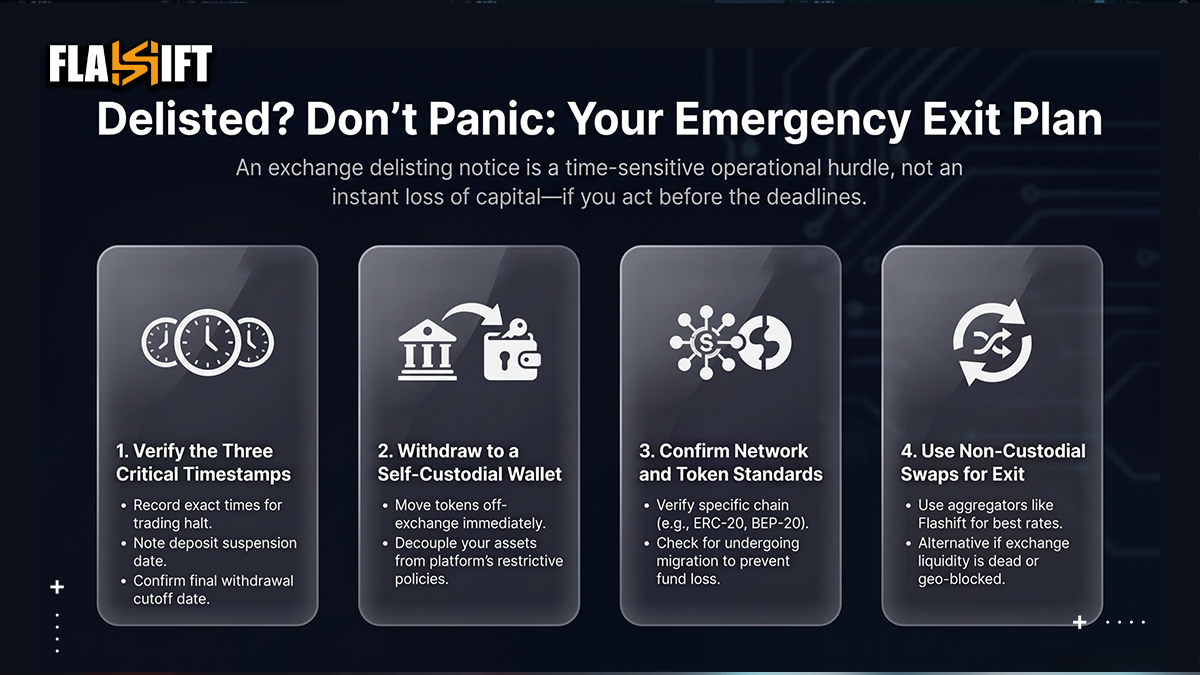
If you hold an asset facing delisting, execute this tactical workflow.
1. Identify the 3 Critical Timestamps
Do not rely on push notifications. Open the exchange’s official notice and record:
-
Trading Halt Time: The moment buy/sell order books close.
-
Deposit Suspension Time: When incoming chain transactions are rejected.
-
Withdrawal Cutoff Date: The hard deadline after which funds may require manual support recovery or be converted automatically at unfavorable rates.
2. Verify Token Standards & Migration Status
Executing a transfer on the wrong network during a delisting panic is a common cause of lost funds.
-
Confirm whether the asset uses a native mainnet or a layer-2 / wrapped standard (ERC-20, BEP-20, Solana, etc.).
-
If the delisting is tied to a token migration or contract upgrade, sending old tokens directly to a destination deposit address will fail. Check official developer documentation for migration portals.
3. Check Off-Exchange Liquidity Depth
Before market-selling into a collapsing order book, check DEX and non-custodial exchange rates. When a CEX announces a delisting, market makers often pull bid depth immediately, resulting in heavy slippage for sellers.
How Non-Custodial Swapping Mitigates Delisting Risk
Holding assets on a centralized exchange ties your market access to that platform’s listing decisions and geographic licenses. Moving to a non-custodial setup decouples your asset access from exchange policies.
Why Route Through a Non-Custodial Aggregator?
When CEX liquidity dries up or regional geo-blocks kick in:
-
No Geo-Locking Barriers: Non-custodial platforms operate directly on-chain or via decentralized provider networks without regional trading halts.
-
Best-Rate Routing: Instead of accepting low local liquidity, an aggregator scans multiple liquidity sources simultaneously to find the best conversion rate.
-
Zero Custodial Hold Risk: Assets move directly from your private key wallet to the target cryptocurrency without depositing into a third-party CEX account.
Executing an Exit with Flashift
When time is limited and local exchange pairs are restricted,a cross-chain swap aggregator like Flashift compares real-time rates across multiple non-custodial exchange providers.
-
Paste your target address: Select the asset you are exiting and the destination coin (e.g., BTC, ETH, USDT).
-
Compare provider rates: Review final output amounts, estimated settlement times, and network fees across various providers.
-
Execute directly from self-custody: Complete the swap without creating new exchange accounts or undergoing regional KYC delays.
Summary
An exchange delisting notice is a time-sensitive operational issue, not an immediate capital loss. By checking hard timestamps, verifying network standards, transferring to self-custody, and using non-custodial swap routing like Flashift, you retain control over your assets regardless of centralized exchange restrictions.
FAQs
- What actually happens if I miss the withdrawal deadline? Are my funds gone?
They aren’t destroyed, but they get locked in CEX cold storage. Once the deadline passes, the wallet UI disappears. You’ll be stuck dealing with weeks of support tickets, heavy manual recovery fees, or forced conversions at worst-market rates. Treat the withdrawal deadline as a hard cutoff.
2. Order book depth is dead and slippage is insane. Should I dump at a loss or transfer out?
If slippage costs you more than network gas fees, move the funds off-exchange immediately. Market makers pull liquidity fast after delisting notices, leaving retail order books ruined. Transferring to self-custody lets you route through aggregators like Flashift to hit global DEX liquidity instead of taking a massive haircut on a dying CEX order book.
3. Can I transfer a delisted token directly to my wallet if the project is undergoing a contract migration?
Not without checking the contract address first. If a delisting is triggered by a token swap or chain split, sending legacy tokens to a standard deposit address can trap your funds. Check the project’s official migration docs first to see if you need to swap through a specific portal rather than doing a basic on-chain transfer.