

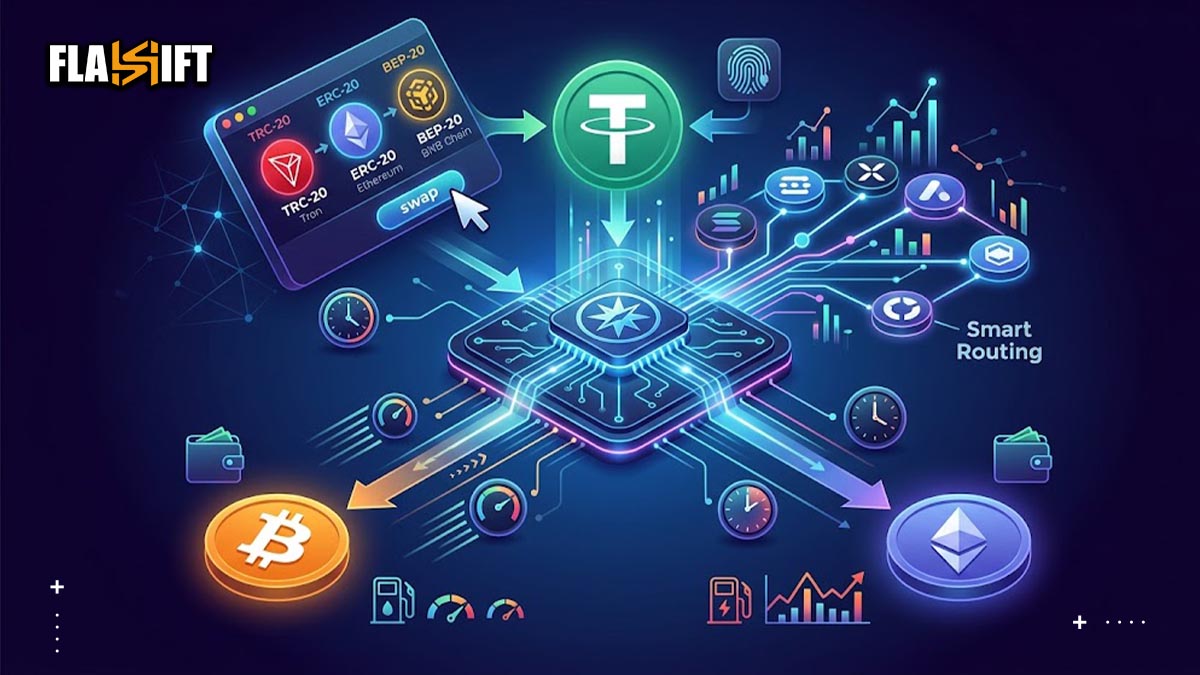
What if moving your USDT into BTC or ETH could take a few clicks instead of a full exchange signup?
USDT to BTC and USDT to ETH are two of the most popular crypto pairs. Whether you’re looking to hold BTC, use ETH for DeFi, or simply change your portfolio exposure, a non-custodial swap can let you make the conversion directly from your wallet without going through a traditional exchange account.
The catch is that the exchange rate isn’t the only number that matters. Network fees, liquidity, slippage, and the blockchain you choose for USDT can all affect how much BTC or ETH you actually receive. This guide breaks down both routes step by step, explains why they’re so popular, and shows what to watch for when comparing ERC-20 USDT with cheaper alternatives.
Why Are USDT to BTC and USDT to ETH So Popular?
Swapping USDT for Bitcoin or Ethereum is essentially the crypto equivalent of moving cash from a stable reserve into the broader market. Because USDT is pegged to the dollar, it acts as a perfect staging area before jumping into the two biggest assets in the space—each of which serves a very different purpose.
When traders move from USDT to BTC, they’re usually looking to park their capital in a long-term hold, diversify their portfolio, or grab Bitcoin exposure without the hassle of cashing out to traditional fiat first. Because Bitcoin’s market is so massive, these swaps easily absorb large-volume trades without a hitch.
Flipping USDT to ETH, on the other hand, is often more tactical. Ethereum isn’t just a major asset; it’s the fuel that powers a massive ecosystem of DeFi protocols, smart contracts, and NFTs. If you want to actually interact with decentralized apps, you need ETH in your wallet to cover the network fees, making this swap a practical necessity for on-chain users.
Because everyone is trading these specific pairs, they benefit from incredibly deep liquidity. That translates to tighter spreads, better market pricing, and an easier time comparing offers. Still, what actually lands in your wallet ultimately depends on the live exchange rate, network gas fees, and slippage at the exact moment you hit confirm.
If you want to make these swaps without the friction of signing up for a centralized exchange, non-custodial exchanges and their aggregators are a great shortcut. Aggregators let you compare live rates from multiple liquidity sources all in one interface.
* For a seamless, privacy-first swap, Flashift’s non-custodial aggregator offers the most optimized routing: Try Flashift.app
How to Swap USDT to BTC Using Flashift.app
Swapping USDT for Bitcoin on Flashift is quick and entirely hands-off. Because Flashift is a non-custodial aggregator, the platform never holds your funds. It simply hunts down the best rates and routes your trade to the provider that actually executes the swap.
Here is how to get it done (All the steps below are the same for Ethereum. Just select ETH instead of BTC and enter your Ethereum wallet address):
- Choose Your Pair and Network
Select USDT as your sending asset and BTC as your destination. Type in the amount of USDT you want to swap, and—crucially—make sure you have selected the correct USDT network (like ERC20) before moving forward and don’t send other networks’ USDT.
- Compare the Offers
Flashift will pull up a list of available exchange offers. Scan the expected BTC payouts, live exchange rates, and transaction details, then pick the provider that gives you the most favorable terms.
- Enter Your Bitcoin Address
Paste your personal Bitcoin wallet’s receiving address into the destination box. Take an extra second to double-check this; blockchain transactions are irreversible, and a typo means a permanent loss of funds.
- Review and Send
Do a final pass over the details: the USDT you are sending, the estimated BTC you are getting, and the provider you chose. When you are ready, Flashift will generate a specific deposit address. Send the exact amount of USDT required to that address from your wallet.
- Wait for Your Bitcoin
Once your USDT transfer gets the necessary blockchain confirmations, the provider processes the trade and deposits the BTC directly into your wallet. This usually takes about 3 minutes, though network congestion can occasionally slow things down.
Quick tip: Don’t just stare at the headline exchange rate. Focus on the final estimated BTC you will receive. Network fees, market slippage, and provider conditions all factor into the actual amount that lands in your wallet. Flashift’s AI Smart Routing makes it easy and shows you the best option.
Network Fee Tip: ERC-20 vs. Other USDT Networks
Networks’ fees are not same. For example, if you have USDT-ERC20 in your wallet, you probably have to spend more money as fee to send it away. ERC-20 runs on Ethereum and is widely supported, but its gas fees can be considerably higher and fluctuate with network demand. Other networks such as TRC-20, BEP-20, and Layer-2 networks can offer much lower transfer costs when the receiving platform supports them.
| USDT Network | Typical Transfer Fee* | Approx. Speed | Best For |
| ERC-20 (Ethereum) | ~$0.20–$15+ | Seconds to minutes | Ethereum DeFi & broad compatibility |
| TRC-20 (TRON) | ~$0.10–$3 | A few seconds | Low-cost USDT transfers |
| BEP-20 (BNB Chain) | ~$0.05–$0.30 | Seconds | Low-cost transfers within BNB Chain |
| Arbitrum / Base / Optimism | Often <$0.50 | Seconds to a few minutes | Lower-cost Ethereum-compatible transfers |
| Solana | Usually <$0.01 | Seconds | Very low-cost transfers |
*Fees are indicative rather than fixed. Actual costs change with network conditions, gas prices, and the wallet or exchange’s withdrawal fee.
FAQ
- What happens if I send TRC-20 USDT when the swap asks for ERC-20?
If the exchange provider doesn’t support the network you actually used, your transaction likely won’t be credited. Even though USDT exists on multiple blockchains, the addresses are absolutely not interchangeable. Always double-check that the deposit network shown on your swap screen matches the network you selected in your wallet before hitting send.
- Why do network fees look different for USDT-to-BTC versus USDT-to-ETH?
You are crossing into completely different ecosystems. Sending funds to an ETH address requires Ethereum-based settlement, while a BTC destination relies on the Bitcoin network. The total fee you see isn’t just a simple gas charge; it rolls up the specific blockchain costs, provider processing fees, and exchange-rate spreads for that exact route.
- Does swapping a massive amount of USDT guarantee a better rate?
Not automatically. While larger trades can sometimes tap into better pricing if the liquidity is deep enough, they can also trigger heavier price impact (slippage) if the selected route is thin. Instead of just looking at the advertised exchange rate, always check the final estimated BTC or ETH payout to see the true cost of a large swap.
- My USDT deposit is confirmed. Why is my BTC swap still pending?
A confirmed deposit is only the first half of the transaction. Once your USDT lands, the provider still has to execute the actual exchange and send the BTC payout to your wallet. Because the Bitcoin network has its own specific block times and potential congestion, the final leg of the journey often becomes the bottleneck, even if your USDT settled instantly.