
- 📊 2026 LINK Acquisition & Custody Matrix
- The 2026 Chainlink Architecture: CCIP and the Tokenization of Finance
- Sovereign Acquisition: Transitioning from Centralized Hubs to Non-Custodial Routing
- Centralized Exchanges: The Counterparty Trap
- The Non-Custodial Alternative: Flashift’s AI-Driven Routing
- Step-by-Step Sovereign Swap: Acquiring LINK with Zero Intermediary Risk
- Strategic Market Timing: When NOT to Acquire LINK
- Security Protocols for Institutional-Grade Custody
- Conclusion: The Sovereign Path Forward
In 2026, Chainlink (LINK) has transitioned from a speculative decentralized oracle network into the definitive cross-chain infrastructure layer for institutional Decentralized Finance (DeFi) and tokenized Real-World Assets (RWAs). As global banking systems and sovereign financial entities utilize Chainlink’s Cross-Chain Interoperability Protocol (CCIP) to securely move trillion-dollar portfolios across public and private blockchains, acquiring and securing the native LINK token has become a strategic priority for sophisticated web3 participants.
However, the liquidity landscape of 2026 demands more than simple exchange registrations. With tightening global regulations, heightened counterparty insolvency risks, and pervasive data harvesting, protecting your capital requires a zero-custody approach. True financial sovereignty means executing high-velocity swaps without exposing personal metadata, bypassing central database vulnerabilities, and orchestrating ironclad cold storage configurations.
📊 2026 LINK Acquisition & Custody Matrix
| Method / Framework | Primary Infrastructure | Censorship & KYC Risk | Counterparty Threat Level | Best Practice for $2026$ |
| Non-Custodial Aggregation | Flashift AI Smart Router | Negligible (No registration, zero database footprint) | None (Direct wallet-to-wallet execution) | Ideal for instant, private asset rotation without exchange exposure |
| Decentralized Exchanges (DEXs) | Uniswap v4, Curve | Low (Smart contract-based, geo-blocked in Tier-1) | Moderate (Vulnerable to MEV front-running and toxic liquidity) | Require advanced RPC routing and slippage protection |
| Centralized Exchanges (CEXs) | Binance, Coinbase, Kraken | Extremely High (Unilateral fund freezes, invasive AML loops) | High (Exchange insolvency, database data leaks) | Limit exposure; withdraw immediately to cold storage |
| Cold Storage Orchestration | Ledger Nano X, Trezor Safe 5 | None (Self-hosted private keys) | Negligible (Requires physical device access) | Enforce customized passphrases and multi-signature policies |
The 2026 Chainlink Architecture: CCIP and the Tokenization of Finance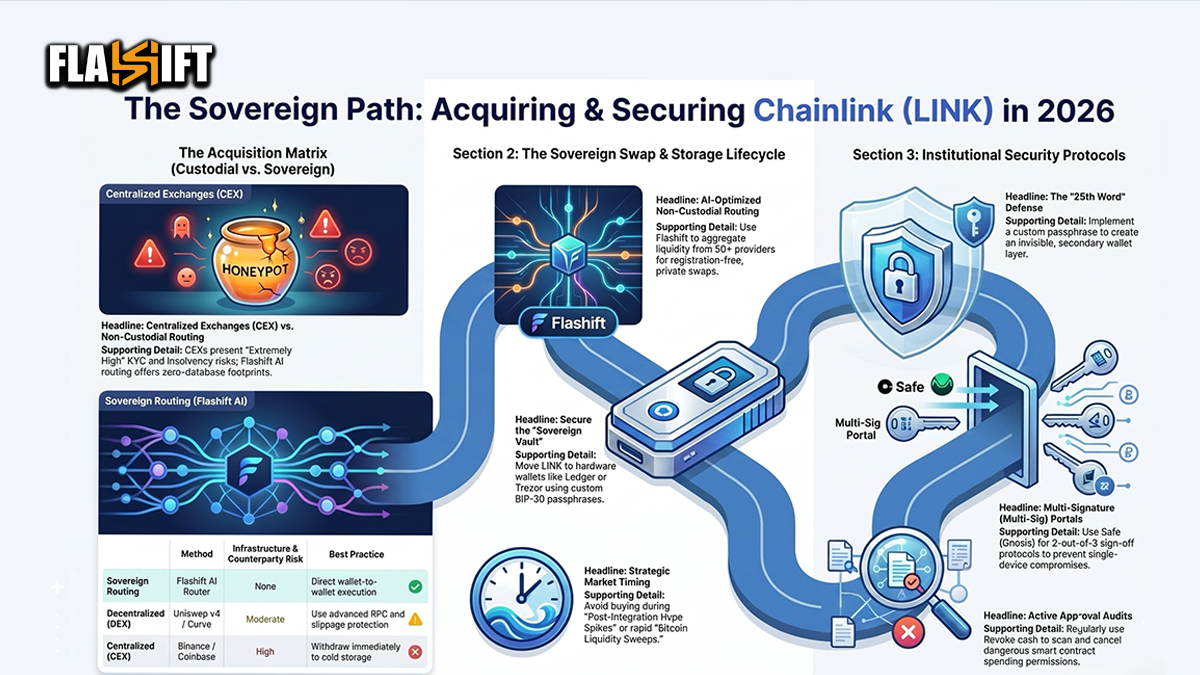
Understanding the value proposition of LINK in 2026 requires moving beyond the primitive concept of “price feeds.” The token has evolved into a global utility coin that powers high-value transactions across the financial sector.
[Traditional Capital / Private Bank] ──► [CCIP Security Gateway] ──► [Public Blockchain / DeFi]
                                                │
(LINK Utility Consumption)- CCIP as the Interoperability Standard: Chainlink’s Cross-Chain Interoperability Protocol (CCIP) acts as the secure messaging and liquidity transfer gateway between public networks and legacy private networks (such as Swift and Euroclear).
- The Utility Fee Loop: Every cross-chain message, data delivery, and automated smart contract execution orchestrated via Chainlink requires fee payment. When paid in alternative assets, these are algorithmically converted to LINK, creating a structural buy pressure directly tied to global financial utilization rather than retail speculation.
- DeFi Infrastructure Core: As Decentralized Oracle Networks (DONs) secure hundreds of billions in Total Value Locked (TVL), holding LINK is increasingly treated by institutional treasuries as a strategic infrastructure asset, similar to holding computational bandwidth.
Sovereign Acquisition: Transitioning from Centralized Hubs to Non-Custodial Routing
Traditional centralized exchanges (CEXs) remain a common entry point for retail buyers, but they introduce extensive structural vulnerabilities. The modern, privacy-first investor prioritizes non-custodial acquisition to minimize intermediate risk.
Centralized Exchanges: The Counterparty Trap
While platforms like Binance, Coinbase, and Kraken offer deep liquidity, they expose users to severe operational boundaries:
- Arbitrary KYC Freezes: Compliance algorithms in Tier-1 jurisdictions frequently flag regular transactions, trapping legitimate assets in months of bureaucratic verification loops.
- Honeypot Data Leaks: Centralized identity databases are high-value targets for hackers. Your personal documentation, transaction histories, and financial standing are permanently stored on vulnerable server networks.
- No Ownership: As the golden rule of cryptography dictates: not your keys, not your coins. Leaving LINK on an exchange wallet exposes you to exchange insolvency and network withdrawal suspensions.
The Non-Custodial Alternative: Flashift’s AI-Driven Routing
For elite on-chain participants, Flashift functions as a highly secure Chain Abstraction Layer. Instead of registering with a single centralized custodian, Flashift’s routing engine aggregates liquidity from over 50 world-class providers, enabling instant, registration-free swaps directly to your self-custody wallet.
[Source Asset: e.g., USDT / ETH] ──► [Flashift AI Router] ──► [Sovereign LINK Wallet]
               │                                                    │
       (Self-Custody)                                      (Absolute Ownership)
Through this framework, you achieve:
- Zero-Custody Execution: At no point during the swap lifecycle does Flashift hold or process your assets. Transactions are executed directly wallet-to-wallet.
- Strategic Privacy Protection: By avoiding database registration, your wallet addresses are protected from global leakages and unnecessary profiling.
- Proactive Rate Optimization: Flashift’s AI monitors liquidity depths in real time. If a provider displays an artificial rate but hides excessive slippage or transaction friction, the router automatically redirects the payload to a cleaner, more reliable network.
Step-by-Step Sovereign Swap: Acquiring LINK with Zero Intermediary Risk
This step-by-step framework outlines how to execute a secure, non-custodial acquisition of LINK using Flashift’s automated routing layer:
Step 1: Configure the Routing Parameters
Navigate to the routing interface on Flashift.app.
- In the “From” field, select your funding asset (e.g., ETH, USDT, or USDC).
- In the “To” field, select LINK.
Step 3: Input the Sovereign Destination Address
Paste your non-custodial address in the destination field. Flashift’s routing protocol is completely non-custodial; your assets are routed directly back into your private storage, eliminating intermediate hot-wallet risk.
Step 4: Authorize and Broadcast the Payload
Execute the transaction by sending your funding assets to the unique address provided by the gateway. The moment the swap is confirmed on-chain, the aggregated liquidity will deliver native LINK to your self-custodial wallet—fully private, secure, and completed within minutes.
Strategic Market Timing: When NOT to Acquire LINK
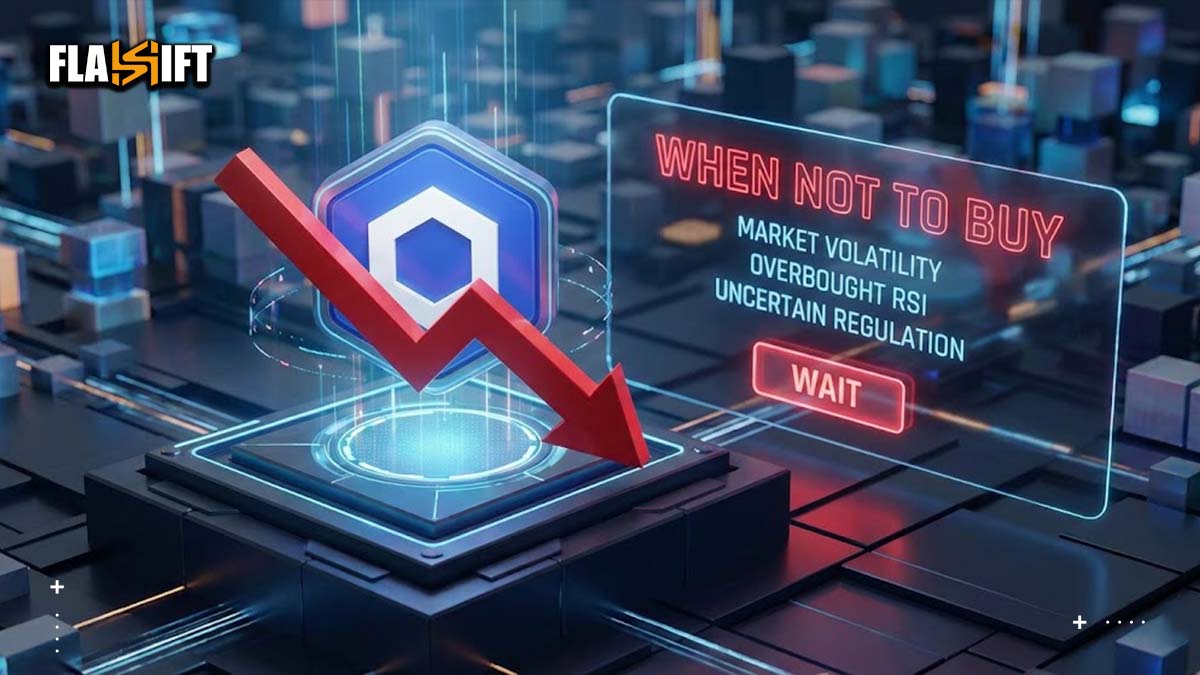
Experienced investors avoid chasing retail momentum. Historically, LINK displays distinct accumulation and distribution patterns. To maximize capital efficiency, avoid buying during the following phases:
- The Post-Integration Hype Spike
Chainlink announcements regarding high-profile banking integrations or major network expansions (e.g., new CCIP partner networks) frequently trigger localized retail market peaks. Historically, these events result in a sharp “hype spike,” followed by a 10% – 15% market correction within the subsequent 48 – 72 hours as early traders secure profits. Avoid chasing green candles; wait for the post-news consolidation.
- Fast Bitcoin Liquidity Sweeps
During sudden market-wide deleveraging events—where Bitcoin (BTC) drops more than 3% – 5% in a highly compressed time window—altcoins experience immediate liquidity drains. No matter how strong LINK’s fundamental institutional utility is, it cannot hold its dollar value during a systemic margin squeeze. Stand aside during rapid BTC support breaks, and wait for the volatility index to settle to capture a significantly cheaper entry.
- Periods of High Network Latency & Extreme Gas Fees
Because LINK’s primary trading volume occurs on the Ethereum mainnet, high on-chain traffic can push base network fees past 80 – 100 gwei. If you are conducting small or medium-sized swaps, gas costs of 15 – 40 per transaction can severely erode your capital efficiency. When mainnet congestion spikes, utilize non-custodial cross-chain bridges or execute swaps onto high-speed Layer-2 networks (such as Arbitrum or Base) via intelligent routing gateways.
Security Protocols for Institutional-Grade Custody
To guarantee your wealth remains protected against advanced phishing scripts, supply chain attacks, and physical recovery threats, enforce the following protocols:
- Enforce Custom BIP-39 Passphrases: Go beyond the standard 24-word seed recovery sheet. Implement a custom passphrase (commonly referred to as the “25th word”). This passphrase acts as a separate, invisible wallet layer, protecting your funds even if a physical actor gains access to your recovery phrase.
- Implement Multi-Signature (Multi-Sig) Portals: For high-volume assets, rely on multi-signature systems like Safe (formerly Gnosis Safe). Enforcing a 2-out-of-3 or 3-out-of 5 sign-off protocol ensures that even if one of your hardware wallets is compromised, your total capital remains secure.
- Establish Active Approval Audits: DeFi protocols require token transfer allowances. Over time, these open approvals create critical vectors for smart contract exploits. Routinely scan and revoke excessive spending limits on tools like Revoke.cash.
Read More: The most secure crypto wallets
Conclusion: The Sovereign Path Forward
In the highly institutionalized crypto landscape of 2026, Chainlink (LINK) is no longer a speculative bet; it is the infrastructure foundation of a new financial era. However, capturing the upside of this asset requires an uncompromised commitment to security.
Relying on custodial exchange infrastructure means accepting the perpetual threat of arbitrary freezes and metadata tracking. By shifting to non-custodial routing engines like Flashift and securing your positions in isolated, multi-sig cold storage configurations, you claim absolute ownership over your capital. Protect your privacy, eliminate counterparty risks, and secure your financial sovereignty today.
FAQ
Can I acquire Chainlink (LINK) without exposing sensitive personal documents?
Yes. By routing swaps through Flashift’s non-custodial gateway, you can exchange assets like ETH, USDT, or BTC directly for LINK natively across multiple chains with zero registration, zero accounts, and complete privacy.
Why is non-custodial swapping safer than keeping LINK on centralized exchanges? Centralized exchanges act as custody holders. If they experience a security breach, regulatory pressure, or liquidity insolvency, your funds can be locked indefinitely. Non-custodial swapping ensures you retain control of your private keys at every stage of the transaction.
What is the Cross-Chain Interoperability Protocol (CCIP)?
CCIP is Chainlink’s standardized communication architecture that enables secure data transfer and token movement across public and private blockchains. This technology is currently used by global banking networks to automate the movement of tokenized assets.
How does MetaMask compare to a physical hardware wallet for LINK storage?
MetaMask stores private keys on your internet-connected computer, making it vulnerable to malware, Trojan exploits, and sophisticated phishing scripts. Hardware wallets keep keys permanently offline, requiring physical buttons to confirm any transaction signature.
What should I do if my wallet gets compromised by a malicious dApp approval?
If you suspect you signed a malicious approval, navigate to a revocation interface like Revoke.cash immediately. Connect your wallet, audit your pending allowances, and revoke the exploiter’s spending permission to secure your remaining assets.