
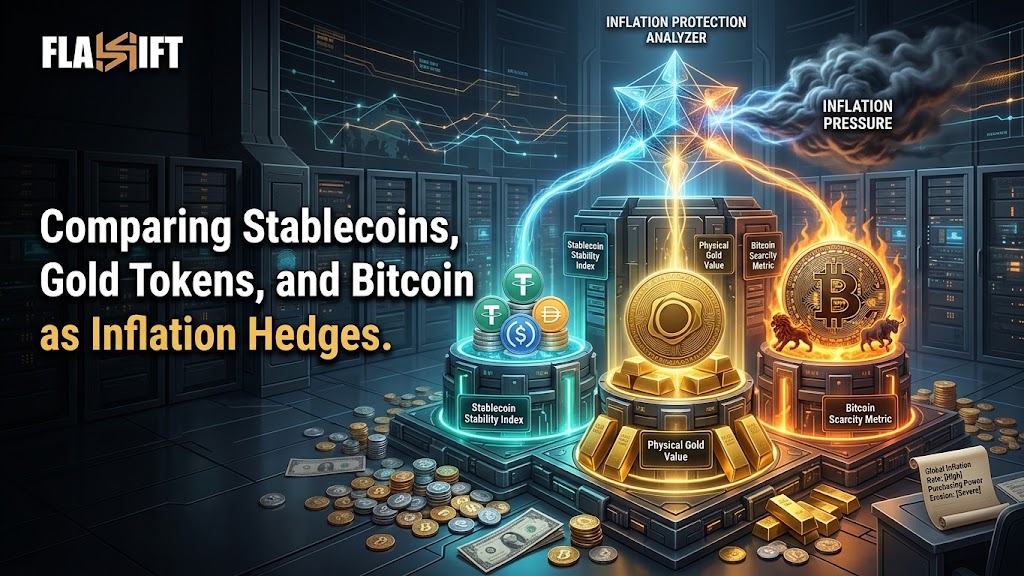
- 📊 2026 Inflation Hedge Matrix: Assets & Execution
- Deep Dive: Analyzing Return and Security
- 1. Stablecoins: Liquidity Without Real Growth
- 2. Gold Tokens (PAXG): Blending Tradition with Blockchain
- 3. Bitcoin: The Asymmetric “Digital Gold”
- Which Asset Works Best Against Inflation in 2026?
- The Tier-1 Custody Trap: IRS, MiCA, and CEX Risks
- Sovereign Execution: Swapping Native Assets Without Bridges
- ❓ FAQ
In times of macroeconomic uncertainty, investors search for assets that can preserve their wealth against rising prices. Every period of economic turbulence leaves operators in Tier-1 jurisdictions (US, UK, DE) asking the same question: how do I protect the purchasing power of my capital? Inflation eats away at savings quietly but relentlessly, and in 2026, the pace of currency erosion requires more than just traditional strategies.
While physical gold has long been the classic inflation hedge, the digital era has introduced new, highly liquid contenders. Today, capital is aggressively rotating into on-chain alternatives: Stablecoins for liquidity, Tokenized Gold (PAXG / XAUT) for vaulted stability, and Bitcoin (BTC) for asymmetric digital scarcity.
However, an inflation hedge is entirely useless if your assets are locked inside centralized exchanges vulnerable to account freezes, regulatory surveillance, and identity data breaches. This comprehensive guide breaks down the strengths and weaknesses of these digital assets, and outlines the exact operational steps to rotate between them utilizing Zero-Approval and No-KYC execution.
The Silent Tax: Why Traditional Safe Havens Are Evolving
Inflation doesn’t always make immediate headlines. By the time living costs spike, the spending power of cash has already been severely undermined. For investors, the real danger isn’t short-term market volatility, but the slow, compounding erosion of wealth over years.
Historically, capital flowed toward physical gold during crises. But the financial landscape has fundamentally changed. Physical bullion lacks the velocity, divisibility, and borderless nature required by modern operators. Today, investors demand assets that combine the historical reliability of hard money with the frictionless transferability of the blockchain.
📊 2026 Inflation Hedge Matrix: Assets & Execution
Before diving into the individual performance of each asset, examine how their structural architecture impacts your portfolio:
| Asset Class | Primary Asset | Inflation Protection | Counterparty / Custody Risk | Execution Profile |
| Fiat Stablecoins | USDT, USDC | 🔴 Zero (Inherits USD fiat debasement) | Smart contract & issuer depeg risk | High liquidity; best used as a temporary parking spot |
| Tokenized Gold | PAXG, XAUT | 🟢 High (Directly pegged to vaulted physical gold) | Custodial risk (dependent on vault audits) | Low volatility; ideal for digital wealth preservation |
| Digital Gold | Bitcoin (BTC) | 🟢 Asymmetric (Mathematically capped at 21M) | Zero counterparty risk in self-custody | High volatility; historically outpaces currency inflation |
Deep Dive: Analyzing Return and Security
To build a resilient portfolio, you must understand the dual forces of Return and Security for each digital asset.
1. Stablecoins: Liquidity Without Real Growth
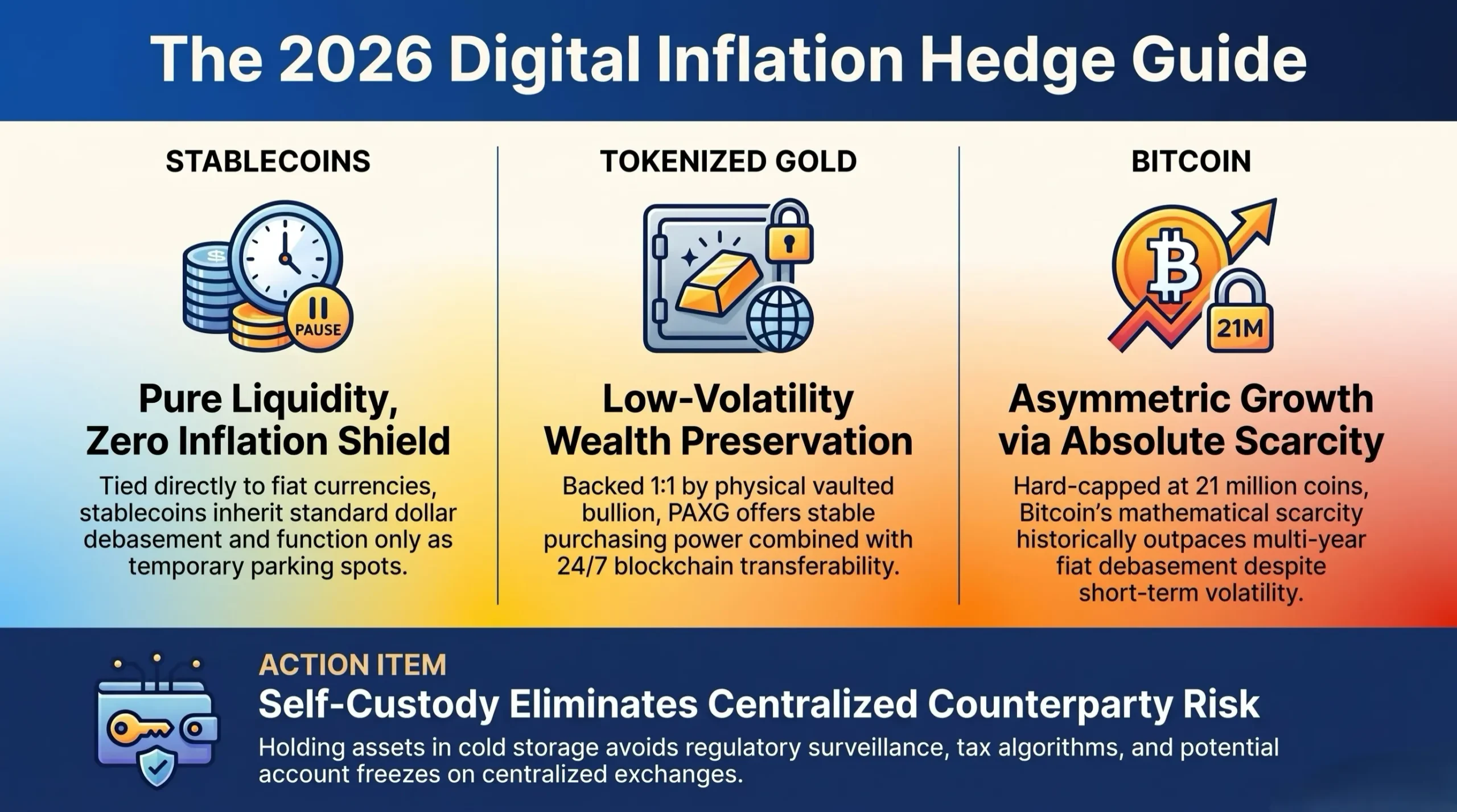
At first glance, stablecoins seem like the obvious refuge. Pegged 1:1 to currencies like the U.S. dollar, they allow you to park funds in the crypto ecosystem without facing the extreme volatility of native digital assets.
-
The Return Profile: Stablecoins do not protect against inflation. Because they are tied to fiat currency, they inherit the exact same loss of purchasing power as the underlying dollar. They are a tool for convenience and agility, not a shield for your savings.
-
The Security Profile: While their price is structurally designed to be stable, the true risk sits beneath the surface. Stablecoins rely heavily on central issuers to hold fiat reserves and maintain regulatory compliance. They are excellent temporary parking spots, but weak as long-term standalone hedges.
2. Gold Tokens (PAXG): Blending Tradition with Blockchain
Gold’s reputation as an inflation hedge has survived centuries of monetary experiments. Gold-backed tokens (like PAXG) take that proven credibility and tokenize it. Instead of locking coins in a physical safe, you hold a digital token that represents a legal claim on physical London Good Delivery bullion stored in institutional vaults.
-
The Return Profile: Returns mirror the physical asset, modest in calm markets, but exceptionally strong when fiat currencies weaken. It is about holding an asset that retains its purchasing power during economic downturns.
-
The Security Profile: Tokenized gold bridges traditional finance and Web3, offering accessibility in small denominations. The primary security consideration is trusting the token issuer and the vault custodians to honor redemption rights and maintain 1:1 backing.
3. Bitcoin: The Asymmetric “Digital Gold”
Bitcoin is fundamentally different from fiat currencies that can be printed endlessly. Its supply is mathematically hard-capped at 21 million coins, making absolute scarcity its primary value driver.
-
The Return Profile: Over a long enough horizon, Bitcoin has dramatically outperformed both gold and fiat-linked assets. As an inflation hedge, its return profile is asymmetric: if global trust in fiat erodes, Bitcoin historically outpaces traditional assets. However, its short-term volatility requires conviction and disciplined position sizing.
-
The Security Profile: From a network perspective, Bitcoin is the most secure, decentralized, and censorship-resistant asset in the world. The only weak link is personal custody—you must take responsibility for your own private keys to eliminate centralized counterparty risk.
Which Asset Works Best Against Inflation in 2026?
There is no single “perfect” asset. Advanced operators construct a resilient portfolio by blending assets based on their immediate macroeconomic needs:
-
Need stability and temporary liquidity? Stablecoins (USDT/USDC).
-
Want tried-and-true wealth preservation? Gold Tokens (PAXG/XAUT).
-
Looking for asymmetric macroeconomic growth? Bitcoin (BTC).
The Tier-1 Custody Trap: IRS, MiCA, and CEX Risks
For investors operating in Tier-1 jurisdictions (US, UK, Germany), utilizing centralized exchanges (CEXs) to buy Bitcoin or Gold tokens introduces severe counterparty risks. Connecting your identity to a CEX instantly exposes your portfolio to aggressive regulatory surveillance, mandatory IRS/MiCA tax reporting algorithms, and sudden account freezes during market volatility.
True inflation protection requires absolute Financial Sovereignty. You must acquire and hold your assets in self-custody cold storage, completely free from centralized gatekeepers.
⚡ Rotate Your Capital Instantly: Protect your purchasing power now. Swap your depreciating stablecoins directly into Native Bitcoin or PAXG using zero-approval routing engine.
Sovereign Execution: Swapping Native Assets Without Bridges
When transitioning wealth from stablecoins to Bitcoin or Gold tokens, execution architecture is just as critical as asset selection. A common fatal mistake is utilizing decentralized cross-chain bridges or synthetic wrapped tokens (like WBTC).
Cross-chain bridges contain massive smart contract security vulnerabilities and function as centralized honeypots, leading to billions in historical exploits. Flashift eliminates this systemic risk entirely by operating as a pure Chain Abstraction Layer.
-
No Bridges, Only Native Assets: Flashift executes direct native-to-native swaps. When you exchange USDT for Bitcoin, you receive real, native BTC on the Bitcoin network—not a vulnerable synthetic token.
-
Zero Custodial Pools: Flashift operates a strict non-custodial architecture. We do not hold your funds, operate hot wallets, or utilize centralized user accounts. Your capital routes directly from your self-custody wallet, through the liquidity provider, and instantly into your destination address.
-
AI Continuous Post-Trade Analysis: If a liquidity provider attempts a predatory bait-and-switch tactic mid-transaction (e.g., hidden slippage or sudden KYC demands), our AI engine instantly detects the anomaly, blacklists the provider, and secures your execution path to guarantee your funds remain safe.
-
24/7 Human Oversight: If blockchain congestion delays a cross-chain settlement, our dedicated human support desk actively monitors the transaction flow to guarantee secure delivery directly to your wallet.
❓ FAQ
Are stablecoins effective hedges against inflation?
No. Because stablecoins like USDT and USDC are pegged 1:1 to the US Dollar, they suffer the exact same loss of purchasing power as physical fiat currency. They are tactical tools for maintaining liquidity, not instruments for preserving long-term wealth.
How do tokenized gold assets like PAXG work?
Tokens like Pax Gold (PAXG) represent legal ownership of one fine troy ounce of physical London Good Delivery gold stored in institutional vaults. They provide the historical stability and inflation-hedging power of gold, combined with the 24/7 transferability and divisibility of blockchain assets.
Is Bitcoin or tokenized gold a better hedge against inflation?
Both serve complementary functions. Tokenized gold offers stability with minimal price volatility, making it an ideal defensive anchor. Bitcoin provides asymmetric upside; while volatile in the short term, its absolute mathematical scarcity (21 million hard cap) historically outperforms fiat debasement over multi-year cycles.
Can combining these assets create a stronger hedge?
Absolutely. Sovereign operators use stablecoins for short-term agility, gold tokens (PAXG) to anchor the portfolio with low-volatility preservation, and Bitcoin for asymmetric growth. Rotating between them via non-custodial layers like Flashift ensures your portfolio remains dynamic and resistant to both inflation and centralized censorship.
Can I swap stablecoins for PAXG or Bitcoin without KYC?
Yes. By using non-custodial aggregators like Flashift, you can swap USDT or other base assets directly for PAXG or BTC without creating an account or providing identity documents, maintaining complete financial sovereignty.