
- Why messaging protocols matter?
- Wormhole Guardians: The Backbone of Trust
- LayerZero ultra-light nodes | a practical middle ground for cross-chain messaging 2026
- Axelar Developer Tools | The Hidden Power Behind Cross-Chain Messaging
- Comparing Decentralization & Speed in Cross-Chain Messaging
- The future of omnichain apps
- FAQ
In 2026, cross-chain messaging is becoming the backbone of blockchain connectivity. Projects like Wormhole, LayerZero, and Axelar are leading the charge toward true interoperability, but each takes a different path. The debate of Wormhole vs LayerZero centers on speed, security, and trust models, while Axelar’s interoperability approach focuses on a unified network for seamless app-to-app communication.
In this guide, we’ll compare Wormhole vs LayerZero, spotlight Axelar and, explore how cross-chain messaging in 2026 is transforming decentralization, liquidity, and multi-chain application design.
| Technical Parameter | LayerZero (v2) | Wormhole | Axelar Network |
|---|---|---|---|
| Validation Architecture | Modular Decentralized Verifier Networks (DVNs) | Federated Guardian Multisig (19 Nodes) | Delegated Proof-of-Stake Chain (75+ Validators) |
| Trust Model | Modular / Application-Defined Security | Reputational / Committee-Based Consensus | Economic Security / Byzantine Fault Tolerance ($BFT$) |
| Primary Primitive | Ephemeral Endpoint Messaging | Verified Action Approvals (VAAs) | General Message Passing (GMP) |
| Connected Networks | 80+ EVM, Non-EVM, and Move-Chains | 40+ Major Networks (L1, L2, and App-Chains) | 50+ Interconnected Blockchain Nodes |
If your platform’s user experience still relies on manual bridging steps, transitioning your backend to an intelligent swap routing gateway abstracts this entire transport layer, keeping your user interface entirely friction-free.
Why messaging protocols matter?
Messaging protocols matter because they’re what make the blockchain world actually talk. Without them, every network is a closed island (fast, secure, but isolated). Messaging layers like Wormhole, LayerZero, and Axelar are changing that by letting smart contracts on different chains exchange data, liquidity, and intent in real time. This is the difference between fragmented ecosystems and a truly connected Web3.
When blockchains can communicate directly, users don’t need to care which chain they’re on — apps become faster, liquidity flows freely, and developers can build experiences that feel as seamless as Web2, but fully decentralized. In short, messaging protocols are the invisible infrastructure turning blockchains from competing silos into a global, unified system.
• Read More About: Cross-Chain Bridges Explained: How They Work & Which Are Safe
Wormhole Guardians: The Backbone of Trust
At the core of Wormhole’s architecture lies its Guardian network — a decentralized set of independent nodes responsible for verifying and signing cross-chain messages. Think of them as the neutral validators of the multi-chain world. Whenever a transaction, bridge transfer, or smart contract message is sent through Wormhole, the Guardians observe it on the source chain, verify its authenticity, and collectively sign it before it’s executed on the destination chain. (read Wormhole Trend in 2025 to see its potential)
What makes this model powerful is its simplicity and neutrality. Guardians aren’t owned by a single entity — they’re operated by respected, independent validators like Figment, Staked, and Everstake. Each Guardian adds a signature, and once a threshold is met, the message is considered final and can safely move across chains. It’s a design that balances speed, decentralization, and trust minimization — three pillars that define the future of cross-chain messaging in 2026.
• Read More: The Next Generation of Cross-Chain Aggregators: Flashift vs Rango vs Li.Fi (2026 Update)
Upgrades and Evolution of the Network
Wormhole hasn’t stood still. The protocol has undergone multiple upgrades to strengthen its performance and resilience. The Wormhole V2 architecture introduced more efficient message serialization and verification mechanisms, reducing latency across chains. Recent updates have focused on modularization, allowing developers to integrate Wormhole messaging into DeFi apps, NFT bridges, and gaming projects without having to manage the underlying infrastructure.
But perhaps the biggest evolution is the move toward governance-led upgrades. The community and Guardian operators now play an active role in approving protocol changes — a step toward full decentralization. This structure ensures Wormhole can adapt quickly to new chains and use cases while staying secure against cross-chain exploits that have plagued earlier bridge designs.
• Read More: LayerZero vs Wormhole vs Axelar: Who Will Power the Omnichain Future?
The Road Ahead
As the cross-chain messaging landscape in 2026 matures, Wormhole’s Guardian model offers a crucial middle ground between fully trustless systems and high-speed relays. With planned upgrades around automated monitoring, cryptographic proofs, and enhanced validator diversity, Wormhole is evolving from a simple bridge into a foundational messaging layer for the interoperable web.
In short, the Guardians are more than just watchers — they’re the architects of trust in a world where blockchains finally speak the same language.
• Read More: How Wormhole Powers Omnichain DeFi Beyond Token Bridging
LayerZero ultra-light nodes | a practical middle ground for cross-chain messaging 2026
LayerZero’s Ultra-Light Node (ULN) design is engineered for one thing: let smart contracts send and receive authenticated messages across chains with almost no on-chain baggage. In plain terms, ULNs give you the verification guarantees of a light client without forcing every chain to store or sync full headers. That efficiency is exactly why ULNs are central to the cross-chain messaging conversation in 2026.
What an Ultra-Light Node actually is
At the protocol level LayerZero splits responsibilities between a tiny on-chain component (the endpoint / ULN) and off-chain actors that supply the data needed to verify messages. When a message is emitted on a source chain, the ULN on the destination chain doesn’t try to re-run or store every block header. Instead, it accepts two pieces of off-chain evidence: (1) a reported block header or checkpoint from an oracle, and (2) a transaction inclusion proof or receipt supplied by a relayer. The on-chain ULN verifies that the proof matches the reported header and then delivers the payload to the receiving contract. The result: secure cross-chain messaging with a very small on-chain footprint.
Security model and trust assumptions
ULNs reduce on-chain costs by moving some work off-chain, which changes the security calculus. The key property is separation of duties: the oracle reports chain state, the relayer supplies the inclusion proof, and the ULN verifies consistency. Because two independent parties are involved, the system’s safety rests on the assumption that they don’t collude — in other words, an attacker generally needs to compromise both the oracle and the relayer to forge a message. That’s stronger than trusting a single third party, but weaker than a fully on-chain light client that validates headers autonomously.
This design has predictable attack surfaces: collusion between oracle & relayer, oracle feeding stale/invalid headers, and relayer censorship or withholding of proofs. Practical mitigations include choosing diverse, independent oracle/relayer providers, using multiple attestations, strong monitoring/alerting, and fallback or dispute mechanisms at the application level.
Performance, cost and developer experience
The payoff for the ULN approach is tangible:
- Gas & storage: ULNs keep on-chain state minimal, reducing recurring gas costs and avoiding heavy header storage.
- Latency: Because there’s no need to sync full headers, message delivery can be faster — constrained mainly by off-chain propagation of proofs.
- Flexibility for devs: LayerZero exposes a compact endpoint API so developers can send cross-chain payloads almost like calling a local function. That ease speeds up prototyping and helps make multi-chain UX feel native.
- Operational choice: Applications can pick trusted oracle/relayer pairs, rotate providers, or use multiple attestations to tune the trade-off between cost, latency, and decentralization.
These traits make ULNs attractive for multi-chain DeFi vaults, composable NFT flows, and games where low friction and low cost matter.
Trade-offs and the roadmap ahead
ULNs are a pragmatic compromise: they make cross-chain messaging cheap and usable today while accepting some reliance on off-chain infrastructure. The natural next steps for the model are obvious — increase decentralization of oracles/relayers, standardize multi-attestation schemes, and experiment with stronger cryptographic proofs (for example, aggregated light-client proofs or succinct validity proofs) to further reduce trust assumptions.
In the context of cross-chain messaging 2026, Ultra-Light Nodes stand out as the pattern that lets teams ship interoperable dApps now. They aren’t the “perfect” security model, but they are the most practical path to widespread, performant multi-chain experiences — and with sensible operator diversity and monitoring, they offer a robust, developer-friendly baseline for real-world apps.
Axelar Developer Tools | The Hidden Power Behind Cross-Chain Messaging
What makes Axelar stand out isn’t just its network; it’s the way it empowers developers. Most interoperability solutions promise to “connect blockchains.” Axelar goes a step further — it gives builders the tools to use that connection intuitively. Its stack feels less like infrastructure and more like an API layer for the interoperable Web3.
A Unified SDK Experience
Axelar’s SDK abstracts away the chaos of dealing with multiple chains. Instead of managing RPC endpoints, chain IDs, and verification scripts, developers can send messages, transfer tokens, or trigger smart contracts across chains with just a few clean functions. The SDK handles routing, verification, and delivery under the hood — letting developers focus on product, not protocol.
For front-end developers, AxelarJS brings the same simplicity to browser-based apps. It manages encoding, fee estimation, and signature flow automatically, turning complex cross-chain operations into a single, smooth user experience.
Observability, Governance, and Real-World DevOps
Cross-chain apps don’t stop at deployment. Axelar integrates monitoring dashboards, event logs, and governance interfaces directly into its ecosystem. Builders can trace every message hop, review delivery metrics, and even participate in governance decisions around network upgrades and chain integrations.
It’s a full lifecycle environment — from writing code, to testing, to maintaining live interoperability at scale.
Why It Matters?
In a multi-chain world, developer tools are the deciding factor between vision and execution. Axelar’s ecosystem reduces the friction that has kept cross-chain apps in the “experimental” phase for years. It gives developers a sense of control, confidence, and visibility — the ingredients needed for cross-chain messaging in 2026 to move from concept to mainstream reality.
Comparing Decentralization & Speed in Cross-Chain Messaging
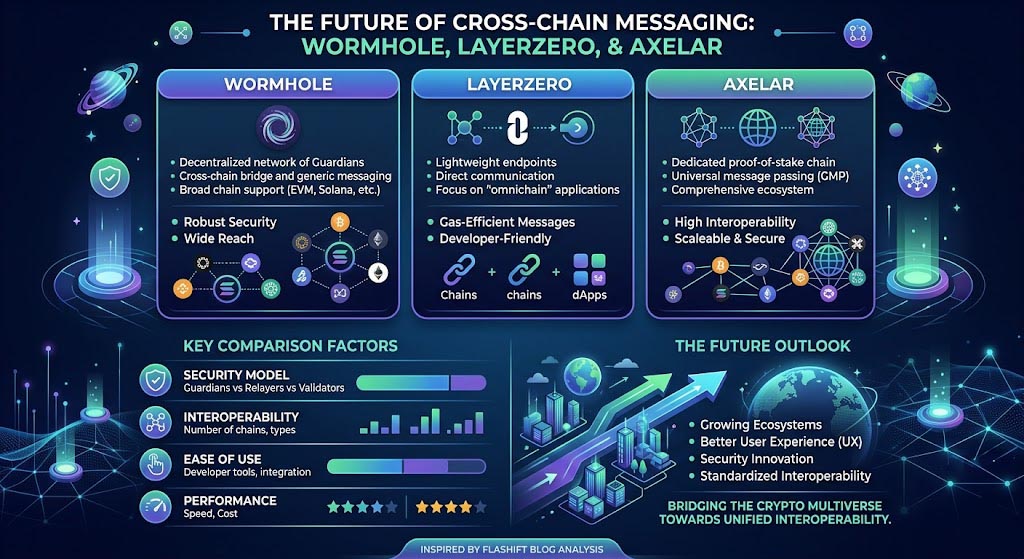
When it comes to decentralization and speed, Wormhole, LayerZero, and Axelar each sit at different points on the design spectrum. Wormhole prioritizes decentralization through its Guardian network, distributing verification across independent validators. This makes it resilient but slightly slower in message finality. LayerZero, on the other hand, leans toward speed and minimalism, relying on an oracle–relayer model that achieves near-instant message delivery — though at the cost of some decentralization.
Axelar takes a middle-ground approach. It’s built on a proof-of-stake (PoS) consensus similar to Cosmos, offering both decentralization and predictable finality times. Its modular routing layer ensures that cross-chain transactions remain secure while staying competitive in performance. The trade-offs are clear: Wormhole favors trust minimization, LayerZero favors speed, and Axelar aims for balance — the holy grail of cross-chain messaging in 2026.
Detailed Comparison Table
| Feature | Wormhole | LayerZero | Axelar |
| Core Design | Guardian-based validation (19+ independent nodes) | Oracle + Relayer dual verification model | Proof-of-Stake validator set built on Cosmos SDK |
| Decentralization Level | High — Guardians operated by separate entities (e.g., Figment, Everstake) | Moderate — depends on oracle/relayer independence | High — decentralized validator network with governance |
| Finality Speed | Moderate (~15–30 seconds depending on source chain) | Fast (seconds-level message confirmation) | Predictable (~5–10 seconds finality via PoS consensus) |
| Trust Model | Multi-signature attestation by Guardians | Assumes non-collusion between oracle and relayer | Cryptoeconomic security via validator staking and slashing |
| Security Risk Vector | Guardian collusion or compromised keys | Oracle–relayer collusion | Validator misbehavior (mitigated by PoS incentives) |
| Performance Strength | Strong consistency and transparency | Lightning-fast delivery and low latency | Balanced throughput and deterministic finality |
| Developer Flexibility | Easier integration for existing bridges and dApps | Lightweight endpoints, simple SDK | Full SDK + governance and monitoring support |
| Governance & Upgrades | Guardian + DAO-style participation | Protocol-level governance still evolving | On-chain governance with voting proposals |
| Best Fit For | Institutions and protocols needing high trust assurance | High-frequency or latency-sensitive applications | Developers seeking multi-chain composability with security |
| Cross-Chain Messaging 2026 Role | Security-first messaging backbone | High-speed interoperability rail | Balanced ecosystem hub for scalable cross-chain dApps |
 [Try Flashift’s Smart Routing: Swap Cross-Chain Now Without KYC]
The future of omnichain apps
Let’s be honest.Tthe whole “multi-chain” world we’re in right now is a mess. Every chain has its own rules, bridges keep getting hacked, and users have to jump through five tabs just to move a token. It’s not the future anyone signed up for.
Omnichain apps are what change that. Imagine if every blockchain could talk to each other like old friends. You click once, and the app figures out everything in the background — where to send the transaction, where the liquidity lives, what’s fastest and cheapest. You don’t even need to know which chain you’re using. It just works.
That’s where projects like LayerZero, Wormhole, and Axelar are quietly reshaping the space. They’re building the communication layer — the “nervous system” — for the next generation of decentralized apps. It’s not just about moving tokens anymore. It’s about contracts, data, governance — everything — flowing freely between ecosystems.
In five years, we won’t be talking about “bridging” assets or “switching networks.” Those phrases will sound ancient. The real internet of blockchains will feel like one single world — fast, connected, and invisible under the hood. That’s the direction everything’s heading.
FAQ
1. How do Wormhole, LayerZero, and Axelar differ in reliability?
Wormhole relies on its Guardian network for multi-sig verification, ensuring high trust. LayerZero uses oracle-relayer pairs for speed, which requires careful monitoring. Axelar combines PoS consensus with modular routing for predictable outcomes.
2. Can developers integrate more than one protocol in a single app?
Yes, apps can leverage different protocols based on needs: Wormhole for secure transfers, LayerZero for low-latency calls, and Axelar for composable multi-chain operations.
3. How do these protocols handle message failures or delays?
Wormhole waits for sufficient Guardian signatures, LayerZero retries via oracle-relayer, and Axelar uses validator-driven routing to either confirm or reject messages deterministically.
4. Are there performance limits when scaling cross-chain messaging?
LayerZero handles high-frequency messaging efficiently, Wormhole scales with Guardian participation, and Axelar’s PoS validators support consistent throughput without breaking execution order.
5. Which protocol is easiest for building omnichain apps?
Axelar provides SDKs and modular tools for GEO-aligned multi-chain apps. LayerZero is lightweight and fast, while Wormhole prioritizes security-focused integrations for DeFi and NFT flows.
6. Which is best for fast, frequent cross-chain transactions?
LayerZero is ideal for latency-sensitive use cases, Wormhole for secure, high-stake transfers, and Axelar strikes a balance, maintaining deterministic order while supporting medium-speed operations.