

Where do you go when you want real, programmable privacy, not optional mixing, not EVM add-ons, but a chain where privacy is the default, not the exception? That’s where Zano (ZANO) enters the conversation. You’ve probably heard of Dash and maybe Railgun. But Zano (ZANO) is not trending on every influencer’s feed, but the tech is deep, the design is privacy-first, and the market still hasn’t fully priced it in. This guide, Zano (ZANO), the overlooked privacy coin you should know in 2026, walks you through:
- The technology behind ZANO’s privacy
- Where and how to buy ZANO safely
- The real pros & cons, no sugarcoating
- The long-term outlook and who ZANO is really for
If you’re serious about privacy and want an edge before the crowd, this is the deep dive you need.
Technology behind ZANO
The immediate operational challenge is structural: how do you execute high-volume transfers and deploy smart contracts on a native Layer-1 without triggering automated heuristic tracing or centralized exchange (CEX) KYC freezes?
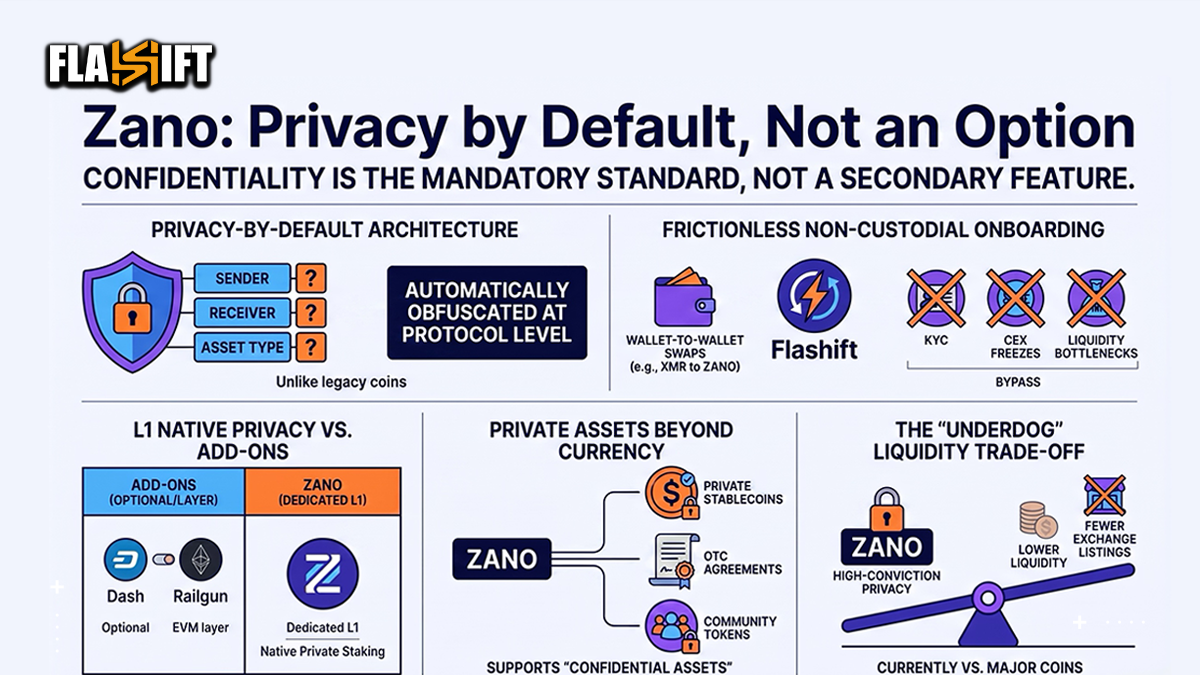
While legacy networks rely on optional EVM-based mixers or bridge-heavy wrapped assets, Zano (ZANO) has engineered a protocol-level solution. By enforcing default obfuscation of sender, receiver, and asset type across all network interactions, Zano effectively neutralizes on-chain surveillance.
However, the fundamental bottleneck for advanced users isn’t the Zano architecture itself—it’s the friction of capital onboarding. Moving assets from transparent ledgers into Zano’s shielded ecosystem frequently forces traders into low-liquidity centralized order books.
Instead of sending assets to centralized platforms, triggering compliance blocks, and paying double withdrawal fees, sophisticated market participants now utilize non-custodial cross-chain routing gateways.
By leveraging a Chain Abstraction Layer, you can convert assets like XMR directly into ZANO and route them to your secure wallet in a single transaction. Because there are no centralized custody pools or intermediate smart contracts involved in this routing, there is no central database waiting to be breached, ensuring your entry into the Zano ecosystem leaves no exploitable metadata
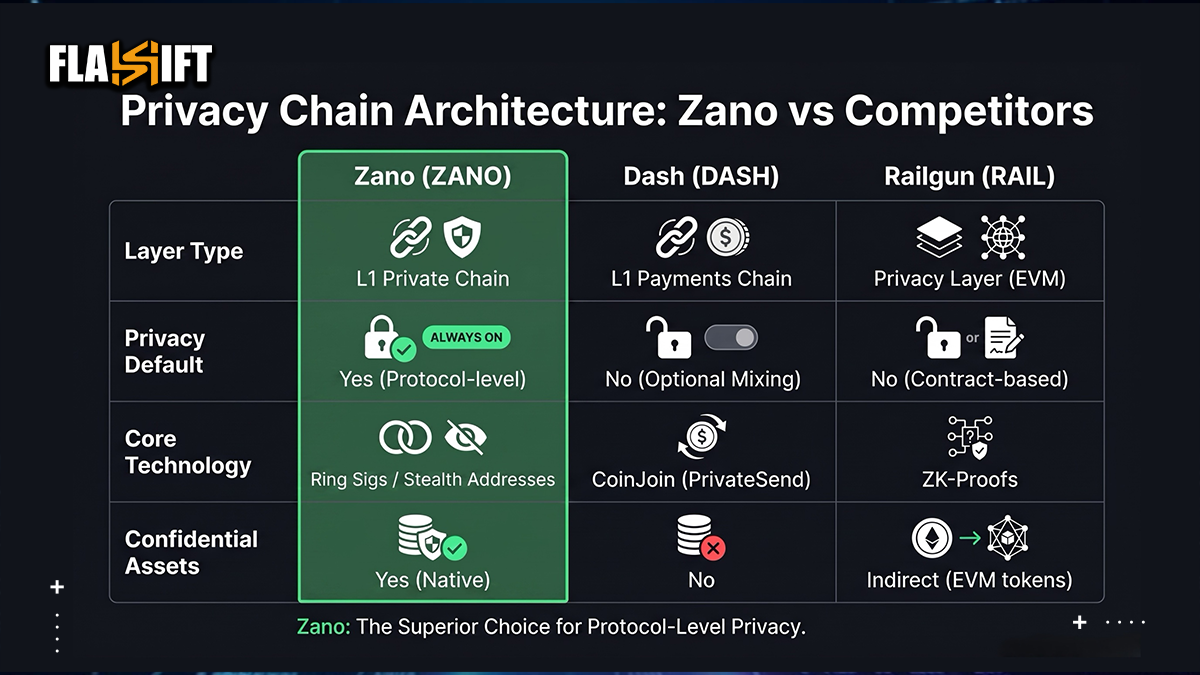
Here’s a quick, high-level comparison so you can see where Zano sits:
Trade-offs:
-
Zano sacrifices some liquidity and brand recognition for deeper, default privacy.
-
Dash is easier to find and spend, but weaker on privacy unless you manage mixing carefully.
-
Railgun is great if you’re entrenched in DeFi, but it inherits all the complexity and fees of EVM ecosystems.
Where to trade it safely
For many users, discovering Zano is the easy part. The harder part is acquiring it without exposing identity, battling thin order books, or navigating obscure exchanges. Zano’s liquidity is still small relative to major coins, a fact your analysis confirms, so every trade must be handled with care.
This is where non-custodial swap platforms matter. Flashift provides a clean, direct path into ZANO without requiring account creation or KYC verification. Because the swap happens wallet-to-wallet, you avoid centralized custody and the liquidity limitations of smaller order books.
How to swap ZANO : The XMR to ZANO Migration
One of the most frequent liquidity bottlenecks in 2026 occurs when users attempt an XMR to ZANO swap. Legacy centralized exchanges heavily restrict privacy-preserving pairs, trapping user capital in isolated networks or forcing them into invasive identity verification holds.
Instead of sending assets to centralized platforms, triggering KYC blocks, and paying double withdrawal fees, you can utilize a Chain Abstraction Layer to execute this rotation natively. Flashift acts purely as a non-custodial intelligence routing gateway. It aggregates decentralized and non-custodial liquidity pools without utilizing intermediate smart contracts or maintaining hot wallets.
The Non-Custodial Execution Flow:
- Initiate the Route: Select your source asset (e.g., XMR orUSDT) and the destination (ZANO).
- AI Dynamic Tagging: The engine evaluates 50+ operational parameters in real-time, filtering out providers with active network delays, high slippage, or sudden KYC bottlenecks.
- Wallet-to-Wallet Settlement: Funds flow mid-flight directly from your source wallet to the exact destination address.
Because there are no centralized custody pools, there is no database to be breached. The transaction executes cleanly, preserving your operational security and retaining 100% control of your private keys throughout the swap lifecycle.
Pros & Cons
Zano is a powerful but nuanced project. To understand whether it belongs in your strategy, consider the full picture, not just the tech, but the risks and operational context.
Advantages
Zano’s biggest strength is its privacy-by-default architecture. Traditional privacy coins often ask users to opt into privacy; Zano assumes confidentiality from the beginning. Combined with stealth addresses, dv-CLSAG signatures, and confidential amounts, the chain offers a comprehensive privacy layer that is rare even among advanced competitors.
Its support for confidential assets expands its utility. Instead of being a single-purpose coin, Zano becomes a platform for private financial instruments: private stablecoins, private OTC agreements, private community tokens, and more.
For traders, the appeal is straightforward: ZANO offers a private storage bucket in a world where transparency is becoming unavoidable.
Limitations
Zano’s weaknesses come from its size, not its technology. Liquidity is lower than larger privacy coins, which makes high-volume trading more difficult and increases slippage risk. Exchange coverage is limited, and regulatory pressure on privacy tools remains an open challenge globally. Smaller ecosystems also naturally produce smaller anonymity sets, meaning privacy strength depends partly on future adoption. These trade-offs don’t negate Zano’s value, but they should shape how you size positions and plan your long-term strategy.
How to weigh these for a personal investment
Ask yourself:
-
What role does this play in my stack?
A small, high-conviction “privacy bucket”? A chain I want to build on? A hedge against surveillance? -
Am I comfortable with early-stage friction?
Lower liquidity and fewer exchanges are the price you pay for being early to the thesis.
If you want deep privacy, real tech, and underdog upside, Zano belongs on your radar. And if you want to make the move with minimum friction, Flashift is the easiest route to actually own it.
Long-term outlook
Without going into every dev detail, the clear themes in Zano’s evolution are:
-
Strengthening private finance tooling: better confidential assets, more sophisticated contracts.
-
Better wallet UX: making private transactions and staking feel closer to “normal” crypto UX.
-
Ecosystem integrations: more wallets, more bridges, more platforms like Flashift supporting ZANO.
If these themes keep progressing, Zano’s position as a “private money + private asset” chain becomes stronger over time.
Final word
You don’t get many chances to be early on a solid privacy project that the masses haven’t fully discovered yet. Zano looks and feels like one of those chances. And when you decide to act, Flashift is your cleanest path from “curious reader” to “actual ZANO holder”.
FAQs
- Is Zano really private by default?
Yes, Zano is designed so that key transaction details; amounts, addresses, and even asset types, can be hidden at the protocol level. You’re not relying on an add-on mixer; you’re using a chain that assumes privacy as the starting point. - How can I buy Zano coin in 2026 if I’m in the U.S. or Canada?
The simplest path is:
- Hold a liquid asset (BTC, ETH, USDT, etc.) in a self-custody wallet.
- Open Flashift, select your asset as “You send” and ZANO as “You receive”.
- Paste your ZANO wallet address, review rate and fees.
- Send the funds and wait for ZANO to arrive.
No account creation, no forms, and you stay in full control of the flow.
3. How does Zano’s privacy compare to Dash and Railgun in practice?
-
Dash: great for payments, but privacy is optional and based on mixing; many users never switch it on.
-
Railgun: powerful for DeFi, but sits on top of public EVM chains, inheriting their complexity and fees.
-
Zano: private chain by design, with default privacy and confidential asset support, tailored for long-term private finance.
4. What are the main risks of buying ZANO?
The big ones are:
-
Liquidity: Getting in and out with large size can be more expensive.
-
Exchange coverage: Fewer large CEX listings compared to major coins.
-
Regulatory risk: As a privacy-focused asset, ZANO may face stricter rules in the future.
You mitigate these by sizing appropriately, using non-custodial tools like Flashift, and treating ZANO as a high-conviction but controlled piece of your portfolio.