
- Crypto Wallet vs Exchange: What’s the Difference?
- When Keeping Crypto on an Exchange Makes Sense
- When a Wallet Makes More Sense
- Exchange or Wallet? Think in Terms of Risk
- What About Swapping Crypto?
- Where No-KYC Wallets Fit In
- A Practical Storage Strategy for 2026
- Crypto Storage Checklist
- The Bottom Line
- FAQ
You bought your crypto on an exchange. Now what? Should you leave it there for convenience, or move it to a wallet and take control of the keys yourself?
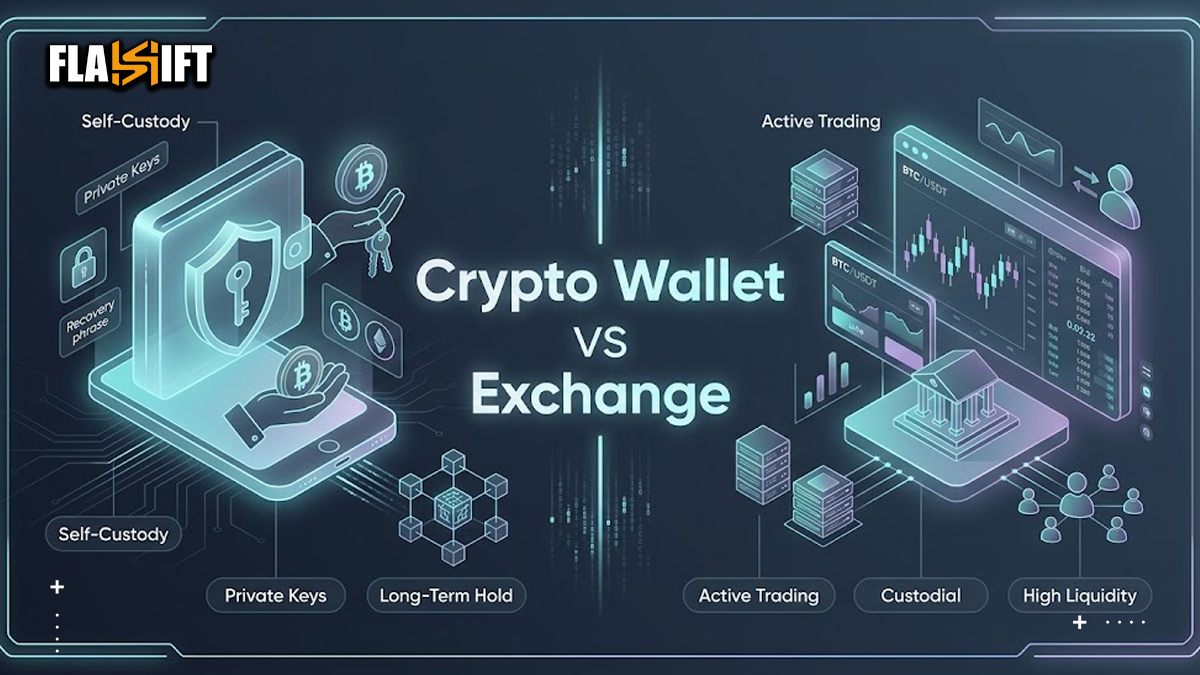
There is no universal answer. Exchanges are generally more practical for active trading, while self-custodial wallets make more sense for assets you plan to hold independently for the long term. For many users, the most sensible approach is to use both, with each serving a different purpose.
The key is understanding what you are trading off: convenience and liquidity on one side, direct control and self-custody on the other.
Crypto Wallet vs Exchange: What’s the Difference?
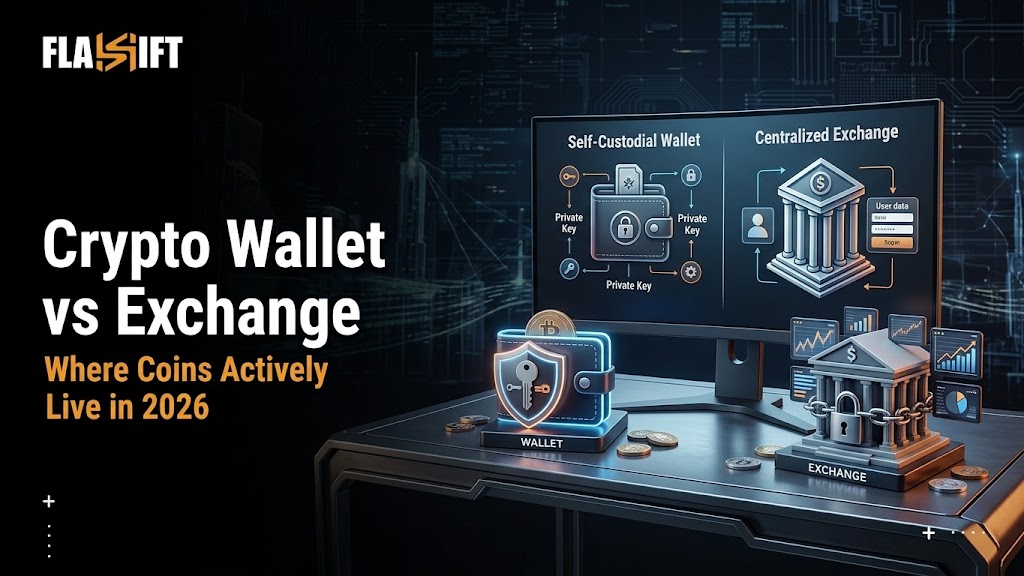
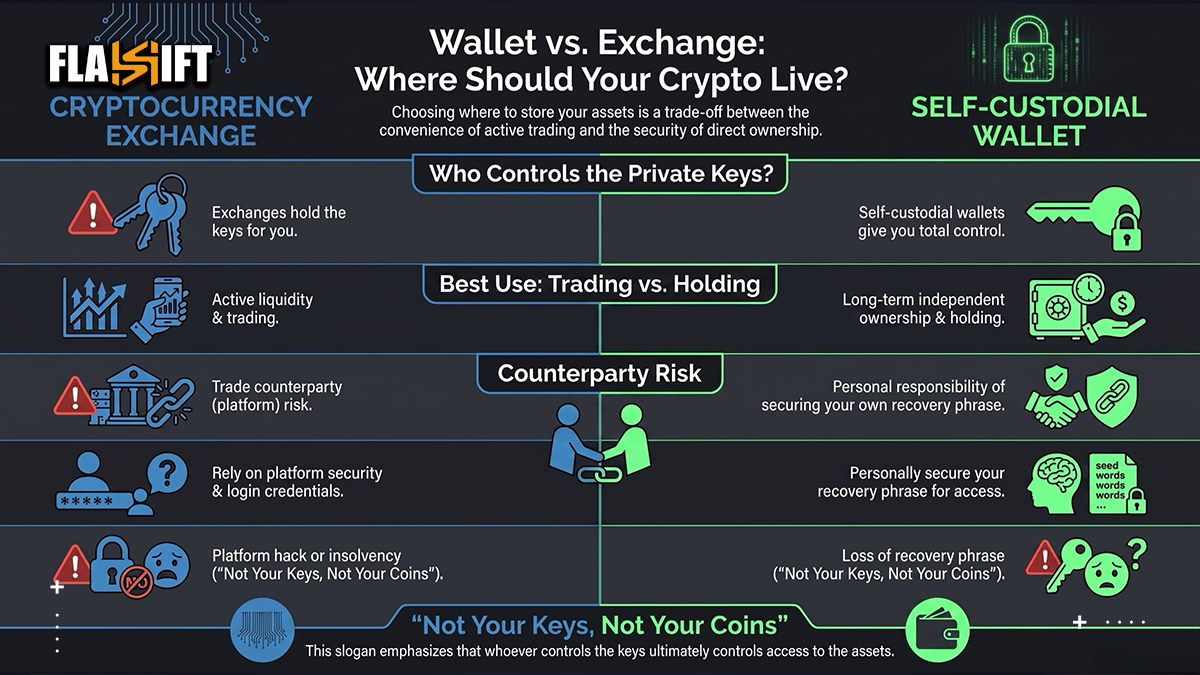
The biggest difference is custody. With a centralized exchange, the platform controls the underlying private keys for the crypto held in your account. With a self-custodial wallet, you control the keys.
| Cryptocurrency Exchange | Self-Custodial Wallet | |
| Who controls the keys? | The exchange | You |
| Best suited for | Active trading and liquidity | Long-term holding and direct ownership |
| Trading access | Built-in order books and trading tools | Usually requires an external exchange or swap route |
| Counterparty risk | Higher reliance on the platform | Lower reliance on a centralized custodian |
| User responsibility | Lower for key management | Higher for security and recovery |
| Main risk | Exchange, operational and withdrawal risk | Key loss, phishing, malware and user error |
This is why “not your keys, not your coins” is more than a crypto slogan. It describes who ultimately controls access to the assets.
But that does not mean a wallet is automatically safer in every situation. Self-custody removes some third-party risks while making you responsible for protecting the keys yourself.
When Keeping Crypto on an Exchange Makes Sense
An exchange is often the more convenient option when your crypto is part of an active trading strategy.
You already have access to:
- Order books and trading pairs
- Market and limit orders
- Exchange liquidity
- Fast execution
- Fiat on- and off-ramps, where supported
If you are regularly entering and exiting positions, transferring funds to a wallet before every trade can create unnecessary transactions and fees.
The important distinction is between trading capital and long-term holdings. Keeping the amount you actively need on an exchange can be practical; keeping your entire portfolio there simply because it is convenient is a different decision.
When a Wallet Makes More Sense
A self-custodial wallet becomes more attractive when your primary goal is long-term ownership rather than frequent trading.
You are no longer relying on an exchange to maintain access to your funds, and you control the private keys directly. That can reduce exposure to issues such as exchange restrictions, operational failures or problems affecting the platform itself.
The trade-off is responsibility.
If your recovery phrase is lost or exposed, there may be no customer support team that can restore access. A compromised device, malicious software or incorrect transaction can also put funds at risk.
So before moving a significant amount into self-custody, make sure you are comfortable managing the security and recovery process.
here is a Full Guide: No-KYC Crypto Wallets in 2026: Software vs Hardware, Compared Honestly
Exchange or Wallet? Think in Terms of Risk
The decision is easier when you stop asking which option is “safer” and instead ask which risks you are willing to manage.
Keeping crypto on an exchange means accepting more:
- Counterparty risk
- Platform and operational risk
- Potential withdrawal restrictions
- Dependence on a centralized service
Self-custody means accepting more:
- Key-management responsibility
- Recovery-phrase risk
- Device and phishing threats
- Irreversible user errors
Neither model eliminates risk. It simply puts more of the responsibility on a different party.
For a long-term holder, that distinction can make self-custody worthwhile. For an active trader, the convenience of an exchange may justify keeping a working balance there.
What About Swapping Crypto?
A swap is different from simply moving crypto between an exchange and a wallet.
If you are transferring Bitcoin from an exchange to your own Bitcoin wallet, you are not swapping anything. You are changing where the same asset is held.
If you exchange Bitcoin for another cryptocurrency, however, you need to evaluate the swap itself:
- Final amount received
- Exchange rate
- Network fees
- Slippage
- Liquidity
- Provider conditions
- Whether KYC may be required
Your wallet may offer an integrated swap feature, but that does not necessarily mean it has access to every possible route or the best available offer.
This is where an non-custodial crypto aggregator can be useful. It brings together offers from different non-custodial exchange providers so you can compare available routes in one place, without connecting your wallet or creating an account.
With support for3500+ tokens, floating and fixed rates, cross-chain swaps and detailed transaction information, Flashift can be particularly useful when the swap you need is not available through your wallet’s built-in options.
Before committing to a swap, compare the actual transaction conditions—not just the rate displayed at the top.
Why the Displayed Swap Rate Isn’t the Whole Story
A surprisingly attractive rate can sometimes hide the details that matter.
The final amount can change because of slippage, provider fees, network conditions or liquidity. There is also the risk of a provider showing an attractive initial rate and changing the economics during the transaction.
Flashift’s AI Engine and Post-Trade Analysis are designed to address this problem by identifying and blocking providers associated with bait-and-switch behavior, including situations where an attractive displayed rate is followed by unexpected slippage or an unexpected KYC request.
That gives users another reason to compare routes rather than automatically accepting the first integrated swap option they see.
Cross-Chain Swaps Without the Usual Complexity
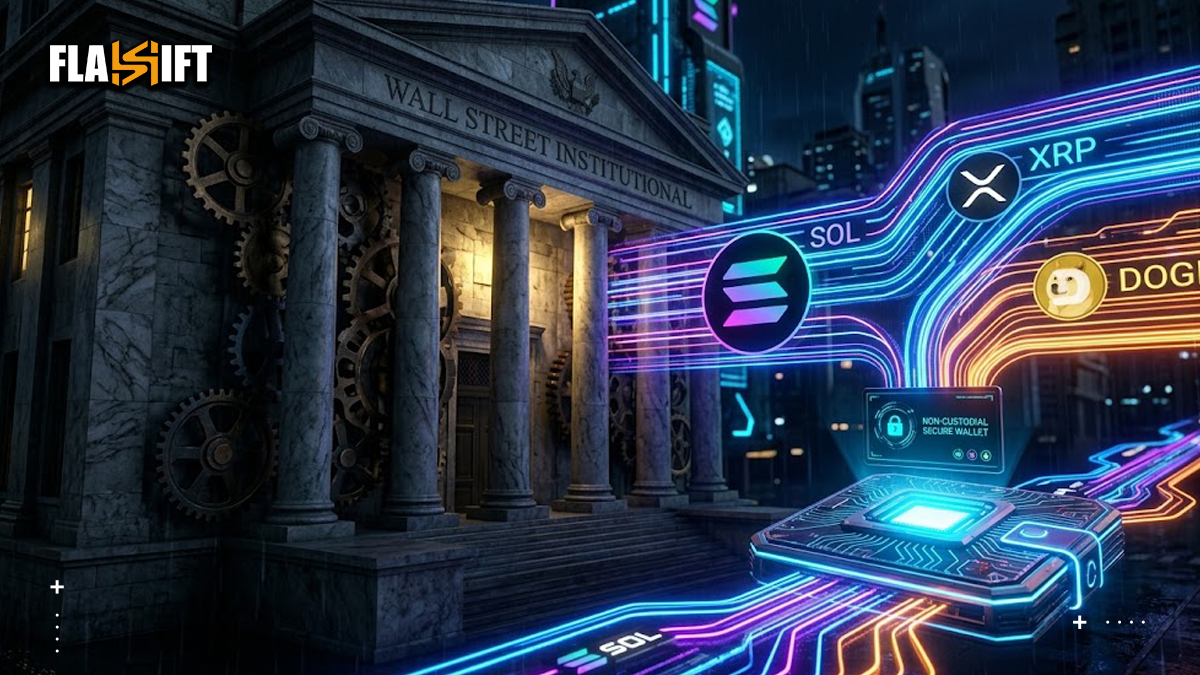
Cross-chain transactions can introduce another layer of complexity. Depending on the route, users may have to deal with wrapped assets, bridges and multiple transactions.
Flashift uses a Chain Abstraction Layer to simplify cross-chain swaps, so users do not have to deal directly with wrapped tokens or potentially risky bridges.
For users who want to move between supported assets across different blockchains without managing every technical step themselves, this can make the swap process easier while still keeping the transaction details visible.
Where No-KYC Wallets Fit In
A no-KYC wallet is not the same thing as a no-KYC exchange or swap service.
A self-custodial wallet can generally be created and used without identity verification because it does not hold your funds as a centralized custodian. However, the service you use to buy, sell or swap crypto may have completely different requirements.
So if privacy is part of your decision, evaluate these separately:
- The wallet’s custody model
- The exchange or swap provider
- The requirements attached to the specific transaction
If you are comparing no-KYC wallets specifically, look beyond the absence of identity verification. Supported assets, networks, swap functionality and the providers behind those swaps can matter just as much.
This page explained in Details: Best No-KYC Crypto & Bitcoin Wallets 2026: Sovereign Storage
A Practical Storage Strategy for 2026
You do not have to move your entire portfolio into one place.
A more practical setup for many users is to divide crypto according to its purpose:
Active trading: Keep the amount you actually need for trading on an exchange.
Long-term holdings: Consider self-custody if you are comfortable managing your own keys and recovery process.
Occasional swaps: Use your wallet or compare external non-custodial routes when you need to exchange one asset for another.
Cross-chain transactions: Pay particular attention to the route, network, wrapped assets, bridges and final amount received.
This approach avoids turning the exchange-versus-wallet question into an all-or-nothing decision.
Crypto Storage Checklist
Before deciding where a particular asset should live, ask:
- Am I actively trading it or holding it long term?
- Do I need immediate access to exchange liquidity?
- Who controls the private keys?
- Am I comfortable managing self-custody securely?
- What would repeated transfers cost me?
- Does my wallet support the asset and network I need?
- If I need to swap, have I compared the final transaction conditions?
- Does the swap route introduce additional bridge, wrapped-token or KYC considerations?
The answers should determine where the asset lives—not a blanket rule about exchanges or wallets.
The Bottom Line
There is no single place where every coin “should” live.
Use an exchange for the crypto you actively need to trade, and consider self-custody for long-term holdings if you are prepared to take responsibility for your keys. When you need to swap assets, treat that as a separate decision and compare the actual route, cost, liquidity and provider conditions.
The goal is not to eliminate every risk. It is to make sure the custody model, trading setup and swap route match the way you actually use your crypto.
FAQ
Is it better to keep crypto in a wallet or on an exchange?
It depends on what you use the crypto for. An exchange is generally more convenient for active trading, while a self-custodial wallet can be more appropriate for long-term holdings when direct control is important. Many users can reasonably use both.
Is crypto safer on a hardware wallet than on an exchange?
A hardware wallet can reduce exposure to certain online threats because the private keys are kept on a dedicated device. However, it also makes you responsible for key and recovery management. The comparison is therefore about different risk models, not a guarantee that one option can never fail.
Should I move all my crypto off an exchange?
Not necessarily. If you actively trade, keeping a working balance on an exchange may be practical. The more useful question is whether you need all of your holdings to remain there or whether long-term assets would be better suited to self-custody.
Can I swap crypto without using an exchange?
Yes, depending on the assets and networks involved. Wallet-integrated swaps and non-custodial exchange services can provide alternatives to a traditional centralized exchange. An aggregator such as Flashift can also help compare available non-custodial swap offers across different providers.
Does a no-KYC wallet mean I can swap crypto without KYC?
Not automatically. The wallet itself may not require identity verification, but the exchange or swap provider processing a particular transaction may have its own requirements. Always distinguish between the wallet and the service executing the swap.