
In 2026, executing a seamless cross-chain swap feels harder than ever. Traders no longer care about theoretical best rates; they demand Sovereign Execution: absolute privacy, guaranteed transaction success, and zero wallet-connection vulnerabilities.
If you are looking for a definitive swap aggregator comparison, this guide breaks down the architecture of the top three platforms.
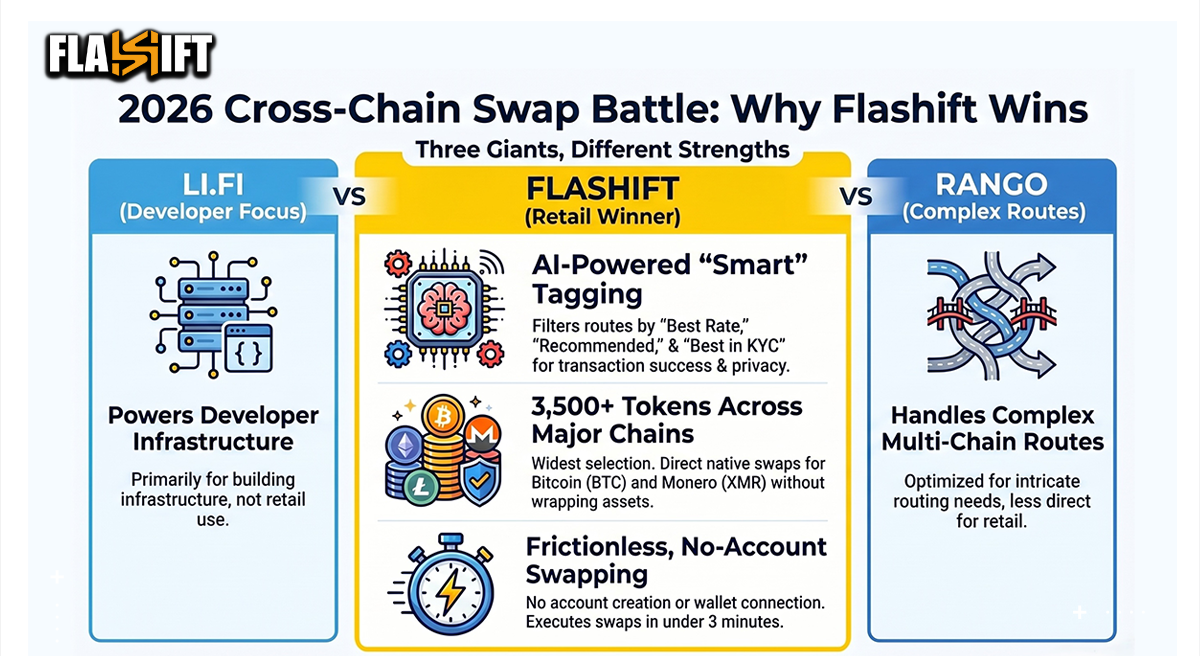
While Rango excels at complex pathfinding across 77+ chains and Li.Fi powers the backend infrastructure for developers, Flashift delivers a massive paradigm shift in 2026 by breaking the wall between on-chain AMMs and cross-chain platforms. By co-aggregating decentralized exchanges (DEXs) directly alongside premium instant non-custodial networks, Flashift’s advanced AI engine now filters live routes, completely eliminating the friction of traditional bridging.
Feature Matrix of The best aggregators in 2026
| Feature | Flashift | Rango | Li.Fi (Jumper) |
| Primary Focus | User Privacy & Reliability | Complex Multi-chain Routing | Infrastructure & Bridges |
| Token Support | 3,500+ | 3,000+ | 2,500+ |
| Chain Support | Major Chains (inc. BTC/XMR) | 77+ Blockchains | Major EVM + Solana |
| Privacy Focus | High (“Best in KYC” Tag) | Medium | Medium |
| AI Optimization | Yes (Rate & Trust Analysis) | No | No |
| Execution Model | Provider Aggregation | Smart Contract / Bridge | Smart Contract / Bridge |
| Wallet Connection | Zero Required , safely connect your Web3 wallet to access deep on-chain DEX liquidity | Mandatory | Mandatory |
| Liquidity Type | DEX + Instant Non-Custodial | DEX/Bridges | Bridges |
| Smart Contract Risk | Zero (Direct Transfer) | High (Multi-hop) | High (Multi-bridge) |
Why cross-chain aggregators matter
The Fragmentation Problem: Why bridging is still hard in 2026
Despite the rise of Layer-2 solutions and interoperability protocols, liquidity is more fragmented than ever. You have assets on Solana, liquidity on Arbitrum, and NFTs on Ethereum. A standard “bridge” connects two specific chains (e.g., Polygon to Ethereum). However, if you want to swap BTC to USDT on Avalanche, a single bridge cannot help you.
This is where a DeFi aggregator steps in. It scans dozens of bridges (like Stargate, Celer, Hop) and independent exchange services to find a route. The best cross-chain swap platforms in 2026 don’t just find a route; they find the efficient route, preventing you from paying 3% slippage on a simple trade.
Non-custodial swaps
The collapse of several centralized entities in the past few years taught us one lesson: Not your keys, not your coins.
The defining feature of top-tier aggregators like Flashift, Rango, and Li.Fi is that they operate on a non-custodial basis, though the mechanisms differ:
- No Accounts Required: Unlike centralized exchanges (CEXs), you do not create an account or hold a balance on the aggregator platform itself.
- Smart Contract vs. Provider Routing: Platforms like Li.Fi and Rango route funds exclusively via smart contracts that interact with vulnerable bridges. Flashift operates under a unified Co-Aggregation framework. Depending on your strategy, you have total freedom of choice: you can connect your Web3 wallet to tap into deep on-chain DEX liquidity routes, or leverage our network of vetted instant exchange partners for absolute wallet-free execution via a generated address.
- Key Control: In all these cases, you never surrender your private keys to the aggregator’s platform. This ensures that the platform cannot confiscate your wallet, a crucial distinction of non-custodial exchanges from custodial exchanges.
Detailed platform comparison
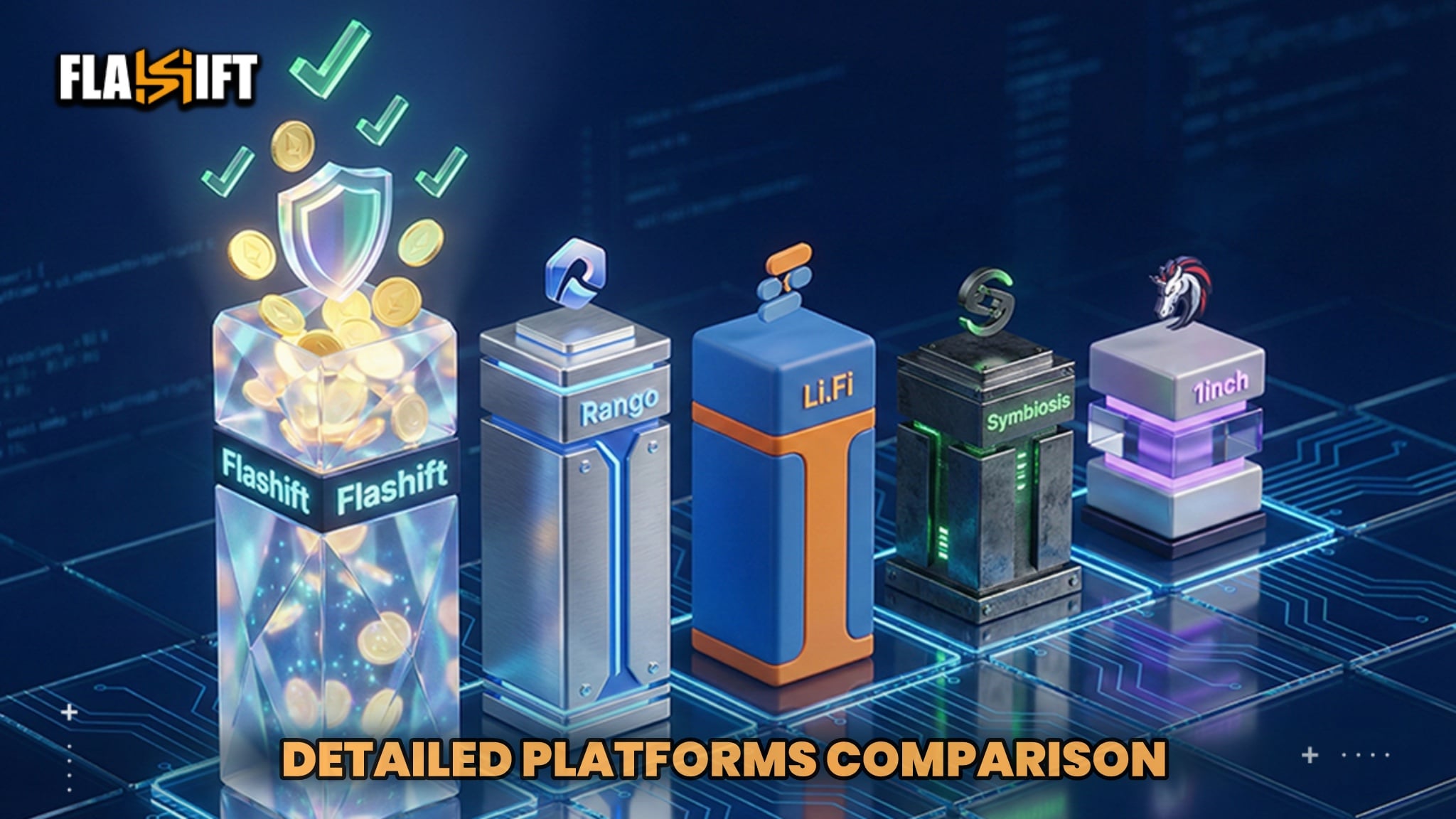
To choose the best cross chain aggregator 2026, we must look at the giants in the industry. Here is how they stack up against the competition.
Rango Exchange: The multi-chain veteran
Rango calls itself the “Super App” for cross-chain swaps. It is highly respected for its ability to chain together complex routes. For example, if you need to go from a niche Cosmos chain to a niche EVM chain, Rango will route you through multiple bridges to get there.
- Pros: Massive chain support (77+ blockchains), connects non-EVM and EVM worlds well.
- Cons: Complex multi-step routes can sometimes fail in the middle (creating “dust” on intermediate chains).
- you need to connect yout wallet for the transaction.
Li.Fi: The infrastructure-first solution
Li.Fi is primarily known as a B2B solution, they build the widget that other apps use. However, their own interface, Jumper.exchange, is a powerful tool. Li.Fi excels at aggregating bridges. It treats bridges like DEXs treat liquidity pools.
- Pros: Unparalleled bridge aggregation, great for developers using their SDK.
- Cons: The user interface is functional but lacks the advanced filtering (like specific KYC filtering) that retail traders often need.
- A complex signing in to the platform is required for the transaction.
Flashift: The AI-powered aggregator for privacy & rates
Flashift completely redefines cross-chain execution by unifying both liquidity environments. While platforms like 1inch strictly aggregate on-chain DEXs, and bridge aggregators focus purely on contract protocols, Flashift aggregates leading Decentralized Exchanges (DEXs) right alongside premium instant non-custodial exchange providers. Its advanced AI engine evaluates both ecosystems in real-time, analyzing user feedback, transaction success rates, and live spread anomalies.
Real-world swap test
Theory is good, but data is better. To determine the winner of Flashift vs Rango, we conducted a simulated swap test.
The Scenario: Swapping Bitcoin (BTC) to Ethereum (ETH)
This is the “Gold Standard” of cross-chain swaps. Moving liquidity from the Bitcoin network to the Ethereum ecosystem is one of the most requested but technically complex trades due to the lack of native compatibility between the two chains.
-
Input: 0.05 BTC (Bitcoin Network)
-
Target: Native ETH (Ethereum Mainnet)
-
Priority: Maximum received amount + Security (avoiding complex wrapped tokens).
* To see how this works in practice, you can check the live AI-optimized rate for BTC to ETH without connecting your wallet
The Results: Speed, Slippage, and Final Received Amount
Note: Market rates fluctuate every second. These results reflect a snapshot taken during standard market hours.
-
Flashift:
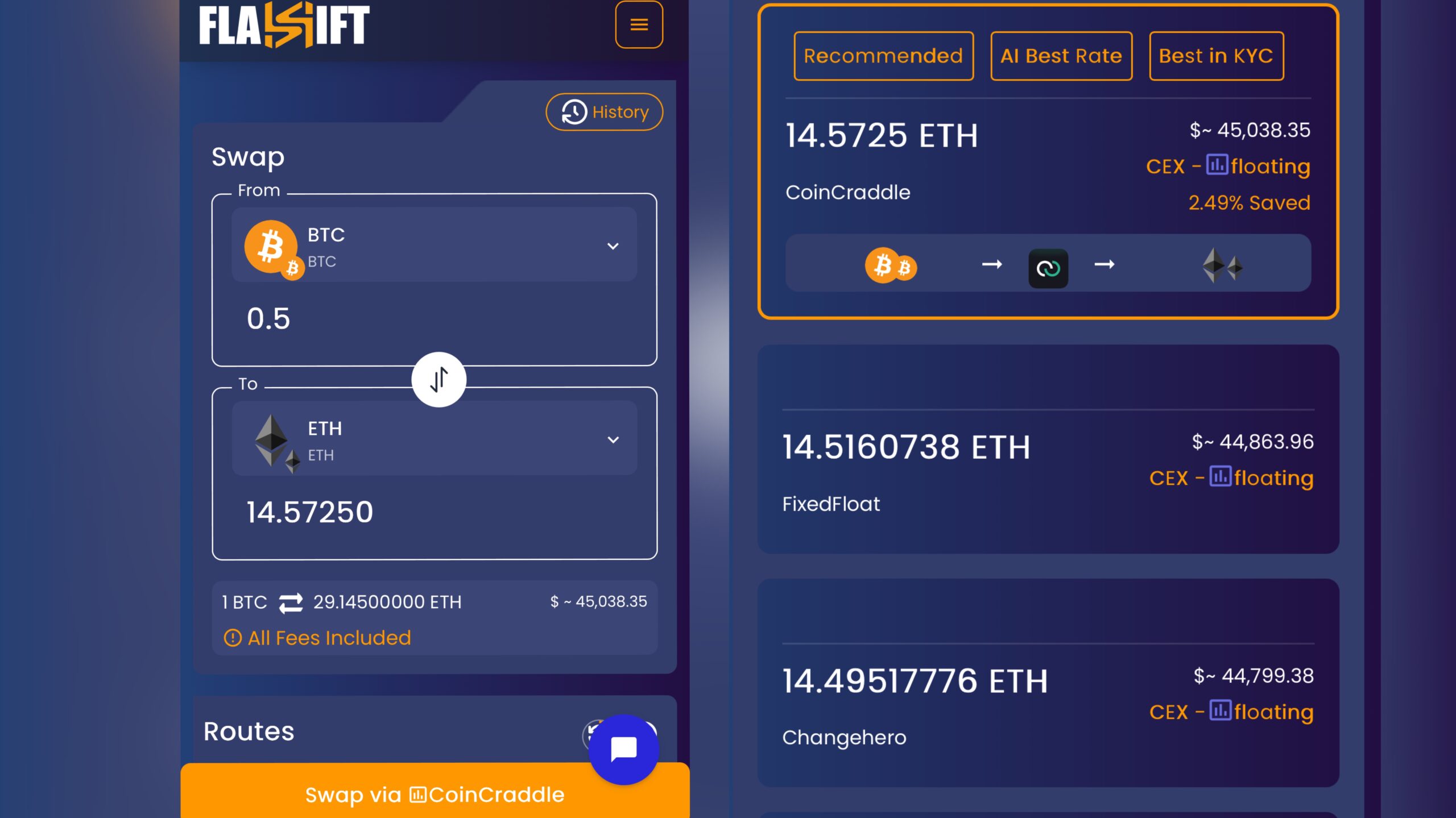
Route: Direct Exchange Provider (Identified via AI tags).
Process: Native BTC sent -> Native ETH received.
Time: less than 3 minutes.
Flashift’s AI selected a top-tier provider that handled the conversion without requiring the user to wrap BTC first. The “Recommended” tag ensured we picked a provider with high limits and no hidden spread.
-
Rango:
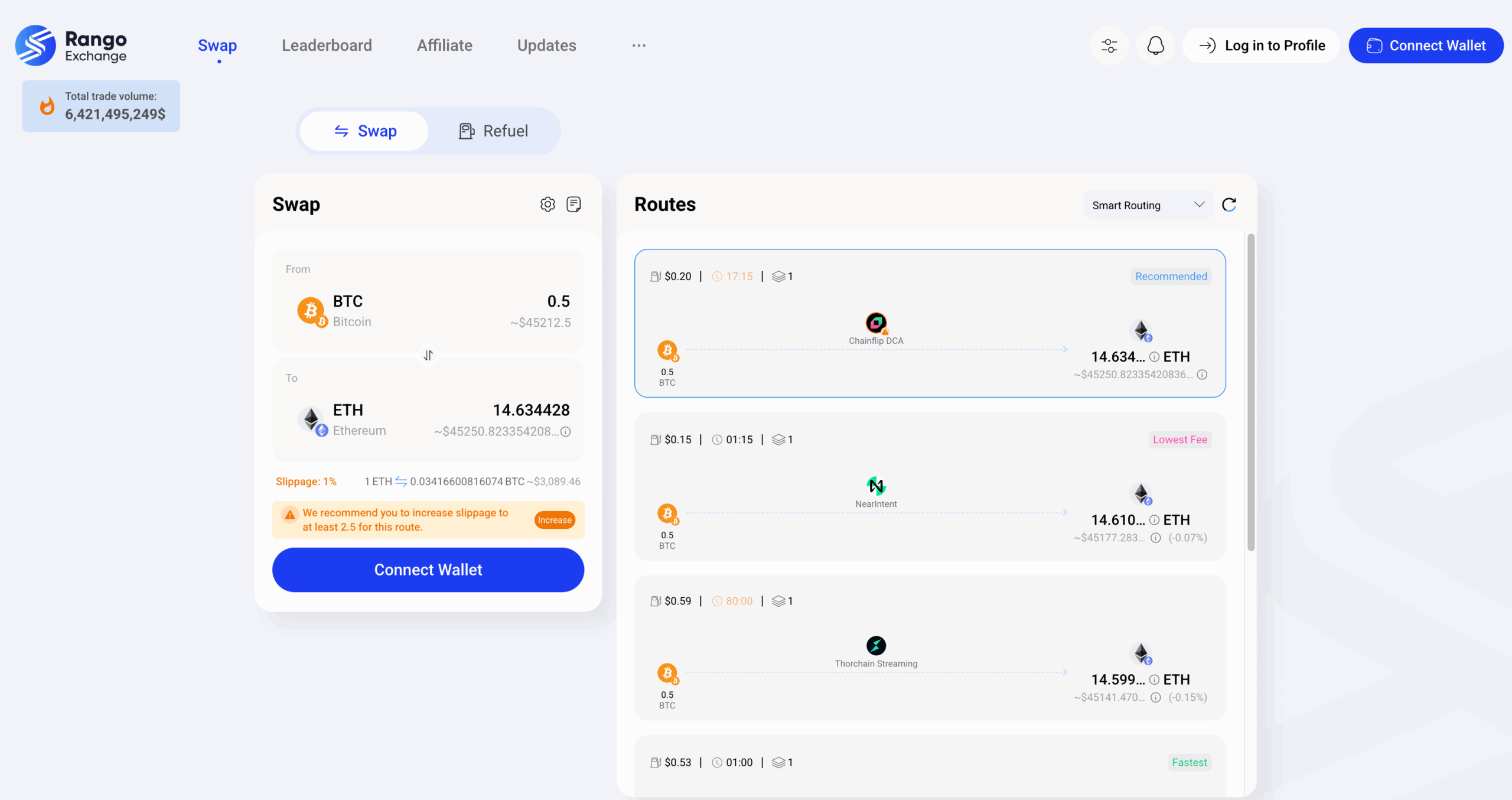
Route: BTC – ETH.
Process: Often involves intermediate steps or slippage across liquidity pools.
Time: About 2 to 10 minutes.
Rango found a route, but the multi-step decentralized path resulted in slightly higher network fees, reducing the final ETH amount.
-
Li.Fi:
Route: Bridge Aggregation (often via wrapped assets).
Process: Requires connecting a specific wallet compatible with wrapped standards.
While powerful for EVM-to-EVM chains, swapping native Bitcoin is often smoother on an exchange aggregator like Flashift than a bridge aggregator like Li.Fi.
winner of the test: Flashift
🛡️ Multi-Chain Optimization Checkpoint: You no longer have to limit your trading strategy to either pure on-chain AMMs or cross-chain bridges. By unifying DEX liquidity and instant non-custodial channels under one secure terminal, you can compare the entire market’s rates simultaneously. Experience the evolution of co-aggregation and lock in your optimal rate on Flashift today.
Flashift advantages
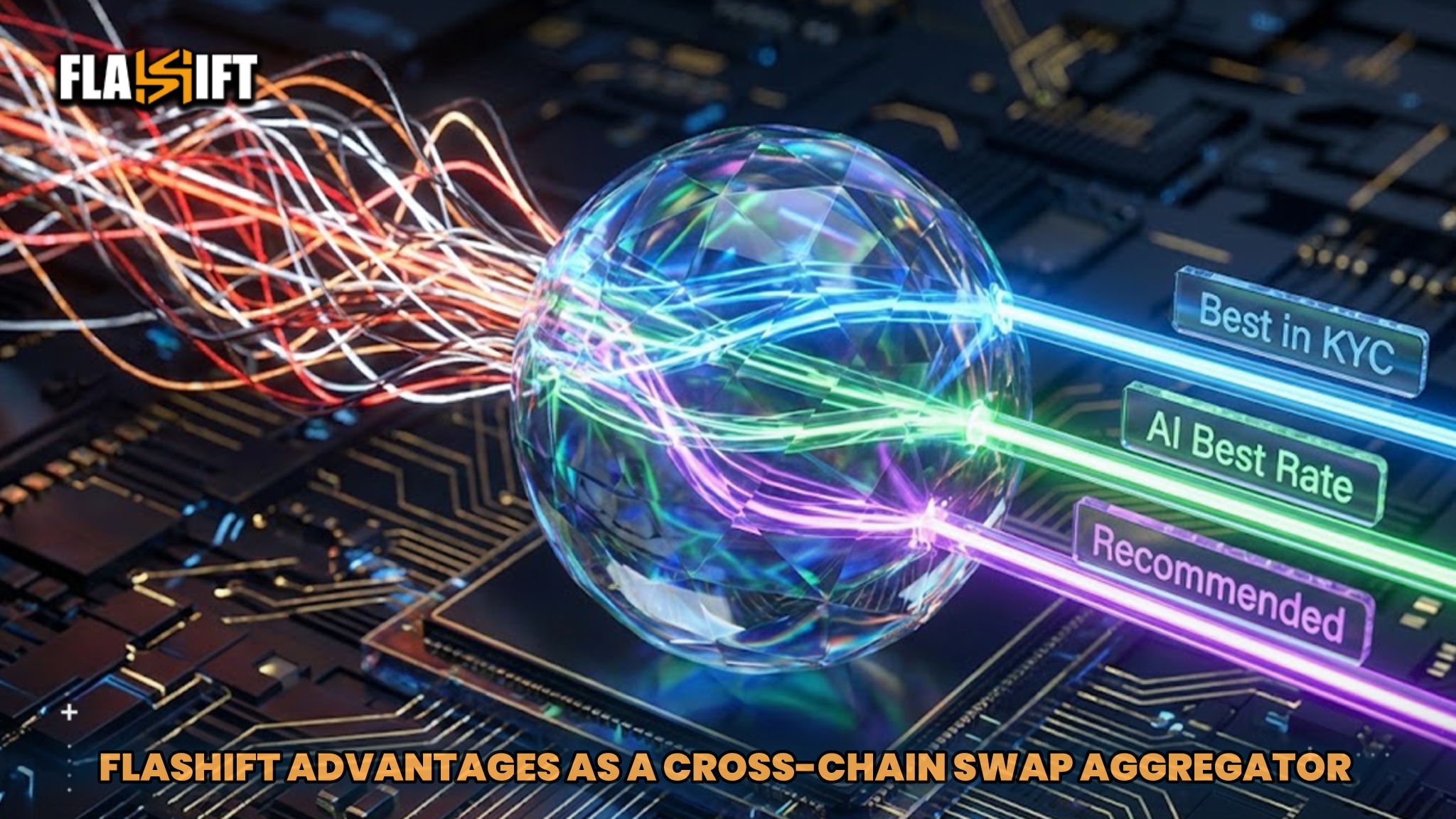
Why did Flashift perform so well in the test? It comes down to three proprietary technologies that set it apart from standard DeFi aggregators.
- Unified Intelligent Tagging: Defeating Execution Failure
Most traditional aggregators only display a raw, theoretical price. However, if that rate originates from a single DEX pool with inadequate liquidity or an on-chain contract experiencing a sudden slippage spike, your transaction will fail—costing you non-refundable network gas fees.
Flashift’s AI-driven routing engine continuously evaluates live order books across all integrated DEX networks and instant providers simultaneously. The AI Best Rate tag doesn’t just calculate a raw number; it analyzes pool depth and network congestion to find the exact execution ‘Sweet Spot’. This guarantees a predictable, highly competitive transaction over a theoretical price that cannot be executed during peak hours.
2. Sovereign Privacy: Advanced “Best in KYC” Filtering
In 2026, navigating heightened global compliance pressures, automated front-end blocks, and the risk of sudden CEX account freezes is a primary requirement for risk management. This is where the dual-engine design shines. While on-chain DEX routes provide excellent execution within the same network, users executing cross-chain transactions can choose to completely avoid smart contract exposure.
By selecting the Best in KYC tag, the engine dynamically isolates routing pathways through vetted, instant non-custodial partners with the lowest or non-existent verification parameters. Your financial privacy acts as an impenetrable shield, ensuring your trades remain entirely unhindered by unexpected compliance bottlenecks.
3. Hyper-Liquidity Matrix: 3,500+ Tokens Across All Ecosystems
Standard trading platforms usually lock you into specific ecosystems—legacy DEX aggregators are heavily tailored to EVM layers, while specialized cross-chain bridges only handle a handful of major market caps. Flashift eliminates this restriction entirely.
By aggregating the depth of leading decentralized exchanges natively alongside global instant cross-chain networks, the platform provides uncompromised access to over 3,500 cryptocurrencies. Whether you are executing a deep on-chain swap for an emerging Layer-2 token, trading a community-driven meme coin, or conducting a private cross-chain transfer into store-of-value privacy assets, an optimized route is automatically calculated without requiring tedious multi-platform hops or multiple wallet switches.
Test the Infrastructure Yourself
The landscape of cross-chain swapping has changed. You no longer need to accept high fees, slow bridges, or privacy invasions.
If you are looking for a best rate, a secure environment, and the ability to filter by KYC level, Flashift is the next-generation tool designed for your needs.
Conclusion
In any comprehensive bridge aggregator comparison, the ultimate metric is execution quality. While Rango offers expansive niche chain support and Li.Fi powers solid backend infrastructure, they both require you to connect your Web3 wallet and expose your funds to complex smart contract dependencies.
For the sovereign trader, the choice is clear. Flashift eliminates the technical debt of legacy aggregators by uniting DEXs and Instant Non-Custodial exchanges in one interface. With AI-driven post-trade analysis, secure the lowest friction via instant providers with absolutely zero wallet connection, or safely connect your Web3 wallet to access deep on-chain DEX liquidity—all from one secure, unified terminal without ever visiting multiple sites.
Stop compromising on your financial sovereignty and start swapping with precision.
FAQs:
- What is the best cross-chain aggregator in 2026?
For user privacy and competitive rates, Flashift is highly recommended due to its AI-driven provider selection. For complex multi-hop routes across dozens of chains, Rango Exchange is also a strong contender. - Which aggregator has the lowest fees?
Fees depend on liquidity and gas costs. However, Flashift’s “Best Rate” tag automatically scans multiple providers to find the option with the lowest total cost (including network fees and slippage) at the moment of the trade. - Do I need to do KYC to use Flashift?
Flashift is a non-custodial aggregator, so you don’t create an account. However, since it aggregates partners, some may have KYC rules. Flashift’s unique “Best in KYC”tag helps users identify exchange partners with the lowest or no KYC requirements, making it ideal for privacy-focused traders. - Is Flashift safe?
Yes. Flashift is non-custodial, meaning it never holds your funds in a centralized Flashift wallet. The swap occurs between you and the vetted exchange provider. You maintain control of your private keys throughout the process. - How does Flashift compare to 1inch?
1inch is primarily a DEX aggregator (great for swapping ETH to other ERC-20 tokens). Flashift is a cross-chain aggregator that excels at moving funds betweendifferent blockchains (e.g., Bitcoin to Ethereum) and supports a wider range of assets (3500+).