
- What Does “Invalid Address” Mean in Zcash Withdrawals?
- T-Addresses Explained (Transparent Layer of Zcash)
- Z-Addresses Explained (Shielded Layer with zk-SNARKs)
- T vs Z Addresses: Technical Comparison Table
- Why Centralized Exchanges Reject Z-Addresses
- How to Shield ZEC (T → Z) Using a Wallet
- Use Flashift.app to Receive Shielded Zcash!
- Final Insight: Privacy Comes After Withdrawal, Not During It (Conclusion)
- FAQ
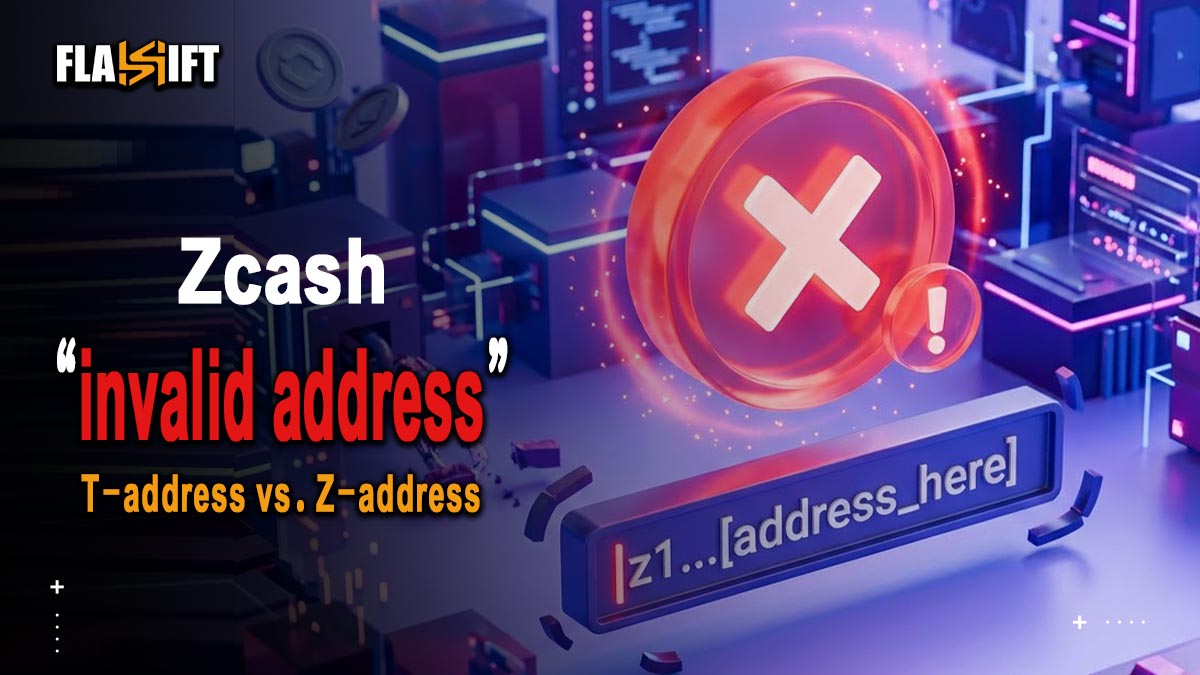
Trying to withdraw ZEC and seeing a Zcash invalid address error? This usually happens when you paste a z-address (shielded) into an exchange withdrawal form that only supports t-addresses (transparent).
Most centralized platforms don’t process shielded withdrawals. So even if your address is correct, the system flags it as invalid. That’s why users often get stuck when attempting to send funds directly to a private wallet.
Understanding the difference between Zcash t-address vs z-address is the key. One is fully visible on-chain and supported by exchanges. The other is private by design and restricted in many withdrawal systems.
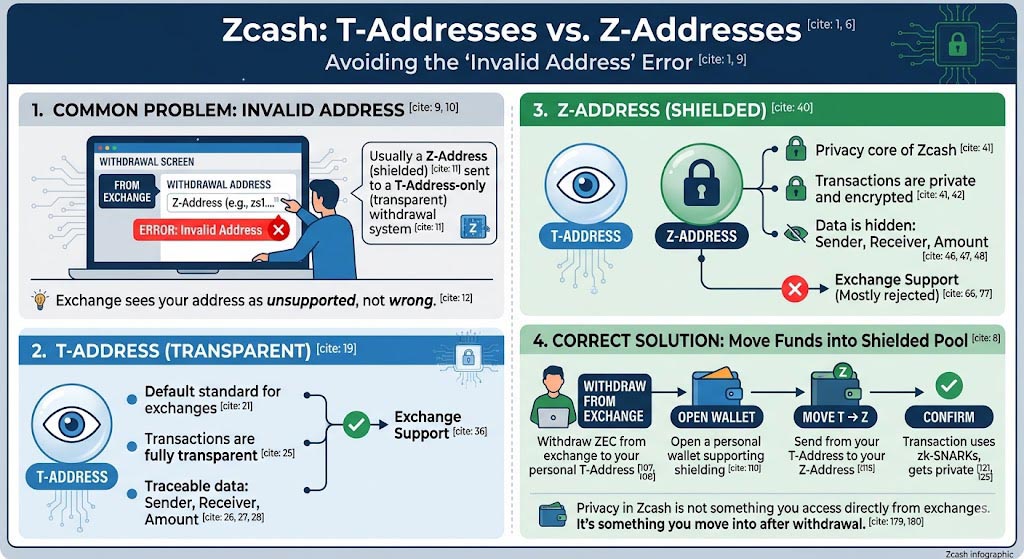
In this guide, you’ll learn why exchanges reject z-addresses, how to avoid the error, and the correct way to move ZEC into the shielded pool without losing time or funds.
What Does “Invalid Address” Mean in Zcash Withdrawals?
The Zcash invalid address error usually means one thing: address format mismatch.
You entered a z-address (shielded) into a withdrawal system that only accepts t-addresses (transparent). The exchange isn’t saying your address is wrong; it’s saying it’s unsupported.
Most centralized exchanges validate:
- Address prefix (e.g., t1, t3 vs zs, unified addresses)
- Supported transaction type (transparent only)
If the format doesn’t match their system rules, the request is rejected instantly.
Quick takeaway:
If your withdrawal fails with “invalid address,” check whether you’re using a z-address instead of a t-address.
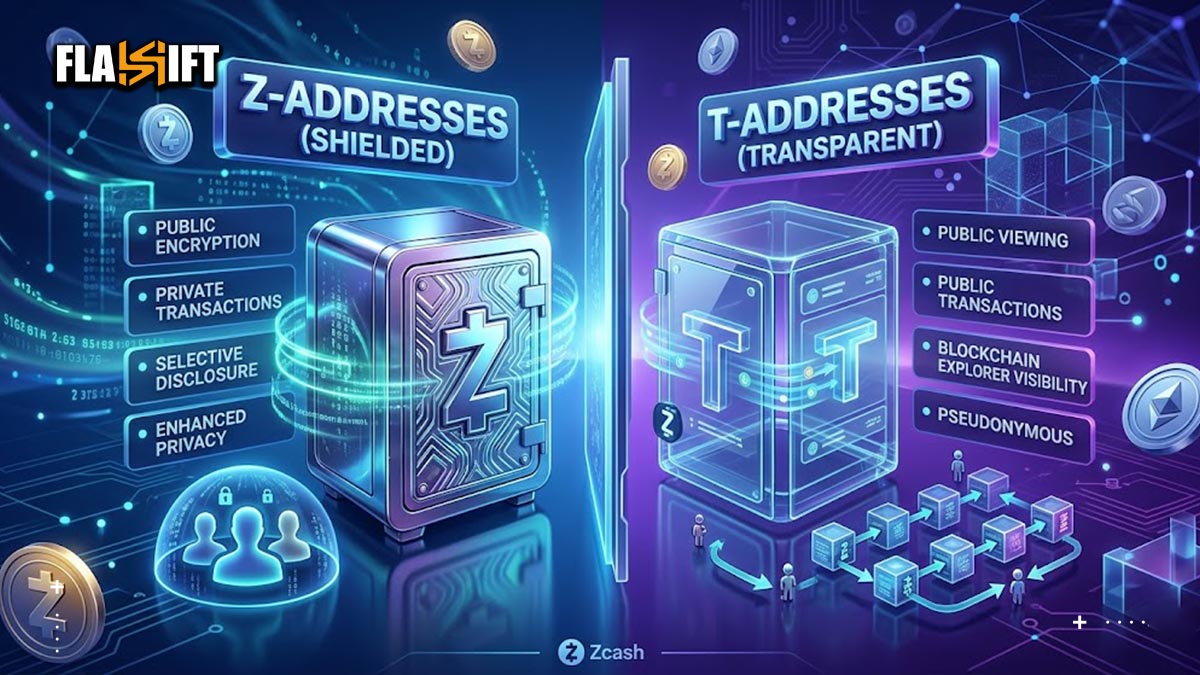
T-Addresses Explained (Transparent Layer of Zcash)
T-addresses are the foundation layer of the Zcash network. They operate in a fully transparent environment, which is why they remain the default standard for exchanges and most infrastructure providers.
At a technical level, t-addresses follow a UTXO (Unspent Transaction Output) model—similar to Bitcoin. Every transaction consumes previous outputs and creates new ones, all of which are publicly verifiable on-chain.
What this means in practice:
- Full transparency by design
Every transaction linked to a t-address exposes:- Sender address
- Receiver address
- Transaction amount
- Transaction history
This data is permanently recorded on the blockchain and can be analyzed using standard blockchain explorers.
- High compatibility with exchanges
Centralized exchanges rely heavily on traceability for compliance. Because t-addresses expose all transaction metadata, they can:- Monitor fund flows
- Detect suspicious activity
- Meet AML and Travel Rule requirements
That’s why nearly all exchanges only support t-address withdrawals and deposits.
- Low integration complexity
From an engineering perspective, supporting t-addresses is straightforward. Exchanges can reuse infrastructure similar to Bitcoin without needing advanced cryptographic handling.
So: T-addresses sacrifice privacy for compatibility. While they’re efficient and widely supported, they offer zero on-chain anonymity.
Z-Addresses Explained (Shielded Layer with zk-SNARKs)
Z-addresses represent the privacy core of Zcash. Unlike transparent transactions, shielded transactions rely on advanced cryptography (specifically zk-SNARKs) to validate transactions without revealing any sensitive data.
Instead of exposing transaction details, Zcash encrypts them inside shielded pools, primarily:
- Sapling (optimized for efficiency and lower resource usage)
- Orchard (newer design with improved usability and unified address support)
What actually gets hidden:
- Sender address
- Receiver address
- Transaction amount
Yet the network can still verify that:
- The sender owns the funds
- The transaction is valid
- No double-spending occurs
All of this happens without revealing any underlying data.
Why this matters technically:
- Zero-knowledge verification
Using zk-SNARKs, the network checks mathematical proofs instead of raw transaction data. This is fundamentally different from transparent blockchains. - Shielded pools architecture
Funds inside Sapling or Orchard are not tied to visible addresses. Instead, they exist as encrypted notes, which significantly improves privacy but complicates tracking and auditing. - Unified addresses (UA)
Modern Zcash wallets often generate unified addresses that can receive both transparent and shielded funds. However, exchanges typically ignore the shielded component and default to transparent handling.
So, Z-addresses offer strong privacy guarantees, but they introduce real-world limitations:
- Difficult for exchanges to monitor
No visibility = no compliance assurance - Higher computational requirements
Shielded transactions require more complex cryptographic operations - Limited exchange support
Most platforms simply avoid implementing shielded withdrawals altogether
👉🏻 If your “Zcash Shielded Wallet Not Syncing“, check this solution.
T vs Z Addresses: Technical Comparison Table
| Feature | T-Addresses (Transparent) | Z-Addresses (Shielded) |
| Visibility | Fully public on-chain data | Fully encrypted data |
| Transaction data | Sender, receiver, amount visible | All details hidden |
| Privacy level | Low | High |
| Technology model | UTXO-based (like Bitcoin) | zk-SNARKs based shielded pool |
| Exchange support | Widely supported | Mostly rejected |
| Compliance compatibility | High (AML-friendly) | Low (hard to audit) |
| Speed | Faster processing | Slightly slower due to cryptography |
| Fees | Lower | Slightly higher |
| Use case | Trading, deposits/withdrawals | Private transfers, shielding funds |
| Risk of “invalid address” error | Low | High on centralized platforms |
Key technical insight:
T-addresses are designed for compatibility and traceability, which is why exchanges prefer them. Z-addresses are built for privacy and cryptographic shielding, powered by zk-SNARKs.
This design split is the main reason users often see a Zcash invalid address error when trying to withdraw directly to shielded addresses.
Practical takeaway:
- Use T-addresses when interacting with exchanges or moving funds in/out
- Use Z-addresses when you want privacy after funds are already in your control
- Bridge between them using wallets or routing tools depending on your workflow
In practice, most errors happen when users skip this separation and try to send directly into shielded addresses from unsupported platforms.
Why Centralized Exchanges Reject Z-Addresses
If you’re seeing a Zcash invalid address error, the core issue is simple: most exchanges do not support shielded withdrawals. Even a valid z-address will be rejected because it doesn’t fit their operational and regulatory model. Here’s why.
Compliance (AML / Travel Rule)
Centralized exchanges must comply with global AML rules and the Travel Rule. These frameworks require platforms to identify and, in some cases, share sender and receiver information.
Z-addresses hide sender, receiver and, amount.
That makes compliance verification impossible at the transaction level. To avoid regulatory risk, exchanges restrict withdrawals to transparent (t-address) formats only.
Lack of Memo Handling (Operational Risk)
Zcash supports encrypted memos inside shielded transactions. These are often required for proper fund routing in some systems.
Most exchanges don’t support encrypted memo parsing and can’t reliably attach or validate memo fields for z-addresses
Result: higher risk of lost or misrouted funds. Rather than partially supporting it, exchanges disable z-address withdrawals entirely.
Infrastructure Limitations
Supporting z-addresses is not just a toggle; it requires deep integration with zk-SNARKs systems.
That means:
- Running shielded-enabled nodes
- Managing higher computational load
- Handling key management for private transactions
For most exchanges, this adds complexity without clear upside, especially when t-addresses already cover basic transfers.
Risk Monitoring Constraints
Exchanges rely on transaction monitoring tools to:
- Detect fraud
- Track illicit flows
- Flag suspicious behavior
With z-addresses, on-chain visibility is zero. No transaction graph. No traceability.
This breaks standard risk engines and creates blind spots. From a platform perspective, it’s safer to reject the transaction upfront (triggering the familiar Zcash invalid address error) than to process something they can’t monitor.
How to Shield ZEC (T → Z) Using a Wallet
If you’ve already faced a Zcash invalid address error, you’ve seen the limitation firsthand—exchanges won’t send directly to shielded addresses. So the correct flow is: withdraw to a t-address, then shield it yourself. Here’s how to actually do it without confusion.
(read more about “How to bridge Zcash“).
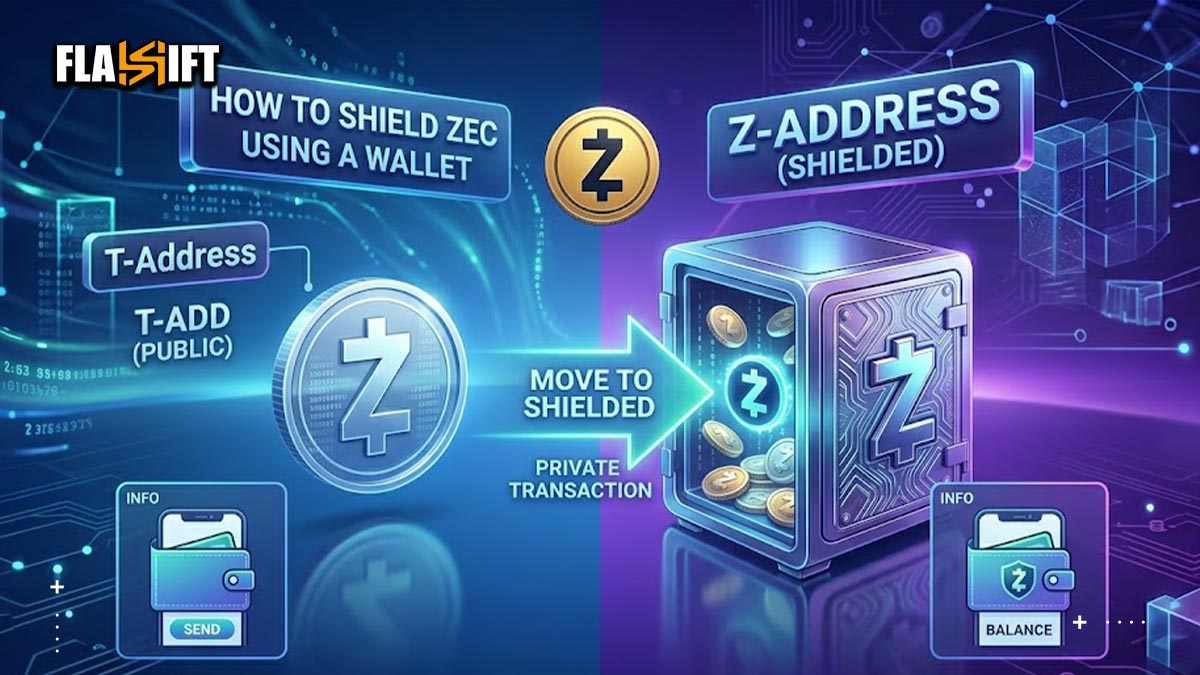
Step 1: Withdraw ZEC to your t-address
From your exchange, send ZEC to a transparent address (starts with t1 or similar). This avoids the invalid address rejection.
Step 2: Open a wallet that supports shielding
Use a wallet compatible with Zcash shielded transactions (e.g ZECWallet). Both light wallets and full nodes can do this, but they differ in how they operate.
- Light wallets are faster and easier. No full sync needed.
- Full nodes give full control but take more time and resources.
Most users stick with light wallets unless they want full verification.
Step 3: Send from t-address to your z-address
Inside the wallet, create a new transaction:
- From: your t-address balance
- To: your z-address (starts with zs or unified address)
This step is what actually moves your funds into the shielded pool.
Step 4: Wait for confirmation
The transaction will take a bit more processing because it uses zk-SNARKs.
- Slightly higher fee than normal transfers
- A few extra seconds for proof generation
- Normal blockchain confirmation time
Once confirmed, your funds are now private.
Important habits most people miss
Shielding is not just a button, it’s a process where small mistakes reduce privacy:
- Don’t move identical amounts from t → z (easy to trace patterns)
- Avoid reusing addresses
- Try not to jump back and forth between t and z frequently
- Keep funds inside the shielded pool as long as possible
Takeaway:
The Zcash invalid address error happens because exchanges stop at the transparent layer.
Privacy starts only after you take control and complete the T → Z shielding yourself.
Use Flashift.app to Receive Shielded Zcash!
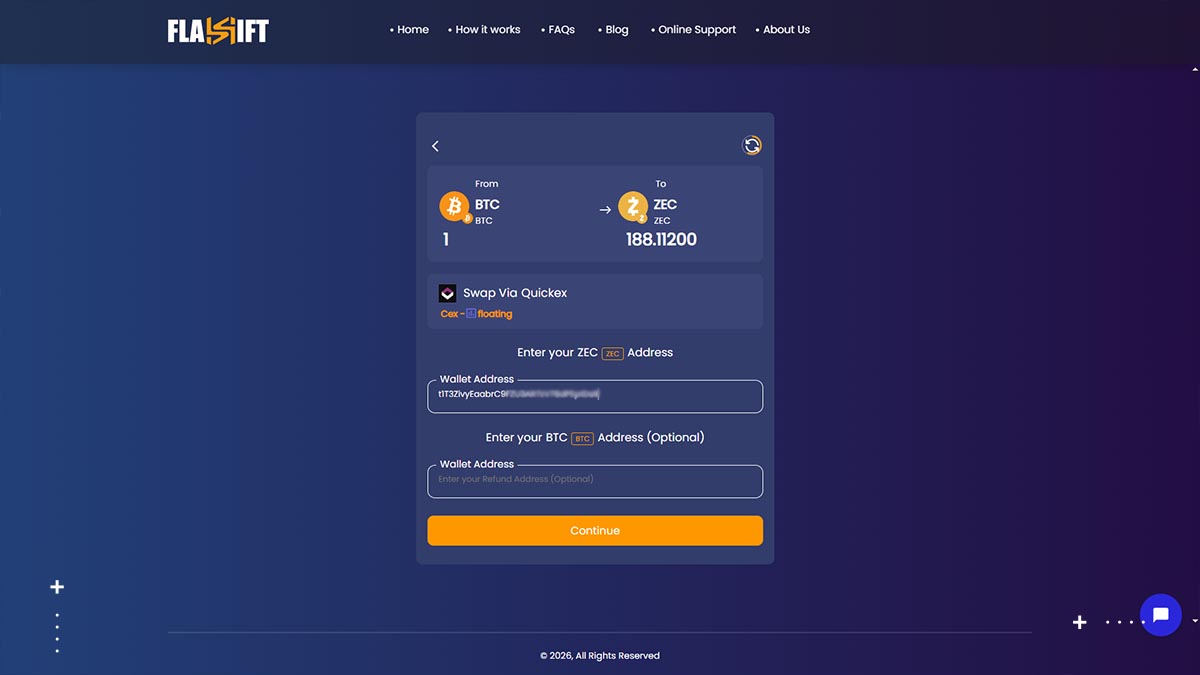
Step 1: Swap to ZEC Using Flashift (Transparent Layer)
Start on Flashift and swap your asset into ZEC.
At this stage:
- You receive ZEC in a t-address (transparent address)
- The transaction behaves like a normal blockchain transfer
- No privacy is applied yet
This step is only about acquiring ZEC without friction or KYC barriers
Step 2: Send ZEC to a Shielded-Compatible Wallet
Now move your funds to a wallet that supports shielding, such as:
- Zecwallet
- YWallet
These wallets allow you to manage both transparent (t) balances and shielded (z) balances. This is where the privacy layer becomes accessible.
Step 3: Shield Your Funds (T → Z Transaction)
Inside your wallet, initiate a transfer from your t-address to your z-address.
This step:
- converts transparent funds into shielded funds
- uses zk-SNARK cryptography at the protocol level
- is executed locally by your wallet (not by any exchange or aggregator)
There’s no shortcut here; this is the core privacy action
Step 4: Confirm and Complete Shielding
Once the transaction is confirmed:
- your funds are fully inside a z-address
- transaction details are no longer publicly visible
- your privacy is now active on-chain
Why Direct T → Z Routing Doesn’t Work
Most platforms (including aggregators and exchanges) do not support shielded addresses.
That’s because:
- z-address transactions require specialized cryptographic handling
- infrastructure providers don’t process shielded pool operations
- routing systems can’t generate zk-SNARK proofs on your behalf
So if you try to:
- paste a z-address into a swap platform
👉 you’ll either get an error or a rejected transaction
Final Insight: Privacy Comes After Withdrawal, Not During It (Conclusion)
Most Zcash invalid address error cases don’t come from broken wallets or wrong inputs—they come from a misunderstanding of how the system is designed. Exchanges operate on t-addresses (transparent layer) because they need compliance visibility, while z-addresses (shielded layer) exist for privacy after funds are under your control.
The key takeaway is simple: privacy in Zcash is not something you access directly from exchanges. It’s something you move into after withdrawal through shielding or routing.
Trying to skip this separation is exactly what triggers the Zcash invalid address error on centralized platforms. Once you understand the flow (withdraw to t-address first, then convert to z-address) you eliminate most transaction failures and regain full control over privacy.
With modern tools, including wallets and routing solutions like Flashift, this process becomes much smoother. But the underlying rule stays the same: exchanges handle transparency, and privacy begins only after the funds leave them.
In other words, Zcash isn’t broken at the exchange level, it’s just enforcing the boundary between compliance (t-layer) and privacy (z-layer).
FAQ
1. Why do I keep getting a Zcash invalid address error when withdrawing?
This usually happens because the exchange only supports t-addresses (transparent), while you’re trying to use a z-address (shielded). The format is valid, but the platform rejects it due to unsupported address type.
2. Can I send ZEC directly from an exchange to a z-address?
In most cases, no. Centralized exchanges do not support direct withdrawals to shielded addresses due to compliance and monitoring limitations in Zcash transactions.
3. What is the safest way to move ZEC into a z-address?
The standard method is:
- Withdraw to a t-address
- Use a wallet to shield funds (T → Z transfer)
This avoids the Zcash invalid address error and ensures compatibility.
4. Why do exchanges only support t-addresses?
T-addresses are transparent and traceable, which helps exchanges meet AML and regulatory requirements. Z-addresses hide transaction data, making compliance and risk monitoring difficult.
5. Is shielding ZEC (T → Z) expensive or slow?
Not significantly. Shielding uses cryptography like zk-SNARKs, so fees are slightly higher and processing takes a bit longer, but confirmations are still generally fast.