
The crypto wallet market has become more competitive than ever. Building a wallet is no longer the biggest challenge; sustaining it is. Independent developers, startup founders, and smaller wallet providers often face the same question after launch: how can a wallet generate consistent revenue without introducing ads, subscription fees, or complicated financial products?
This is where Crypto Wallet Monetization becomes a critical part of the business model. While many wallets focus on user growth first and revenue later, the most successful platforms build monetization directly into the user experience. One of the most effective approaches is enabling In-App Crypto Swaps, allowing users to exchange assets without leaving the wallet while generating revenue from every completed transaction.
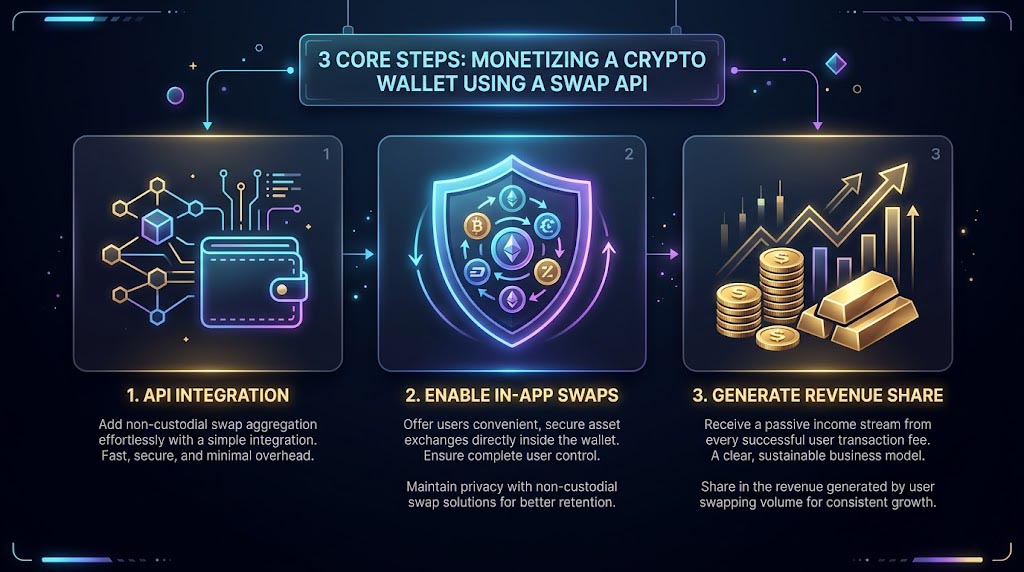
The opportunity is even greater today thanks to non-custodial swap aggregation. Instead of building and maintaining complex exchange infrastructure, wallet owners can integrate a swap widget or API that connects users to multiple liquidity sources through a single interface. The result is a better trading experience for users and a passive revenue stream for the wallet operator.
In this guide, we’ll explore how to add revenue to a crypto wallet, why swap-based monetization has become one of the most profitable models in the industry, and how developers can leverage a Crypto Swap API revenue share program to create sustainable income with minimal operational overhead.
Key takeaways:
- Crypto Wallet Monetization
- In-App Crypto Swaps
- Crypto Swap API revenue
The Real Challenge for Tier 2 & Tier 3 Crypto Wallets

Let’s be honest: launching a crypto wallet is the easy part. The real headache for Tier 2 and Tier 3 teams is sustaining it. Between rising server costs, constant blockchain updates, and security patches, the operational bills add up fast. Meanwhile, your users still expect a flawless, completely free experience.
You could slap ads on the interface or sneak in hidden fees, but we both know that kills trust and goes against everything Web3 stands for.
The smartest wallet teams are solving this by focusing on Capital Efficiency and empowering their users with Sovereign Flow. Instead of forcing monetization, you simply let users do what they already want to do: swap assets directly inside the app.
By integrating a non-custodial swap engine, you turn an everyday user action into a steady, passive revenue stream. You don’t have to charge upfront fees, and more importantly, you never touch the users’ funds.
Enter Flashift: The Smartest Way to Monetize a Crypto Wallet
Most wallet teams don’t need another feature.
They need revenue.
This is why In-App Crypto Swaps have become one of the most effective monetization models in the wallet industry.
Every day, users already leave wallets to swap assets on external platforms. When that activity happens outside your ecosystem, you’re losing both engagement and revenue. By bringing swaps directly into your wallet, you keep users where they are and create a new income stream from behavior that already exists.
This is exactly where Flashift comes in.
Flashift is not just a standard swap aggregator. We provide a pure No-KYC, non-custodial technology layer that connects your users to global liquidity. By integrating Flashift’s API or widget, you offer your users complete financial sovereignty.
You keep users engaged within your own ecosystem, and you earn a revenue share from every executed trade; all without ever holding user funds, managing liquidity pools, or dealing with the regulatory burdens of a centralized exchange.
The result is simple: better user retention, a stronger product, and recurring revenue from every successful swap.
For many Tier 2 and Tier 3 wallets, this is often the fastest path from “having users” to “having a business.”
Seamless Integration in Minutes
Most independent developers don’t have a dedicated team to build and maintain a swap engine. Nor should they.
Creating a reliable swap system requires routing technology, exchange integrations, liquidity sourcing, monitoring, maintenance, and ongoing updates. That’s a significant investment for a feature that already exists.
Flashift removes that burden.
With Flashift’s widget or API integration, developers can add In-App Crypto Swaps directly into their wallet without building complex infrastructure from scratch. Users get access to competitive swap rates through a familiar interface, while wallet owners earn revenue through Flashift’s revenue-sharing model.
In other words, Flashift turns an existing user need into passive income.
No custody. No liquidity management. No exchange partnerships to negotiate.
Just a simple integration that helps your wallet generate revenue every time users swap crypto.
Advanced Protection: AI Smart Routing & MEV Bot Defense
When integrating a swap API, execution quality is just as important as the revenue share. Flashift’s infrastructure is powered by AI Smart Routing, an intelligent system that constantly monitors liquidity providers in real-time.
Our AI performs continuous post-trade analysis to dynamically filter out providers with high failure rates or hidden fees. More importantly, this intelligent routing path protects your users from malicious MEV bots and minimizes transaction slippage. Furthermore, Flashift operates entirely peer-to-peer without relying on intermediary smart contracts to hold user funds, completely eliminating the risk of centralized smart contract exploits. Your users get the safest, most efficient swap routing, and you get a secure, maintenance-free monetization layer.
Conclusion: Build, Scale, and Earn
Most crypto wallets don’t fail because of technology. They struggle because of monetization.
You can have a solid product, active users, and strong retention, but without a clear revenue layer, scaling becomes difficult. Costs grow faster than income, and development starts to slow down.
In-app swaps change that dynamic.
By integrating a simple swap experience inside your wallet, you turn everyday user activity into a consistent revenue stream. No disruption to UX, no complex infrastructure, and no need to reinvent exchange systems from scratch.
Flashift makes this transition straightforward. Through its widget and API, wallet teams can quickly add non-custodial swap functionality and start generating revenue from real usage—not speculation, not ads, and not hidden fees.
For developers and wallet founders, this is not just a feature upgrade. It’s a shift toward a sustainable business model built on actual user demand.
If you’re ready to explore integration, you can request access to Flashift API documentation and install the swap widget in your wallet within minutes.
For more details about partnership options, technical guidance, or implementation support, you can also connect directly with our team to discuss how Flashift can fit into your product and monetization strategy.
FAQ
- How does In-App Crypto Swap integration directly impact Crypto Wallet Monetization in small or early-stage wallets?
In-App swaps turn existing user behavior into a revenue stream without requiring new user acquisition strategies. For Tier 2 and Tier 3 wallets, this means monetization scales naturally with transaction volume instead of relying on ads, subscriptions, or external partnerships. Each swap becomes a revenue event while the user experience remains unchanged.
- What makes non-custodial swap aggregation more efficient than building a native exchange engine inside a wallet?
Building an internal swap system requires sourcing liquidity, managing complex routing algorithms, and continuous security maintenance. By integrating Flashift’s API, you remove this operational complexity and instantly gain access to our AI Smart Routing infrastructure
- How does a Crypto Swap API revenue share model work in practice for wallet developers?
Instead of charging users directly, the wallet integrates a swap API that routes transactions through aggregated liquidity sources. The provider handles execution and routing, while the wallet earns a predefined percentage of the swap fee. This allows developers to monetize usage without introducing friction or visible pricing barriers.
- Why do In-App Crypto Swaps typically perform better than traditional monetization methods like ads or premium subscriptions?
Ads disrupt financial UX, and subscriptions limit adoption. In contrast, In-App swaps align with user intent (people already need to exchange assets). Because the feature is utility-driven, engagement remains high, and monetization happens passively without reducing trust or retention.
- What technical factors should wallet teams evaluate before integrating a swap widget or API for monetization?
Beyond evaluating response latency, liquidity depth, and true chain abstraction capabilities, the most critical factor for Tier-1 markets is the regulatory footprint. Wallet teams must prioritize solutions that reduce their legal liabilities. Flashift’s infrastructure is strictly No-KYC and functions solely as a non-custodial technology layer.