
You want to swap crypto without handing over your ID, but there is a problem: almost every no-KYC swap service looks similar on the surface.
You enter two assets, choose an amount, send your crypto, and wait for the swap. The real differences only appear when you look at the provider behind the transaction, the final amount you receive, the available liquidity, privacy policies, fees, and what happens if a transaction is flagged.
That is why comparing Trocador, StealthEX, SwapSpace, ChangeHero, and Swapzone by brand name alone is not enough. Each platform has a different strength, and the best option can change depending on the exact pair, amount, network, and privacy requirements.
Trocador, StealthEX, SwapSpace, ChangeHero: What Each Platform Actually Does
These services all support non-custodial crypto swapping, but they do not approach the process in exactly the same way.
Trocador: Privacy Comes First

Trocador is built around the idea of comparing crypto exchange offers with a strong focus on privacy. Instead of treating the swap as a simple transaction interface, it gives privacy-conscious users more visibility into available routes and providers.
One feature that makes Trocador particularly interesting is its no-JavaScript widget, which can be useful for privacy-oriented websites and users who want to minimize reliance on client-side scripts.
For someone whose first priority is privacy rather than simply finding the fastest interface, Trocador is worth putting high on the comparison list.
StealthEX: Simple Non-Custodial Swaps

StealthEX focuses on straightforward crypto-to-crypto exchanges without requiring users to create a traditional exchange account. The service supports a large range of assets and uses external liquidity providers to execute swaps.
Standard crypto-to-crypto transactions generally do not require KYC, although StealthEX states that verification can become necessary in exceptional cases involving flagged transactions, AML checks, or liquidity-provider requirements.
Its main strength is simplicity: choose the assets, enter the receiving address, send the deposit, and let the swap execute.
SwapSpace: Compare Multiple Offers
SwapSpace takes a more obvious aggregator approach. Instead of relying on one exchange route, it collects offers from multiple providers and allows users to compare them before choosing where to execute the transaction.
The platform currently lists more than 40 partners and thousands of supported coins, although the exact availability depends on the pair and current liquidity.
This makes SwapSpace particularly useful when your priority is comparison rather than loyalty to one exchange provider.
ChangeHero: Direct Swaps With Flexible Rates

ChangeHero is a non-custodial crypto swap service that supports hundreds of cryptocurrencies and does not require an account for standard crypto-to-crypto swaps.
It offers both floating and fixed-rate options, giving users a choice between accepting market movement and locking in a specified rate.
There is an important privacy caveat, however. Although normal swaps do not require registration or ID, ChangeHero’s terms allow KYC/AML checks in certain situations. Users who refuse a required verification can also face additional costs when funds are returned.
That makes the actual transaction conditions more important than simply seeing the words “no registration” on the homepage.
Swapzone: A Broader Comparison Layer

Swapzone is another established crypto exchange aggregator. It compares offers from multiple exchange providers and lets users sort available routes by factors such as rate, speed, and provider rating.
The platform currently advertises more than 30 aggregated exchange providers and thousands of supported coins. Swapzone itself states that it does not charge a separate platform transaction fee, while provider and network costs can still be reflected in the rates shown.
Its advantage is straightforward: instead of opening multiple exchange websites manually, you can compare their available offers from one interface.
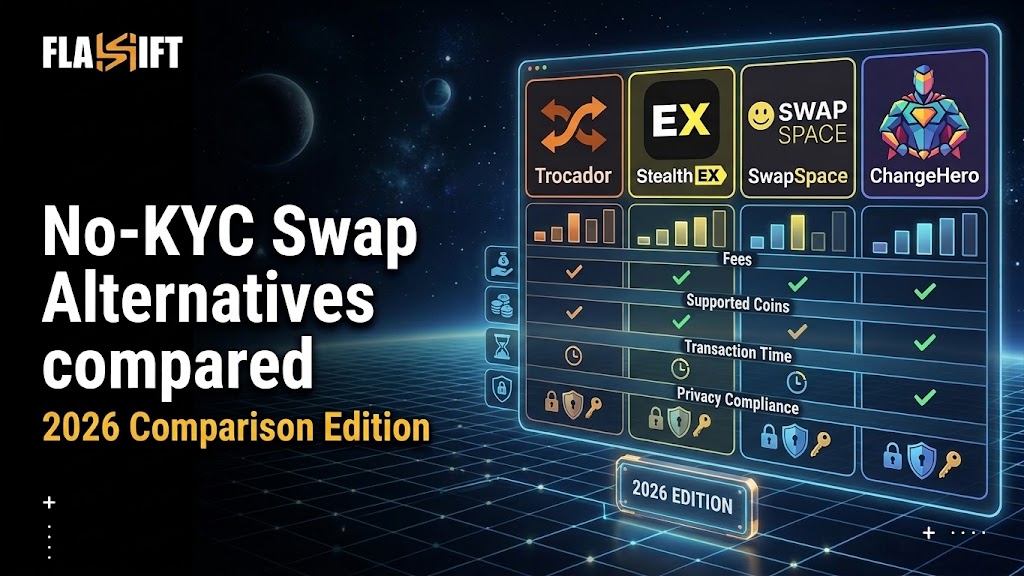
No-KYC Swap Platforms Compared
| Platform | Main model | Provider coverage | Privacy focus | Fee approach | Standout feature |
| Trocador | Aggregator | Multiple providers | Strong | Depends on provider | Privacy-oriented comparison and no-JavaScript widget |
| StealthEX | Non-custodial swap service | External liquidity providers | Strong | Network/provider costs vary | Simple account-free swaps |
| SwapSpace | Aggregator | 40+ partners | Moderate/route-dependent | Provider/network fees; no SwapSpace markup | Large offer comparison |
| ChangeHero | Non-custodial swap service | Multiple liquidity sources | Moderate | Best/fixed-rate models | Fixed and floating rate options |
| Swapzone | Aggregator | 30+ providers | Route-dependent | 0% platform fee; provider/network costs remain | Rate, speed and provider comparison |
The important point is that provider count alone does not determine the best swap. A platform with more partners may have a better route for one pair but a worse route for another.
Where Each Platform Wins
Trocador Is Strongest for Privacy-Oriented Users
If privacy is the first filter in your decision, Trocador deserves particular attention.
Its privacy-focused approach and no-JavaScript widget give it a different positioning from aggregators that mainly emphasize price and convenience.
That does not automatically make it the cheapest option for every transaction. A privacy-focused user should still compare the final output, provider requirements, and supported route before sending funds.
StealthEX Works Well for Straightforward Swaps
StealthEX makes sense when you want a relatively simple way to exchange one cryptocurrency for another without creating an account.
It supports a large asset selection and keeps the transaction flow relatively direct. The important limitation is that “no KYC” should not be interpreted as an unconditional guarantee: StealthEX explicitly notes that exceptional transactions can trigger verification.
For a normal crypto-to-crypto swap, however, its account-free model can be convenient.
SwapSpace Wins When Comparison Matters
SwapSpace is more useful when you do not want to manually check several exchange providers.
Its aggregator model puts multiple offers in one place, making it easier to compare rates, estimated times, and other transaction conditions.
This is particularly valuable when liquidity changes quickly. The provider that looks best in the morning may not be the provider offering the best route a few hours later.
ChangeHero Makes Sense for Simple, Direct Transactions
ChangeHero is a reasonable choice when you prefer a direct swap interface and want the flexibility of both floating and fixed-rate transactions.
Its rate structure can be attractive for certain pairs, but users should check the actual quote and transaction conditions rather than assuming that a fixed rate is automatically cheaper or that a no-registration swap can never trigger KYC.
Swapzone Is Useful for Broad Route Comparison
Swapzone is strongest when your priority is seeing multiple offers without visiting several exchange websites.
Its comparison model can save time and make it easier to identify differences in rate, speed, and provider reputation.
As with any aggregator, however, the displayed rate is only one part of the decision. The provider executing the swap still determines important parts of the transaction experience.
Why the Advertised Rate Is Not Enough
A common mistake when comparing no-KYC swaps is to choose the first platform showing the highest rate.
The displayed number may not tell you the complete cost of the transaction. Network fees, provider fees, liquidity conditions, slippage, minimum amounts, and rate changes can all affect the final amount you receive.
This is especially important with floating-rate swaps. A quote that looks excellent when you create the transaction can change before the swap is completed.
The better comparison is therefore:
How much crypto will actually arrive in my wallet after all applicable costs and under the stated transaction conditions?
That question is more useful than simply asking which platform advertises the lowest fee.
Why a No-KYC Swap Can Still Lead to KYC
“No KYC” is not always a guarantee that every transaction will remain verification-free.
Many non-custodial swap services rely on third-party liquidity providers. Those providers can have their own compliance systems and risk policies.
A transaction may therefore be completed without verification in normal circumstances but trigger an AML or KYC review if the provider detects a risk flag, suspicious activity, a blacklisted address, or another compliance issue.
This is why privacy-conscious users should evaluate the actual provider behind the route, not only the front-end aggregator.
What About SideShift and the SideShift Reddit Discussion?
SideShift is another option worth considering when researching no-KYC crypto swaps. It operates as a non-custodial swap service and does not require an account or identity verification for standard swaps.
If you search for SideShift Reddit discussions, you can find user experiences covering issues such as transaction speed, support, privacy, and individual swap outcomes.
Community feedback can be useful, but it should not be treated as a guarantee. A Reddit experience from one transaction may involve a completely different asset pair, liquidity condition, or provider environment from the swap you are planning.
Use community reports as one signal, then verify the current transaction terms and quote yourself.
What About a Changelly Review?
A similar rule applies when reading a Changelly review.
Older reviews can tell you something about historical user experiences, but they may not reflect the current fee structure, supported assets, KYC procedures, or liquidity relationships.
For a current decision, focus on what happens to the exact transaction you are about to make:
- What rate is being offered?
- What amount will you actually receive?
- Is the rate fixed or floating?
- Could KYC be requested?
- Which provider is executing the swap?
- What happens if the transaction is flagged?
- What network and service fees apply?
This transaction-level approach is more useful than choosing a platform based solely on an old review score.
Where Flashift Fits Into the Comparison
Flashift belongs in the same broader conversation because it also uses an aggregation model rather than depending on a single swap provider.
The difference is that Flashift combines route comparison with additional transaction screening. It supports 35000+ tokens, floating and fixed rates, and cross-chain swaps without requiring a wallet connection or account registration.
Its AI Engine and Post-Trade Analysis are designed to identify providers associated with bait-and-switch behavior, such as displaying an unusually attractive rate and then introducing unexpected slippage or KYC requirements during execution.
For cross-chain transactions, Flashift also uses a Chain Abstraction Layer, allowing users to swap across supported networks without directly dealing with wrapped tokens or traditional bridge mechanics.
That does not mean Flashift is automatically the best choice for every swap. Trocador may be more attractive if privacy-focused tooling is your main priority, while SwapSpace or Swapzone may be preferable when you mainly want broad offer comparison.
The practical advantage of Flashift is different: it combines multi-provider routing with additional screening of the routes themselves.
If you are also comparing a single-provider service with an aggregator, the ChangeNOW vs Flashift comparison goes deeper into how the two models differ in routing, liquidity, fees, and execution.
For users mainly interested in cross-chain swaps, the Rango vs Flashift comparison is more relevant because it focuses on cross-chain routing, wallet interaction, bridge exposure, and execution models.
How to Choose the Right No-KYC Swap
Instead of asking which platform is “the best,” start with the transaction you actually need to make.
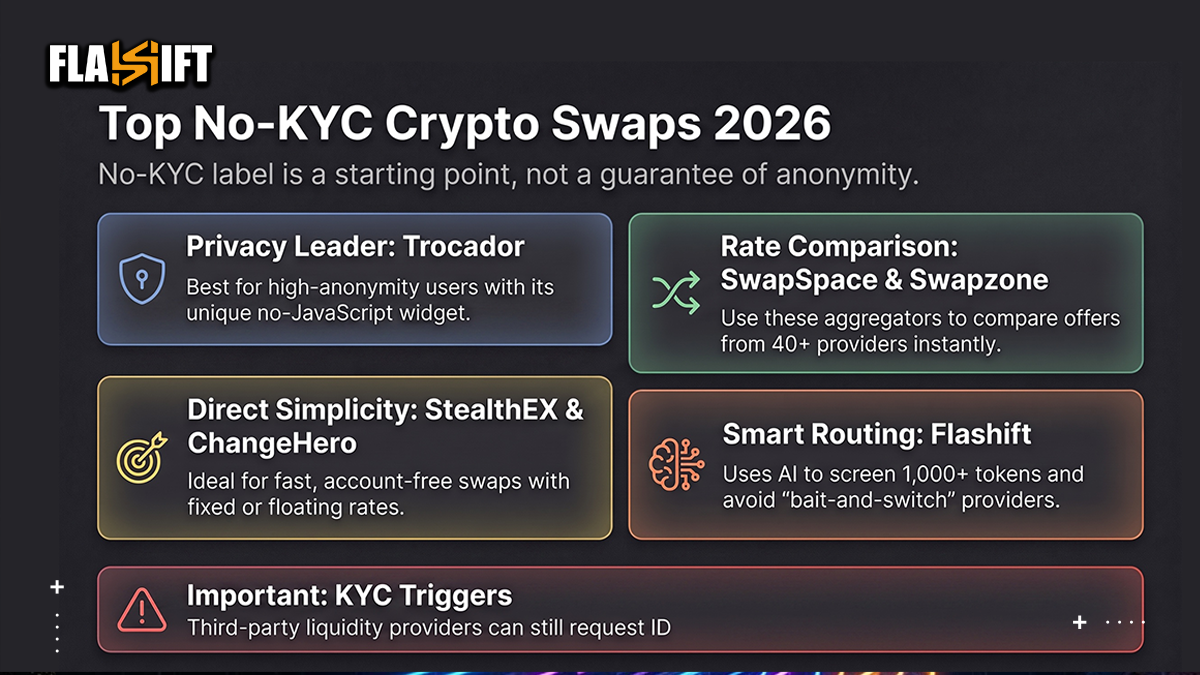
For privacy-first users: Trocador may deserve extra attention because of its privacy-oriented approach.
For simple crypto-to-crypto swaps: StealthEX or ChangeHero can be convenient when the exact pair and quote work for you.
For comparing many offers: SwapSpace and Swapzone are useful when you want multiple providers in one interface.
For cross-chain and route optimization: An aggregator such as Flashift may be worth comparing because it can evaluate multiple providers rather than locking you into one route.
Before sending funds, check five things:
- The exact asset and network.
- The final estimated amount received.
- Provider and network fees.
- Whether KYC can be triggered.
- The conditions for refunds if something goes wrong.
A five-minute comparison can matter more than the brand name printed at the top of the swap page.
The Bottom Line
No-KYC swap platforms are not interchangeable, even when the basic transaction looks identical.
The safest way to choose is not to search for a permanent winner. Compare the exact swap you are about to make, look beyond the headline rate, check the provider’s KYC conditions, and focus on the amount that will actually reach your wallet.
That is the difference between choosing a no-KYC swap platform by reputation and choosing one based on the transaction that actually matters.
FAQ
Which is better for no-KYC swaps: Trocador or StealthEX?
The better option depends on what matters most for the specific transaction. Trocador has a stronger privacy-oriented positioning, while StealthEX focuses on straightforward non-custodial swaps and broad asset support. Compare the actual route, final output, and provider conditions before choosing.
Is SwapSpace completely no-KYC?
SwapSpace itself operates as a non-custodial aggregator, but the third-party provider executing a particular swap can have its own KYC or AML requirements. The correct question is whether the specific offer you select requires verification.
Does ChangeHero always work without KYC?
Standard crypto-to-crypto swaps do not require an account or ID, but ChangeHero’s terms allow KYC/AML procedures in certain circumstances. Users should check the conditions attached to the specific transaction rather than treating “no registration” as an unconditional no-KYC guarantee.
Is SideShift better than an aggregator?
SideShift and an aggregator serve slightly different purposes. SideShift gives you a direct non-custodial swap route, while an aggregator can compare multiple providers before you choose one. If price and route comparison are important, aggregation can be useful; if you prefer a direct service, SideShift may be simpler.
Which no-KYC swap platform is best in 2026?
There is no single winner for every transaction. Trocador is particularly relevant for privacy-focused users, StealthEX and ChangeHero can work well for straightforward swaps, SwapSpace and Swapzone are useful for comparing offers, and Flashift adds multi-provider routing with additional transaction screening and cross-chain capabilities. The best choice is the one that provides the strongest combination of final output, privacy, supported route, provider reliability, and transaction conditions for your specific swap.